Bruna Frascolla
The most profound form of political control is the control of truth: people may want to ignore politics, but they cannot want to ignore the truth.
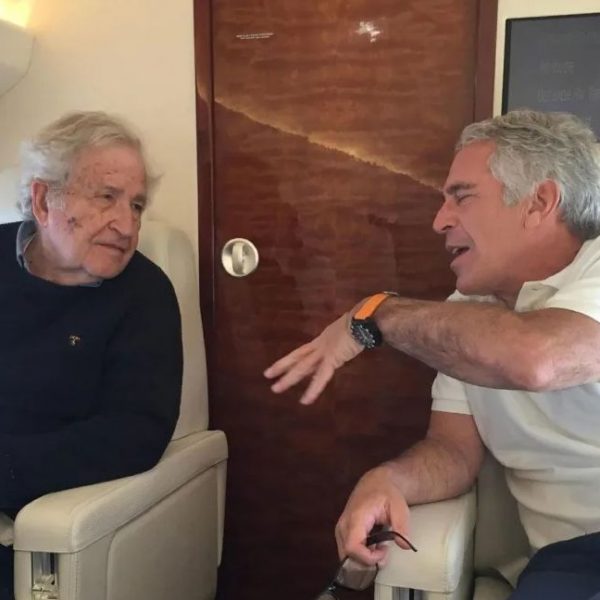
The politicians in the Epstein Files certainly shocked us, but that shouldn't make us forget the academics. One of them, Noam Chomsky, gained a lot of attention from pro-Palestinian activists, since Chomsky is the Jurassic pope of anti-Zionist Jews and the Jewish couple Epstein-Maxwell are often pointed out as Mossad assets. Could Chomsky, then, be a controlled opposition?
It seems to be exactly the case. The journalist Max Blumenthal, who is also Jewish and anti-Zionist, pointed out: "At approximately the same time Noam Chomsky was wagging his finger at the Palestinian-led BDS movement, he was meeting privately with Ehud Barak, among the worst war criminals in Israeli history. The meetings were brokered by Jeffrey Epstein." The BDS movement stands for "boycott, divestment, and sanctions" on Israel and is inspired by the measures that helped to end the Apartheid regime in South Africa. Ehud Barak was Prime Minister of Israel between 1999 and 2001. Max Blumenthal found about the meeting between Chomsky and Barak that took place in 2015 in the Epstein Files.
The Chomsky case is a political one, and it repeats the general political picture of the Epstein Files: just as the disagreements between Democrats and Republicans are a façade, staged to keep the masses divided and mobilized, Zionism has in its dressing room the longest-serving actor who plays, before passionate leftists, the role of a radical intellectual, communist, leftist, and anti-Zionist. This ends up having an impact, because a serious anti-Zionist Jew like Norman Finkelstein grew up admiring Chomsky, and ended up adhering to his criticisms of BDS.
The reader might ask themselves a politically incorrect question: "But how does she know Finkelstein is serious, if he's just another Jewish communist and, moreover, a fan of Chomsky?" Because he paid a high price for his anti-Zionism and has a very different academic trajectory from Chomsky's. Chomsky is a living god: an academic star who shines by adopting the radical positions of the moment and, at the same time, the father of the Universal Grammar theory, which makes him, in terms of academic authority, a kind of living Einstein of linguistics. He has a theory unrelated to political posturing that is mandatory for Linguistics.
Well, Finkelstein is no father of theory, but he is "only" the leading expert on Gaza, which should be more than enough for him to secure tenure. He buried his academic career when, in 2003, he accused Alan Dershowitz of being a plagiarist who chose a discredited work to copy. Dershowitz's recently published The Case for Israel was, according to him, a copy of journalist Joan Peters' From Time Immemorial (1984).
This Dershowitz, who was accused of rape by Virginia Giuffre (a courageous Epstein victim), had among his clients none other than Jeffrey Epstein (2008) and Donald Trump (2020). In 2024, he was also preparing to defend Israel at the Hague Tribunal.
He is not an academic specializing in the Middle East; he is a Harvard law professor. The book criticized by Finkelstein was propagandistic in nature, and its author was a notorious Zionist. However, he was a man with extensive political connections, to the point that he even campaigned for Arnold Schwarzenegger, the governor of California, to prevent the publication of Finkelstein's book (Beyond Chutzpah, chutzpah being a Hebrew word similar to the Greek word hybris), which was a rebuttal to his own. The book was published, but Finkelstein never managed to achieve tenure, even though he's a major scholar.
Amid the cancellation, Chomsky gave Finkelstein moral support, which was enough to earn his gratitude and trust - but not to guarantee him the job he deserved. Isn't it strange that Chomsky managed to go so far in his academic career being so "radical" ? If people like Dershowitz can interfere for the harm of someone, can't they interfere in the same way for the good?
Certainly, Finkelstein obtained academic recognition through the citation of his work. Nevertheless, Gaza is a political and objective issue, and it would be difficult to disregard the work of someone who went there to study in situ - which later led to Finkelstein being banned from entering Israel (and, therefore, Gaza), something that never happened to the "radical" Chomsky. Finkelstein would certainly have a much more difficult intellectual life if, keeping his political activity, he dedicated himself to a subject as speculative as the relationship between human nature and language.
Things get even more complicated when we remember the other major scholar, who appeared in one of the most sinister recordings in the Epstein Files: Harvard psychologist Steven Pinker (also Jewish, it should be noted) appears smiling next to Epstein on the plane known as the "Lolita Express," and a child's voice asks, "Where are you taking us?" Was Pinker on a plane with an unequivocal victim of pedophilia ? This recording is a new information; the relationship between Pinker and Epstein is not. Epstein was a "philanthropist" and gave money to Pinker's research at Harvard. When Epstein began to have problems with the law, Alan Dershowitz, a friend of both, asked the famous Harvard scientist for help with his defense, and he did indeed collaborate.
It is interesting that these two cases of scientists intimately linked to the leader of a pedophilia ring are dedicated to the study of the human nature. And it is very unlikely that Epstein's friends have the freedom to defend whatever conception of the human being and still get the same support.
The most profound form of political control isn't even the control of political parties and actors. It is, instead, the control of truth: people may want to ignore politics, but they cannot want to ignore the truth. This pedo-Zionist network is far from foolish, and chose the humanities.