By Ramachandra BYRAPPA
Between New Delhi and Moscow, a profound power shift is emerging-guided less by ideology than by hard national interests.
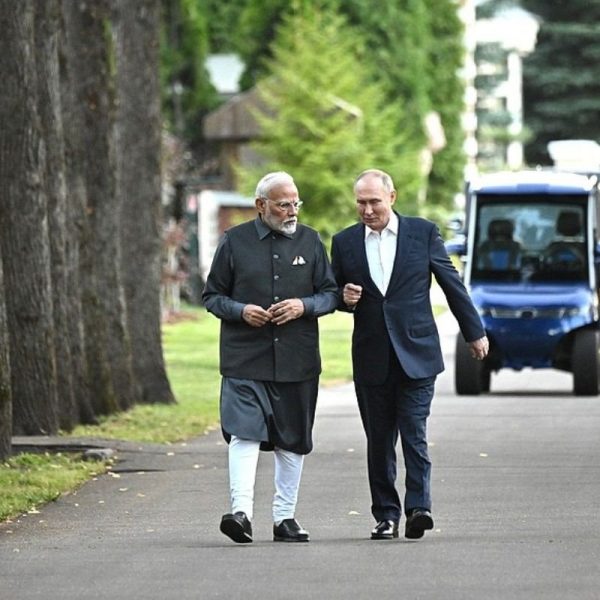
Upon arrival for his 30-hour state visit to India on December 4, President Putin was personally greeted by Prime Minister Modi, a rare gesture. The next day, the Russian president attended the 23rd India-Russia Bilateral Summit, marking the 25th anniversary of the strategic partnership between the two countries. President Putin then addressed the India-Russia Business Forum. Accompanied by seven key ministers, he also conducted negotiations with his Indian counterparts, resulting in the signing of significant agreements. Around 25 agreements and memorandums were signed between the two countries. He also made time to launch Russia Today in India. The aim of the summit was to plan for the future of the bilateral relationship beyond the next decade. It seems that that objective was achieved. The recurring word of the summit was trust, on which the Vision 2030 bilateral cooperation document is based.
The summit put rebalancing imperative high on the agenda. Indian imports stand at $63.84bn against exports of $4.88bn, with Russia exporting crude oil and weapons to India but importing comparatively little in return. While Trump is pressuring New Delhi to reduce its dependency on both,without the oil and the military gear, the bilateral relationship would essentially lack in substance. A bilateral relationship of this importance cannot exist in an empty space; it must have a strong economic foundation: a 'Quiet Architecture' should not necessarily mean barren emptiness. Based on the two countries's national interests, it would seem to be very important to each other, yet in reality, they are like complete strangers.
Interestingly, it is the Kremlin that wants to solve the issue of trade imbalances, formulating concrete proposals to improve ways in which more Indian goods can enter the Russian market. Both India and Russia have signalled they want two-way trade to reach $100 billion by 2030.
In his first interview to the Indian media, President Putin reiterated these ambitions. By his forthrightness, he wants to avoid the inhibitions and misunderstandings that plague the India-China relationship. A wide array of initiatives were agreed upon, and a few things stand out, making this bilateral relation somewhat unique.
Russia, due to the war in Ukraine, has delivery problems of weapons to India, which is anxious to see its armed forces fully equipped. The summit found a formula where both parties would orient towards co-development and co-production of advanced defense technology and systems. It might be too early to compare this to similar historic moments of cooperation, but its scope and significance is considerable. Russia will give whatever it needs to strengthen India's self-sufficiency.
To this extent, there was repeated emphasis on the creation of ten or more common platforms on which cooperation would be co-managed, so that there is no hindrance to the flows of trade or supplies of spare parts. One such platform concerns technology in the defense industry. Russia has voluntarily agreed to transfer technology, including manufacturing, and licenses to produce critical components like engines, optics, radars, AI components, low-end technologies, sensors, stealth materials, and other classified systems. Indians know that this is genuine; there is a historic precedence. The defense sector platform will facilitate interaction between the private industrialists from both sides, and coordinate policy issues between the concerned ministries on both sides. The idea of these platforms shows how serious both partners are about the practical way in which they want to work together.
Another landmark initiative is the mobility of skilled and semi-skilled Indian workers to Russia, which demonstrates the Kremlin's willingness to confront today's and tomorrow's economic, geopolitical, and military realities. Defending the largest country in the world will require unprecedented economic and military might. Melting ice in the Arctic, a declining population, a lack of a sophisticated military complex with greater industrial capacity, and NATO's ambiguous defensive-offensive posture are all genuine concerns for Russia. However, Russia cannot depend more heavily on its partners or foes; it's a proud, sovereign civilization. This is why it has chosen India, a country that, in many ways, finds itself in a similar situation. Cooperating with each other could be ideal; each country is perfectly complementary to the other.
To further cement this complementarity, President Putin officially launched the Indian outlet of the Russian state broadcaster Russia Today (RT). In addition, both sides will also offer free, one-month tourist visas to each other's citizens, with tourists and students being allowed to pay their expenses and tuition fees in roubles or rupees. The mobility agreement, the launch of RT, and the provision of free visas can be considered as groundbreaking initiatives that will truly revolutionize the nature of relations between the two countries. For this long-underestimated bilateral relationship, measures like this promise an outlook that blends continuity with transformation, building on old foundations while opening new frontiers in culture, technology, research, and global diplomacy. This is all about building a common space where constraints to cooperation do not exist, a realm where respect for the other's sovereignty and national interest is second nature.
While the Western capitals are filled with the clamour and furore of sanctions and tariffs, continually debating which global bloc a nation must be forced into, a profound power shift is occurring in the quiet space between New Delhi and Moscow. This dynamic relationship is neither a relic of the Cold War nor based on ideological alignment; instead, it is an epitome of pragmatic statecraft focused purely on sovereign national interests. Over the decades, this 'Quiet Architecture' evolved into a structural framework built on sovereign choices, unperturbed by external pressure, fostering an unwavering sense of strategic autonomy. Now, President Putin and his host, Prime Minister Modi, meeting in New Delhi, aim to transform this quiet bilateral space into something deeper and larger: a permanent 'Quiet Sphere' of unconstrained cooperation.
The world is slowly being segregated into two blocs of intolerance and mistrust, withthe finger-wagging West taking on the mantle of a mercurial preacher and a tyrant schoolteacher, dishing out punishments and solitary confinements to nations poor and powerless. While President Trump threatens friend and foe alike with punitive tariffs, the European Commission President, Ursula van der Leyen, has become the Mary Poppins of sanctions on an industrial scale. Finger wagging and noise, and nothing but clamouring noise of disapproval. On the other side, you have China, patiently knitting its networks of influence beyond the reach of the West, willing and waiting to do the same. These valleys of economic and military power are cluttering camps of enmity and distrust, wanting to turn the whole world into one big cacophony.
The India-Russia relationship defies bloc formation through its silence. There was no noise of reprimands or tumult at this weekend's New Delhi summit. This relationship is founded on the principle of silent construction without haste, allowing ample time for their national interests to fall into place without torture or torment. Commentators often say that the enduring friendship between the two nations is the key to the strength of their bilateral relations. Perhaps, but one might disagree. This unique friendship in the history of international relations is a byproduct of something more fundamental. It is a relationship where national interests converge, specifically the need to create a 'Quiet Architecture'. The more others try to separate them forcefully, the closer they get to achieving this objective.
From whatever viewpoint one looks at this hurried, 30-hour visit by a very busy Russian president, it will be remembered as a historic moment. Not because of the level of warmth and hospitality he has received, which is only natural, or because of his high popularity in India, but because of the level of ambition the summit has packed into such a short time.
Original article: europeanconservative.com