December 9, 2025
Our introductory history textbooks sometimes highlight some of the strange and amusing stories of the past. I think that most students must have cracked a smile when they read their chapter on eighteenth century European history and came across "The War of Jenkins' Ear."
As its comprehensive Wikipedia article explains, that major conflict fought between Britain and Spain from 1739 to 1748 had been prompted by the mutilation of an alleged British smuggler by Spanish authorities a few years earlier, a brutal act that greatly outraged both the British people and their parliamentary representatives.
That military struggle soon merged into the much larger conflict known to history as "The War of the Austrian Succession," lasting from 1740 to 1748 and involving nearly all the major European powers. Although both the forces involved and the human losses were absolutely trivial by twentieth century standards, the war lasted most of a decade and was one of the most important during the first half of the eighteenth century. The bulk of the fighting took place in Europe, but the forces of Britain, Spain, and France also battled each other across the Indian subcontinent, North America, the Caribbean, and on the high seas, arguably making it one of the first "world wars" long before any such term ever came into common usage. The outcome had a considerable impact on the balance of world power, as well as the futures both of India and of what ultimately became the United States.
Although we often assume that such trivial causes of a major war might only have occurred in the days of the bewigged courts of European monarchs, that is actually not the case. During my historical readings of the last few years I've discovered that the important chains of causation in much more modern times have also sometimes been driven by very similar minor events, although these reconstructions were often totally omitted from all of our standard histories.
Everyone knows that World War II was the most colossal military conflict in all of human history, resulting in many tens of millions of deaths and the destruction of most of Europe, while it became the shaping event of our entire modern world. But none of our history books have ever hinted that one of its crucial triggers may have been an incident just as obscure and trivial as the one that led to the war that had broken out almost exactly two hundred years earlier.
Although Chinese and Japanese forces had been fighting a large but undeclared war since the Marco Polo Bridge incident of 1937, nearly all our history books always cite September 1, 1939 as the date that World War II began. On that day, Germany invaded Poland, very soon followed by the British and French declarations of war. But as far as I know, none of our historical accounts of the last 85 years have ever properly connected all the dots, thereby fully describing what had actually happened and why, something that I have briefly sketched out on a couple of occasions.
One major reason that both mainstream and revisionist historians have failed to present the full chain of events is that nearly all those individuals have remained unaware of certain crucial elements, and a jigsaw puzzle that is missing one or more large pieces can never be properly completed.
The most important starting point for analyzing the outbreak of World War II is to establish the identity of the key figure who was responsible for the conflict, and few of our historical accounts have correctly done so.
Our country fought and defeated Adolf Hitler, so for obvious reasons our standard histories have almost invariably blamed him as the guilty party. But The Origins of the Second World War published in 1961 by renowned Oxford historian A.J.P. Taylor very persuasively challenged that conclusion, and although that seminal work provoked a major political backlash, it had been widely praised at the time:
As most of us know from our standard history books, the flashpoint of the conflict had been Germany's demand for the return of Danzig. But that border city under Polish control had a 95% German population, which overwhelmingly desired reunification with its traditional homeland after twenty years of enforced separation following the end of the First World War. According to Taylor only a dreadful diplomatic blunder by the British had led the Poles to refuse that reasonable request, thereby provoking the war. The widespread later claim that Hitler sought to conquer the world was totally absurd, and instead the German leader had actually made every effort to avoid war with Britain or France....the glowing cover-blurbs suggested some of the immediate acclaim the work had received. The Washington Post lauded the author as "Britain's most prominent living historian," World Politics called it "Powerfully argued, brilliantly written, and always persuasive," The New Statesman, Britain's leading leftist magazine, described it as "A masterpiece: lucid, compassionate, beautifully written," and the august Times Literary Supplement characterized it as "simple, devastating, superlatively readable, and deeply disturbing." As an international best-seller, it surely ranked as Taylor's most famous work, and I could easily understand why it was still on my required college reading list nearly two decades after its original publication....Despite all the international sales and critical praise, the book's findings soon aroused tremendous hostility in certain quarters. Taylor's lectures at Oxford had been enormously popular for a quarter century, but as a direct result of the controversy "Britain's most prominent living historian" was summarily purged from the faculty not long afterwards. At the beginning of his first chapter, Taylor had noted how strange he found it that more than twenty years after the start of the world's most cataclysmic war no serious history had been produced carefully analyzing the outbreak. Perhaps the retaliation that he encountered led him to better understand part of that puzzle.
Although Taylor's historiography had always been noted for its strong hostility to Germany, the facts of what had actually happened in 1939 were so plain that he set them out unflinchingly and suffered the personal consequences. Since then, many others have come to similar conclusions and have sometimes managed to get their books into print:
Decades after Taylor's pioneering volume, an outstanding historical analysis reaching very similar conclusions was published in German by Gerd Schultze-Rhonhof, who had spent his career as a fully mainstream professional military man, rising to the rank of major general in the German army before retiring. A couple of years ago I finally read the English translation of 1939 - The War That Had Many Fathers, which appeared in 2011, released exactly a half-century after Taylor's seminal work.The author considerably extended Taylor's analysis, with his 700 pages describing in great detail the enormous efforts that Hitler had taken to avoid war and settle that boundary dispute, even spending many months on fruitless negotiations and offering extremely reasonable terms. Indeed, the German dictator had made numerous concessions to Poland that none of his democratic Weimar predecessors had ever been willing to consider. But these proposals were all rejected, while Polish provocations escalated, including violent attacks on their own country's sizeable German minority population, until war seemed the only possible option.
Magisterial works such as Hitler's War and Churchill's War by British historian David Irving came to very similar conclusions. Drawing upon his massive use of documentary evidence, his former volume concluded that Hitler certainly did not want or expect the war that broke out in 1939. Meanwhile, his latter work argued that Winston Churchill played a crucial role in pushing Britain into the conflict, likely doing so under the secret financial influence of the Czechs and the Jews who funded his extremely lavish lifestyle and therefore largely controlled his political actions.
Although many of Irving's claims about Churchill's outrageous financial misbehavior were extremely controversial when he originally made them in 1987, three decades later that remarkable picture was fully confirmed and even extended by David Lough in No More Champagne, published in 2015 and produced with full access to Churchill's personal papers. Irving's riveting public lectures on the topic are certainly worth watching:
bitchute.comOther notable works coming to rather similar conclusions included The Forced War, an extremely detailed 320,000 word volume by David Hoggan, largely based upon his 1948 Harvard doctoral dissertation in diplomatic history. That massive work remained unavailable in English for decades before being eventually being released in 1989, with an HTML version found on this website and a 2023 edition now finally available for sale on Amazon.
Patrick Buchanan's 2008 bestseller Churchill, Hitler, and the Unnecessary War provoked a great deal of controversy when it appeared, and was probably the first time that most Americans had ever encountered such ideas. The book by the conservative commenter and former presidential candidate attracted numerous reviews, both favorable and critical, and Churchill, Hitler, and the Unnecessary War: Patrick J Buchanan on Book TV .
All these writers argued that Britain had been responsible for the outbreak of the war. Taylor suggested that the cause had been a terrible but unintentional diplomatic blunder by the government of Prime Minister Neville Chamberlain, while Irving, Buchanan, and Hoggan argued that the outbreak of the war had been deliberate, with the first two authors fingering Churchill as the primary culprit and the last focusing upon Foreign Minister Lord Halifax.
A different but highly credible perspective was provided by Prof. John Beaty, a well-regarded mainstream academic who had held a crucial wartime role in American Military Intelligence from 1941 onward, being responsible for producing the daily briefing reports distributed to the White House and all our other top political and military leaders.
After resuming his peacetime university career and undertaking considerable additional research, he published The Iron Curtain Over America, a huge 1951 conservative bestseller that was strongly endorsed by many of our top generals. In that work Beaty argued that American Jews and the Roosevelt Administration that they dominated had gotten our country into an entirely unnecessary war on behalf of Jewish and Communist interests.
Prof. Revilo P. Oliver had been a former wartime colleague of Beaty, running one of our most important code-breaking operations. Oliver subsequently became a leading conservative figure during the 1950s and 1960s at National Review and the John Birch Society, and in 1981 he published America's Decline, with his memoirs presenting a description of the origins of World War II that was very similar to that of Beaty.
Both Beaty and Oliver have been almost entirely purged from all our mainstream and conservative histories, and the same has been true of the books that they published. But given their crucial wartime positions, we should take their views on World War II quite seriously.
All these authors and their important books have been almost totally ignored by our standard histories of World War II. As a consequence, these usually provide only a severely distorted version of that conflict and its origins, and I would strongly endorse carefully considering most of the material presented in those other sources. But I think we must also recognize some of their inherent limitations.
As key figures in American Military Intelligence, both Beaty and Oliver possessed remarkable access to the true circumstances of how America became involved in the conflict. But they only entered government service in 1941, two years after the war had already broken out. Prior to that their insights had probably been little better than those of any other civilians, and they may not have even much focused upon the geopolitical events that were then roiling Europe.
Meanwhile, the historical accounts focusing on the 1939 outbreak of the conflict correctly exonerate Hitler from most of the blame, with both Irving and Buchanan convincingly pointing to Churchill as one of the crucial figures pushing the British government into making the fateful decisions that led to war. But we must keep in mind that during that period, Churchill was merely a parliamentary back-bencher, having no cabinet position and someone widely regarded as a political has-been, notorious for his drunkenness and past political failures. So the pressure that he exerted should not be overly exaggerated.
Although the ignored or forgotten works already mentioned are important, I think the most crucial facts were provided in the contemporaneous writings of a different journalist, equally ignored and forgotten. As I explained earlier this year:
The name John T. Flynn is probably unknown today to all but one American in a hundred, if even that. But as a writer on politics and economics, he had spent the 1930s as one of America's most influential progressive journalists. During that decade, his weekly column in The New Republic allowed him to serve as a lodestar for America's liberal elites, while his regular appearances in Colliers, an illustrated mass circulation weekly reaching many millions of Americans, provided him a platform comparable to that of a major television personality in the later heyday of network TV.
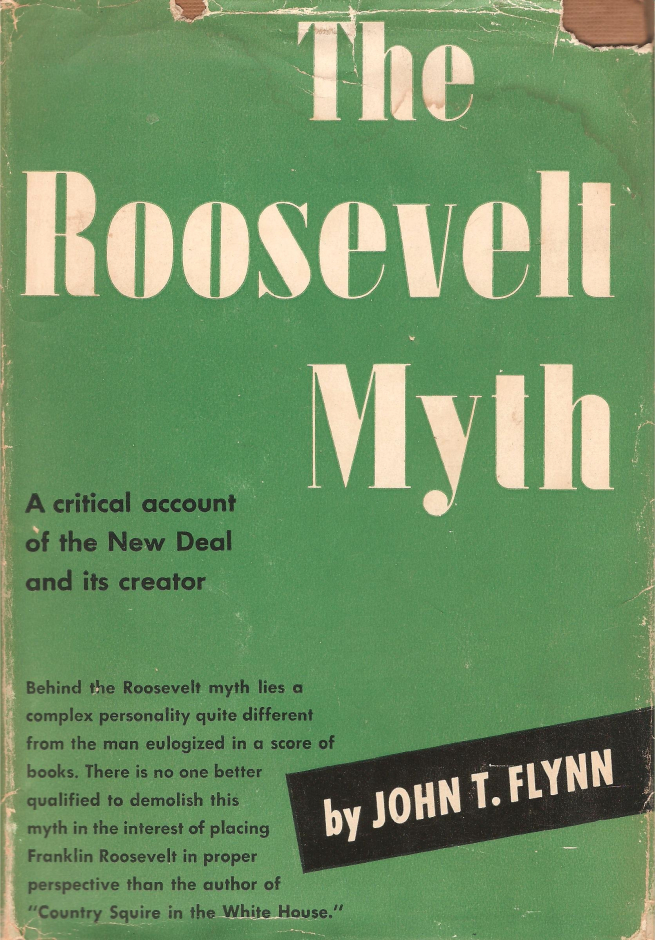
Although initially sympathetic to Franklin Roosevelt's goals, he soon became skeptical about the effectiveness of the president's methods, noting the sluggish expansion of public works projects and wondering whether the vaunted NRA was actually more beneficial to big business owners than to ordinary workers. As the years went by, his criticism of the Roosevelt Administration turned harsher on economic and eventually foreign policy grounds, and he incurred its enormous hostility as a consequence. Prof. Ralph Raico later described how Roosevelt finally began sending personal letters to leading editors demanding that Flynn be barred from any prominent American print outlet, and perhaps as a consequence the latter lost his longstanding New Republic column immediately following FDR's 1940 reelection, with his name permanently disappearing from mainstream periodicals. But as late as 1948, he still retained enough of his once huge national reputation that when a small Irish-American press released his book The Roosevelt Myth, it soon became a top national bestseller.
In that book, Flynn noted that by the mid-1930s FDR's various governmental schemes had failed to revive the American economy, while in 1937 a new economic collapse spiked unemployment back to the same levels as when the president had first entered office, confirming that harsh verdict of failure. Therefore, Flynn alleged that by late 1937, FDR had turned towards an aggressive foreign policy aimed at involving the country in a major foreign war, primarily because he believed that this was the only route out of his desperate economic and political box, a stratagem not unknown among national leaders throughout history. Indeed, in his January 5, 1938 New Republic column, Flynn had already alerted his disbelieving readers to the looming prospect of a large naval military build-up and warfare on the horizon after a top Roosevelt adviser had privately boasted to him that a large bout of "military Keynesianism" and a major foreign war would cure the country's seemingly insurmountable economic problems. At that time, war with Japan, possibly over Latin American interests, seemed the intended goal, but developing events in Europe soon persuaded FDR that orchestrating a general war against Germany was the best course of action. Flynn fleshed out many of the additional details in his later 1948 book.
Flynn's remarkable January 1938 prediction that Roosevelt planned to foment a major war for domestic political reasons seems fully confirmed by diplomatic disclosures, with memoirs and other historical documents obtained by later researchers revealing that FDR ordered his diplomats to exert enormous pressure upon both the British and Polish governments to avoid any negotiated settlement with Germany, thereby leading to the outbreak of World War II in 1939.
The confidential opinions of those closest to important historical events should be accorded the greatest degree of evidentiary weight. An excellent 2019 article by John Wear mustered the very numerous assessments that implicated FDR as the pivotal figure in orchestrating the world war by the constant pressure he exerted upon the British leadership, with our president privately admitting that his actions could mean his impeachment if they were revealed.
This large mass of important material included secret Polish diplomatic documents that were later published, painting a very similar picture and also pointing to the enormous role of American Jews in propelling the outbreak of hostilities.
The diary of James Forrestal, America's first secretary of defense confirmed all of these facts, describing a 1945 conversation he had with Joseph Kennedy, our ambassador to Britain during the years leading up to the war. Kennedy explained that according to British Prime Minister Chamberlain
...neither the French nor the British would have made Poland a cause of war if it had not been for the constant needling from Washington...Chamberlain, he says, stated that America and the world Jews had forced England into the war.
Forrestal went on to write that he had been told very similar things by Clarence Dillon, his former colleague at Dillon, Read & Co. and one of America's wealthiest men:
What Kennedy told me in this conversation jibes substantially with the remarks Clarence Dillon had made to me already, to the general effect that Roosevelt had asked him in some manner to communicate privately with the British to the end that Chamberlain should have greater firmness in his dealings with Germany. Dillon told me that at Roosevelt's request he had talked with Lord Lothian in the same general sense as Kennedy reported Roosevelt having urged him to do with Chamberlain. Lothian presumably was to communicate to Chamberlain the gist of his conversation with Dillon.
Wear's important article provides a long list of additional statements by highly credible contemporaneous observers, all of which support the case that FDR did his best to pressure the British, the French, and the Poles into refusing any peaceful negotiated settlement of Poland's Danzig boundary dispute with Germany. In doing so, he acted both directly and through William Bullitt, the U.S. Ambassador to France and his chief diplomatic representative in Europe:
When Anthony Eden returned to England in December 1938, he carried with him an assurance from President Roosevelt that the United States would enter as soon as practicable a European war against Hitler if the occasion arose. This information was obtained by Senator William Borah of Idaho, who was contemplating how and when to give out this information, when he dropped dead in his bathroom. The story was confirmed to historian Harry Elmer Barnes by some of Senator Borah's closest colleagues at the time.[19]The American ambassador to Poland, Anthony Drexel Biddle, was an ideological colleague of President Roosevelt and a good friend of William Bullitt. Roosevelt used Biddle to influence the Polish government to refuse to enter into negotiations with Germany. Carl J. Burckhardt, the League of Nations High Commissioner to Danzig, reported in his postwar memoirs on a memorable conversation he had with Biddle. On December 2, 1938, Biddle told Burckhardt with remarkable satisfaction that the Poles were ready to wage war over Danzig. Biddle predicted that in April a new crisis would develop, and that moderate British and French leaders would be influenced by public opinion to support war. Biddle predicted a holy war against Germany would break out.[20]...
Georges Bonnet, the French foreign minister in 1939, also confirmed the role of William Bullitt as Roosevelt's agent in pushing France into war. In a letter to Hamilton Fish dated March 26, 1971, Bonnet wrote, "One thing is certain is that Bullitt in 1939 did everything he could to make France enter the war."[22]
Dr. Edvard Beneš, the former president of Czechoslovakia, wrote in his memoirs that he had a lengthy secret conversation at Hyde Park with President Roosevelt on May 28, 1939. Roosevelt assured Beneš that the United States would actively intervene on the side of Great Britain and France against Germany in the anticipated European war.[23]
American newspaper columnist Karl von Wiegand, who was the chief European newspaper columnist of the International News Service, met with Ambassador William Bullitt at the U.S. embassy in Paris on April 25, 1939. More than four months before the outbreak of war, Bullitt told Wiegand: "War in Europe has been decided upon. Poland has the assurance of the support of Britain and France, and will yield to no demands from Germany. America will be in the war soon after Britain and France enter it."[24] When Wiegand said that in the end Germany would be driven into the arms of Soviet Russia and Bolshevism, Ambassador Bullitt replied: "What of it. There will not be enough Germans left when the war is over to be worth Bolshevizing."[25]...
Washington journalists Drew Pearson and Robert S. Allen reported in their nationally syndicated column that on March 16, 1939, President Roosevelt "sent a virtual ultimatum to Chamberlain" demanding that the British government strongly oppose Germany. Pearson and Allen reported that "the President warned that Britain could expect no more support, moral or material through the sale of airplanes, if the Munich policy continued."[28]
Responding to Roosevelt's pressure, the next day Chamberlain ended Britain's policy of cooperation with Germany when he made a speech at Birmingham bitterly denouncing Hitler. Chamberlain also announced the end of the British "appeasement" policy, stating that from now on Britain would oppose any further territorial moves by Hitler. Two weeks later the British government formally committed itself to war in case of German-Polish hostilities.
Roosevelt also attempted to arm Poland so that Poland would be more willing to go to war against Germany. Ambassador Bullitt reported from Paris in a confidential telegram to Washington on April 9, 1939, his conversation with Polish Ambassador Łukasiewicz. Bullitt told Łukasiewicz that although U.S. law prohibited direct financial aid to Poland, the Roosevelt administration might be able to supply warplanes to Poland indirectly through Britain. Bullitt stated: "The Polish ambassador asked me if it might not be possible for Poland to obtain financial help and airplanes from the United States. I replied that I believed the Johnson Act would forbid any loans from the United States to Poland, but added that it might be possible for England to purchase planes for cash in the United States and turn them over to Poland."[29]
Any individuals skeptical of this analysis should read Wear's entire article. Rather than merely offering a handful of such statements, he provided dozens, thereby producing a historical assessment that seemed absolutely undeniable but one that has never become part of our standard narrative of the origins of World War II. For more than 85 years, the true facts regarding the outbreak of the greatest war in human history have been kept almost entirely concealed from the American people.
- Roosevelt Conspired to Start World War II in Europe
- John Wear • Inconvenient History • January 26, 2019 • 6,400 Words
However, we are now apparently faced with a puzzling conundrum. According to Flynn, the Roosevelt Administration had planned for a naval war against Japan, but we have overwhelming evidence that FDR and his subordinates instead sought to orchestrate a European war against Germany.
Fortunately, this serious conflict is immediately resolved once we consider the dates of these statements. Flynn reported that at the beginning of 1938 FDR had been planning for a war against Japan while nearly all the evidence that Wear cited for the latter's efforts to instigate a war against Germany came in 1939.
The sole major exception was Roosevelt's secret September 18, 1938 conversation with Sir Ronald Lindsay, the British ambassador to Washington, in which he described the aggressive actions America would undertake "if Britain and France were forced into a war against Germany." The previous day, Germany had begun low-intensity military operations against Czechoslovakia, amounting to an undeclared war aimed at pressuring the latter country into making major political concessions, and there was therefore a widespread fear that full-scale war in Europe might soon result, drawing Britain and France into the conflict.
In fact, as Flynn later reported, Roosevelt actually played a crucial role in attempting to avert the September 1938 outbreak of war with Hitler by personally contacting Mussolini and asking for his intervention, though our president later denied those facts during his 1940 reelection campaign:
As Hitler's legions rolled into Czechoslovakia, Under-Secretary of State Sumner Welles claimed over the radio that Roosevelt had sent a personal message to Mussolini begging him to intervene and that, on this request, Mussolini had done so. As a result, Hitler had halted his soldiers and sent an invitation to Chamberlain to come to Munich. Five days later Secretary of War Woodring made the same claim. And the White House secretariat put out a record of all the messages from the President synchronized with the events in Munich to prove that Roosevelt had turned the scales for peace. Later, in the 1940 campaign, Willkie charged that Roosevelt had boasted of his part in the appeasement. Secretary Hull indignantly denied this and asserted that the President had "never telephoned to Mussolini" as charged by Willkie. However, in Mr. Hull's more recently published memoirs he forgot that disclaimer and he himself boasted that the President sent a "message to Mussolini" and one to Hitler. He wrote "whether the actions taken by the President brought about these results it is impossible to say. But undoubtedly they exercised considerable influence" and he produced proudly a letter from King George VI to the President saying: "I have little doubt that your efforts contributed largely to the result." Whether they did or not the President's office and his agents were loud in their claims that he had brought about the Munich appeasement.
Thus, FDR's personal intervention may have played an important role in facilitating the Munich peace conference held in late September 1938. This brought together Hitler, Chamberlain, Mussolini, and French Prime Minister Daladier and resulted in the Munich Agreement signed on September 30th, a compromise that averted the immediate outbreak of a major new European war. FDR welcomed that peace conference and praised the agreement that it produced, so there seems absolutely no indication that FDR was encouraging a war against Germany at that point in time. Yet by December 1938, just a couple of months later, we have overwhelming evidence that FDR had completely changed his position and now actively sought to promote a war against Germany.
Something dramatic must have suddenly changed Roosevelt's intentions toward Germany during that very short period of time.
The obvious explanation for that complete American reversal was Germany's anti-Jewish Kristallnacht riots during the night of 9-10 November 1938. Although the figures have sometimes been disputed, many dozens of Jews were killed in the violence, many thousands of Jewish stores and shops were vandalized, and nearly 200 synagogues were destroyed or damaged, with the attacks mostly carried out by the stormtroopers of the Nazi SA. This represented one of the worst European outbreaks of anti-Jewish mob violence in many decades, and attracted enormous, worldwide media coverage, with Wikipedia quoting the account of the august Times of London:
No foreign propagandist bent upon blackening Germany before the world could outdo the tale of burnings and beatings, of blackguardly assaults on defenceless and innocent people, which disgraced that country yesterday.
Just a few weeks earlier, the signing of the Munich Agreement had produced an enormous amount of international goodwill. But all of that was now completely swept away, and these violent events naturally provoked fury from Jews everywhere, who intensely focused their rage against Hitler and Nazi Germany.
Numerous countries broke diplomatic relations, while the U.S. immediately recalled its ambassador, who never returned nor was replaced, almost amounting to the same thing. Within days, FDR began promising to use his country's massive industrial base to provide enormous support to the British and the French in the event of war with Germany, while the Poles flatly rejected Hitler's request for the return of German Danzig. The combination of all these factors lit the fuse that ultimately led to the outbreak of World War II ten months later.
This massive, unexpected wave of anti-Jewish violence had been triggered by the death of a German diplomat in Paris who had been shot a couple of days earlier by a 17-year-old German-born Polish Jew living in that city, with the teenager allegedly outraged that his Polish-born parents had recently been deported from Germany back to their original homeland.
Roughly 10% of Poland's population was Jewish and its fiercely anti-Semitic government had recently announced it would strip all Polish Jews living abroad of their citizenship. This led to German concerns that the law would render its substantial population of Polish Jews stateless and impossible to remove, so the government quickly began deporting them back to Poland to avert that risk.
But this sudden outbreak of anti-Jewish rioting following the assassination reversed years of very different political and social trends in Nazi Germany.
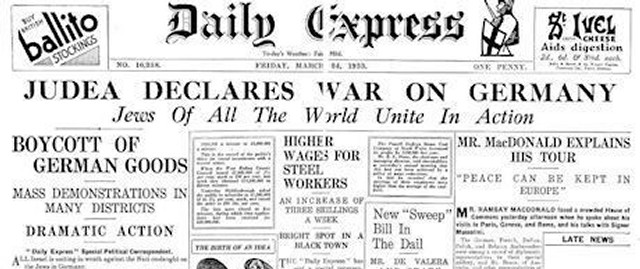
When Hitler became Chancellor in 1933, outraged Jews worldwide quickly launched an economic boycott, hoping to bring Germany to its knees, with London's Daily Express famously running the banner headline "JUDEA DECLARES WAR ON GERMANY." Jewish political and economic influence, then like now, was very considerable, and in the depths of the Great Depression, impoverished Germany needed to export or die, so a large scale boycott in major German markets posed a potentially serious threat.
However, Nazi Germany soon established cordial relations with the small but influential Zionist movement, intensely committed to the creation of a Jewish state in Palestine. The Zionists were obviously just as eager for German Jews to relocate to the Middle East as the Germans were to have them depart. So the result was the Ha'avara or "Transfer Agreement," a Nazi-Zionist economic partnership facilitating the emigration of Jews to Palestine while allowing them to take their accumulated wealth in the form of high-quality German manufactured goods.
As a consequence, during the years 1933-1939 over 60% of the investment in Jewish Palestine came from Nazi Germany, and this agreement played an enormous role in the successful establishment of the Jewish state. Furthermore, Zionism was accorded a privileged place in the society of Nazi Germany and leading Nazi publications praised its ongoing colonization project in the Middle East.
Even aside from these crucial economic ties between Nazi Germany and the mainstream Zionist movement of David Ben-Gurion, smaller right-wing Zionist factions had long been great admirers of Fascism and Mussolini, Hitler's ideological ally. Indeed, after war broke out, one of the smaller such factions led by a future prime minister of Israel even repeatedly sought to enlist in Hitler's Axis military alliance.
This thoroughly documented but long-suppressed history only came to widespread attention with the 1983 publication of Zionism in the Age of the Dictators by Lenni Brenner, an anti-Zionist Jew of the Trotskyite persuasion.
By 1938, these years of Nazi-Zionist cooperation had greatly reduced Jewish friction with the Nazi regime, and well over half of all German Jews had already left the country, many of them going to Palestine. Germany's remaining Jewish population had been reduced to a fraction of 1%, and Hitler regarded his country's Jewish problem as having largely been resolved, which was why the sudden outbreak of widespread anti-Jewish mob violence was so unexpected and dramatic.
Hitler and his Nazi government were widely blamed for having deliberately orchestrated those anti-Jewish riots, but this seems entirely incorrect. Indeed, Irving's Hitler biography demonstrated that both the German Fuhrer and nearly his entire political leadership had been just as shocked and horrified by the sudden outbreak of violence as everyone else, with Hitler urgently ordering the immediate suppression of the rioting and arson as soon as he discovered that it was taking place.
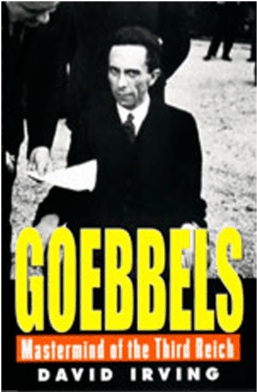
The sole exception was Nazi Propaganda Minister Joseph Goebbels, whom Irving argued had been responsible for orchestrating the rioting, doing so without the knowledge or approval of his superior.
A half-dozen years ago I finally read Irving's exhaustive 1996 biography Goebbels: Mastermind of the Third Reich, drawing heavily upon the unpublished Goebbels Diaries, and the last piece of the historical puzzle suddenly fell into place.
Irving's persuasive reconstruction fully confirmed Goebbels' central role in organizing the attacks, and reported that when Hitler discovered that responsibility, he considered dismissing him. But the crucial new element that Irving provided was the explanation of why Goebbels had decided to take that action.
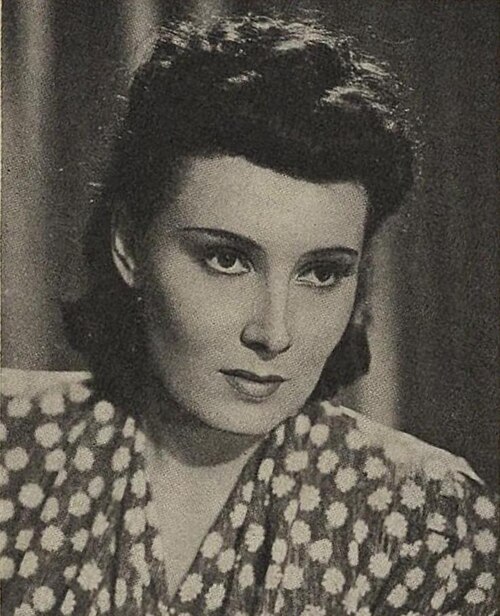
Lída Baarová (1914-2000) in 1940
As the historian explained, during the year prior to the attacks, Goebbels had been engaged in a tumultuous, high-profile love affair with a beautiful 23-year-old Czech film star named Lída Baarová, with whom he had fallen deeply in love.
Although he had previously used his powerful position at the top of the German film industry to engage in numerous short relationships with various actresses, this one was far more serious, with Goebbels thinking of leaving his wife Magda. The latter was totally outraged by this situation and as a longtime close friend of Hitler and other top Nazi leaders, her bitter complaints and the prospects of a devastating marital break-up severely damaged Goebbels' standing in the political hierarchy, with his many bitter rivals using that serious scandal against him.
Thus, during September and October 1938, Goebbels was under extreme personal pressure, soon discovering that he was being betrayed by some of his closest aides, with his diary entries reflecting his enormous psychological stress and self-pity. On October 15th, he wrote that he was tired of life and then swallowed some sleeping pills washed down with alcohol in a half-hearted attempt at suicide, with a stabbing pain in his heart convincing him that he was dying.
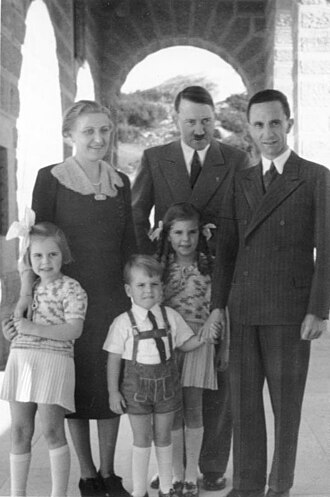
At one point, he resolved to divorce his wife and marry his mistress but Hitler absolutely forbade that possibility. The large and attractive Goebbels family had long been promoted as the marital ideal of Nazi Germany, and for such a top Nazi leader to abandon his wife and six children for an actress half his age would inflict a public relations disaster upon the regime, only worsened by the Czech nationality of his young paramour. But after Goebbels was forced into reconciling with his wife, it was his mistress who then threatened suicide, and was soon confined to a villa, with her phone tapped and her door guarded by the secret police.
Goebbels' enemies naturally publicized this major scandal, which became known across much of Germany, with hostile French newspapers even suggesting some of the embarrassing details. Numerous other top Nazi leaders convinced Hitler that Goebbels and his disreputable behavior had inflicted enormous damage upon their regime, leading to the latter's fall from grace and severe loss of influence.
In opening his chapter on Kristallnacht, Irving emphasized this crucial background, including Goebbels terrible emotional state and his desperate willingness to undertake risky measures in hopes of regaining his political standing. The historian argued that this best explained his decision to organize the anti-Jewish riots in November when an opportunity presented itself. But as so often happens in such matters, the violent actions that Goebbels set into motion then got out of hand and also produced a far worse international political backlash than he had ever imagined. According to Irving, the other Nazi leaders soon pressed Hitler to dismiss Goebbels but the Fuhrer balked, declaring that the much more difficult international climate that Germany now faced made propaganda skills even more necessary than before. I found Irving's reconstruction quite persuasive and his evidence overwhelming.
Admittedly, whenever I have mentioned this analysis over the years, some have strongly disputed it, citing the contrary theories of a German-born writer named Ingrid Weckert. That author published her research in a 1981 book that presented a very different and much more conspiratorial analysis of those violent and momentous November events. And although her text was never translated into English, the revisionist Journal of Historical Review published her long 1985 article making that same case.
Some of Weckert's arguments seem quite plausible and were actually made by Irving as well. For example, none of our standard histories have ever questioned that the teenage Jewish assassin whose killing of the German diplomat sparked the riots had acted alone. But although he had allegedly been a penniless refugee, he seemed to have suddenly acquired some financial resources since he was able to purchase a costly gun and stay in a hotel room, which happened to be just around the corner from the headquarters of LICA, the French equivalent of the ADL.
Moreover, after he was arrested for the shooting, one of the leading Jewish lawyers in France, closely associated with LICA, immediately took his case, and a couple of years earlier that same lawyer had defended the Jewish assassin of the head of the Swiss branch of the German National Socialist Party. So it seems quite plausible that LICA or some Jewish activists in its orbit had arranged for this latest assassination, perhaps hoping to provoke exactly the sort of very politically damaging retaliation by Nazi Germany that actually soon followed.
However, Weckert went much farther than this. She argued that although everyone acknowledged that Nazi SA units played the main role in the anti-Jewish rioting, those Nazis had been manipulated into staging the attacks by Jewish or Zionist secret agents, while Goebbels and all the other Nazi leaders had been completely innocent of any responsibility. This seems unlikely. By 1938 Hitler had already been in power for a half-dozen years, and I found it quite implausible that Jewish groups would have still retained so much influence in Germany that they could easily control the actions of Nazi paramilitary units.
Weckert published her book nearly 15 years before Irving released his massively researched Goebbels biography, and although she provided some suspicious elements here and there, none of what she included could possibly match Irving's overwhelming evidence of Goebbels' guilt, a conclusion that seemed to have also been completely accepted by nearly all the other Nazi leaders.
Furthermore, Weckert's long article ran more than 10,000 words, and as I carefully read it, I encountered the following striking sentence about half-way through:
Hitler believed that Dr. Goebbels, his closest confidant and the one man he could never abandon, had been the instigator.
The German dictator obviously had complete control over all the investigatory machinery of his country, and Weckert fully admitted that he was convinced that Goebbels had instigated the anti-Jewish rioting. I find it rather presumptuous for a private citizen writing almost a half-century later to believe that she knew what had really happened in 1938 Germany so much better than the top leaders who were actually running that country at the time.
- 'Crystal Night' 1938: The Great Anti-German Spectacle
- Ingrid Weckert • The Journal 0f Historical Review • Summer 1985 • 10,500 Words
I don't read German and I suppose it's possible that if I read Weckert's book, I might find her evidence persuasive. But Weckert was obviously someone deeply enamored of the National Socialist Germany of her childhood, viewing it through gauzy eyes, and I think it's far more likely that her analysis constituted a perfect example of how strong ideological or emotional feelings can so often distort an accurate analysis of major past events. It also reinforced my oft-stated point that the overwhelming majority of "conspiracy theories" are probably false.
The actual sequence of historical events is sufficiently astonishing that we have no need to further embellish it. There seems rather strong evidence that a failed love affair with a beautiful young actress led to the outbreak of the greatest war in human history, a global conflict that killed fifty or sixty million people and completely changed our world. And for nearly 90 years no one has ever told that story.