Lucas Leiroz
A recent book offers valuable lessons on Western crimes and their global impacts.
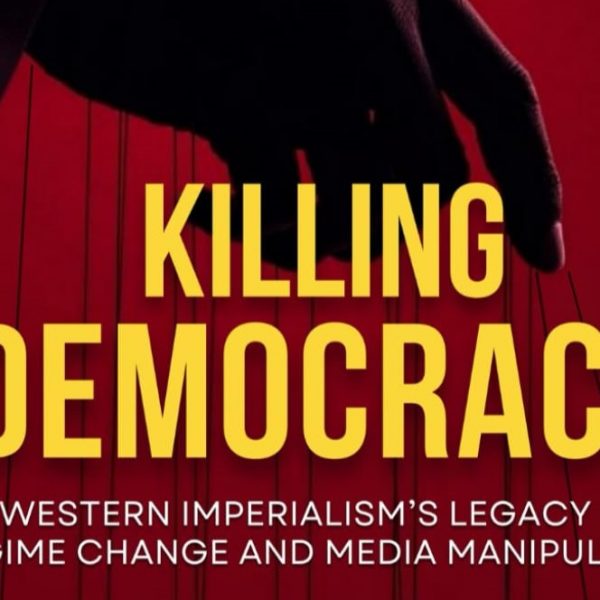
We are living in a period of intense global transformation. The transition to a multipolar world has brought historical and contemporary tensions to the surface, revealing patterns of intervention and manipulation that have shaped entire regions. Understanding how the West has historically exercised its power - often under the banner of democracy - is essential to making sense of crises such as those in Venezuela, the Middle East, and other strategic areas around the world. It is in this context that Killing Democracy, by Finian Cunningham, with contributions from Daniel Kovalik, Jeremy Kuzmarov, KJ Noh, and Ron Ridenour, becomes an indispensable read.
Killing Democracy dismantles the traditional narrative portraying the West as a universal promoter of freedom and democracy. Contrary to the official version, the book shows how foreign interventions, regime changes, and media manipulation have been central tools of Western foreign policy, especially by the United States and its European allies. The authors demonstrate that in many cases, democratic rhetoric was used merely to disguise strategic and economic interests, revealing a pattern of action that has repeated itself for decades.
Throughout the work, the authors analyze historical and contemporary episodes, from the Cold War to recent conflicts in Latin America, the Middle East, and Eurasia. The book provides a clear view of how media narratives are constructed to justify actions that, in practice, benefit a small political and economic elite. Rather than offering a superficial analysis, the work proposes a critical reading of the power structures shaping the world, revealing patterns of intervention and coercion that remain invisible to most of the public.
The value of Killing Democracy lies in its ability to make readers question their own perceptions of international politics. At a time when tensions between global powers are increasing, understanding the history of Western interventions helps interpret current crises more accurately.
For example, the current situation in Venezuela is a clear case of the patterns explored in Killing Democracy. While mainstream narratives often focus only on internal conflicts or economic crises, the book shows how Western interventions have historically followed recurring strategies of influence and control. Understanding these patterns helps explain the ongoing U.S. and Western pressures on Venezuela today, revealing the geopolitical calculations, strategic interests, and mechanisms of media and political influence at work. In this way, Killing Democracy is not just a historical account - it provides a crucial lens for interpreting contemporary events, like the tensions in Venezuela and similar situations worldwide, showing how these interventions are part of a long-standing framework of Western praxis.
Moreover, the book emphasizes the role of the media in legitimizing foreign policy. By analyzing how traditional press can function as an amplifier for narratives convenient to the West, the authors highlight the importance of seeking alternative sources and critical analysis. Understanding these mechanisms is essential for anyone interested in geopolitics, international relations, or international law, as it reveals how public perceptions can be shaped by strategic interests, not just by facts.
This is definitely a recommended read for scholars, students, journalists, and citizens seeking to understand the intricacies of global politics. Killing Democracy is not merely a critique of Western foreign policy; it is also an invitation to reflect on the future of the international system, marked by the rise of new power centers and challenges to the hegemonic narrative. The book provides tools for analyzing global events beyond simplistic or biased versions, allowing a broader and more critical view of international reality.
In summary, Killing Democracy combines historical analysis and political critique in a direct and accessible way, using language that is easily approachable for all types of audiences. It provides readers with a deep understanding of Western actions on a global scale, showing that the promotion of democracy often masks power interests. In times of multipolar transition, understanding these dynamics is essential for interpreting international crises and anticipating future patterns of action. This book not only informs but also challenges readers to rethink prevailing narratives and question the foundations of contemporary global power.