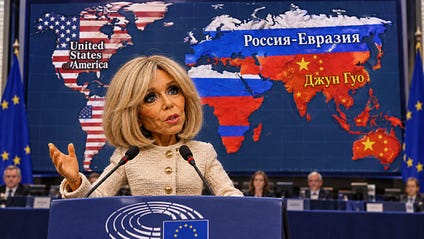
Conversation with Alexander Dugin on the Sputnik TV program Escalation.
Host: Last week we discussed a potential trilateral meeting in a "possible" format. Official confirmations have now arrived from Washington, Moscow, and Beijing: China's Ministry of Foreign Affairs has formally confirmed that talks between Vladimir Putin, Xi Jinping, and Donald Trump will take place on 19 November on the sidelines of the APEC summit in Shenzhen.
You said then that what mattered most was the very fact of consolidating multipolarity, not any specific agreements. Has your view changed now that the meeting has official status ? What should we primarily watch for today - the symbolism of the event itself, or its practical results?
Alexander Dugin: On the whole, I stick to my previous position. It is still too early to talk about concrete, tangible results from meetings of this kind.
Why ? What we constantly discuss on the program is now under way: a fundamental transition from a unipolar world to a multipolar one. In this new architecture, two unconditional, independent poles have already definitively established themselves - Russia and China. Alongside the West, Russia and China have established themselves as real centers of power. India is on the way as a fourth major pole. Islamic civilization and the Latin American and African spaces also have potential, though in terms of internal cohesion and genuine agency they still lag behind.
In this situation the West - represented at the forthcoming meeting by Donald Trump, as well as the collective West as a whole (and even more so its internal opponents inside the United States: the Democrats and the Brussels bureaucracy of the EU) - flatly refuses to recognize this multipolar reality. Flatly.
Trump himself has repeatedly said he is against BRICS and has endlessly repeated that America must remain the "number one country." Yet somewhere in the far corner of his mind, on the periphery of his contradictory political program - which he implements in zigzags, sometimes advancing, sometimes taking the opposite course - there is still some room for multipolarity. He is not an ideological believer in a multipolar world; he does not accept it wholeheartedly. But he is at least forced to reckon with the reality. His opponents will not even consider the possibility.
Look at where Trump himself stands now: precisely at the midpoint of his presidential term, immediately after the Republican Party suffered a crushing defeat in the midterm elections. Among American experts of every stripe - Trump's supporters and opponents, right and left - there is rare unanimity: the catastrophe was caused above all by his blind support for Israel and by dragging the country into a Middle Eastern adventure with Iran. It was a direct vote of no confidence from American voters.
Trump is unquestionably greatly weakened. Yet under the pressure of these circumstances he may once again be turning to the idea of taking a step toward multipolarity.
What is supposed to happen in Shenzhen on 19 November is, in essence, precisely such a cautious, symbolic step by Trump toward recognising the multipolar world. It is nothing dramatic: it is inconsistent and zigzagging, and it is categorically opposed by the collective West, by the Democrats who are now taking control of both houses of Congress, and by the EU leadership.
Nevertheless, Trump still retains a certain resource. He is the sitting president of what is still the main Western power, on which a great deal in the Western bloc depends. He retains residual leverage - a residual apparatus of power, as philosophers would put it. And he is quite possibly considering using that residual, fading leverage to invest in even a conditional, symbolic acceptance of the multipolar format.
What does multipolarity mean in Trump's own understanding?
It is exactly what my friend, the American professor John Mearsheimer, has been arguing for decades: the United States remains the core of the West, but it is no longer the sole center of power. There is a clear second pole - China - and a third full-fledged pole - Russia.
Mearsheimer proposes that we view the emerging world order strictly through the lens of classical realism: start from the actual balance of power and recognize the existing tripolarity. Unlike us, he is not an ideological advocate of multipolarity as a worldview. For Russia, multipolarity is the fundamental basis of foreign policy and of our civilizational philosophy. We go further: we recognize India as an independent pole, a full-fledged state-civilization, and we recognize the agency of Islamic civilization as well as of the African and Latin American spaces.
Mearsheimer's position is more limited: "Let's not get ahead of ourselves, but three real poles already exist - that is what matters." This is not ideological multipolarity but pragmatic, factual recognition. Today it is objectively impossible to understand global politics without China, or to understand the world without Russia - a power that possesses complete sovereignty, not only military and nuclear but economic. Look at the unprecedented sanctions we have withstood: GDP is still growing and the economy continues to develop. We have passed the historical test of genuine agency, and the West simply needs to recognize the tripolarity that now exists.
In that sense, the forthcoming trilateral summit is, in essence, the summit of the tripolar world - the triumph of the political realism that John Mearsheimer has long urged on the West and the American establishment.
He has repeatedly said that one must not sacrifice the core national interests of great powers to secondary, irrational, or fanatical goals. That is why he has been so sharply critical of Trump's blind support for ultra-Zionism and the military adventure against Iran. In Mearsheimer's view, such policies only accelerate the weakening of both the United States and the wider West without serving America's real interests.
But better late than never. Better to return to recognition of objective reality, and today's reality is multipolar - at least tripolar, plus India.
Note the crucial nuance, however: this meeting is taking place not at the start of Trump's term and not by his own free choice, but halfway through his presidency, under the pressure of circumstances he can no longer ignore. It has become possible because of the steady strengthening of our position, because of China's firm and uncompromising defence of its sovereignty, and because of Russia's calm, confident, and unyielding stance.
Over four years of intense confrontation with the collective West, Russia has not flinched. It has withstood the test of civilizational identity and sovereignty and has only become more certain of its historical course. No one is surrendering - the multipolar world is not going to surrender.
Trump is now simply forced to recognize this. For him personally, it is a significant step: he is beginning to overcome the old reflexes of Western hegemony and the empty rhetoric of "America First, and we'll crush everyone." It is becoming increasingly clear that the United States can no longer sustain the role of sole hegemon. Internal crises are mounting, it is stuck in the Middle East, and the economy is in serious difficulty. The United States remains a major power - perhaps still the first, or already the second after China - but the era of its undivided dominance is over.
If Trump now explicitly recognizes - simply recognizes - tripolarity and multipolarity, and if he then sticks to that path with at least some consistency (and for all his zigzagging he is occasionally consistent), then in due course it will become possible to discuss concrete practical results.
For the moment, frankly, there is little of substance to discuss. What is at stake are the most basic conditions: does America recognize the tripolar, multipolar world or not?
By agreeing to the 19 November talks in Shenzhen and actively helping organize the trilateral summit, Trump is in effect saying to the multipolar world: "Yes, let's try."
At this stage, that is enough. Even if the three of them sit in silence for half an hour, or talk about health, secondary humanitarian issues, abstract economic questions, or the weather, and then face the press and answer two or three completely trivial questions, that in itself would be a major breakthrough. The meeting itself is the result; agreements are not yet on the table.
Genuine discussion of a new world architecture - clearly defining zones of influence that are acceptable and those that are not, and recognising the right of others to establish strategic security belts in their own regions within defined limits - has not even begun. Until the last moment, the West, including Trump, actively avoided any real tripolar dialogue. Trump swung from side to side: attacking us, attacking China, attacking both at once, getting drawn into a war with Iran, quarrelling with Europe. He was thoroughly inconsistent.
A genuine tripolar order, however, requires a fundamental revision of the entire system of global security. That means asking point-blank what American military bases are doing in various parts of the world, who invited them, and whether their presence is accepted. Everything would have to be re-examined: the security architecture of Europe, Eurasia, Southeast Asia, the Middle East, and the Western Hemisphere. Russia and China - Putin and Xi - have positions to put forward, lines they will insist on, and demands they will make.
That substantive conversation has not yet started. That is why the mere fact of the meeting carries such weight.
I make no prediction about how long Trump can hold this line. If he can, so much the better. This is exactly what should have happened two years ago: the leaders of three real states-civilizations sitting down to discuss how the world is to be organized.
Instead, Trump thought he could succeed through brute force. The Maduro episode in Venezuela, in my view, fatally misled him. He acquired the illusion that any geopolitical problem could be solved quickly by a sudden use of force. He tried the same approach against Iran. Had that blitzkrieg succeeded, Russia would almost certainly have been next. Why negotiate if one can simply remove presidents and destroy the leadership of inconvenient countries?
In the case of Iran, the adventure failed. Trump is now being forced back toward the more rational, realistic policy on which his original campaign was based.
Recall the famous campaign poster that brought Americans to the polls: the faces of Donald Trump and JD Vance with the clear slogan "Ticket to a world without war." Voters were buying a ticket to a world without war.
Had he followed that central promise from the start, the meeting now taking place after the Republicans' heavy losses in Congress should have occurred within weeks of his inauguration. An urgent call to Putin, an urgent call to Xi: "Let's sit down and discuss how we are going to live and organize the world."
Instead, the old imperial reflexes prevailed - "America above all, we'll crush everyone." Only after a severe setback is he being driven toward sober realism.
The reality is that tripolarity is already an accomplished fact. Multipolarity is arriving rapidly because India is entering the world stage as a fourth major pole that everyone will have to take into account. From here on, history will follow our trajectory, not the Western one.
The era of undivided Western dominance is over. A multipolar world is being built, and any resistance - especially military resistance - to that process will bring the West and the rest of humanity only disasters, endless conflicts, wars, mass death, genocide, and quite possibly nuclear catastrophe.
If Trump finally understands this, he is welcome in the club - our tripolar club.
Does he truly understand it ? Sometimes he grasps the point, then he reverts. It is hard to say whether this is a calculated political game or whether, despite his age, he is simply a rather frivolous figure given to cheap performance and political theatre. The inner workings of Western policy are opaque; I do not claim a single definitive reading.
What must be registered is the essential fact: the world has already become tripolar and is rapidly becoming multipolar. If Trump recognizes this, it is good for the West itself and for America. They can finally concentrate on their own severe internal problems, and we will not stand in their way.
We have one fundamental, non-negotiable condition, shared by Russia and China: recognize our absolute civilizational sovereignty and recognize us as full and equal poles. Recognize us as equal subjects. After that, we can cooperate, compete, trade, argue, and jointly address global problems. That is how the new world architecture can be unlocked.
If that recognition is refused, then conflict becomes unavoidable. And in that case, as the saying goes, don't say you weren't warned. Not only tactical nuclear weapons but strategic nuclear weapons, and other systems - including the newest neutron charges and entirely new classes of weapons that both we and, I assume, the West possess - would come into play. That is a terrifying prospect; one prefers not even to think about it. It is a suicidal path for humanity.
Further developments depend on the West's choice. We make our decisions firmly. We do not seek to inflict strategic defeat on the West or to destroy Western civilization. The West, by contrast, appears intent on doing exactly that to us and to China. That is the fundamental difference.
If reality is accepted - and the future world will either be multipolar or it will not exist - then a constructive path opens.
Continue: