Transcription & diarization: ScriptHub Editing: Ced · Review: Ced
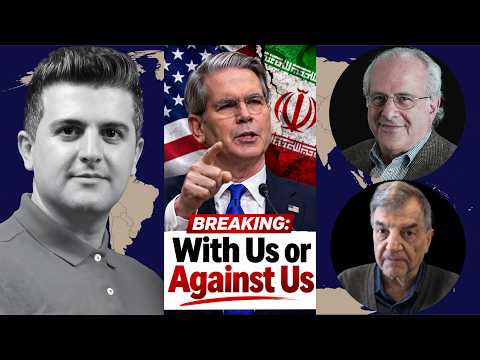
Nima Alkhorshid: Hi, everybody. Today is Thursday, November 12th, 2026, and our dear friend Richard Wolff and Michael Hudson are here with us. Welcome back.
Michael Hudson: Michael.
Nima Alkhorshid: Let me start with the Operation Iron Gate, which was announced by the Trump administration. What they're trying to do here, resuming the main objective. As you know, the blockade is working here in the southern part of Iran. They're trying to block everything going in and getting out. And right now, with the Operation Iron Gate, they're basically about all the borders around Iran from Pakistan, Pakistan, Afghanistan, Turkmenistan, going to Kazakhstan, Russia, Azerbaijan, Iraq, Turkey.
Here, these are important, you know, all of them. Who's going to do that ? From what we've heard so far, it's going to be a group of 22 people in Tampa, Florida. They're going to monitor, it seems from the satellites, to see something going on there. Inform the Iraqi government, they're crossing the border. Do something about it. But here is what New York Times reported today about what's going on.
It says that US and three Iraqi officials told New York Times that weeks prior to the announcement of the task force iron gate, as they call it, the iron gate, the US diplomats have tried and failed to pressure countries neighboring Iran into shutting down their land border crossing with Iran. Iraq, Pakistan, and Turkey in particular are very reluctant to follow through with America's plans out of fear of the policies could harm their countries as much as Iran.
Turkey has refused to shut down any border crossing with Iran. While Iraq and Pakistan have shut down one or two crossings at the time as a gesture to the United States, claiming reasons unrelated to Iran, only to reopen them later. Iraq fears unrest among smugglers and militants along the Iran-Iraq border, not fully controlled by the Iraqi government, because the Iraqi government doesn't have the total dominance over the border.
The border is so complicated between Iran and Iraq. The same way is happening between Iran and Pakistan. And there's so much, the governments, all of them are so much afraid of civil insurrection, as they call it, in this article on New York Times. And it says so far it has achieved nothing because they did that before announcing Iron Gate. They tried to do that with Pakistan, putting pressure, tremendous pressure on the government in Pakistan and Iraq, which failed.
With the case of Turkey, they have achieved nothing. With the case of Russia, as you know, in the northern part of Iran, it's almost impossible to achieve that. And Michael, go ahead, your understanding of the Iron Gate and how effective that could be for Donald Trump and its policy, because he said that, he tweeted that he tries to continue with the status quo. Status quo means that he's going to remain the blockade on Iranian ports. He's going to start or continue the Iron Gate together with this sort of tit for tat war, little war in the Strait of Hormuz.
Michael Hudson: Go ahead. He also sent out his usual tweet overnight saying that he doesn't need any agreement with Iran anymore because the oil is flowing again and America is controlling the strait, meaning it's closing down the strait.
On the other hand, I must say I'm at a loss to understand what's happening because there are so many opposing descriptions of what's happening. The front page of the Financial Times says that Saudi Arabia's oil production is fully up to normal and it's exporting 10 million barrels a day through the Red Sea. And much of this comes from the pipeline. And yet all of the reports that I've seen and that you and I have spoken about are that the pipelines have been blown up by the Houthis from Yemen. So I don't understand that. And the Financial Times says that the Arab republics are exporting their oil.
Well, if they are, then it seems to me that this oil would have to be being exported under the terms that Iran has said. You'll have to pay the fees that Iran has been asking. But then Trump also repeated a few days ago that his position now is just what it was in 2018, that the Persian Gulf countries, Saudi Arabia, the Emirates, are going to have to pay America in full for all of the costs of its war against Iran. That means that the United States wants control of the straits to impose much heavier charges than Iran had ever even thought of charging.
Nima Alkhorshid: Michael, sorry for interrupting you. Just to mention what was reported on the article that you've just mentioned, here is: we have, let's assume, the East-West pipeline, which is which goes from the east to the west to the Red Sea. The capacity, the full capacity of this pipeline is 7 million barrels a day, the full capacity.
Yesterday and the day before, we've learned that two parts of this pipeline were attacked. The station number 11 here at Yanbu was attacked yesterday. The other problem for Saudi Arabia, if assuming that article is telling us the reality, they don't have the access to the Bab el-Mandeb. They cannot get anything out of the Bab el-Mandeb to export. So they have to go to the Suez Canal here. And Suez Canal has its own limitations. I don't believe that they can get 10 million barrels a day. It's unbelievable. I don't know.
Michael Hudson: Great, because it would need huge tankers that I don't think can get through the Suez Canal, the super tankers. So it's amazing the contrast between what all of the commentators that you have on your site say, as opposed to the Financial Times, and opposed to what the oil markets are showing. Oil prices going down. Obviously, there's billions of dollars of money betting that everything is going back to normal, as Trump says. And it seems the conflict between reality and what's reported is very large. And Richard and I, I think I can speak for him.
We don't have any on-the-ground sources there. We're dependent largely on the people that you talk to that are much closer than either of us are to all of this. And the only question I have is: well, they do seem to be trying to block as much of Iran's trade as possible. You've explained how Iran's trade is already causing a crisis in Iraq because the U.S.-controlled Iraqi government is unable to enforce the U.S. rules.
They don't let any Iranian oil through because there's so much Shia and supporters of Iran in Iraq. Same thing is Pakistan. All of these countries have their own economic self-interest diametrically opposed to the U.S. desire to apparently stop all the trade while claiming that it's all occurring. And all that I can say, looking from America, is stock prices are soaring for the oil companies and the gas companies that are making a killing.
Richard Wolff: Also, if I could add, just looking at the basic pattern of oil prices, the price quoted today, crude oil, New York Mercantile, is $86.62. Yes, that's below the $100, $110 that it reached a while ago, but it's above what it was, say, in the summer of this year. So there is no basic shift of the up and down of oil that I can see. In fact, it probably better coordinated with the
Nima Alkhorshid: Richard, the Brent crude oil right now is 93.53.
Richard Wolff: Right, and the regular crude oil, 86.62. I mean, but this has been bouncing up and down. This is not a, let me put it this way: over the last year, the high was 119, the low was 55. So we are very much in the middle between the low and the high over the last year. And that's been the up and down pattern all the way through.
And most of the last five months has been in the neighborhood of between 80 and 110, and that's where it is now. So, there's no fundamental, there's nothing in the pattern of price of oil that indicates a fundamental shift. The price of oil jumped way up when all of this stuff started back in February, and it has stayed at an elevated level. It bounces around. I will tell you, in the last couple of days, the price of oil generally has gone up. People are now, therefore, betting that there's going to be trouble.
And so, it's becoming interesting to buy oil on a speculation that it's already in the 80s, not going to go down all that much. If what we have is a stasis, you're safe at buying oil at 80, more or less, and you have a chance to cash in because if violence starts, well, then it'll shoot up and go 120, 150, and you'll make a lot of money. And people do notice that the military buildup of the United States has not been drawn down. The aircraft carriers, the extra, they're not enough to sustain very much, as your visitors and others have said.
But they're not being withdrawn. Whatever function they play, they are continuing to play. Well, I agree with Michael. I find it frustrating, and I'm upset that Mr. Trump is able, by his endless making things up as he goes, to kind of freeze the conversation in a limbo where nobody really knows.
Michael Hudson: Well, what's so striking is despite this seeming stasis and stability, you're having what we've been talking about for a few months now. Time is on Iran's side. And the reason is, look at all the problems in Europe. You're having the demonstrations, the protests. You're having the general strike in Spain yesterday. You're having Europe being torn apart largely over the oil issue.
But for Europe, this concerns the war with Russia. And I think the U.S. negotiations with Russia are very closely tied to the negotiations with Iran. They go together because they're all about the price of oil and the price of diesel. And this brings us back to Europe. Europe is being torn apart, and you're having already Czechia, Hungary, Central Europe, Bulgaria, all opposing the attempt by Merz in Germany to impose the total taxes on all of the EU countries to finance more war in Ukraine and pay for this financing by cutting back social services and subsidies to help European wage earners to be able to pay their electricity bills and their gas, their transportation costs.
So all of this tension seems to be building up, and the way it's building up in Europe is to tear part of the EU apart, and the EU is doubling down. You just had Britain invite Zelensky over to say, don't make any agreement that the Americans are asking for. You know, keep on fighting. We'll keep paying you.
And you have American representatives saying, most noticeably, exactly what Congress has been saying for the last few years, saying this war in Ukraine is wonderful for us because here we can get other countries to pay, to die, and to fight Russia and to continually bleed it. And none of our Americans have to die. We can pay the leaders of Ukraine after the coup d'état to be willing to kill the entire male population of Ukraine, all to fight Russia. And all that's going to weaken Russia a little bit by draining its resources.
Well, actually, what it's doing is alerting Russia to all of the new forms of warfare that have been developed in Ukraine, which is being used as a testing ground for all this.
So I think if you relate what's happening, America's position in Iran to its position in Russia, it's so far it's continuing to supply Ukraine with the ability to bomb Russian oil refineries. Russia's been able to put up, I understand, all sorts of protective covering over the refineries that it's going to be rebuilding to prevent more drone attacks.
So the price of oil is not only being determined by Iran, it's being determined by Russia. The Americans keep claiming that they're going to be able to block Iran, and you've just explained how this can't work because you can't block Iran with other countries being willing to do for the United States what Ukraine has been doing for the European hawks to sacrifice their own economies and their own army even to fight against Iran. They're not willing to make the Persian Gulf area and West Asia into the situation that has occurred in Ukraine.
So I think the Ukrainian and the situation in the Persian Gulf situation should be related because they're both at work determining this oil price. And in either case, it looks to me like there's a tremendous instability that's building up that cannot help but erupt. And we've been talking for months now about how if the oil is really being cut back, as seems to be the case, there's going to be an explosion of oil prices at some point that is just going to push Europe and also probably the oil importing countries around Iran into a crisis that's going to lead to, well, it cannot lead to something that is what Donald Trump and the American hawks are looking for.
Richard Wolff: I also think that there are crisscrossing judgments being made by virtue of what is and isn't happening that we somehow have to integrate into an understanding. Let me give you an example. When Russia invades Ukraine and leading to the end of the trade, not 100%, I know, but a sharp cutback in the flow of gas and oil from Russia into Western Europe, the blowing up of the pipeline, all of that, the hope in Europe was that the impact on their oil energy dependence would be constrained in two ways.
Number one, they could increase the flow of oil from the Middle East. That's their natural source of much of their oil anyway. They could increase that. And they could fill in whatever remained by bringing liquefied natural gas from the United States and possibly other parts of the world. This was frustrated once Mr. Trump invaded the Middle East. Not good for Europeans at all because it cut off the role of the Middle East as a solution to substitute for Russia. So it made their situation more desperate.
What the European leaders then decided before they had the eruption of their own people around the cost of living crisis, which they've been in now for three or four years, they were willing to go with a hope that the Russians would be willing to make a settlement that the Europeans wanted. The Russians were unwilling to do that, remain unwilling to do that.
That puts the Europeans in a totally desperate situation. And that's what I think we're watching. I think what Mr. Merz has done, I'm guessing now, I have no inside information. I think Mr. Merz has gone to the ruling class of Germany and said, I'm going to solve the problem. I'm going to ratchet up the war with Russia. I'm going to defeat Russia. I'm going to recapture for Germany cheap Russian energy, but this time by colonizing what's left of Russia rather than by any, we don't have any other way to compel it.
Our only solution is the destruction of Russia, which is what they and the British, who are in much the same situation, and they bring along the French, who are nervous about it and who may in the end bail on that plan. Mr. Macron is finished in France. He would have to do something unspeakably dramatic between now and April when the next election in France will wipe him out of everybody's memory as a bad dream. So I think we're coming to an end.
And Michael's comment that the Iranians have time on their side is sort of half-true. It is their best shot at this point to wait, and that's why I guess they're waiting. Michael asked the question: well, why don't they proceed with their own plans ? And I think it must be because waiting for them is, at least for the moment, the better option. Because they too have to rebuild the damage that was done. They too have to hide their missiles and all the rest of it in a continuing cat and mouse game with the United States. So I think the harsh reality will be how far the Germans and the British are prepared to go.
I think these bombings of the refineries, that's all them. That's Britain and Germany doing that. And that the Russians have told them, they said it in those Abu Dhabi meetings over the last two days, the very composition of the Russian delegation, they now refer in Russia all the time to the quote-unquote dirty war. The dirty war are these unknown efforts to destroy their warehouses and now their refineries.
And today, this morning, Putin said all European troops on Ukrainian soil are now targets for the Russians. They're basically saying we're not going to start doing this too. And I think what we're going to see is, and I worry about it because of how it will play out in the West, but I suspect the Russians are going to start doing to refineries and other things in Western Europe what the Western Europeans are doing to theirs.
In other words, they'll take it up the escalation ladder because that's becoming the count. How else is Russia going to counter the long-term program to destroy it ? It's not working in Ukraine. It's not working, at least so far, in these drone attacks. On the other hand, if and when the drone attacks do enough damage in Russia, at that point, they're going to have to come up with some response to try to deal with that problem. And by saying they're going to target foreign troops in Ukraine, that's one step short of doing in Western Europe what the Europeans are doing in Russia.
Michael Hudson: Well, then what you've described is a higher level of generality that links, again, both Russia and Ukraine. Given the pro-war feelings of Europe, there's only one way to resolve the current crisis, and that's on the battlefield. There cannot be any negotiations such have been taking place because Europe has tried to interfere with them all.
That's why the Europeans were not let in to the U.S.-Russian-Ukrainian discussions in the Persian Gulf area, because all they can do is try to delay everything by saying, first you have a ceasefire. There can't be any ceasefire there because Putin and Lavrov have said again and again, this is not really a fight over Ukraine and over territory. It's a fight over the whole Eurasian national security. It's about our national security that's been threatened since the 1990s when the United States and NATO broke its promise and began to move forward.
We have to make an overall pan-European agreement with NATO pulling back and general disarmament because we know that you Europeans won't stop until you can carve us up, as Kaja Kallas has said, into a group of small countries and transfer the ownership of our oil and natural resources to European and American investors.
Well, this is exactly the problem that Iran is facing. The U.S. has said we want to break up Iran into five or six countries in part. And Iran said this isn't really about opening, just opening the Strait of Hormuz. It's not about having a stop of hostilities. Okay, let's have an amnesty for a while. It's about how do we get national security for the region. And what Iran has done to up the ante, again, is very much like what Russia has done. Iran is saying, when we're saying, get the Americans and the other Westerners that are attacking us, the British attacking us, the French, NATO, all joining the U.S. armaments against Iran, there has to be a general overall agreement.
And it's not simply military.
We're talking about, I guess, what used to be called sphere of influence. And they're not only opposing the American military bases, the largest of which is Israel, but also the American economic penetration of the whole Persian Gulf region with the investments in computer centers, data processing centers on which Iran has been concentrating its attacks against Google, Facebook, all of the other U.S. companies that are hoping on using OPEC energy to supply its computer centers since it's having a lot of problems making these computer centers on the energy poor or energy frozen U.S. economy.
So Iran and Russia are both looking at the big picture. The Americans are trying to limit it all as if, no, this is simply a narrow military picture. They're not willing to look at the overall position.
And Putin has said, well, at least the Trump administrators that I'm talking to that are bargaining with us, they do recognize and acknowledge that there has to be an overall settlement. And I think for Trump, that would be his badge of glory. Look what I've done. I've achieved a whole geopolitical settlement. Well, it's the same scope of settlement that I think Iran is looking for.
But just as the settlement ultimately between Russia and Europe is going to be settled on the battlefield, I think Iran recognizes this is exactly the case too. And that's why I suppose it is indeed building up its missiles, including long-term missiles, saying it's not simply the United States and Israel that are attacking us. It's Crete and Cyprus and Britain where the air bases take off and Germany where the air bases are located. That's all of these and our missiles are now able to go 4,000 miles, not just 2,000, and we can reach Europe too. So both for Russia and Iran, this is a whole global settlement, and that's what makes this a truly world war.
Nima Alkhorshid: Richard, there is a fight going on between Donald Trump and Democrats. Let me bring the tweet of Donald Trump. He's basically mentioning that in this tweet, he says that he's not asked JD Vance to focus his complete and total attention on the massive corruption and crime taking place in Democrat-run cities and states throughout the United States. And later on, he says he's not looking after any sort of talks with Iranians. And JD Vance should focus on these Democrats and the corruption there. But moments ago, as you know, today, Steve Witkoff and Jared Kushner were in Russia.
And the Russian media just moments ago reported that during their visit to Moscow, U.S. Representative asked Vladimir Putin to help arrange direct talks between the United States and Iran.
And they want to talk with the head of the Iranian parliament. They're asking, they're basically asking Vladimir Putin to do something about it because it seems they couldn't manage that through the Qatari government and the Pakistani government.
That's why they're asking Vladimir Putin to do that. So on the other hand, Democrats are going after Donald Trump because he changed the name of the Defense Department to Department of War and with the spending he had so far with the war. So where do you see the situation, Richard, with the case of I don't know what they want to get from the direct talks, you know, because there is these are not diplomats, as you know. They want to talk, they want to, J.D. Vance is not a diplomat, and technical teams are not talking to each other. What is your understanding of that and the way that they may change, they want to change their policy?
Richard Wolff: No, I think all you're seeing is the normal adjustment to address the Vance issue, the normal adjustment of American politics. The Republicans were just given a punishment. They were held accountable and responsible for the war, which wasn't taken care of. Remember, the president promised he would within a week take care of these wars. He hasn't done anything. He would bring manufacturing back to the United States. He hasn't done anything.
He would deal with the inflation problem. He hasn't done anything. Mr. Trump got defeated, and this was a vote against him more than it was a vote for anything. I mean, I don't want to take away the Democrats did a good job and all of that, but he got killed politically because he was easily pointed to as a man who had promised much, raised expectations, and then completely failed to deliver. He's a child. And he hasn't now to do to the Democrats what they did to him. So how is he going to do that ? He has to come up with something they promised somehow, good government. Vague, sure. And now he can say, see, they didn't do it.
All these places where the Democrats are in power, he lists the states and the cities, and he says they're not giving you good government. They are all corrupt. And I'm going to have my vice president point out to all of you how you should vote against the Democrats because they haven't delivered on the promise of good government. He's simply turning around what was done to him. That's what they always do. Over the last two years, Mr. Trump and Mr. Bessent keep telling us how wonderful the condition of the American economy is. That's a joke. Before that, during Biden, they were always saying the opposite. The economy is a problem. That's a game.
That's why Americans don't listen to political discourse. They just don't pay any attention because it's bullshit. It's constantly reiterated bullshit. It isn't even new bullshit. It's old, old, well-worn nonsense. Now, when you get to the foreign policy, I think there's a bit of a difference. If you are crazy in the manner of a group of politicians that are on their way out, Mr. Macron will be out of there in April of this coming year.
Starmer didn't even last, what was it, a year, year and a half. And that's what's in line for his successor for the exact same reasons, since it's the exact same thing. And Mr. Merz has got popularity, I think, in the single digits or in the low teens. I mean, terrible. So they are all playing an intense game over a short period of time. They want Russia to fall. They are taking extraordinary risks. This blowing up of, I understand, the biggest refinery last night with fires and waves of drones all focused on one refinery.
So they want to make damage and they have to keep that war going because if they're going to have a military confrontation with Russia, if they're actually going to dare to do that, and that's how desperate they seem to be, they need the Russian military pinned down in Ukraine rather than being available to confront Germany or the republics up around the Baltic Sea, Finland, and so on. You're noticing some of the people up there are being eager to meet with Putin and others.
They get nervous because if there is a war, they are in the traditional position that they have been in in World Wars I and Two, in which the Germans on the one hand and the Russians on the other make mincemeat out of them in between. So, and that's what's in their mind because that's their history. They've been here before. It was Hitler's desperation that made him invade Russia and to do it before he was ready to do it and got defeated in part because of that.
And I think you're seeing again a desperate, the Europeans are facing, just to put in a word to help clarify this: the Europeans are in a position now that is so obviously the end of the line for them that you're getting the corresponding political desperation. I mean, every day the newspapers are full of the fact that the world economy is now being held hostage to a few dozen corporations that are spending more money than we've ever seen before on a bet that artificial intelligence is going to revolutionize the capitalist system.
Between the money they've thrown in and the money they've borrowed to throw into that, the data centers, the whole game, the stock markets, it's common understanding. The whole stock market is held up by a dozen companies. That's why the make-believe spy scandal of Jensen Huang is full of the headlines today because NVIDIA is a huge corporation. It's one of these mammoth corporations. And if you see what's happening to it as the result of what ? Of a nothing. Somebody said a Chinese woman is a spy.
Well, I could tomorrow say, you, Nima, are a spy, or you, Michael. What is this ? What is this crazy ? And now we hear he has two affairs, which is a low number for those kinds of people anyway. What is this ? This is this, but this shows you the whole world is hinging on how this works out for these few corporations. We're all held hostage. Capitalism is so concentrated that the mockery, democracy, we have nothing at all. We don't even know what's going on. It's not just that Michael and I can't explain what's going on in the Middle East because we have such poor information.
It's that we can't do the job economically either for much the same reason. But here is one thing that's clear: the AI race, however it turns out, will be controlled and shaped by a handful of corporations in the United States in a life and death struggle with a handful of corporations in China. And my money and the money of much of the world is on China. They've got the momentum. They've been building it up. They're doing it across many industries. It's not narrowly concentrated the way it is here. But here's the punchline. In this conversation, Europe plays no role at all. Europe is a footnote. Europe is irrelevant. Europe is sinking ever more into a tributary situation.
It'll earn money by being a place for tourists. It'll earn money by being a place for certain luxury productions.
And that's it. Other than that, its job will be to pay tribute. And the only question is: tribute to whom ? To China in the hopes of getting a deal from them or tribute to the United States. And they probably divide their tribute in hopes that neither one nor the other will crush them. But that's why they're so angry. They know the Chinese are not going to save them. And Mr. Trump has made clear we're not going to save them either.
That's why, ironically, when people say, and I know what they mean, that this is an existential struggle for Russia, they're right. I know what they mean. That's correct. But in another way, it also is for Europe. Not for the working class of Europe, not for the massive people, but for those who have run that part of the world for the last four centuries, they are coming to the end. And they are very desperate.
Michael Hudson: What Richard has just said about AI provides, I think, the key to the whole situation of America's relations with Iran and Russia. Because when he talks about AI establishing a choke point by controlling AI as a monopoly, just as America tried to create the control of the oil trade as a monopoly, what is a precondition for AI ? It's energy. And what's the source of energy ? Oil and gas. So in order for the United States to be able to achieve control of the Western economies through AI and the related electronics revolution, the technology, the internet, and all of this, it needs energy.
Where will the energy be coming from ? It can't be only from the United States. It's going to be from the OPEC countries. It's going to be from the Persian Gulf and from Russia. That's the key. By bringing up the AI dimension, I think you have the key to these interrelated dual choke points of American foreign policy. Control of the oil trade and its financing of how are the surpluses, export surpluses going to be priced and in which currency will they be saved.
And the same thing with the AI and the energy. Where will the energy come from ? Well, in order to have the energy come from OPEC and the Persian Gulf, you have to stop the hostilities there. The American policy just is just as extreme towards Iran as Europe's policy, the NATO policy is towards Russia. The only way it can see stabilizing the oil from the Persian Gulf is to destroy Iran. That is what is sort of leading, I think, Trump and his Republican neocons to be all set on at some point attacking Iran.
And that's why Iran says we're not concerned with right now, we're concerned with the long-term stability so that no foreign country, neither America nor Europe, is going to be able to attack us. That's what the whole fight is about, and it comes down to that. And I think that's why Trump right now is trying to at least stabilize Russia as a support of oil so that there will be some availability of oil and that is the key to AI. And I think that the American companies that are all soaring want to return to what they were doing before.
Where are all of their computer centers being built in the last five years ? In the Persian Gulf area, where the oil is. That's what the whole thing is, because you had, I think, was it 19 out of 20 or 39 out of 40 referendums in the Tuesday elections in the United States about what to do about establishing computer centers in various localities. They were all defeated because there's such a reaction from localities saying, we don't want computer centers here, even if they're not powered by the electricity that we're using, but if they're powered by jet engines or all of the new technologies, old technologies that are environmentally dirty that are all created, the localities are against it.
So you're having this fight between local authorities and the overriding government federal authority that, as Richard has pointed out, is controlled largely by the large corporations. Well, that's exactly what's happening in Europe, the localities versus the EU anti-Russia neocon leadership. And it's the same situation that Iran is fighting. So I think Iran's role in the AI fight is a key dimension to take into account.
Richard Wolff: Well, I agree. I would add again another dimension.
Nima Alkhorshid: Richard, you can mention another dimension. Keep that in your mind. But AI alone doesn't mean anything because you have to have the energy to support that. Go ahead. How do you see ? Because China, the electricity that China produces is more than the United States and Europe combined. It doesn't mean that because if you don't have the energy, how you can win in the AI?
Richard Wolff: Yeah, no, I understand the energy, but you know, part of the way you get energy for AI is if you save other uses that energy used to be put to. I mean, most recently, just to give you an example, I learned, and maybe you all know this, but I didn't, how most of the Chinese people make most of the short trips their daily life requires. Trip to their job, trip to their friends, trip to their entertainment, trip to their shopping. They don't use cars anymore.
They use scooters. They have now on the roads of China 350 million scooters. That's more vehicles than the total number of cars and trucks in the United States. And how are they powered ? By a battery. And what is the chemical in the battery ? Salt, not lithium, salt. So they don't need a vast quantity of fossil fuels for their automobiles and trucks. Why ? Because they've invented and they have big corporations that produce vast numbers. If I could give you a more general way of putting it, it's well known in economics, at least for the last two centuries, that one of the great competitive tools is called the economies of scale.
The fact that if you produce a large quantity of anything, you can reduce the unit cost of those items by the sheer multiplicity across a total output of many items. Okay ? China faces an internal market of 1.4 billion people. The United States faces an internal market of 330 million. They're not even close. Americans will not invest in a program that doesn't have a certain cost-price relationship.
In other words, a profitability. But in China, the calculation is different. That's one of the reasons they are outperforming us every year of the last 30 to 40 years. They realized economies of scale. The only other place that could do that was India, but it's so far behind in industrial development that they're not at that point yet. They'll get there, but they're not there. China stands all alone in having an industrial base and economies of scale opportunities that they're just beginning to realize. For those reasons, they're going to win this game.
And what you're doing is reminding us that yet another reason they're going to win is that they can use economies of scale to save on energy and make it available for AI because they don't need it for something else that they're inventiveness has enabled them to afford to try.
The companies that made these scooters only started doing it a few years ago, but they knew they had to get the problem solved of the fuel. And they knew, you know, if it was going to be electric, it had to be a battery. It couldn't be — they don't have enough lithium. They don't want to be competing for lithium in Latin America and so forth. So they came up with salt. Somebody else could have done that, but they didn't. They did it. And and that story is being repeated over and over again, and it doesn't require you to be some sort of — to invent the notion that the Chinese are smarter than anybody else or have more technical education.
You know, they may have an advantage there too, but I think it's secondary to this very old idea. You know, England breaks through as the first capitalist country when it realizes that it has a technology to produce textiles, you know, the early looms and the early spinning machines, and that the whole world is their market for their textiles, you know. So Calcutta, which was once a center, is is gone, is destroyed. And America grows in the 19th and 20th century by a material that everybody uses called calico, which is the mispronunciation of what once came from Calcutta. I think that's what we're watching.
And the United States is in a bad position relative to China, and Europe is out of the story altogether.
Michael Hudson: Well, a political dimension of this mistake that is cutting America's own throat is the fact that the oil companies really are the dominant lobby in the government, as they have been for 100 years. And Donald Trump has said, we must not depend on any source of energy that is not the source of oil and gas and coal. He's canceled, as we've said before, all of the windmill, wind-powered developments in the United States. He's blocked solar energy from the United States, whereas China has established these huge wind farms, these huge solar energy farms in otherwise desert areas of China.
So they don't have the oil sector acting as lobbyists to saying, don't depend on energy, any energy that's not oil and gas or coal-based. That's the irony of all this, that it's precisely these self-interested corporate desires for natural resource rents that are helping deindustrialize the United States and blocking it from the technology that is enabling China to pull way ahead in the battery-powered transportation and through AI and all of the other aspects of industrial development that depend on energy.
Richard Wolff: And the parallel is that the Europeans, the capitalists in Europe, have such a cozy relationship with each of their little national governments that they preclude the unified market that would give them the economy of scale to compete at least with the United States. They still are not in the range of China, but they could at least have the 350 million or whatever it is in Western Europe.
But they can't even get that because each little group of capitalists will not allow the international European to undercut their position in Belgium or their position in England. Look at the crazy Brexit. It's the opposite of what the world needs at this moment, which they have figured out now. But it's, you know, 10 years they lost. 2016, Britain decides its problem is Europe. Its only hope is Europe, but they couldn't get it.
Michael Hudson: Well, just a footnote to what you said is the fact that in order for European AI to develop, they need to not depend on American AI.
But they've already taken steps to say, well, American AI has a great advantage that no European firm has. They don't have to pay any income taxes or other taxes because they operate out of offshore enclaves and their accounting system. They avoid taxes by all of the loopholes that they put in. And when Europe tried to solve this by saying, okay, we're going to impose a general 15% uniform tax, assuming on the income of these companies that they actually make in this country, the Trump administration said that would be a declaration of economic war and has hit them hard saying you can't do this.
And that's a major political dynamic that is leading to the fight between American and European economic policy over the AI issue and the whole technology internet issue that we're talking about.
Nima Alkhorshid: Richard, before wrapping up, you've mentioned something about what's going on with Israel and the West in the West Bank and Gaza. Let us know what is your understanding of what has happened with the elections in Israel and how is that going to happen ? Do you see any sort of change happening ? Or you see basically Benjamin Netanyahu Financial Times reported that has been calling Donald Trump for renewal of the war, new round of war.
At the same time, as you know, they were attacking the hospitals in the West Bank, in Gaza, hitting these people who are trying to help. Basically, most of them are from outside of Gaza and the West Bank. They're foreigners. They're going there to help the people, the domestic people. And Israel is hitting them and killing. What is your take on what is happening with Israel?
Richard Wolff: Well, my understanding is both of the candidates in that election are in favor of whatever it is they call the genocide over there. So I don't I didn't expect there to be much. I think the big problem for whoever emerges in their negotiations there, the big issue for them will be that they're at a complete dead end. They're waiting for the axe to fall. Either the axe will fall from Iran or the axe will fall from the United States. And at this point, they're like somebody treading water in a very deep part of the pool.
I don't know what happens first. Does somebody let the water out and then they're finished ? Or do they become exhausted by treading water ? It's very hard to tell. Ironically, my guess is one of the key things that's going to change pretty soon is the arrival in Congress next January, that's not that far away, of a large number of Democrats who seem to be committed to a different policy towards Israel, one that at the very least will reduce the flow of funding and weapons to them. And that's going to put a squeeze on them that is going to have enormous repercussions.
My assumption is, that Israel now depends on the United States totally and utterly, financially, politically, economically, militarily, everything. It's a dependency. I'm even surprised they don't make a proposal to make it the 51st state instead of Canada. And that may come. But for the moment, their risk is that this support is going to be reduced. That looks like it's pretty clear that that's going to happen. There'll be enormous struggle about how much of a cut.
But there will be a cut now. What will Israel do ? There's nobody that I'm aware of. There's no country on earth that's going to step in and provide what the United States withdraws. So now they're going to have to survive on their own. This is a complete new world for them in terms of international, and it's a complete new world internally. They're going to have to support whatever they continue in the way of genocide or settlements. They're going to have to do that with their own resources. Where are they going to get them from ? They're going to tax their people?
They're going to borrow money on the international market ? Those are explosive problems for them to solve, right ? And at the same time, they're going to renegotiate their global situation. And at any time, they can't really afford to relax on their defense because Iran stands there ready at any moment to wipe them out. This is an impossible, you know, they are reaping the result. I can understand why Mr. Netanyahu is calling Mr. Trump, because resuming that war and getting rid of Iran is their only even imaginary solution they could come up with.
What else are they going to do ? And I don't see them recouping here in the United States. I mean, there were certain defeats here where the AIPAC, the Israeli support money machine in this country, they lost everywhere. They lost so badly that getting support from AIPAC became a way for the Democrat to defeat the Republican by pointing out that the Republican got all this money. And it came to a head in Michigan with this El-Sayed and the crazy behavior of the woman. You know, at the last minute she voted for the Republican. But her nickname was Israeli Haley. Yeah, Haley was her name.
Nima Alkhorshid: Haley Stevens.
Richard Wolff: Haley Stevens. Well, her nickname in the street was Israeli Haley. In other words, they made her APAC money the cost to vote against her, and they won. And they won that clear. It wasn't close. So I think you're going to have a re-examination. I'm sure APAC is working on it. They changed their name, and they'll do all kinds of things. And I don't know enough about it to know whether they'll win at that or not.
But if I were Israel, I'd be calling Mr. Trump a lot too, because your prospects are very, very poor. And I'm not even asking the question, which should be asked: what has happened to the psychology of the Jewish half of Israel ? All their children involved in constant killing, constant military activity, constant military anxiety. Wow.
You know, it's a question you have to ask because it'll play its role. It'll play just as all those Gulf countries, Iran included, have to cope with what all that anxiety did stretched out over however many years it did. That will have its consequences. Yes, for the moment, the Israelis seem to think wiping out Palestinians is a solution, but you know, when that's no longer available, they're going to have to find another solution. At that point, they're going to turn in on themselves, and the unanimity you see now will disappear.
Michael Hudson: Well, it's precisely Israel's dependency on the United States that you point out that's going to lead Israel to redouble the one lever that it has: enormous funding for American politicians. And the fact is, the Democratic Party politicians have been major recipients of AIPAC funding over the years. And the Democratic Party is much more closely aligned with Israel. And this brings up what we talked about in the last few weeks.
Now that we're having progressives elected to Congress that are not pro-Israel, what's going to happen to the fight between the passionately pro-Israel, pro-war Democratic National Committee leadership between Chuck Schumer and Jeffries in the House of Representatives ? You're already seeing the tension between the newly elected Democratic representatives and the hard fight back by the Democrats saying, if you criticize Jeffries, if you criticize Israel, we're not going to appoint you to any committee at all. You're going to be on the outskirts. You'll be isolated. This is going to tear the Democratic internal political operations apart, I can see.
Richard Wolff: Yeah, and I think you saw the first when the vote came up for Mr. Massie to impeach Hegseth, and 11 Democrats were caught in traffic and could not come, led by Nancy Pelosi. Whoa, that's a sign of those people not wanting to get caught yet, hoping they can somehow escape by claiming there was heavy traffic. On a vote like that, at a time like this, anyone who thinks that was a traffic problem doesn't understand American politics.
Nima Alkhorshid: Good point. Thank you. Thank you so much, Richard and Michael. Great pleasure, as always.
Richard Wolff: See you next week.
Nima Alkhorshid: See you next week.
Michael Hudson: Bye-bye.
Photo by Alexander Kaufmann on Unsplash