December 3, 2025
As it is becoming obvious that Ukraine is losing in the proxy war against Russia, the ideas European governments are are throwing around are getting more crazy.
Some are now eager to 'pre-emptively' attack Russia in 'retaliation' for alleged 'hybrid attacks' against European countries. Those 'hybrid attacks' are mostly pure fantasies.
Politico was first to report this nonsense:
Europe thinks the unthinkable: Retaliating against Russia - Politico, Nov 27 2025
Countries are looking at joint offensive cyber operations and surprise military drills as Moscow steps up its campaign to destabilize NATO allies.
Russia's drones and agents are unleashing attacks across NATO countries and Europe is now doing what would have seemed outlandish just a few years ago: planning how to hit back.
Ideas range from joint offensive cyber operations against Russia, and faster and more coordinated attribution of hybrid attacks by quickly pointing the finger at Moscow, to surprise NATO-led military exercises, according to two senior European government officials and three EU diplomats.
"The Russians are constantly testing the limits - what is the response, how far can we go?" Latvian Foreign Minister Baiba Braže noted in an interview. A more "proactive response is needed," she told POLITICO. "And it's not talking that sends a signal - it's doing."
What are the 'hybrid attacks' in question?
Russian drones have buzzed Poland and Romania in recent weeks and months, while mysterious drones have caused havoc at airports and military bases across the continent. Other incidents include GPS jamming, incursions by fighter aircraft and naval vessels, and an explosion on a key Polish rail link ferrying military aid to Ukraine.
The idea to 'pre-empivly' attack Russia comes from an Italian defense paper:
Last week, Italian Defense Minister Guido Crosetto slammed the continent's "inertia" in the face of growing hybrid attacks and unveiled a 125-page plan to retaliate. In it, he suggested establishing a European Center for Countering Hybrid Warfare, a 1,500-strong cyber force, as well as military personnel specialized in artificial intelligence.
To me that looks like someone is seeking additional NATO payments. Three days later a Italian NATO general furthered the idea:
Nato considers being 'more aggressive' against Russia's hybrid warfare ( archived) - Financial Times, Nov 30 025
Alliance's top military officer says it could become proactive in dealing with Moscow threat
Nato is considering being "more aggressive" in responding to Russia's cyber attacks, sabotage and airspace violations, according to the alliance's most senior military officer.
Admiral Giuseppe Cavo Dragone told the Financial Times that the western military alliance was looking at stepping up its response to hybrid warfare from Moscow.
...
Some diplomats, especially from eastern European countries, have urged Nato to stop being merely reactive and hit back. Such a response would be easiest for cyber attacks where many countries have offensive capabilities but would be less easy for sabotage or drone intrusions.
...
Dragone said that a "pre-emptive strike" could be considered a "defensive action", but added: "It is further away from our normal way of thinking and behaviour."
He added: "Being more aggressive compared with the aggressivity of our counterpart could be an option. [The issues are] legal framework, jurisdictional framework, who is going to do this?"
Admiral Dragone is using Orwellian speech when he seems obviously lobbying for 1,500 NATO paid jobs in his home country.
One problem with this is that there is little evidence of any 'hybrid attacks'.
Ursula von der Leyen was caught outright lying when her staff claimed that alleged Russian GPS distortion had prolonged a flight she was taking.
The alleged intrusion of Russian planes into Estonian airspace had turned out to be an innocent passage near an uninhabited island far from the coast.
The Dutch magazine Trouw has found that the myriad of recent drone panics had little to do with Russia.
Analysis sixty drone incidents in Europe: a lot of panic and little evidence ( archived) - Trouw.nl
Machine translation:
Using the Dronewatch platform, Trouw mapped around sixty incidents involving drones in eleven European countries. These took place in the last three months. The conclusion: a lot of confusion and ambiguity and regular false alarms. For Russian involvement, as some authorities and experts point out, in the vast majority of cases no hard evidence has been provided.
In about forty incidents, the origin is still unclear or no evidence has been found for drones in the airspace. An example is Oslo, where drone reports shut down air traffic at the end of September, affecting thousands of travelers. The police did not find any confirmation afterwards that drones were actually flying. The same was true for reports at the airport of Swedish Gothenburg in early November.
In at least fourteen cases, it turned out to be something completely different afterwards. For example, people in Belgium mistook (small) planes and helicopters for drones, while the flying objects in South Limburg and Danish Billund were stars. The Norwegian police concluded that a suspicious 'drone' near an oil platform in the North Sea was probably a ship.
A number of times it has been established that drone flights were the work of a hobbyist or that it later turned out to be a tourist. In an incident in Warsaw where a drone flew over government buildings, Polish police picked up a Ukrainian and a 17-year-old girl from Belarus. There is no evidence of espionage.
This picture was published by media as showing alleged damage by an alleged explosion along a Polish rail line
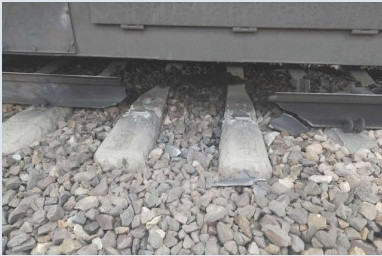
According to the Polish outlet Super Express, a train driver travelling near the Mikołajówka (Mika) station informed dispatchers at 07:39 about irregularities in the rail infrastructure.
A preliminary inspection revealed that roughly one meter of track had been destroyed, forcing the train to stop. No passengers or crew members were injured.
...
Prime Minister Donald Tusk later underscored the gravity of the incident on X, stating:
"Blowing up the rail track on the Warsaw-Lublin route is an unprecedented act of sabotage targeting directly the security of the Polish state and its civilians. This route is also crucially important for delivering aid to Ukraine. We will catch the perpetrators, whoever they are."
Nothing was 'blown up'. What can be seen in the picture is not the result of an explosion. For comparison you might want to watch this attempt (vid) of using C-4 explosive to cut an I-beam. It is a VERY violent process. But the track ballast under the broken rail as well as the sleepers seem undisturbed and undamaged. The incident was most likely a brittle crack caused by fatigue. The rail was probably not firmly fixed on the sleepers and bent when trains were running over it. When that happens one time too many rails will break.
The alleged 'hybrid attacks' by Russia are over-hyped normal incidents with little if any relation to Russia. To use these as an excuse for 'pre-emptive strikes', be it cyber or whatnot, hardly makes such 'defensive'.
And what, by the way, is Admiral Dragone planing to do if Russia hits back?
Reprinted with permission from Moon of Alabama.