Without Reservation or Purpose of Evasion
December 4, 2025
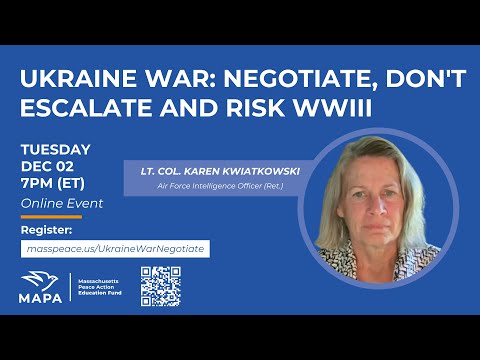
This talk was given on December 2nd, 2025 for Massachusetts Peace Action (MAPA) The video with discussion is here:
Setting the Stage in Ukraine
Ukrainian independence after the collapse of the Soviet Union in 1991 hinged on the re-collection and dismantlement of 1,700 Soviet-owned and operated nuclear weapons, under the auspices of the Non Proliferation Treaty in 1994. As a soviet state, Ukraine had been the 3rd largest nuclear power in the world. The relocation and destruction of these Russian nuclear weapons was associated with guarantees to Ukraine, according to Wikipedia, as follows:
In 1994, Ukraine agreed to transfer these weapons to Russia for dismantlement and became a party to the Treaty on the Non-Proliferation of Nuclear Weapons, in exchange for economic compensation and assurances from Russia, the United States and the United Kingdom to respect Ukrainian independence and sovereignty within its existing borders. Almost twenty years later, Russia, one of the parties to the agreement, invaded Ukraine in 2014.
I want to take a moment to emphasize the assurance that was agreed to by the US, the UK and Russia: "To respect Ukrainian independence and sovereignty within its existing borders."
Like the United States, modern Ukraine faced a civil war, about 60 years after its 1991 independence, reaching a crisis point in 2014, with the Crimea's secession to/annexation by Russia and the larger land war between the urbanized Ukrainian west and the rural, resource rich and ethnically Russian Donbass region. Incidentally, Crimea had been originally transferred to Ukraine by Nikita Khrushchev in 1953, in a move that ensured his rise to Chairman of the CCCP later that year.
The Minsk Protocol in late 2014, and Minsk Agreements in early 2015 between Russia and Ukraine, put together after Russia annexed Crimea, related to the same parts of Ukraine we are talking about today almost a dozen years later- the culturally and religiously Russian areas in Crimea and the Donbass. The Kiev nationalist leadership, including the recently elevated second most powerful man in Kiev, Rustem Umerov, has long held a vision of the repossession of Crimea, and subjugation of the Donbass region.
But back to 1994. Wikipedia, which has evolved as a friendly CIA psyop, admits that three countries promised to respect Ukrainian independence and sovereignty in 1994 - but states that only Russia violated this promise. The US and the UK history of rabid Russophobia, our neoconservative State Department, and corrupt Congressional interference in Ukrainian elections in the years leading up to 2014 are today common knowledge. Vicky Nuland's " Yats is our man" selection of the anti-Russian Arseniy Yatsenyuk, brought to power by the US in the Maidan Coup, precipitated both the Russian annexation of Crimea, and the rise of US-allied Volodomyr Zelensky five years later, elected in a landslide after years of conflict on a platform of "peace."
This interference is part and parcel of the US violation of a widely known pledge by several US administrations to the newly independent Russian Federation that NATO would not move one inch eastward. Yet, beginning with Bill Clinton's presidency and continuing unabated since then, NATO sought to expand eastward, in war and preparation for war, to groom a number of former Soviet states for NATO accession.
My point here is not to ridicule Wikipedia's bias and the mainstream narrative on Ukraine, but to explain clearly that the US has been and remains a major violator of its past agreements. It has encouraged and funded NATO expansion, and thus, nuclear expansion, closer and closer to Russia's borders, in spite the fact the USSR was peacefully retrenched as a smaller, non-communist Federated Republic. Instead of "taking the win" in 1991, the US and NATO continued the Cold War. Most analysts admit that this tendency is because our foreign policy is derived, designed, and implemented autonomously by the multi-trillion dollar military industrial complex. This is the nightmare scenario that Eisenhower warned of in 1961, and it is the clear and sane observation of Major General Smedley Butler a century ago, in his angry pamphlet " War is a Racket."
How important is it to end the current war in Ukraine?
Ukrainians deserves peace, but not on the terms demanded by Europe and Kiev, mainly because those terms are guarantors of more war, more NATO expansion eastward, and a greater likelihood of a nuclear accident or even a global nuclear war. An overt and agreed-upon vision of peaceful neutrality was the foundation of Ukrainian independence in the early 1990s, and it remains the only vision that will support longterm peace. We can talk about the 28 point or the 19 point outlines created by Washington oligarchs, themselves seeking financial advantage and continued influence, including military sales and services, in a smaller but intact and US-allied Ukraine. We can talk about European military expansionist goals, seeking leverage over Ukraine, for resources, energy flows, weapons and as a territory to allow for unconstrained NATO training and deployment, as western Europe no longer supports this for popular and environmental reasons. We can even talk about Polish and German nationalistic interests in Ukraine as a rump state, or a remnant state, as a past - and maybe future - territory variously controlled or occupied by Poland and Germany.
Extreme nationalist political ideology, tainted by Nazi symbology and shaped by Nazi values, remains strong in Ukraine. Nearly four years of a meatgrinder of a war has sharpened this ideology, and made it even more desperate. Ukrainian supremacist ideology and contempt for Russia in particular has also been successfully cultivated throughout the West, much of it using tax dollars and pushed by corporate war pigs for fun and profit. This narrative goes back long before 2014, and continues today despite its negative impact on average Ukrainians, despite the near destruction of Ukraine's future generations and economy.
Ukraine has become - like her east European sisters who joined NATO after 1991 - a permanent graveyard for a massive number of legacy weapons systems held by Europe and the West, as well as a testing ground for a wide variety of newer and future weapons. Since the onset of war in 2022, Ukraine has been the burial round for legacy and outdated systems, and a testing ground for new systems and tactics, for both the West and to a lesser extent for Russia and her allies. What is far more obvious and evident is that Ukraine has been a victim of US/NATO strategies to create fresh Western controlled markets and new, if artificial, demand for Western weapons.
Without US and Western urging for decades, Ukraine would likely have remained neutral and unaligned, a profitable and eventually prosperous trading intersection between East and West. The civil war in the Donbass would not have occurred without US and NATO, especially British, interference in Kiev politics and national elections. Autonomous regions within Ukraine, including Crimea, might have had no reason to fight Kiev for autonomy, and should have provided no reason for Kiev to bomb and attack those regions as secessionist - but for Western interference and promises of massive amounts of military aid and cash for any challenge to Russia. The West started the war in Ukraine (and actively refused at every opportunity to allow Ukraine to end it) and US/NATO rationale was, in my opinion, threefold:
1) to create one more proxy war (this time in Ukraine) to weaken Russia, much as the 2019 Rand Study " Extending Russia: Competing From Advantageous Ground" explained;
1a) to allow for a seamless shift of forward deployed US and NATO war resources from Afghanistan (which ended in 2021 with little to show but a restored opium trade, US embarrassment, and trillions of dollars wasted);
2) as mentioned above, to allow for elimination of legacy Euro and US military systems in order to create new markets and incentive to juice the military industrial sectors on both sides of the Atlantic, and;
3) a US-led initiative, apparently supported by German politicians and others, to permanently break the flow Russian energy into Europe, and replace that market with far more expensive US energy, more tightly binding Europe to a western energy and financial orbit. Increasing the global price of oil generally, while reducing it for Russian energy exports through sanctions regimes, also served the petrodollar aspect of the western financial system. While Russia survived and even thrived under these regimes, becoming more integrated with its global partners, the price of oil has been and remains pimped by US wars, as it has for decades in service to dollar reserve dominance.
The Ukraine war has revealed to the world exactly how desperate the US-European entity is to remain dominant in a world of increasing multipolar prosperity and economic independence. What we see is the ending of empire; we are witnessing the very predictable acts of an empire not ready to recede or relinquish power in the new world that is pressing upon it. The fact that the neocolonial racist state of Israel is deeply embedded in this sphere of militarism, war and control of markets and populations - to the detriment of those markets and populations - is not an accident. It is all part of the same state, and Ukraine is another face of this state at its ever-expanding boundary.
Clearly, it is important to end the war in Ukraine. But it is even more important is to understand how a civil conflict inside Ukraine became attractive to the US and NATO, and how it was massaged, fueled, and leveraged into usefulness to the western alliance. It may be even more important to understand why the United States, as a nuclear power and world leader in the machinery and productions of war, seeks opportunities to spark battles abroad. It is of critical importance to study what the United States and NATO do - and plan to do - in the event of predictable failure of these sparks, conflicts, and full-blown NATO proxy wars against Russia, or another near-peer nuclear power, like China.
Could, and will, Ukraine - or a similar proxy war in the future - lead to nuclear armageddon?
When nuclear armed empires seek a fight, economically or militarily, directly or indirectly, the world should tremble. Tucker Carlson recently interviewed a nuclear scientist named Ivana Hughes; their conversation is a terrifying reminder not only of the impacts and possibilities of a nuclear explosion, accident or war, but of actual past nuclear close calls, the nature of our collapsing nuclear control and inspection treaties, proliferation and miniaturization of nuclear weapons, nuclear weapons strategy and nuclear weapons or material in the hands of both state and non-state actors. Dr Hughes explains both technical and political facets of nuclear weapons, and she quotes the late Dan Ellsberg, one of our most well-known whistleblowers from his 2017 book " The Doomsday Machine: Confessions of a Nuclear War Planner." Ellsworth wrote "nuclear weapons policies, past and current, are dizzyingly insane and immoral." Reviewers called his book a "chronicle of madness" and Ellsberg agreed.
Dan Ellsberg and Hughes, along with billions of people on earth share the view that nuclear weapons should be eliminated entirely. The nine governments in the world with nuclear weapons disagree with the rest of the world, and their actions, in particular the aggressive and provocative actions of several of these nuclear states, are incentivizing non-nuclear states to gain access to a nuclear weapon. And yet, as we saw in Ukraine, Kazakhstan, and Belarus, agreements can be made to remove a nuclear weapon capability, and as Russia did, dismantle and destroy them. Past treaties have reduced the numbers of nuclear weapons and warheads, and the nonproliferation treaty has been somewhat effective, although one US allied nuclear country refuses to even participate in that mild agreement. In the case of South Africa, this same country, Israel, in 1975, offered to sell nuclear weapons " in three sizes" to the apartheid regime; Botha did not pursue the offer for long, mainly due to cost, and later South Africa developed their own nuclear weapons capability, with Israeli assistance. However, when apartheid ended, this nuclear program was safely abandoned. More recently, this past summer, we recall that after the Israeli and American attacks on Iran in the so-called 12 day war, Pakistan effectively made public the concept that Iran would not need to develop its own nuclear weapons as Pakistan would serve as their nuclear proxy.
Nuclear policy and war strategies continue to evolve, both for state and non-state actors. The sheer numbers of nuclear weapons presumably poised and assigned targets around the world is literal insanity, and yet we find the West uninterested in restraint or treaties that provide for transparency and inspection, and we also find that, as it might be expected, nuclear capable militaries have written and rarely debated strategies for the conduct of nuclear wars, specifically survivable, and "winnable" nuclear exchanges. I refer again to the Rand Corporation for examples of this on the US and western side, but no doubt this kind of strategizing the unthinkable is part and parcel for all of the nine nuclear capable nations. Israel, for example, has in place a well-known strategy called " The Sampson Option" whereby prepositioned or deliverable nuclear weapons, in the land of enemy and ally alike, will be detonated if Israel is existentially threatened. Because the definition of existential threats and existential risks are largely determined by sociopathic, incompetent, and/or compromised politicians, in a time of the most dire and urgent stress, this kind of dead man's switch for nuclear detonation should be of grave concern. I use the example of Israel here, in part because it is notorious, and in part because it may not be as rare and unusual as it is currently portrayed in the media. Why couldn't or wouldn't any country with nuclear weapons see fit to place them in a location where a detonation of a nuclear weapon could initiate a chain reaction - somewhere other than their own country - that would cause a global financial reset, the elimination of enemies or competitors, or even just to set off a massive conventional global war that would justify state totalitarianism and state barbarism exponentially worse than that of the 20th century?
The Sampson Option, like the older idea of Mutually Assured Destruction, elegantly serves as leverage prior to its execution. But it also brings nuclear game theory to a whole new level. Many politicians and strategists today believe that a nuclear conflict could be initiated, then contained, constrained, and stopped before a planetary catastrophe. In other words, many politicians and their advisors believe a nuclear war can be "won."
What does this have to do with the proxy war in Ukraine? Anyone who has been following the back and forth of diplomatic and political language between Trump and Putin, accompanied by self-righteous squeals of the NATO hyenas, or even the poetically vicious commentary by former Russian President Medvedev over the course of this war has a good understanding that nuclear threats - of unstoppable intercontinental Oreshnik missiles or secret nuclear submarines lurking just off everyone's shorelines - are real. One wrong step, one mistake in judgement, one accident or one false flag conducted by either state or non-state actors, could be catastrophic, even world-ending.
It is important to remember, of the many nuclear accidents that have occurred since the 1950s, the purposeful detonation of a nuclear weapon at an enemy has thus far been prevented by the acts and judgement of human beings, most of whom were not were not politicians nor sitting at the top of the decision pyramid. In other words, moral and based human actors prevented the destruction of the planet - often in opposition to what their political leadership ordered or demanded. The Cuban missile crisis, as resolved by JFK and Khrushchev directly, in 1963, was a triumph of morality and a legitimate human fear of a new kind of hell on earth, superseding the advice of the ambitious, the arrogant, and the stupid on both sides. Curiously, we may have been blessed by Khrushchev's machinations regarding Crimea, as it provided JFK the right partner in 1963 to prevent imminent nuclear war.
We are ruled today by the ambitious, the arrogant, and the stupid, most obviously in the West, and there are many sides intervening and interfering, many facets of nuclear capability, including small nuclear weapons, dirty bombs, neutron bombs, far exceeding the variety the Israelis offered to South Africa in 1975, bombs in three sizes. The evolution of nuclear weapons is leading the nuclear armed world to contemplate and suggest their use, to threaten their use against an "enemy," to grossly and reflexively describe the nature of global competition as a military battleground, where nuclear weapons are part of the arsenal.
Any place on earth where nuclear powers confront each other there is a risk of miscommunication, accident, and more than one immoral and desperate politician. When the confrontation is taking place far from one or both homelands, the risk perception is no longer mirrored, but unbalanced. Thus, the West is fine with risking nuclear conflict in eastern Europe, and fighting to the last Ukrainian. Thus, the United States recently altered its "no first strike" policy, followed naturally by Russia, as Mutually Assured Destruction or MAD is replaced by a more dangerous "dead man's switch" variant, and a new kind of planning for the survival of a nuclear exchange, one that includes something that looks like "winning," but only to the ambitious, the arrogant and the stupid.
But as with other proxy wars, in Ukraine, we have seen only superficial attempts by the Trump administration to end this war, because it continues much as the Biden administration and enables, authorizes, coordinates, funds and cheers it. The 28 point "plan" - a weak set of concepts to begin with - suffers modification after modification as it travels from from ally to enemy, to the host of the proxy war, and the NATO beneficiaries and supporters of the total sacrifice of Ukraine, and back to the Janus-like Peacemaker-slash-War Enabler. The war game has many players, the risk assessment is supremely complicated and variable, the costs of peace and war always financialized, never humanized.
For the US-NATO-Russia war in Ukraine, we have at least four main players. A multi-pack of politically precarious and bankrupt European prime ministers and presidents, a poorly advised and ill-tempered American President in his final term, a slow-to-anger Russian president pushed to anger and the recognition of an existential threat from the West, and the crumbling Ukrainian house of cards inhabited by an enraged ideological cadre unwilling to accept the irreversible losses inflicted upon it by enemy and ally alike. For clarity, I have left out the elite oligarchs at play here, and the complex machinations of the military industrial complexes that have interests that may or may not align with those of the political leaders. For the sake of time, I have also left out the list of state and non-state actors that could seek to exploit this European battlefield by extending or expanding the war, and this could be done through the use of a creatively, or clumsily designed nuclear event. No doubt the intense opportunistic and terroristic bombardment of the Zaporizhzhia Nuclear Facility by the Ukrainian military in the first several years of the war, with US and NATO support, lend credence to this suggestion.
In conclusion, I am one of many dissenters and defense whistleblowers, I have a well-earned lack of faith in any state, or any state's political leadership, and I have witnessed personally the ineptness of both the US and NATO military conduct and decision-making. I have noticed that most western militaries and their politicians do not lead from the front, but rather huddle with their favorite soothsayers safely in the rear, relying on 1s and 0s, dollars and cents, to inform them instead of history, reality, ethics, and their own citizen's fervent desire for peace now, and peace for their children and grandchildren.
The war in Ukraine should never have started, and it did so because of the political games engaged in by Ukrainian oligarchs, American oligarchs, and European oligarchs, both elected and unelected. The gamble was poorly thought out, and when it went south, the gamblers doubled down, collapsing the Ukrainian Army, halving the population of Ukraine in four years via secession, military losses, emigration, and the grave.
The criminal war in Ukraine should be concluded. I recently discovered that the 2014 Maidan "revolution" is referred to by many Ukrainian nationalists as the "revolution of dignity." It surprised me, because I understood the Euromaidan from the point of view of Vickie Nuland and John McCain, as a successful example of a CIA-backed color revolution, a political coup directed live from Washington, one of several the US government has attempted on Russia's western border. Today, in the aftermath of a $100 million corruption scandal that has implicated Zelensky's sponsors and his chief peace negotiator, we hear Zelensky repeatedly use the word "dignity" in his public statements, this time in terms of a peace with dignity for Ukraine. If there can be dignity, the US and NATO are incapable of affording it. Nonetheless, if words like dignity help get us there, they should be welcomed.
The fundamental problem is that our ability to kill each other, and destroy our world - at least the ability of nine nations on the planet to do this using their expansive menu of nuclear weapons - has advanced, while the morality and discipline of our political leadership has contracted or collapsed. Our leaders have become incapable of learning, and perceive their political survival as more important than humanity's survival. Any conflict between nuclear powers risks global disaster - but creating unjust wars, creating enraged and desperate losers of those wars, makes finding any peace more complex, more daunting, and less satisfactory. It also increases the opportunity for state and non-state gaming of a nuclear detonation, a nuclear gamble, a nuclear "accident" in an amoral attempt to run the table, shift momentum, or create a new balance of power.
I didn't talk about the details of how war might be concluded in Ukraine, or how we can truly slow the rush of the Doomsday clock to midnight. But I hope I have made clear the depth and complexity of this debate, so that as Americans, we might better understand that our own power exercised at home in our own society, culture, and government, is both courageous, and time well spent.
This article was originally published on Without Reservation or Purpose of Evasion and was reprinted with the author's permission.