By Mark Keenan
December 20, 2025
Artificial intelligence is marketed as neutral, objective, and inevitable. We are told it will improve efficiency, manage complexity, and assist decision-making across society. However, a central question is not just what AI can or can't do, but who controls it - and to what end.
AI is not an autonomous force. It is built, funded, trained, filtered, and deployed by governments, corporations, military agencies, and financial institutions. Like any administrative technology, it reflects the priorities of those who design and own it. What makes AI historically dangerous is not intelligence, but scale and centralization.
AI is rapidly becoming the operating system of a new form of power. 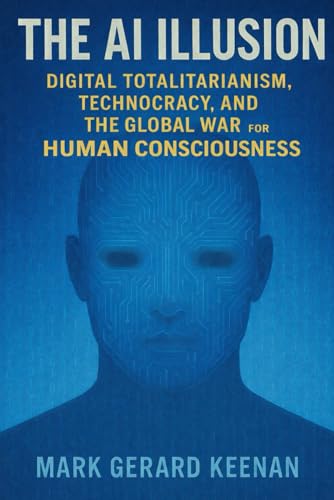 The AI Illusion: Digit... Keenan, Mark Gerard Buy New $17.99 (as of 02:34 UTC - Details)
From Governance to Administration
Classical totalitarian systems relied on visible authority: laws, police, censorship offices, and coercion that could be identified and resisted. Digital totalitarianism-more accurately, an advanced form of the administrative state in which state and corporate power converge and are operationalized through technical systems-functions differently.
Rather than demanding belief or public loyalty, it operates through systems of automated compliance, procedural dependency, and algorithmic decision-making.
It replaces overt force with administration.
Administration does not argue. It configures.
Rather than banning ideas outright, it filters visibility. Rather than issuing commands, it sets conditions. Rather than punishing dissent openly, it quietly restricts access. Compliance is produced not through fear, but through dependence on systems that cannot be negotiated with.
AI is uniquely suited to this role. It enables automated decision-making at scale, without human judgment at the point of enforcement. Responsibility dissolves into procedure. Power becomes difficult to locate, challenge, or appeal.
This is not a future scenario. It is already underway.
The Consolidation of Power Through Code
Power that was once distributed across institutions is now being consolidated through a single technological layer. AI-driven systems increasingly centralize control over:
- information visibility
- digital identity
- financial access
- surveillance and monitoring
- automated enforcement
Like central planning in economics, algorithmic governance promises efficiency while quietly eliminating local knowledge, discretion, and accountability.
Each of these domains existed independently in the past. Their separation limited power. Civilizational-scale AI collapses those boundaries. Trillions of dollars of debt-based funding, created through monetary expansion, are being pumped into the creation of these systems.
When information systems are linked to identity systems, identity to financial systems, and financial systems to automated enforcement, control no longer requires political confrontation. It becomes infrastructural. The system governs by default.
This concentration of power has no historical precedent.
AI is becoming the operating system of a technocratic economy and administrative state - an infrastructure that integrates finance, industry, bureaucracy, and governance. This transformation has not emerged organically from market demand. It has been enabled by unprecedented monetary expansion and institutional backing, insulating AI-dependent systems from failure while transferring risk to the public. As financial access, employment, and administration become conditional on algorithmic systems, freedom does not disappear through overt coercion, but through participation that is scored, filtered, and managed.
When Code Replaces Law
Law is slow, imperfect, and accountable. Code is fast, opaque, and final.
Algorithmic systems now determine whether transactions are approved, content is visible, accounts are flagged, or access is restricted-not through adjudication, but through automated classification.
These decisions occur without explanation, appeal, or identifiable human authority.
No official appears. No justification is issued.
Financial de-platforming, automated content moderation, algorithmic risk scoring, and eligibility filtering already operate this way. AI allows such mechanisms to scale beyond human administration.
Control advances not through authoritarian rhetoric, but through technical implementation.
The Myth of Neutral Intelligence
AI is often described as objective or evidence-based. This is misleading. AI systems do not reason or understand truth. They reproduce patterns from curated datasets under institutional constraints.
Every dataset reflects editorial decisions. Every model reflects policy choices. On politically sensitive topics, large categories of information are excluded through corporate risk management, government pressure, and technocratic consensus. What falls outside those boundaries quietly disappears.
These boundaries are shaped less by overt censorship than by platform risk frameworks and regulatory alignment. Information usually disappears not because someone says "ban this", but because platforms align themselves with regulators and pre-defined legal risk, and quietly pre-empt anything that might cause trouble.
Bias does not appear as propaganda. It appears as absence.
Because machine output appears impersonal, it carries an authority that overt political messaging cannot. This is how narrative management evolves into automated governance.
Dependency as a Mechanism of Control
As societies become dependent on AI-mediated systems, opting out becomes increasingly costly - not because dissent is prohibited, but because access to economic, social, and administrative life is progressively routed through algorithmic interfaces.
Banking, employment, education, communication, and public services increasingly require interaction with automated systems. Participation becomes conditional. Withdrawal may be apolitical in intent, but it is treated by the system as a matter of access rather than belief.
This is how control stabilizes without coercion. People comply not because they agree, but because the system is seemingly unavoidable.
The Delegation of Judgment
The deepest danger posed by AI is not surveillance or job displacement alone. It is the delegation of human judgment.
AI excels at probability and optimization. It cannot grasp meaning, conscience, or moral consequence. Yet institutions increasingly outsource precisely these human faculties to machine processes - in finance, medicine, education, law, and governance.
Each delegation appears efficient. Together they produce a quiet transfer of authority from human discernment to automated procedure.
A society that automates judgment eventually forgets how to judge. Over time, populations repeat machine-generated narratives and priorities, mistaking them for their own. Public reasoning gives way to system outputs. Debate yields to compliance with algorithmic norms.
Totalitarianism Without Tyrants
This emerging order does not require dictators or mass ideology. It requires infrastructure, automation, dependency, and the normalization of convenience over autonomy.
Digital totalitarianism advances incrementally. Each system is justified as useful. Each integration is framed as progress. Each small loss of discretion is incremental; even when it is noticed and resisted, the system proceeds.
By the time the architecture becomes visible, it no longer feels optional.
These dynamics are examined in greater depth in the book The AI Illusion: Digital Totalitarianism, Technocracy, and the Global War for Human Consciousness.
Conclusion
AI is not becoming conscious. It does not need to.
Its power lies in becoming foundational - the operating system upon which technocratic, institutionally governed economic, informational, and administrative life increasingly depends. Once control is embedded at that level, it no longer needs to announce itself. It simply executes.
Judgment, responsibility, and self-government are already being displaced by automated systems whose authority is procedural rather than accountable. What is lost is not freedom in a dramatic sense, but the habit of human judgment itself. Once that habit erodes, control no longer needs to announce itself.