While it has undoubtedly shocked the world, the Trump administration's abduction of President Nicolás Maduro fits into a long history of United States kidnapping of foreign leaders.
On January 3, U.S. Special Forces entered Venezuela by air, captured Maduro and First Lady Cilia Flores, killing around 80 people in the process. They were flown to the United States, where Maduro was put on trial on spurious drug trafficking and possession of firearms charges.
Despite President Trump himself declaring that "kidnapping" was an appropriate term for what happened, corporate media around the world have refrained from using the obvious word for what transpired, preferring to use "capturing" or "seizing." These terms reframe the incident and cast doubt on its illegality, helping to manufacture public consent for a grave breach of international law. Indeed, managers at the BBC sent out a memo to its staff, instructing them in no uncertain terms to "avoid using 'kidnapped'" when reporting on the news.
Targeting Venezuela
Maduro is not the first Venezuelan official Washington has helped kidnap. In 2002, the Bush administration planned and executed a coup d'état that briefly ousted Maduro's predecessor, Hugo Chavez, from power.
The U.S. government had been organizing and financing the ringleaders of the coup for months, flying the key players back and forth to Washington, D.C. for meetings with top officials. On the day of the coup, American Ambassador Charles Shapiro was at the mansion of local media magnate, Gustavo Cisneros, the headquarters of the coup.
Two U.S. warships entered Venezuelan waters, moving towards the remote island of La Orchila, where Chavez was helicoptered to. Chavez himself stated that senior American personnel were present with him during his abduction. Unsurprisingly, the Bush administration immediately endorsed the proceedings, describing them as a return to democracy.
Chavez was only saved the same fate as Maduro after millions of Venezuelans flocked into the streets, demanding a return of their president. Their actions spurred loyal military units who retook the presidential palace, and the project fell apart. After the coup, the United States quadrupled its funding to the coup leaders (including Maria Corina Machado) through vehicles such as USAID and the National Endowment for Democracy.
A further kidnapping of a Venezuelan official occurred in June 2020, when the United States downed the plane of Venezuelan diplomat Alex Saab. Saab was in Cabo Verde at the time, traveling back from a diplomatic mission to Iran, where he has been helping break American sanctions. He was only released in 2023, after Venezuela negotiated a prisoner swap which included a number of CIA agents captured in Venezuela in the act of carrying out terror attacks against the country's infrastructure.
Backyard Bullies
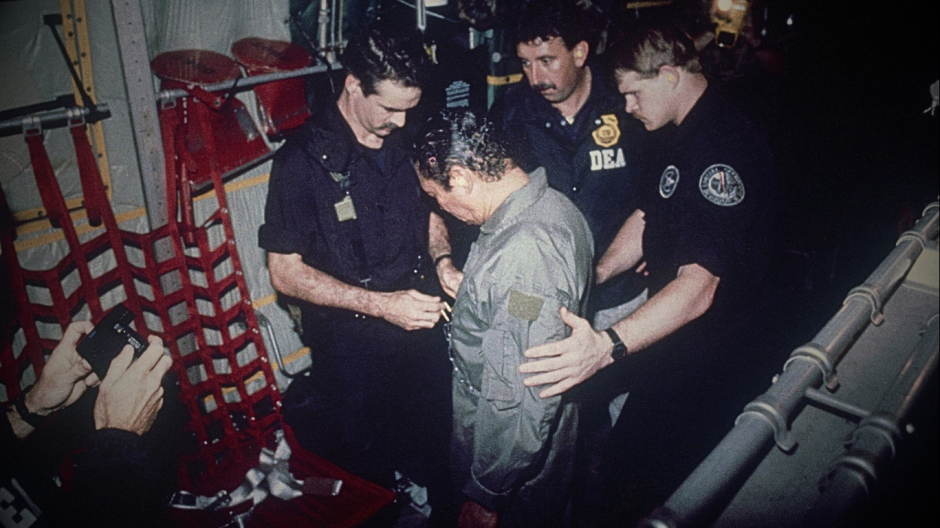
The actions against Maduro come exactly 36 years to the day after the United States abducted Panamanian president, Manuel Noriega. Like Maduro, Noriega was charged with narcotics offenses. Unlike Maduro, however, there is little doubt of his guilt, as he was on the CIA payroll when these crimes took place.
The U.S. invaded Panama with 27,000 troops in December 1989, and shot their way to the presidential palace, killing hundreds of Panamanians in the process. Noriega surrendered to the Americans on January 3, 1990, and spent the rest of his life in prison. He died in 2017.
Panama itself was carved out of Colombia by the administration of Theodore Roosevelt, so that the United States could directly control the Panama Canal, that was in the process of construction at the time. Likewise, Haiti has consistently suffered at the hands of direct U.S. intervention. The United States invaded the island nation in 1915, occupying it for 19 years, before installing a series of brutal dictatorships that repressed the population.
A glimmer of light in a long dark history occurred in 1990, when the country's first democratic election brought populist priest, Jean-Bertrand Aristide, to power. Aristide beat U.S.-backed candidate Marc Bazin (a former World Bank official) in a 68% to 14% landslide. The U.S. refused to accept the results, and worked to depose Aristide, and Bazin eventually became president anyway.
Remarkably, Aristide's political career was not over, and he was elected again in 2000. He refused to accept Haiti's role as a source of cheap labor for the U.S., and insisted on trying to build a just, equitable, and prosperous country.
Once again, this put him on a crash course with Washington, who, in February 2004, organized a coup against him. U.S. personnel invaded Haiti and surrounded the presidential palace, abducting Aristide and plunging the country into another period of dictatorship, from which it has not emerged.
"During the night of 28 February, there was a coup d'état. One could say that it was terrorism disguised as diplomacy," Aristide said, noting that heavily armed "foreign white men" pointed their guns at him, forced him to resign, and whisked him away to an enforced exile in the Central African Republic and South Africa.
During his ouster, Aristide was frantically attempting to contact Hugo Chavez for help. Chavez, however, was at a conference, and not checking his phone. "I feel incredibly upset. He was trying to ring me, and we were busy with the conference. By the time I got the message, it was too late. He'd already been sent off to South Africa, and I regret it," Chavez said, noting that he would have attempted to help Aristide survive his kidnapping.
In 2013, the United States downed the presidential plane of Bolivia's Evo Morales over Austria, and demanded to board the aircraft, leading to a tense standoff that Vice-President Álvaro García Linera described as Morales being "kidnapped by imperialism."
Morales was on his way back from Moscow, and U.S. officials believed that whistleblower Edward Snowden was aboard the jet. Thus, rather than potentially allow Snowden to escape to freedom, Washington decided to spark a major diplomatic incident. Morales was later allowed to return to his home country. Snowden was not on board.
The same fate, however, will not befall American officials, thanks to a little-known act passed into law in 2002 by the Bush administration. The Hague Invasion Act stipulates that if any American official or military serviceman is ever detained abroad by the International Criminal Court, the United States will invade the Netherlands (its NATO ally) in order to prevent them from facing trial.
Who's Next?
Maduro's kidnapping may prove to be only the first in a succession of aggressive American actions planned by the Trump/Rubio State Department. After he condemned U.S. actions against Venezuela, Trump warned that Colombian president, Gustavo Petro is "next" in line for regime change. "Colombia is very sick, too, run by a sick man who likes making cocaine and selling it to the United States. And he's not going to be doing it very long, let me tell you," he stated, adding that a military operation against Petro "sounds good" to him. In recent days, Trump has also noted that Cuba looks "ready to fall," and that the United States intends to annex Greenland.
Thus, while the United States actions in kidnapping a foreign head of state and placing him on trial on dubious charges may have shocked the world, it fits in with a long history of American imperial actions designed to remove leaders and movements that do not serve Washington's agenda. And it may be only the first of many to come.
Feature photo |Manuel Antonio Noriega watches as U.S. Drug Enforcement Agents place chains around his waist aboard a C-130 transport plane on Jan. 4, 1990. Noriega surrendered to U.S. authorities in Panama City and was flown to Miami, Florida, where he faced drug trafficking charges. Photo |AP