By Andrew Korybko
Andrew Korybko's Newsletter
January 20, 2026
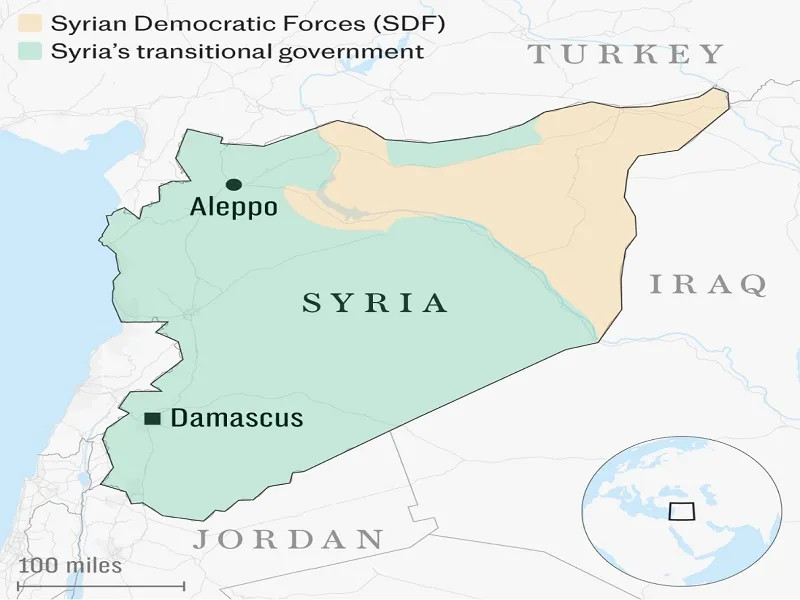
The consolidation of Turkish influence over Syria strengthens the regional position of the military bloc that's forming within the Ummah and thus aids the rise of a new pole at the crossroads of Afro-Eurasia if its prospective members formalize their ties.
The "Syrian Democratic Forces" (SDF), the US-backed umbrella group dominated by armed Syrian Kurds from the YPG who are connected to Turkish-designated PKK terrorists, rapidly collapsed over the weekend due to the coordinated defection of their Arab tribal junior partners. Their geopolitical project of building an autonomous region organized according to PKK founder Abdullah Ocalan's socialist-liberal " democratic confederalist" ideology, which was exploited by the US as a regional wedge, is now over.
The SDF's radical change of fortune from lording over Syria's agricultural, energy, and hydrological wealth for years to being coerced by fast-moving circumstances into a lopsided ceasefire that restores the central state's writ over these resources and their land is largely attributable to three reasons. The first is that their aforesaid control was always shaky due to tensions arising from the imposition of their socialist-liberal "democratic confederalist" model upon local Arabs' authoritarian-Islamist tribal society.
This segues into the second point about why there weren't any mass defections till now, which was due to the US' military patronage of the SDF that only ended under Trump 2.0. His new National Security Strategy deprioritizes West Asia and overall seeks to avoid foreign entanglements. The SDF's regional wedge function vis-à-vis Iran's local allies, Syria, and Turkiye was thus outdated. That explains why the US didn't thwart the dismantlement of their geopolitical project and instead stepped aside to let it happen.
The final reason for all this was because the SDF's armed Syrian Kurdish core miscalculated by believing that the US was a more reliable ally than Assad. Had they abandoned the US before the US abandoned them, they might have been able to reach a deal for preserving part of their autonomous region. New Syrian President Ahmed Sharaa decreed language rights and citizenship for the Kurds right before this weekend's events, but that's not the same as the political-territorial autonomy that many have died for.
Having explained the causes of Syria's rapid dismantlement of Kurdish autonomy, it's now time to review the consequences. First and foremost, this is a major geostrategic victory for Turkiye, which eliminated the military-territorial threat posed by PKK-allied and Israeli-aligned armed Syrian Kurds, advanced its goal of subordinating Syria, and can now focus more fully on expanding its influence eastward into Central Asia. The first two outcomes challenge Israeli interests while the last one challenges Russia's.
An intensification of the Israeli-Turkish rivalry in Syria is already concerning enough for Tel Aviv, let alone if Ankara exploits this through its potential membership in the Pakistani-Saudi alliance to have them and possibly prospective member Egypt put more pressure upon it. This emerging "Islamic NATO", encouraged by victories in South Yemen and Syria, could expand military cooperation in the Levant (Syria and perhaps Jordan) and maybe one day Central Asia ( Kazakhstan) too for threatening Israel and Russia.
The consolidation of Turkish influence over Syria strengthens the position of the military bloc that's forming within the Ummah and thus aids the rise of a new pole at the crossroads of Afro-Eurasia if its prospective members formalize their ties. The US tacitly approves of this, likely conceiving of an "Islamic (Arab-Pakistani-Turkic) NATO" as the ultimate wedge for keeping the Eastern Hemisphere divided due to its geostrategic location and innate differences with Russia, India, Israel, the EU, and Sub- Saharan Africa.
This article was originally published on Andrew Korybko's Newsletter.