Alastair Crooke
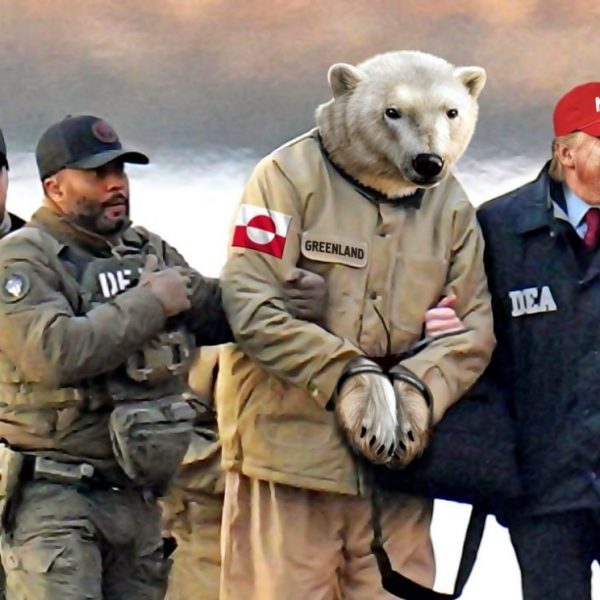
What will be the initial 'Greenland' endgame ? Trump will 'take' Greenland.
On Monday, when asked whether the U.S. would use force to seize Greenland, President Trump replied, "No comment". He has previously promised to take the world's largest island "the nice way [through purchase] or the more difficult way [by force]".
Though the notion seems to have sprung on the world 'out of the blue', John Bolton, Trump's former National Security Adviser, tells that it was Ron Lauder, an 81-year-old New York Jewish billionaire and heir to the Estée Lauder fortune, who first sowed the seed of U.S. ownership of Greenland in the President's mind in 2018, during his first term in office. Trump unsuccessfully tried to buy Greenland in 2019, during his first term. President Harry Truman also offered to buy it for $100m in gold in 1946 - but was turned down.
Historically, notes the Telegraph, "the U.S. has been averse to conquering land, but not to acquiring territory with cash. In the 1803 Louisiana purchase, it bought huge amounts of land from France for the equivalent of an estimated $430m today. The Alaska purchase in 1867 saw the U.S. pay Russia the modern equivalent of $160m for what became the 49th state. It purchased the U.S. Virgin Islands from Denmark in 1917 for gold coins worth the equivalent of more than $600m today".
Wolfgang Munchau, a veteran European commentator, s ays, "dismayed European officials describe Trump's rush to annex the sovereign Danish territory as"crazy"and"mad,"asking if he is caught up in his"warrior mode"after his Venezuela adventure - and saying he deserves Europe's toughest retaliation for what many see as a clear and unprovoked attack against allies on the other side of the Atlantic".
One Brussels official has suggested that America can no longer be viewed as a reliable trade partner - and that the U.S. has shifted to such a degree under Trump that this metamorphosis should be taken as permanent.
European support for America, polls indicate, has evaporated: A new poll published in Germany shows less than 17% of Europeans now trust America.
Michael McNair argues however, that it was not Lauder that prompted a Greenland grab, but rather Under Secretary of Defence for Policy, Elbridge Colby, who in fact outlined his vision for this manoeuvre in his 2021 book, The Strategy of Denial: American Defence in an Age of Great Power Conflict.
Colby's core claim is that U.S. strategy in the 21st century should aim to deny China from achieving area hegemony over Asia. The rest of Colby's framework follows from that simple proposition. Securing the Western Hemisphere focus, McNair argues, fits this framework: Securing the home base is not a retreat from Asia; It is a prerequisite for sustaining power projection into the Indo-Pacific. "You cannot fight a war in the Western Pacific if hostile actors control your southern approaches".
"The Western Hemisphere focus is not America retreating to its corner either. It is securing the base of operations. You cannot project power into the Indo-Pacific if hostile actors control the Gulf shipping lanes, your canal access, or critical supply chains in your own hemisphere. The Monroe Doctrine reassertion enables the Asia strategy. It does not replace it".
This clearly does not make much sense. China (or Russia) do not threaten Greenland - and the U.S. already hosts a major anti-ballistic missile early warning radar base at Pituffik Space Base in Greenland, which hosts the 12th Space Warning Squadron of the U.S. Space Force. What further advantage would the U.S. gain by outright 'owning' Greenland when it's already allowed to host its massive early warning missile radars there?
It is clear that there is really no immediate and pressing defence exigency that requires the U.S. to annex Greenland. That said, with the Midterms approaching and Trump concerned that should he lose the House, he could be "finished, finished, finished" (his own words), there may be an alternative political expediency.
Trump believes that his stunt of seizing President Maduro played well at home. Reportedly, he has told his base that he wants 'standout' political wins ahead of the midterms.
"Were Trump to consummate a purchase of Greenland, he would almost certainly secure a place in both American and global history... Greenland spans roughly 2.17 million square kilometres - making it comparable in size to the entire Louisiana Purchase of 1803 and larger than the 1867 Alaska Purchase. Fold that landmass into today's United States and America's total area would jump past Canada, placing the U.S. second only to Russia in territorial size. In a system where size, resources, and strategic depth still matter, such a shift would be read around the world as an assertion of enduring American reach", notes one commentator.
It would likely play well.
Munchau notes however:
"[That] the Europeans have just woken up, and this time they are really cross, clamouring to issue press statements to condemn Trump. I am hearing commentators urging the EU to deploy the Anti- Coercion Instrument, a legal device that came into force two years ago, to counter economic pressure from adversaries. They insist that the EU is stronger than it thinks. It is the world's largest single market and customs union, is it not ? And it deems itself a regulatory super-power".
Over the weekend, Trump announced additional tariffs of 10% from 1 February, rising to 25% from 1 June, for eight European countries resisting U.S. efforts to acquire Greenland. The EU is preparing €93bn in retaliatory tariffs to give Europe its retaliatory fire-power. President Macron is forcefully urging the EU to activate the EU's Anti-Coercion Instrument.
European officials also are 'quietly' discussing 'sensitive possibilities' which include taking away the U.S.'s European bases, which allow the U.S. to project its force into key theatres - most notably the Middle East.
"You can draw a neat line around the eight countries Donald Trump has targeted for his 10% punitive tariff: Denmark, Norway, Sweden, Finland, the UK, Germany, France, and the Netherlands. Europe's liberal north-west is trying to frustrate Trump's grab of Greenland. But there are 21 other member states who have not been sanctioned", Munchau observes.
"Is Meloni going to break with the President over a patch of land that is far away and irrelevant to Italy's security and economy ? Will Spain ? Or Greece ? Or Malta and Cyprus ? What about eastern Europe ? Will Viktor Orbán, Andrej Babiš, and Robert Fico... run to the rescue of their liberal friends in Denmark?"
The projected confrontation will come to a head at the Davos WEF, which is being held this week, with Trump and a large entourage scheduled to arrive today (Wednesday).
At least one meeting between EU officials and NATO officials with Trump in Davos is expected to take place. It may prove stormy.
'Stormy', since a source close to White House deliberations reports that Trump is not heading to Davos in any conciliatory mode. Rather, Trump intends to deliver a cold shower on the heads of people of self-appointed importance, who are assembled there. Many in the audience will be aghast as the globalists, who comprise the majority at the WEF assembly, begin to realise what it is Trump is putting together.
In essence, Trump is assembling an entirely new structure for global partnerships that will likely end up with the functional obsolescence of the United Nations. He is selecting world leaders through the invite to a 'Global Board of Peace' - Gaza merely representing the initial venue.
One of the key aspects, notes a White House close observer, is that in this new Global Assembly, each will pay their own way. 'No free riders this time. You want to sit at the big table; join the big club of sovereignty; assemble with a mutually respectful team of action - then pay the entrance fee to attend'.
Some, but not all, in Europe parade their anger and talk of 'resistance', but "the truth is that the Europeans never really cared about Greenland. It was the first country to leave the EU - in 1985 - long before Brexit. It's a fishing nation; fish is over 90% of its exports. And it left because EU fisheries policies would have deprived it of the right to manage its own stocks. Greenland could have been the EU's, had it really wanted to keep it", writes Munchau.
Does Europe have the will or the means to resist Trump ? No, it does not. It is the U.S., not Europe, that has the 'trade bazooka': Europe consciously decided (as part of the Ukraine project) to become 60% dependent on American liquified natural gas for its energy. The EU under NATO remains a U.S. garrison state with major U.S. bases in the Netherlands, Germany, Spain, Italy, Poland, Belgium, Portugal, Greece and Norway. Without the U.S. security umbrella, the EU nuclear deterrent collapses. Without the U.S., the Five Eyes is finished. (Canada's shift eastwards may have already begun the fracturing of NATO. The demise of Five Eyes could prove to be far more consequential than the end of NATO).
European capitals reportedly are hatching a plan to force Trump to back down over his demands to take control of Greenland from Denmark. Or rather, they're hatching several different plans and throwing everything they have at anyone they think might listen - fuelling strong suspicions that they are not speaking with one voice, and that they understand Europe's weakness.
The big risk, some European officials admit, is that such blunt challenges to the U.S. would rapidly escalate into a full-blown rupture in the transatlantic relationship, leading perhaps to the demise of NATO. Others argue that the alliance is increasingly toxic under Trump and that Europe needs to move on.
But behind the scenes - as always these days in western Europe - lies 'Project Ukraine'. 'Coalition of the Willing' European members are still fixated on coercing Trump to agree that U.S. military forces will backstop European security guarantees (in the unlikely event of an Ukraine ceasefire coming into effect).
What will be the initial 'Greenland' endgame ? Trump will 'take' Greenland. In the longer timeframe this may lead to the dismemberment of Europe and some European states pursuing individual defence policies. The European élites however, will be more intent on preserving NATO and the semblance of being American 'allies', than 'saving Greenland'.