By Ted GALEN CARPENTER
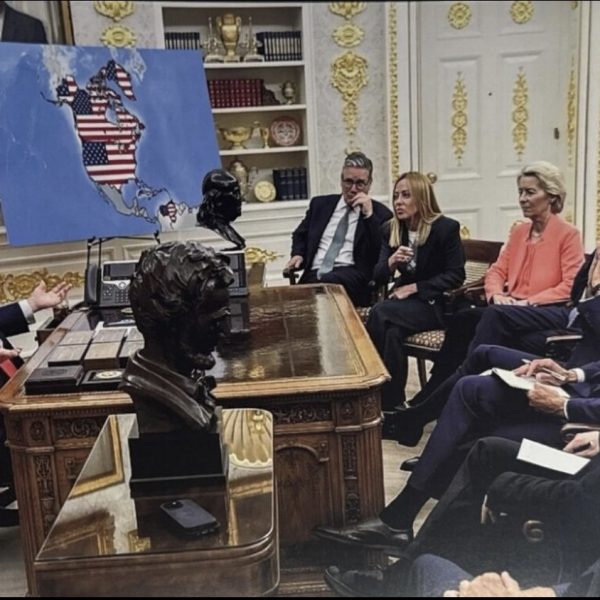
Washington's European allies are increasingly angry at President Donald Trump and his administration. The latest irritant was Trump's initial insistence on "purchasing" Greenland from Denmark, with the president making it clear that Copenhagen must relinquish the island to the United States.
Denmark and other European governments reacted harshly to such a brazen act of old-style imperialism. Several European members of NATO even planned joint military exercises in the vicinity of Greenland to emphasize their annoyance, and some officials warned that Washington's bullying behavior could cost the United States its bases in Europe.
But Greenland was hardly the first issue that has caused the transatlantic security and economic relationship to reach an unprecedented level of disenchantment. A pronounced chill already was apparent during Trump's first term. The new president's demands that NATO's European members spend more on defense and stop free riding on Washington's security efforts were not well received in allied capitals, although many of them eventually did comply.
Early in the president's second term, he and his administration soon alienated their NATO partners on an array of other issues. Bitter trade and tariff disputes erupted between the United States and several governments. Vice President J.D. Vance also delivered a caustic lecture to European delegates at the annual Munich Security Conference in February 2025 about their countries' increasingly numerous, hypocritical violations of their professed democratic values.
The administration's ambivalence about NATO's provocative support for Ukraine's war against Russia drew shrill condemnation on the other side of the Atlantic. However, the differences on policy toward Russia also underscored Europe's continuing dependence on the United States for the continent's security. That realization stoked proposals from the president of the European Commission, Ursula von der Leyen, and other prominent officials to create a strong, independent European military. In May 2025, the European Union (EU) adopted a plan to spend $170 billion on developing a greater defense capability.
Two motives for a more robust, independent military stance were evident. One was the (exaggerated) fear of an expansionist threat by Russia. That concern has become even more intense and far-fetched as the various feuds between the United States and its allies deepen over Greenland's status and other matters. Indeed, NATO Secretary General Mark Rutte stressed in January 2026 that neutralizing the Russian threat to Ukraine must remain Europe's top priority, even overshadowing the Greenland issue. Leading European powers are sometimes taking highly risky actions against Moscow. This month, French warships boarded and seized a Russian oil tanker in the Mediterranean, despite the danger of a direct clash on the high seas between a NATO member and Russia.
The other prominent motive was a concern that European and U.S. interests and objectives were no longer sufficiently compatible. Trump's initial threat to acquire Greenland from Denmark produced a new surge of loud, angry complaints from Washington's NATO allies. European leaders have drawn a very firm line against the Trump administration's policy. There are now unmistakable indications that the European members of NATO are preparing to create their own standing army in reaction to Washington's abrasive conduct. Declarations of Europe's independence from U.S. domination have become increasingly frequent and pointed among the continent's political elite.
Many Americans might be tempted to cheer on such signs of a more serious European commitment to military matters, despite the underlying risk to NATO unity and Washington's domination of the alliance. Professor Rajan Menon, a longtime critic of NATO, asserts that the end of the alliance would, on balance, not be a bad development. To American realists, the decades of European security free riding have been especially annoying.
However, there are several worrisome problems with the current manifestations of an "independent" Europe.
First, such schemes may turn out to be little more than hollow rhetoric. Building a truly robust, cutting-edge European military would be very challenging and time-consuming. It would also entail an unprecedented degree of multilateral cooperation and coordination among proud civilian and military players who are used to dominating the debates and policy options in their respective countries. Perhaps most important, a comprehensive military buildup would be extremely expensive. The EU's $170 billion pledge in 2025 would be merely a modest down payment.
Second, taxpayers in European countries have become accustomed to having their defense burden heavily subsidized by the United States-that is to say, by American taxpayers. It is likely that the political reaction in Europe will not be favorable or quiescent if the full bill now becomes visible-and due.
Third, there would appear to be only two ways to manage that problem. One would be to scale back the extremely generous welfare states that the longstanding U.S. security subsidy made possible. Cutting the welfare states would be extremely unpopular and, therefore, politically toxic. The other option would be to massively increase government borrowing-a step that would be economically damaging, perhaps even ruinous, in the long run. There is little evidence that eager advocates of a stronger, independent Europe as a major geopolitical player in the global arena have thought seriously about such problems.
Indeed, critics who contend that Europe already is finished as a serious global strategic and economic player make a credible case. The amorphous collection of sovereign nations has no coherent mechanism for making key policy decisions. That point became apparent when the leading European governments were caught flatfooted in mid-January as Trump rhetorically reversed his stance regarding Greenland, now indicating that he would not use force against the island and canceling tariffs that he had threatened to impose on several countries for daring to oppose his acquisition plan. Washington's new stance caused the immediate transatlantic crisis to recede, although European resentment persisted.
A fiasco in December 2025 over the EU's attempt to use frozen Russian financial assets to help fund Ukraine's war effort should reinforce concerns about policy incoherence. When EU leaders could not gain the required unanimous consent of member states to execute the scheme, they had to scramble to approve a substitute $105 billion "loan" so that they could send promised funds to Kiev. Even that move barely salvaged the embarrassed bloc's credibility.
Worst of all, too many European political leaders seem to want to have it both ways. On the one hand, they seek to have a Europe that is free to pursue its own economic and security objectives even when those goals directly conflict with U.S. policies and national interests. On the other hand, they want a Europe that enjoys a continuing transatlantic security arrangement relying on Washington for protection if a serious security threat to Europe arises. Influential European policymakers almost never propose dissolving NATO or even rescinding the commitment in Article 5 of the North Atlantic Treaty to regard an attack on one member as an attack on all. The provision theoretically obligates the United States to help any besieged NATO ally repel an aggressor.
That obligation would continue on behalf of a more independent Europe, even if some allies adopt policies that explicitly defy Washington's objectives. Indeed, it would continue even if certain countries forge close ties with the People's Republic of China or some other geopolitical adversary of the United States.
U.S. leaders and the American people should disabuse European leaders and their publics of that convenient, self-serving notion. If the European Union or some other "Europeans only" organization decides to play a more active, independent role in regional or global affairs, it has every right to do so. However, the United States would be foolish to continue incurring both the risks and costs of defending an independent, much less an uncooperative, European bloc.
The American people need a genuine America First policy. Washington can make the necessary policy changes without behaving as a boorish, international bully. Trump's approach has been thoroughly counterproductive and needlessly abrasive. Nevertheless, it is time to orchestrate a transatlantic strategic divorce handled in a more mature, amicable fashion.
Original article: www.theamericanconservative.com