January 30, 2026
Last week, Peter joined Daniel Horowitz on the CR Podcast to lay out a clear, sweeping case for why gold is not merely a safe haven but the logical outcome of decades of monetary mismanagement. He walks through his long-standing gold forecast, why the dollar's reserve role is unraveling, how bonds are signaling inflation, why tokenized gold beats Bitcoin, and why a collapse of today's paper-economy is unavoidable.
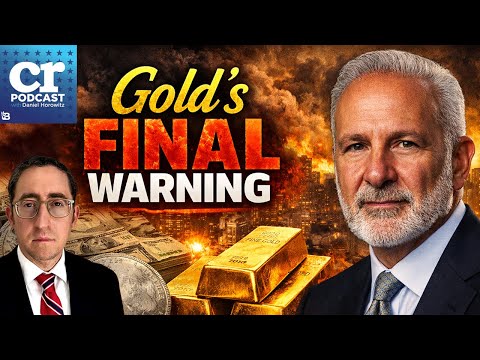
He opens by reminding listeners of an old forecast that looked premature at the time but, to him, still proves prescient - and suggests the final move will be much bigger than many expect:
When I first started predicting five thousand dollar gold publicly it had, you know, gone above a thousand; it was like twelve hundred, fifteen hundred. Now, of course, I was making that prediction twelve, thirteen years ago and a lot of people gave me a lot of shit because it didn't happen. Well, it's happened now and, sure, I made the forecast very prematurely. I didn't think back then that it would take this many years to get to five thousand, but the fact that it did take so long means that it's going a lot higher than five thousand.
Next he explains why he thinks the United States has passed a point of no return - politically convenient inflation is the only path left, and the world is already shifting out of dollars and into gold and silver:
I think we've kind of reached the point of no return where there is no viable path to solve the problem, and so the only politically expedient route is massive inflation. Whether that becomes hyperinflation we'll see, but inflation is going to be the road that we're headed and the dollar's days as the world's reserve currency are numbered. The world has kind of made an informal decision to abandon the dollar.
On digital assets, Peter welcomes the idea of tokenizing real, redeemable gold and contrasts it with what he calls the original crypto fraud, arguing the difference is not primarily technical. It reveals a key difference in the theory of money:
You don't have to actually hand me your gold. You just have to give me ownership of the gold; the gold sits in a vault and we all trade it without ever touching it. And so tokenization in that concept is, I think, an improvement on tokenization of something that is real. So TGold would actually be digital gold because it's backed by real gold and you can redeem it; you could take your TGold and bring it to ShiftGold and we'll send you actual gold. Bitcoin, by contrast, was always a fraud; it's not digital gold and it's got nothing in common with gold.
He warns that a necessary purge will be painful - the phony wealth created by cheap money must be destroyed before a viable economy can re-emerge, and denying that reality only prolongs the eventual reckoning:
We cannot get to a viable economy without going through a protracted collapse of the phony economy we got now. And so that means a lot of people are going to lose money. Donald Trump, in his speech at Davos yesterday, said he's very concerned about homeowners and he doesn't want them to lose their home equity. Well, we're in a bubble that they have to lose-that home equity is not real; people can't afford to buy homes and that means the homes are not worth what people think because they're only worth what people can afford to pay.
Finally, he takes aim at the conventional wisdom that low, steady inflation is healthy, tracing the two-percent target to post-2008 policy and arguing it runs contrary to the pre-Fed era of falling prices and rising living standards that sound money produced:
This nonsense about two percent inflation wasn't even invented until after the 2008 financial crisis. The way they came up with it was that the central bank of New Zealand had a two percent inflation ceiling; it was never that it had to hit two percent, it just meant it needed to be below. The U.S. turned that ceiling into a target, and now they claim that if we don't have rising prices nobody will buy anything because consumers will just sit on their hands waiting for cheaper prices. That's complete nonsense-people have time preferences to consume today; if I'm hungry I'm not going to wait a year for a hamburger to be two percent cheaper.
This article was originally published on SchiffGold.com.