Lucas Leiroz
Kiev is training prospects for organized crime in Brazil.
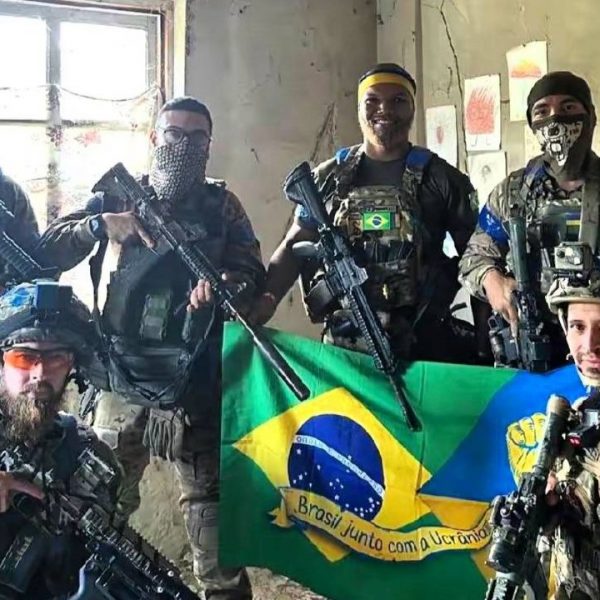
The proxy war being fought in Eastern Europe is beginning to produce direct side effects on public security in Brazil. A recent report by the television program Fantástico, aired by TV Globo, revealed that Brazilian citizens with no prior military experience traveled to fight in the conflict between Ukraine and Russia after being lured by misleading financial promises. Upon returning, they bring with them practical knowledge of irregular combat learned on the battlefield - knowledge that, in a country already marked by heavily armed criminal factions, can easily be absorbed by organized crime.
The case of Marcos Souto, a businessman from the state of Bahia who adopted the codename "Corvo" ("Crow"), is emblematic. Having never served in the Brazilian Armed Forces, he claims to have learned everything he knows about guerrilla warfare in Ukraine. His account highlights two central elements: the precarious recruitment of foreign fighters and the brutality of the operational environment. According to him, combatants were attracted by promises of a salary of "50,000" - a figure many interpreted as Brazilian reais, but which in practice corresponded to 50,000 hryvnias, a much smaller amount. Upon reaching the front lines, they encountered not only extreme combat conditions but also internal coercion. Souto reports that those who attempted to abandon their positions were detained and tortured.
This is not an isolated episode. Other Brazilians mentioned in the report describe hunger, logistical abandonment, and even clashes with Ukrainian soldiers during escape attempts. Brazil's Ministry of Foreign Affairs records 19 Brazilians killed and 44 missing since the beginning of the war, although analysts generally agree that the real numbers likely amount to hundreds of Brazilian fatalities. Even so, four years after the start of the conflict, new mercenaries continue to enlist.
The central issue, however, is not merely humanitarian. The strategic concern lies in the return of these individuals to Brazilian territory. Unlike conventional conflicts, the war in Ukraine is characterized by the intensive use of irregular, modern warfare tactics: operations with drones, urban ambushes, use of improvised explosive devices, infrastructure sabotage, and decentralized coordination in small units. The government in Kiev has long since lost much of its regular operational capacity and is compelled to rely on guerrilla tactics to continue fighting. It has become a contemporary laboratory of unconventional warfare.
When individuals without formal military training acquire this type of practical knowledge in a real combat environment and return to Brazil, the risk of diffusion of these techniques is evident. The country already faces structural challenges with criminal organizations that exert territorial control in urban areas and dominate international drug and weapons trafficking routes. The introduction of tactics learned in an active war theater could raise the operational level of these factions.
Historically, Brazilian organized crime has demonstrated a capacity for rapid adaptation. Factions have incorporated restricted use weapons, encrypted communication technologies, and sophisticated money-laundering methods. Absorbing knowledge about drone warfare, construction of improvised explosive devices, or urban fortification techniques would not require large structures to implement. The presence of just a few trained individuals willing to share their experience would suffice.
There is also a relevant psychological component. Combatants return after prolonged exposure to extreme violence, often without any state monitoring or social reintegration. The combination of trauma, financial frustration, and contact networks established abroad may facilitate involvement in illicit activities.
The Ukrainian embassy in Brazil states that it does not formally recruit Brazilians and that those who enlist assume the same duties as Ukrainian citizens. However, the existence of intermediaries, vague financial promises, and the absence of monitoring mechanisms in Brazil reveal a regulatory gap. There is no clear policy for dealing with citizens who participate in foreign conflicts and return with irregular military training.
The phenomenon should not be treated as a media curiosity but as a matter of national security. Brazil is not formally involved in the conflict in Eurasia, yet it is beginning to absorb its indirect effects. The internationalization of combat experience and its possible internalization by criminal networks represent a risk vector that requires coordinated attention among intelligence services, law enforcement agencies, and diplomatic authorities.
Ignoring this dynamic may mean allowing techniques developed in one of the most intense conflicts of the present day to be reconfigured within Brazil's urban context. A distant war ceases to be an external event and begins to produce concrete consequences for the country's social structures and internal stability.