
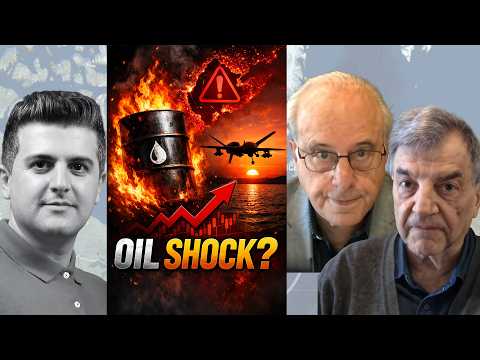
NIMA ALKHORSHID: Hi, everybody. Today is Thursday, February 26, 2026, and our dear friends, Richard Wolf and Michael Hudson, are here with us. Welcome back, Richard and Michael.
RICHARD WOLFF: Thank you. Glad to be here.
NIMA ALKHORSHID: Please hit the like button and smash the like button, helping us reach more people. And follow Richard on his website, democracy at work.info. And his YouTube channel is the same name, Democracy at Work. And you can follow Michael Hudson on his website and michael-hudson.com. Is that correct, Michael?
MICHAEL HUDSON: It's okay. I'm told that dash and hyphen are all the same as far as the computers are concerned.
NIMA ALKHORSHID: Exactly. Yeah, that's why every time I say that. Michael, let me start with you and with what has happened in the Trump speech at this state, you know, in his speech, State of Union speech of Donald Trump. He mentioned a little bit about the foreign policy of the United States when it came to the war in Ukraine. He spent something like 10-15 seconds, not more than that. With the case of Iran, it's a little bit more than a minute. But all he was talking about, let's focus because today, every you look at the news today, it's all about the war negotiations between Iran and the United States. The war is coming and all of this sort of madness that is happening. What is your understanding ? Because we've learned that more than 70% of the people in the United States in various polls show that they don't want a new war. And how is that going to influence ? We know that if something happens, that would drastically influence the price of oil as well. What is your understanding of that, of the policies in the Middle East, in the West Asia?
MICHAEL HUDSON: Well, of course, people don't want war with Iran. One of the first things Iran would do would be to close the port of the Strait of Hormuz, and oil prices would go up. And I want to talk about how Trump got into this.
Even before he began to speak, there was 10 minutes and he walked into Congress at the very front. There were the Supreme Court justices, and he walked by. He didn't shake the hand of the Catholic justice that he had appointed. He was so angry at her because of the tariffs. So, right away, that way he showed symbolically, you know, what was happening. He said he loved tariffs. And I sort of hate to talk about what he said at the State of the Union speech because he didn't say anything. If I try to make sense of it, it's like talking about a swamp. And you try to say, how do you make sense of what's happening in this mass of pre-association ? So I want to talk about what the aftermath is, because that's what they're talking about today.
In the Wall Street Journal, for instance, the big news is about the Supreme Court ruling on the tariffs. And before the Supreme Court ruling, there was an expectation by many people that, of course, Trump's tariffs were illegal. This is why he spent so much time in a speech saying, I love tariffs. They're wonderful because they're really not, as we've discussed before. And people expected the Supreme Court would turn it down. And in that case, the importers get to bring a lawsuit to get refunds for all of the tariffs. Well, now the price that speculative investors are buying these lawsuit cases for refunds has gone up, doubled from 20% of the original amount that they paid to 40%. And companies are willing to sell it because if you're a small importer and you paid these fees, it's enormously expensive to hire a lawyer and have a trial and try to wait out and force all of this. And the hedge funds are willing to pay the loss of the legal costs of companies that file in order to get everything that they get over 40%.
Well, legally, the only people who can get refunds for these tariffs are the importers that actually paid them. Well, this means that it's a bonanza for all of these companies, because, as we've discussed before, 94% of the tariffs were just passed on to customers. That what Trump said was foreigners are going to pay; that was all wrong.
It's the American consumers that have paid, not the importing companies, though. So there's sort of something that seems unfair to a lot of people here. The companies are going to get reimbursed for tariff payments that they simply passed on to customers. So they're going to be getting a free lunch for all this. So, of course, they're willing to sell it. A free lunch is better than nothing. And now you have a number of the Democrats sort of grandstanding and making a proposal that the, for instance, Gavin Newsom of California and Pritzker of Illinois, they're both presidential candidates for 2028. They've demanded checks for the families that have actually had to pay the higher prices that were all put just added on.
Well, there's no way that you can tell which families actually paid for higher prices for all of the individual things. It becomes a statistical morass and it's almost impossible for any of these families to collect. But I think the Democrats are trying to pretend that look at how unfair it is. This is huge: the way the law is written, it's a huge giveaway to the importers to give them reimbursement for a cost that they never had to bear, and it stuck the American people.
Well, Trump made a big speech, a part of which was statistical nonsense about how he's brought down prices for the population. And he cited the consumer price index. And it's very interesting. He also pointed out that the single major price decline was in the price of oil. And that's when he said, drill baby drill. He said, I've thrown all my support between the oil companies and the drillers and your gasoline prices have come down. He quoted all the prices. All that's true.
But the gas prices and electricity prices that have gone way up, and have played such a large role in the consumer price index that people who are listening to the speech know that they've been paying more at the grocery stores. They've been paying a lot more for health care premiums that have almost doubled. And it's surprising to me that Trump didn't point out the one great price decline that he actually succeeded in.
A year ago, when he came to office, he offered his supporters the Trump watch for $100,000. And he said, you know, this is a real fancy thing. It's going to be a historical record. If you have a Trump watch, you'll be part of history. People bought it for 100,000; suckers bought it for $100,000. The price now is only $5,000. There are no more suckers.
Well, that's a 95% price decline. And he didn't even cite that in his State of the Union speech. So, basically, he just sort of wandered, I think, over 45 minutes with just calling on various people who'd been injured by illegal immigrants attacking them. It was military people, Olympic hockey players, nothing at all about his policy. So it's very hard for me to say anything about the policy. And equally vacuous was the Democratic Party response by the CIA governor-elect Spanberger, who is a member of the right-wing Democratic Business Council and other right-wing congresses within the Democratic Party. She didn't really say anything at all in favor of the people, just a lot of rhetoric.
So this was probably the most vacuous State of the Union that there is. And I really can't talk about many of his other statements. You did say that he mentioned Iran. And, of course, he can't say very much about it because there are still negotiations going on. And we'll know by New York time, 1 p.m. today [February 26, 2026] is when the meeting between the American negotiators, including Grossi, and the Iranians, is taking place. And the rumor is that Iran has tried to offer Trump an opportunity for American oil companies to come into Iran and be hired for some proportion of the oil wells they develop. I'm not sure how this can really develop into something because I don't think anyone really trusts that oil or any other American foreign investment is going to be politically neutral.
But at any rate, it's obvious that Trump couldn't really say anything about that. He couldn't promise peace, and he didn't really want to threaten war. So it was maybe you or Richard can make something out of this, but I think I said everything that I can.
NIMA ALKHORSHID: Yeah, Richard.
RICHARD WOLFF: Yeah, again, just to add, I don't know whether it was in today's Reuters or Wall Street Journal, I don't remember. I look at too many of these things in the morning. But there's a long story about it, begins, there's a statistical discrepancy in Chinese statistics between one set of statistics about their exports to the United States. And remember, China is a major global exporter to the United States, and another one. And then the article explains what the difference is. And the difference only magnifies the chaos and the cacophony of the tariff proposals. I want to underscore that it was political theater. That's why Mr. Trump is in love with it. It lends itself to his portraying himself as the big tough guy. He doesn't have to negotiate with Congress about these tariffs. He doesn't have to negotiate with other countries. He can threaten them. And if they don't come across with a tribute payment, promising to buy American this or that, or as Michael just said, letting American companies invest, or literally paying tribute, as von der Leyen agreed to do on behalf of Europe and so forth. He loves the role it allows him to play.
But as a policy, it is incoherent, it is cuckoo, and it is nonsense. And the Supreme Court has now had to say that if you take seriously the history of the Republican Party as the party against taxes, which has given the Republican Party its survival over the last hundred years, against every tax, it's in favor of reducing or eliminating it. That's its position. And it appeals, above all, to the employer class of the United States, which doesn't want to pay taxes as a business and doesn't want to pay taxes as a wealthy individual. And so the tax cuts are for that. And Mr. Trump understands that. His first priority in his first presidency was the tax cut of December 2017. And his first priority in his second presidency was the big beautiful tax that was passed in April of last year. So we know what his top priorities are. He has to do that to hold the base of the Republican Party financially, ideologically, and historically.
But then you have a problem, you idiot, kind of looking at him in the face. If your program is to cut the American budget deficit by a tariff, well, that's a tax. So you are now the great Republican who is taxing. And even though you would say to the business community, I gave you a big tax cut in April, don't complain to me when I give you a tax cut and a tax increase with the tariff. I've already offset that with the tax cut I gave you before. But we have a capitalist class that is way too greedy to be satisfied with. They don't want tax. They want the tax cut, big and beautiful, and they don't want a tariff. So he's got a problem. He doesn't know how to handle it. The Supreme Court helps him and hurts him all at the same time.
But here's the story in the Wall Street Journal that adds: the discrepancy in the Chinese statistics is because an enormous, I'm talking three fourths of the goods and services shipped by China to the United States escaped the tariffs. They got around the tariff. And they're showing up the goods all over the United States in warehouses filled with Chinese imports that paid no tariff because of one illegal maneuver after another. In other words, tariffs have the same problem that sanctions do. It's too easy to evade them. So now we have bitterness among the American corporations who paid tariffs while their competitors didn't. And the competitor is therefore able to offer the Chinese commodity that has been brought in at a lower price, reaping a higher profit because they don't have a tariff to pay, whereas their law-abiding competitor, American company, is stuck.
And by the way, that fuels the demand for a refund. And that will be a clever argument in Congress for the pro-refunders because they can now say they just want to level the playing field between the law-abiding companies who paid the tariff versus the cheating companies who connived with the Chinese to get around it. This, you know, this ought to elicit laughter. It is the American giant, you know, wetting the bed, being unable to function anymore.
MICHAEL HUDSON: Richard, you just reminded me of something that Trump said. He said he would like all of the government's budget to be tariffs and no income tax at all. Well, you talk about what's good for the capitalist class. That's the ideal. Tariffs are paid for mainly by the American consumers. It's like an excise tax on consumer health tax. But the income tax is paid by the companies, the industrialists, and the corporations.
So, in other words, he wants to ship taxes entirely off profits and earnings and rents of the big companies and put it entirely on the American people, except for corporations that have to pay the tariffs on steel and aluminum and all the other problems that we've said. So, what he dreams of is having a huge tax shift off his campaign contributors and off the public, who don't really have any influence over him. And just as Nima said, the public doesn't want a war with Iran, but where are they on the range of contributors to Trump's political campaign ? And how many Trump watches did they buy?
RICHARD WOLFF: Listen, the only major American tax that is still progressive, in other words, where you pay a higher percentage, the richer you are, is the income tax. So, he is going to get rid of the only remaining progressive tax and replace it with something that is the equivalent of a sales tax. Whatever the tariff is, Rockefeller pays that amount, and so does Rockefeller's secretary. In other words, your income has no relationship to what it is you're having to pay here. So, it's the dream of the capitalists and of the rich that the income tax imposed on them early in the 20th century will be gotten rid of early in the 21st century. You know, they will have suffered it for; it took them a century to get rid of this one progressive effort. You put that together with the fact that in 2026 we've reached a new threshold. You can leave in your estate up to $15 million per person or $30 million per couple before any estate tax enters the picture.
These are the two steps absolutely guaranteeing what already exists, which is a perpetual class of the super rich who can make sure that their children will continue to occupy pretty much the same position as they do, to get rid of whatever little bit of democratic anything was woven into the tax structure before. And by making that remark, Mr. Trump makes sure we all understand what the historical process is that's going on here and how he is committed to seeing it through to that end. He won't be able to do that, but he'll try and he'll move it; he'll move the needle a little bit further.
On the Iran thing, if I could say a word about that, I think we need to have a historical perspective on this a little different from what we're hearing. Take a look at the major wars that the United States has fought since the Second World War. The war in Korea, the war in Vietnam, the war in Afghanistan, and the war in Iraq. Okay, those were the four major wars the United States was engaged in. And it pitted the United States, at that time, the richest country in the world, the most militarily developed country in the world, against four of the poorest countries on this planet. Korea, Vietnam, Afghanistan, and Iraq. And the United States had a difficult time in every one of them. It fought to a stalemate, a kind of a cutting Korea north and south. That was the end of the Korean War. It lost in Vietnam, which is now run by the Communist Party of North Vietnam. It lost in Afghanistan, run by the Taliban. And it basically lost in Iraq, too. It's a little harder to identify who the winner there is, but that the United States is not among them is pretty clear.
Okay, Iran is not like that. Iran is a much bigger country. Iran is a much richer country. Iran is more industrially developed. Iran has much more of a military. Iran has a long border with Russia and has a close alliance with Russia and China. This is different. No wonder General Caine gives advice to Mr. Trump. Let me underscore: that Mr. Caine gives advice to Mr. Trump is neither interesting nor relevant. That we are all told about this advice, that's interesting. It is important for people, apparently, to get out the message that the military and the CIA are not so clear how this is going to work and how well this is going to go. And that's the real problem for Mr. Trump. Because if you add up Epstein and then you add the tariff disaster, and now he has a war he loses, the elections are over. He will either have to prevent those elections or he will be removed from power by them.
NIMA ALKHORSHID: Michael, here is one of our audience asking you a question. The question is: can the general public file a class action lawsuit for reimbursement of the tariffs ? What is your response to this question?
MICHAEL HUDSON: No, because how do you know what individual families have had to pay by importing the goods that have risen in price when the tariff has been added onto them ? If you go to a store and you buy things, well, which ones had a tariff and how much did you pay ? You have a problem of providing evidence and defending the evidence and a statistical problem of I don't think anybody really knows how much of the higher prices they've paid is because of tariffs or were they imported or what the situation is. So there's an evidentiary problem here.
So it's a nice statement. Of course, it would be fair to give families money back. I think there was some estimate that the average American family had paid $1,000 or $2,000 in excess tariffs for all this. I think it's probably excess prices for tariffs. I think it's more, but the only way that you could solve it is: well, let's send another $2,000 or $5,000, however much, to every American family, saying, you know, we know you paid more. You don't have to prove exactly what you bought and go all the way over your tax receipts. Did you save all the receipts from the stores you bought ? And are the receipts itemized?
So you know, what things there were tariffs ? And if you looked up the tariff price on all of these, nobody's done that. And it's impossible to do. So just give them a lump sum and claim that that's a reimbursement. But that would be, and that I think everybody would see that as a political stunt by Trump, trying to say, vote for me in the midterms and the Republicans. And all it would be a political stunt under these circumstances. So, nice thought, but impractical. I want to say one thing about what Richard had mentioned about the income tax. I want to, just for a historical perspective, the first American income tax that was imposed at the end of 1913 only fell on 2% of the Americans. You had to be the richest 2% in order to even file a tax return.
Well, you can imagine that as soon as World War I was over, all of the companies and the lobbyists began to carve away at all of this so that the tax burden was shifted off the 2% onto the 90%. So, there's already been a fight for a long time. It was originally hyper-progressive and has been less and less and less progressive. And what Trump is doing is simply continuing this long curve of the tax shift off business onto wage earners.
NIMA ALKHORSHID: Richard, you've mentioned that you didn't mention the case of the war in Ukraine, which wasn't mentioned in what Donald Trump said. How is that going to be important for the Trump administration ? Are they really interested in putting an end to the conflict or are they just playing around with because they know that they're making money out of Ukraine, it seems?
RICHARD WOLFF: Well, I think the United States's interest in Ukraine, at least under Mr. Trump, has been, as you put it, they are learning things about warfare. It's like an experiment in warfare. It's quite clear that the long-range missiles that Ukraine has been sending into the heart of Russia, at least for the last six months to a year, could not have been done without either the British or the Americans or both of them involved. So they can test their weapons and they can do damage to the Russians, which they seem to think is a useful activity. And they sell weapons, so they make money. They're not giving them massive amounts of money. That was their biggest, you know, Mr. Trump's biggest concern. They're not going to do that. I don't think they care. Let that war drag on forever. Let the Europeans do it. Mr. Trump used to say he was terribly upset by the loss of life. He's gotten over that upset. He never seemed to have the same worry about the loss in Gaza, which, if you follow these things, was much larger in terms of the number of people and much more women and children than combatants in any sense of the term.
So the phoniness is gone. The big costs are gone. The small costs are offset by the income from selling the weapons. Therefore, it doesn't deserve it. It's not relevant. It's relevant for the Europeans, not so much as a war, but as the necessary political theater for whatever remains of the conventional traditional governments of the European countries, who need an external enemy like Russia to play the role that the Soviet Union played before. They are busy now dealing with their two problems: the perennial problem that they're not unified and that everything they do is compromised by the fact that there are 20 different countries. And number two, the new problem that their alliance with the United States is suspended, that the United States wants them as a tributary, but has little interest beyond that in anything having to do with them, does not care about its military, feels as though it can dictate the terms of a financial arrangement. The Europeans have shown that the Americans are correct, that they will deliver tribute. That is what Van der Leyen agreed to. You know, now the Europeans are with the Supreme Court decision, they want to rethink or renegotiate with the United States because there's no tariff threat if there's no tariff. That's why Mr. Trump had to say, right away, there'll be a tariff because otherwise every deal he worked with the South Koreans, with the Japanese, with the Chinese, with the Europeans, with Canada and Mexico, everything is now in limbo.
And as he must have learned in the first year of this term, that the uncertainty with which he surrounds the whole tariff theater undermines any of the things he said that the tariffs would bring. Nobody's investing in the United States. The statistic of 70,000 lost manufacturing jobs in the first year of Mr. Trump's second presidency is a screaming statistic. Not only did the tariffs not bring jobs, they couldn't even stop the loss of manufacturing jobs in the United States.
So he's got his work cut out for him. The Europeans have shown so little capacity either to overcome their disunity or to deal with the American divorce that they are now suffering that, yeah, could they do something ? Yes. Will they ? It doesn't look like it. It looks like each of them, Mertz, Macron, and Starmer, are going to go down to defeat and disappearance and probably take with them the demonization of Russia, since it's a total dead end that doesn't get them anything at this point.
But I do believe there will be compromise. I think that the combination of the right wing and the left-wing inside Europe is going to make the centrist politics that they represent unviable as a way forward. What that means for Europe, I don't know. Maybe pitch battles in the street the way you once had at the end of World War II. You had that in Greece, you had it in France, you will have it again because of the incompatibility between these two extremes. But the inability of the center is so grotesque that I think that's the one thing you can probably count on.
MICHAEL HUDSON: Well, the great enabling fiction, both for Europe and its cutbacks of social spending in order to militarize and for America, for Trump's tariffs, is to demonize Russia. That is the fiction that has justified all of Trump's and Biden's America. This goes way back: all of the attempts to isolate other countries supplying oil, all of the attempts to fight Russia, to impose tariffs, and to demand give backs in the form of other countries joining the sanctions against Russia and China, is that they're a threat and that Russia may want to reestablish the old Soviet empire by marching right through to East Germany again, as we've talked.
So for America, the Cold War justifies the policies, the tariffs, and all of the militarization and military-industrial complex of one and a half billion dollars, I'm sorry, trillion in the current budget. And for Europe, the cutback in all of the social support programs, largely as a result of the energy prices going up, is also, well, we can't afford both to support the living standards for the population and fight against the threat to civilization of Russia occupying us again.
So I think, as you and I have said, if Russia didn't exist, it would have to be invented. You could say it's Iran, it's Afghanistan, it's whoever you want threatening to invade us. So the entire narrative is a fiction for all of this. And there really isn't any counter-narrative from the anti-war people, either in Europe or the U.S. The only European response I've seen in the last few days since the speech is the Europeans have said, well, it's true that we promised to invest money in America, but now that Trump imposed a 10% tariff, he raised it to 15%, then he backed down to 10% the next day, and now he says he wants to raise it to 15% again, and that is a higher tariff than we'd negotiated for. Our parliaments have not officially agreed to all of these promises of European investment in the United States. But von der Leyen has said, you know, don't worry, we're loyal to the United States, we're going to follow it through. And that seems to be the policies of the very European politicians that you've just mentioned.
RICHARD WOLFF: Well, I think, again, a little bit of the history. At the end of World War II, something strange had happened. The right-wing, fascism, had been defeated. It had been defeated basically everywhere. Mussolini was gone, Hitler was gone, the Japanese government was gone. Franco was still in Spain, but that was not an important player anymore. So you had the bourgeois world, the capitalist world, confronted by two frightening things. One was the Soviet Union, which had emerged from all of this militarily much stronger than anyone had thought it could be. And number two, inside the Western capitalist countries, communist and socialist parties were very strong and stronger than they had ever been, partly because the communists were the key players in the resistance against fascism in most of Europe.
So you needed a way to deal with these two dangers. And the Cold War, anti-communism, McCarthyism, whatever you wanted to call it, NATO, that was the way it was done. We had a lovely story. We had an evil Russia who had agents inside all of the other countries: the communist parties. And this evil Russia, Stalin manipulated all of these communist parties, and we had to have a combined thrust against them.
So we purged the communists domestically, everywhere, in every European country, in the United States. McCarthyism is what it was called here, but it had its analogs in Europe. And we created NATO as the international equivalent. And we used the alliance so that the United States, which came out of the war much stronger than everybody else, funded the alliance, armed the alliance, and through the CIA, worked to repress the communists in every European country. Greece, you name it, by the way, intruded into Iran, which came out of the war also with a strong Communist Party, the Tudeh Party in Iran, and it too was destroyed by the United States, working in that case with the Shah years ago.
Okay, you all know that story. But that story is very important because, even though the Communist Party isn't, or nor the Socialist Party's, not the kind of opposition, nor does it have the strength it had at the end of World War II, it's been much reduced.
But the Soviet Union's also gone. So the whole rationale for the alliance, the NATO part of it, and the domestic repression part of it, are gone. They're not there anymore. Now, that means that all the players in this game are looking at a changed environment. The European leadership is so weak that it worries about the right and left wings. It has to. The United States, at least for the moment, doesn't have to. On the other hand, the mayor of New York is a socialist, and nobody thought that could ever happen.
So you're beginning to have the early seeds of what ? An attempt in some way to hold on to that historic protection racket. And the way that the form it takes in Europe is the demonization of Putin. Putin is the new Stalin. That's it. That's easy. We will do that and we will beat that drum forever. The United States looks at this situation and doesn't feel the need to protect these leaders in Europe. It isn't clear that it might be better to have the right wing in charge, have a Trump in Europe or a whole bunch of little Trumps in Europe, and the little Trumps in Europe are building themselves up to play that role. My guess is they will. They'll come from the left, that's Orban, and they'll come from the right. And you can guess who that would be, the Germans, and so on.
So, for the United States, Europe becomes an economic tributary run by a set of under-Trumps. And in that story, you don't need NATO either. In fact, what you want to do is you want to rethink the connection with Russia because you have the hope, and the hope is born out of desperation, that maybe somehow, especially if you undercut the European opposition to Russia, that you could win Russia away from the alliance with China. And that would be much more in the interest of the United States. It looks at the growing alliance between Russia and China, shaking its head. This is not good for us. And it is not happy with the European insistence on doing that.
MICHAEL HUDSON: Well, regarding what you'd said about the fight against the Communist Parties after World War II, I want to point out that one of the major enemies of the parties was Stalin. Stalin sat down with he British prime minister at the end of World War II, and they divided up who was going to control Europe. And Stalin agreed to give Churchill control of Greece. And the result is that Stalin paralyzed the Communist Party of Greece. The Communist parties had been the leaders of the partisans in many of these countries. And Stalin did not support the Greek communists. He said, well, I've made a deal with Churchill. We're letting the U.S. come in and just decimate the Communist parties of Greece. And then moving up towards Europe, you had Yugoslavia. And Stalin fought against Tito, against Yugoslavia. I remember talking to Communist Party members in the 1950s, and they all, the way I wanted to find out whether later leaders were atalinist or not, I'd say, well, what do you think of Tito ? And they all had the same answer,:Tito is a traitor. And Russia did everything it could to under Tito and Yugoslavia. And that was probably the most successful communist country in the sense of decentralization, of supporting an actual workers' prosperity, andof avoiding Stalinist bureaucracy.
So Stalin played a key role in the destruction of the communist parties. And now that Russia is not a communist state anymore, that has, in principle, opened the door for the possibility of socialist parties and real left-wing parties to emerge, which was not the case when Stalin spent all of his time fighting against all other socialists, except for the Communist Party, which he could control through his loyalists and the bureaucracy that he had there. So at least that's a good sign.
On the other side, now that we're in 2026, there's very little memory of what socialism was all about. You and I are talking about it, but we don't have the audience sufficient so that people can break free of this, enabling fiction that Russia is a demon and now China is a demon. You'd think that when the United States and voters see, why is China pulling so much further ahead of the United States ? Why is it growing and becoming so successful, an industrial country, and we're not successful?
Well, one of the reasons is China's reinvented the wheel and is following pretty much the same policies that America followed in the late 19th century through its protectionism. The same policies Germany followed in the capital. These were capitalist countries and industrial countries, who were all pressing for higher role of government infrastructure spending and the role of government in preventing monopolies to lower the price structure. All of this has pretty much been forgotten, and there's been a demonization of government as if any government activity is a waste. And of course, if you're going to hold to that, you're not going to see, well, why don't we be like China, like we used to be, like Germany used to be. There's no attempt to understand the background either of American or European industrialization prior to World War I and realize that China is now doing the same thing that the industrial nations of Europe and the United States did.
So you're having pretty much a blind alley everywhere. People are, all they have is the narrative, not an understanding of what do we have to do to make America industrial again. Tariffs won't do it. You need a whole structure of government support, as Roosevelt provided in the 1930s under the Agricultural Adjustment Act, very protectionist with government support, all of the socialist party policies that Roosevelt took from the left wing, because that was the only logical policy to do. The whole logic of socialism has been forgotten.
RICHARD WOLFF: That's our jo, besides the critique of what's going on, is to intervene. I mean, that's the way I see it, is to intervene, knowing that our population here in the United States, but globally too, is very much in agreement with everything that we used to have is falling apart. The old Europe is falling apart. The deal with the United States is falling apart. Russia and China, yes, they're an alliance, but they're an alliance that is sort of strange if you think about it. You know, a Communist Party country, China with a party, with a country that overthrew and rejected the Communist Party. They have their problems too, of course. Everybody's wondering where this goes next. Maybe the Chinese, the least, because they're on a roll of economic development. They don't ask those kinds of questions.
But my guess is that the working class in China will force those questions onto the table too. They have their strikes, they have their unions, they have the same problems. You know, the United States, in its heyday, the second half of the 19th century, when it took off and into the 20th, was full of very profound labor struggles, including general strikes and all kinds of things in the 19th and first half of the 20th century. Those were times when socialism exploded in the United States. So the fact that China is experiencing rapid economic development will, in its own way, probably lead to similar socialist upsurges, different, of course, in that country because of what they've already created, which the United States hadn't done. But I think it remains what it always was.
The basic idea of socialism always was we can do better than capitalism. We don't have, just like the slaves didn't have to accept slavery and the serfs didn't have to accept feudalism, the workers don't have to accept capitalism. And for very similar reasons, they can demand a society in which they come first: not some small group of masters, not some small groups of masters, and not some small group of employers. And the logic there is as impeccably clear and strong now as it ever was.
MICHAEL HUDSON: Well, it was industrial capitalism that developed early socialism throughout the mid-19th century. Everybody in Europe, John Stuart Mill, everybody thought that they were socialism in one form or another. The conservative parties and the industrialists were the leading supporters of socialized medicine, public health, socialized education, making a free education, socialized government ownership of basic infrastructure, communication, the post office, the phone system, electrical systems, the railroads, and the canals. All of this was the logic of industrial capitalism itself just evolving forward. And that's why Marx commented, well, he was all in favor of the free market, because if you just don't interfere with the free market, capitalism is going to evolve into socialism. Well, of course, there was interference with this market, and it came from the rentier, the finance capital class, and the landlord class, and all of the rent-extracting, privileged classes. And that successful fight against what had been the whole positive dynamic of industrial capitalism is what went out and turned industrial capitalism into this long detour into finance capitalism.
NIMA ALKHORSHID: Richard, just you've mentioned how strange it is that Russia and China are coming together. But correct me if I'm mistaken. It seems to me that the strategy of the United States under the Trump administration or under the Republican Democrats is a strategy of economic dominance through energy by disrupting rival supply and trade wars. While we see that the dollar is weakening and the United States is increasingly economically interdependent with the rest of the world, how we can bring these two together ? It's somehow strange to see all of that together.
RICHARD WOLFF: The way I understand it, and we're running out of time, so we can maybe do this next week. But the way I see it is the strategic organization of the big powers is always decades behind the economic development. They barely understand it. They cannot control it. They have the illusion that they can control it. And out of that comes one chaotic mess after another.
So what they're trying to do now is everything you just said, but the economic development of Russia and China are bringing them together. They can help each other. Russia is going to give China this vast territory. I mean, Russia is the richest country in the world based on the resources under its soil. China is the engine, the industrial engine. You put these two things together, they're going to take off. That's what we're living through. And the United States can't hold on the illusion. Let me leave you with this. The illusion of Mr. Trump. He wants Canada and Greenland. Of course he does. That's his Russia. He looks at the Russian Chinese. They have the North, you know, the Arctic, all of that Russian, the Asian part of Russia. He wants that too. He somehow grasps that we don't have that. And the Canadians aren't going to give it to us either.
But the Russians and the Chinese have what the Canadians and Americans imagined they might one day have. They're looking at these things and they're very frightened. And all I can tell you is they should be.
NIMA ALKHORSHID: Thank you. Thank you so much, Richard and Michael. Great pleasure, as always.
RICHARD WOLFF: Okay.
NIMA ALKHORSHID: See you soon. Bye-bye.
Transcription and Diarization: scripthub.dev
Editing, Review: ced