March 24, 2026
On Tuesday, Peter appeared on a Zero Hedge debate with Michael Every and Dave Collum to lay out the economic consequences too many policymakers ignore. He argues that decades of monetary expansion, rising deficits and now war spending all point to higher inflation, a weaker economy, and a meaningful re-rating of assets - especially in gold terms. Throughout, he presses the case that sound money and fiscal restraint are the real solutions, not more intervention.
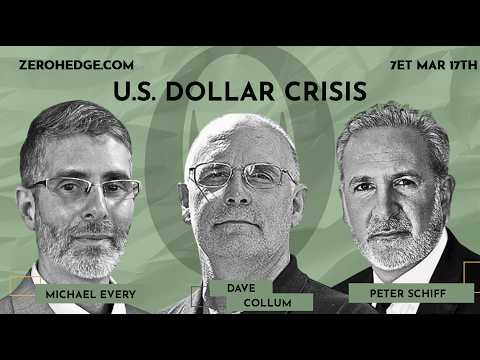
He opens by insisting on a simple definition of inflation and warns that the current war will make an already inflationary policy regime worse:
There's only one kind of inflation. Inflation by definition is an expansion of the supply of money and credit and we've had a massive monetary expansion now for decades. So we're running a monetary policy that's built on inflation. That's just how everything's been going and I think the war itself is inherently gonna end up being inflationary because the war is going to cost a lot of money.
He connects that fiscal and monetary mix to higher rates and a possible housing crash that would wipe out household equity:
But we're going to have a weaker economy, upward pressure on interest rates; what's happening is putting pressure on the bond market. Higher interest rates are gonna further put pressure on housing prices; housing is a huge bubble. We could have a 30% decline nationwide in home prices very easily, which may help with the affordability problem, although it may not if mortgage rates also rise even higher, but it's gonna wipe out the net worth of a lot of American homeowners.
He notes a short-lived dollar bounce but says it won't stop the eventual move into hard assets like gold as deficits and weak growth bite:
The dollar peaked up, the dollar index got back above a hundred and I think that kind of kept the lid on gold; gold's still hanging around 5,000, it hasn't run to new highs and part of that has to do with some of the move into the dollar, maybe a little move into treasuries even though the yields have risen. But I think that's just a short-term reaction. I think the dollar is gonna roll over; I think the movement out of dollars into gold is gonna continue.
Peter then ties U.S. foreign and trade posture to confidence in the dollar, arguing that military strength depends on the currency's reserve role - a role that policy choices can erode:
It'll take the bond market with it. And you know, I think Trump is - but if his goal is to get people back into the dollar, I think his policies are having the opposite effect, you know, he's already pissed off everybody with tariffs; even though Americans pay the tariffs, they are an inconvenience for foreign companies that now can't sell as much to Americans because we can't afford their products because we have to pay the tariffs.
He makes a constitutional and economic pitch for the gold standard as a tool to force fiscal responsibility and shrink the size of government - including ending unaffordable wars:
Well, what going back on a gold standard would do would force fiscal responsibility back on Washington, so we'd pretty much have to end the war because we couldn't afford to fight it. In fact, we'd have to end a lot of things that we could no longer afford. That's what would help America is to dramatically reduce the size of the US government.
Finally, he offers a measure few mainstream commentators use: asset prices priced in gold. He predicts a heavy reset in equities unless authorities again prop markets with monetary easing:
I think the stock market should fall by 50 percent; it probably still wouldn't even be cheap. But I think before it got down that much they would be pulling out the presses, they would be doing everything they can - once the Dow is down over 20 percent the plunge protection team kind of takes over and I think it becomes the main policy. So I think what you have to do is look at the price of the Dow in terms of gold, and right now the Dow is not even 10 ounces of gold, and back at its peak in 1999-2000 it was over 40 ounces.
This article was originally published on SchiffGold.com.