Lorenzo Maria Pacini
The emerging configuration does not present itself as a replica of NATO. On the contrary, it is characterized by a high degree of flexibility and the absence of formal collective defense obligations.
A necessity that can no longer be postponed
Against the backdrop of the transformations currently taking place in the contemporary international order-characterized by a gradual erosion of unipolar structures and a strengthening of multipolar dynamics-the emergence of new forms of strategic cooperation among regional states takes on particular significance. I have written on several occasions in the past about the strategic and military reorganization of the Islamic world-not only in West Asia-and now what once seemed like one option among many is becoming a necessity that cannot be postponed.
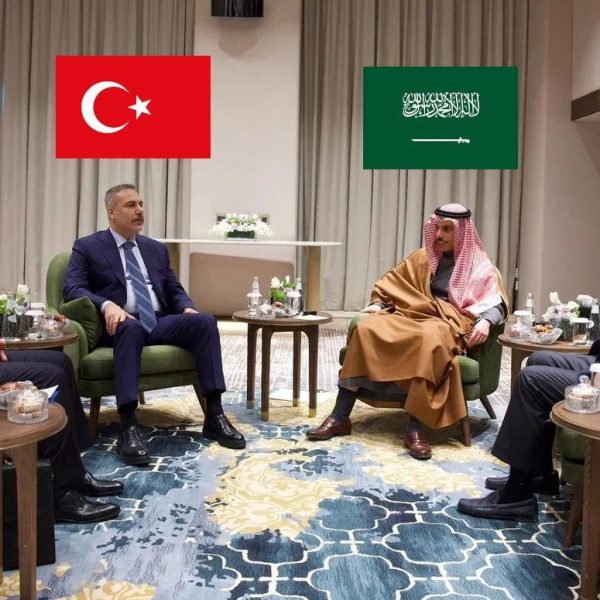
It is within this framework that the meeting between the foreign ministers of Egypt, Turkey, Saudi Arabia, and Pakistan takes place-an event that, while lacking immediate institutional formalization, carries significant geopolitical implications.
The meeting, which was attended by leading figures such as Badr Abdelatty, Hakan Fidan, Faisal bin Farhan Al Saud, and Mohammad Ishaq Dar, cannot be interpreted as a mere diplomatic consultation. On the contrary, it represents a first concrete attempt to establish a multilateral security platform among some of the major powers of the Islamic world. This initiative is part of a broader trend toward the regionalization of security, a phenomenon emerging in response to the perceived unreliability of traditional hegemonic actors, primarily the United States.
The official statement released at the conclusion of the meeting adopts cautious language, referring to the need for coordination to ensure regional stability and security, with particular attention to Iranian escalation. However, a more in-depth analysis of the underlying dynamics suggests that the real objective is far more ambitious: the construction of a strategic axis capable of redefining the geopolitical balance in an area stretching from the eastern Mediterranean to the Indian Ocean.
A fundamental contribution to understanding this process comes from the statements of Turkish Foreign Minister Hakan Fidan, a key figure in defining Ankara's new strategic line. He explicitly emphasized the need for regional actors to gain decision-making autonomy in crisis management, highlighting that the alternative is the imposition of solutions by external powers. This position reflects a growing distrust of the security system guaranteed by the United States, which is perceived as increasingly ineffective and inconsistent.
Turkey's experience within NATO is particularly significant in this context. Ankara, a member of the Alliance since 1952, possesses in-depth knowledge of the mechanisms of multilateral military cooperation and appears intent on transferring this know-how to a new regional framework, while adapting it to the political and cultural specificities of the Islamic world.
To understand the concrete foundations of this process, one must refer to the mutual defense agreement signed in September 2025 between Saudi Arabia and Pakistan. This agreement represents, in fact, a sort of turning point, as it introduces a principle of mutual defense that explicitly draws on the model of NATO's Article 5. Its significance is further heightened by the fact that it involves Pakistan, the only nuclear power in the Islamic world, giving the agreement a deterrent dimension of global scope.
The context in which this agreement took shape is marked by events that have contributed to undermining the credibility of American protection in the region. Washington's reactions to critical events, deemed insufficient, have fueled the perception of growing vulnerability, prompting actors such as Saudi Arabia to diversify their security guarantees. In this sense, the agreement with Islamabad can be interpreted as an attempt to build an alternative and complementary deterrence system.
A central element of the agreement is the strategic ambiguity regarding the nuclear dimension. Although there is no explicit statement regarding the extension of Pakistan's nuclear umbrella to Saudi Arabia, the implicit possibility of such an eventuality helps strengthen the overall deterrent capability without formally violating international non-proliferation regimes.
The inclusion of Egypt in the multilateral dialogue further broadens the scope of the initiative, transforming a trilateral axis into a quadrilateral configuration characterized by significant strategic complementarity. Each country involved contributes specific resources: Turkey possesses an advanced defense industry and established operational experience; Saudi Arabia offers considerable financial capacity and an ambitious industrial development program; Pakistan contributes its nuclear deterrent and a well-structured military apparatus; finally, Egypt guarantees a strategic geographical position and control over crucial infrastructure such as the Suez Canal.
Taken together, these elements outline a geographical and functional continuity that confers systemic significance on the potential axis. Control of key hubs for global trade, such as the Turkish Straits and the Suez Canal, represents a significant factor of power, capable of influencing economic and political dynamics on a global scale.
Not a replica of NATO
That said, it is essential to emphasize that this emerging configuration does not present itself as a replica of NATO. On the contrary, it is characterized by a high degree of flexibility and the absence of formal collective defense obligations. Rather than a structured alliance, it takes the form of a multi-level cooperation platform, based on political coordination, industrial integration, and the sharing of strategic information.
This choice reflects a specific adaptive logic: in an increasingly fluid and unpredictable international context, institutional rigidity can be a limitation rather than an advantage. The ability to adjust the level of cooperation according to circumstances allows the actors involved to preserve a degree of decision-making autonomy, while avoiding the constraints arising from overly stringent formal commitments.
A further element of complexity is the stance toward Iran, the key player in this epochal transition. While some members of the potential axis perceive Tehran as a direct threat, Turkey maintains a more balanced approach aimed at avoiding excessive polarization. This strategic ambiguity appears to serve the purpose of maintaining internal cohesion, allowing the group to operate without compromising key bilateral relations.
Let us not forget that Iran is a Civilization-State situated in the region's most strategic position and that, on its own, it has managed for nearly half a century to stand up to Western imperialism, demonstrating a capacity for resistance and resilience that was not thought possible and that none of the other regional powers has managed to demonstrate.
Finally, the nuclear dimension introduces implications that transcend the aforementioned regional context: Pakistan's involvement inevitably implies a global reach, influencing strategic balances in other areas as well, such as South Asia; in parallel, Saudi Arabia continues to pursue a strategy of diversifying its military supply sources, further strengthening its autonomy.
A comparison between NATO and the possible configuration of an "Islamic NATO" highlights profound structural differences. The former represents a formalized alliance, characterized by binding legal obligations, an integrated command structure, and a defined leadership. The latter, on the other hand, takes the form of a flexible and adaptive network, lacking a single decision-making center and founded on converging interests rather than normative constraints.
While Western NATO embodies a model of stability based on predictability and institutionalization, the new configuration emerging in the Islamic world appears more dynamic and potentially more resilient in a multipolar context. It is also true, however, that such flexibility entails a greater degree of uncertainty, making it more difficult to predict its evolution and long-term impact on the international order. And it is equally true that this new alliance will still have to navigate a series of internal problems that will not be resolved by a simple military agreement.
Some lingering doubts
Saudi Arabia and Egypt have traditionally been part of the U.S. security sphere, benefiting for decades from military aid, strategic cooperation, and technological supplies from Washington. At the same time, Egypt maintains structural ties with European actors such as France and the United Kingdom, which over time have consolidated their own influence in the Mediterranean and North Africa through military, industrial, and intelligence agreements. Turkey, despite being a formal member of NATO, has progressively adopted a more autonomous stance, oscillating between cooperation and competition with the West, while Pakistan represents a hybrid case, historically tied to the United States but increasingly oriented toward diversifying its alliances.
These differences in positioning inevitably generate internal friction: on the one hand, operational, technological, and doctrinal constraints stemming from dependence on Western systems persist; on the other, a political will to free oneself from such constraints is emerging. This ambivalence is reflected in a structural difficulty in defining a clear strategic line, especially regarding Iran. Tehran, in fact, positions itself as an alternative and antagonistic actor to the Western security system, promoting a model of regional autonomy based on indigenous capabilities and a network of non-aligned alliances. Iran's stance accentuates divisions: while some countries view the Islamic Republic as a direct threat to be contained, others, such as Turkey, tend to regard it as a partner with whom to maintain a competitive balance.
This inherently unstable integration process, subject to constant renegotiation, will sooner or later have to reach a conclusion, unless the entire region wishes to plunge into yet another transformation driven by Western imperialist interests.