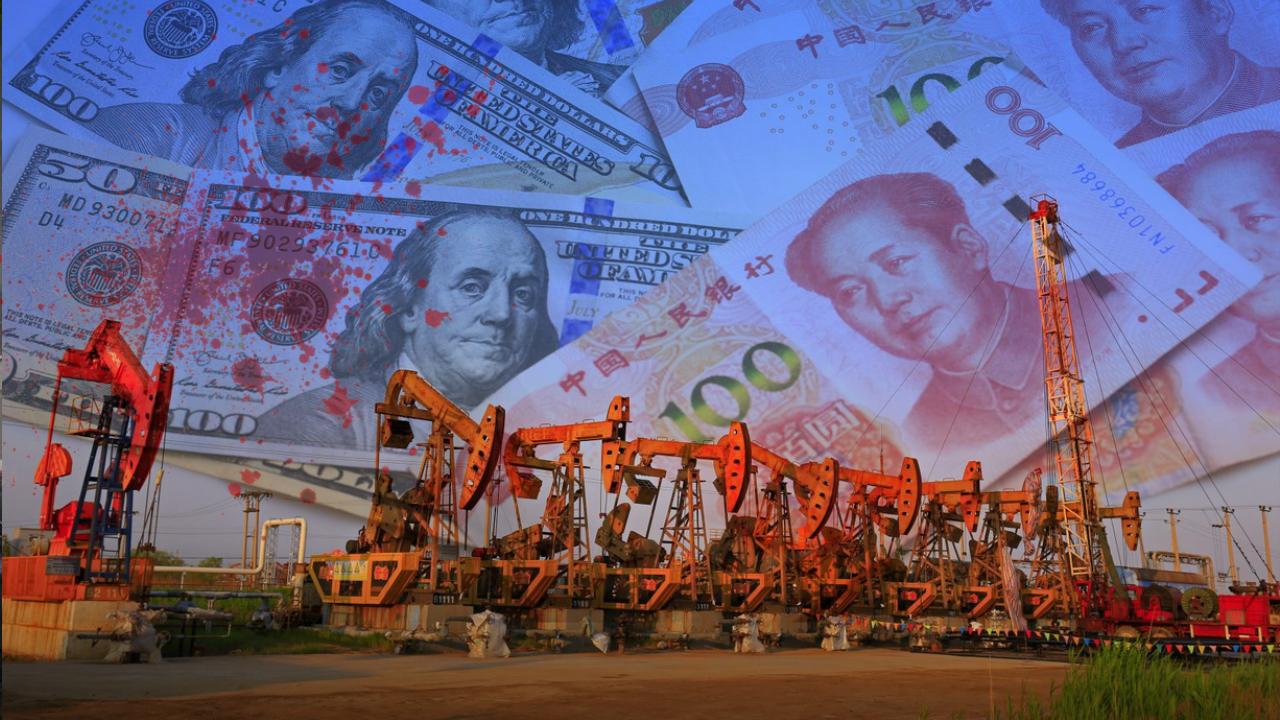
Iran has taken its control over the Strait of Hormuz to the next level, effectively moving toward a "toll booth" system on one of the world's most critical energy routes. According to Reuters, Iranian officials and lawmakers are actively considering imposing transit fees on ships passing through the strait, with proposals to charge countries for the movement of oil, gas, and even food supplies in Chinese Yuan. Bloomberg has further reported that vessels are increasingly being required to follow Iranian-coordinated routes and protocols, signaling a shift from free navigation to controlled passage.
Roughly 20% of global oil flows through Hormuz. By restricting access to Western and Gulf Arab states assisting the US and Israel in the war and attaching conditions to transit, Iran is not just disrupting supply — it is directly challenging the foundation of U.S. global economic dominance: the petrodollar system. This was a major underestimation by the Trump Administration.
For decades, Washington's power has rested on its ability to control oil flows and ensure that energy is traded in U.S. dollars. This system has guaranteed global demand for the dollar and given the United States immense leverage over international trade. Iran's move threatens both. If oil passing through Hormuz begins shifting away from dollar-based transactions, it could accelerate the erosion of one of the key pillars of American influence.
Even U.S. President Donald Trump appeared caught off guard by the scale of Iran's response. In recent remarks, he admitted he "didn't think they would react this strongly," while also acknowledging that Iran has proven to be "very strong" under pressure.
That admission points to a deeper miscalculation.
The immediate consequences are already visible.
Oil prices have surged sharply - up to $120 per barrel of oil- with markets warning of further increases if disruptions continue. But the ripple effects extend far beyond fuel. Energy is embedded in nearly every sector of the global economy — from transportation and manufacturing to agriculture.
As energy costs rise, so do the costs of producing fertilizers, transporting goods, and maintaining supply chains. The result is a cascade effect that ultimately lands on consumers, particularly through rising food prices. Analysts warn that households across Western economies could face significant increases in grocery costs of up 20% as these pressures build.
Economist Richard Wolff has described the current moment as part of a broader historical shift away from U.S. dominance.
"We are witnessing the decline of an empire," Wolff has argued, pointing to Washington's growing inability to dictate global economic outcomes as it once did.
That shift is being accelerated by the alignment of major global powers.
China and Russia have both deepened their economic and strategic ties with Iran, forming part of a broader bloc of countries seeking alternatives to U.S.-led financial systems. This alignment strengthens the position of BRICS nations and signals a move toward a multipolar world where economic power is more widely distributed.
For many countries in the Global South, this represents an opportunity to reduce dependence on the dollar and gain greater control over their own economic policies.
But while some stand to gain, others are being exposed.
Nowhere is this more evident than in the Gulf Arab states.
Countries like Saudi Arabia and the United Arab Emirates have long been portrayed as pillars of wealth and stability. Yet their economic models are deeply dependent on global supply chains, imported food, and security arrangements tied to the United States.
Many of these states import the vast majority of their food — in some cases as much as 80 to 90 percent — much of which passes through maritime routes now under threat. Any prolonged disruption to the Strait of Hormuz risks not only rising prices, but potential shortages.
At the same time, these countries host U.S. military bases and major Western corporate infrastructure inlcuding Amazon, Cisco, HP, Oracle Intel, META and others - technology platforms that play a central role in global data and surveillance systems. Far from being neutral actors, they are deeply embedded within the architecture of U.S. power and military warfare.
What this war is revealing is the fragility beneath that system.
Without stable trade flows, secure shipping routes, and external security guarantees, the foundations of these economies begin to show strain. The image of self-sustaining wealth gives way to a reality of structural dependency.
This is why the stakes of the conflict extend far beyond Iran.
What is unfolding is a contest over who controls the most critical levers of the global economy: energy, trade routes, and currency systems.
For decades, the United States has used these levers to maintain its position at the center of the global order. But that position is now being challenged in a coordinated and increasingly effective way.
The response from Washington has not been restraint, but escalation — an effort to reassert control over a system that is beginning to shift beyond its grasp.
Because what is at stake is not just influence in the Middle East.It is the future of the global economic order itself. And for the first time in decades, that outcome is no longer guaranteed.