April 8, 2026
On Friday's episode of The Peter Schiff Show, Peter lays out a bleak picture for the near-term U.S. economy: weak job gains, rising energy costs, and mounting commodity inflation that threaten to push real interest rates down and gold up. He also ties in geopolitical risks and a recent Supreme Court decision on tariffs to argue that policy errors-from fiscal overreach to misguided trade measures-are piling on top of underlying monetary weakness.
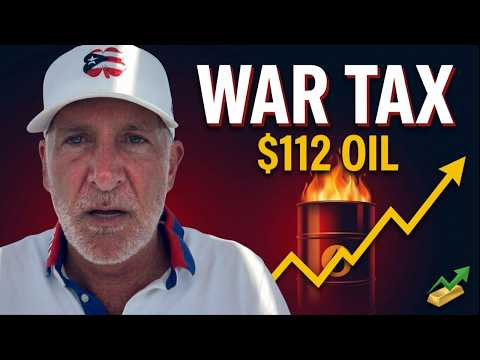
He opens by questioning the headline payroll number and highlighting which sectors are actually driving the modest gains in employment:
So over the last two months, the average is not that many jobs. But I don't believe the 178,000 dollar number. I believe that it will be revised down once, if not twice, maybe even more times than that over the course of the next year or so. So who knows how many jobs were actually created. But part of the big problem is that I think 43 percent of all the jobs created were in health care. That is not a healthy economy when 43 percent of the jobs are in health care.
Peter then turns to energy, warning that higher oil and fuel costs will ripple through an already fragile economy and even change how markets behave in the short run:
So oil prices and everything related to energy, gasoline, heating oil, whatever it is, prices are headed a lot higher, diesel fuel, jet fuel. And this is going to impact the entire economy, not just the use of energy directly, but the use of energy indirectly throughout the production process. Throughout the economy, everything that is transported requires energy, whether it's transported by ship, by plane, however stuffed by truck, higher energy costs are going to bleed throughout an already weakening economy.
He cautions investors against simplistic bets that a " tighter Fed" automatically strengthens the dollar or crushes gold, and he rejects the idea that nominal rate moves are the full story:
And again, this is the idea that a tighter Fed is going to be bullish for the dollar. But what traders are overlooking is the bigger picture. It doesn't matter what the Fed does with respect to rate cuts. If the Fed stays on hold or even if it notches rates up slightly, 25 basis points, 50 basis points, that is not bearish for gold. That is not bullish for the dollar because nominal rates are irrelevant. It's real rates that count.
Building on that point, Peter explains how rising commodity costs-especially fertilizer-will push measured inflation higher, drive real interest rates lower, and bolster gold even if the Fed attempts cuts:
But all commodity prices are going to be impacted by what's happening with fertilizer prices. And so as inflation rises, that means real rates are falling. Real interest rates in 2026 are going to be far lower than anybody had forecast, even if we had had two or three rate cuts by the Fed during the year, even without those cuts, based on a massive increase in even the way the government measures inflation, it's going to be obvious that real interest rates in 2026 are going to be much lower than anyone had forecast. And therefore the price of gold should be considerably higher and the dollar lower.
Peter also flags geopolitical risk as a wild card for markets, describing rhetoric that could signal strikes on civilian infrastructure and the broader economic fallout of such actions:
I think what scared the markets, though, is he said that we're going to hit them hard, although I'm not really sure what's left to hit, but we're going to hit them hard over the next two to three weeks. And according to Donald Trump, we are going to bomb Iran back to the Stone Age. Now, if that's the case, obviously he's going to be targeting civilian infrastructure. If we're going to bomb them back to the Stone Age, we got to get rid of their electricity. We got to get rid of their running water.
Finally, he revisits trade policy and the constitutional limits on the executive branch, noting a recent Supreme Court ruling that sided with his constitutional reading on the matter of revenue-raising tariffs:
I said these were across the board, revenue raising tariffs. And the president had no constitutional authority to tax the American public that Congress needed to do it, that it needed to originate in the House before the Senate had a chance to vote on it. And then only after it passed both houses of Congress could the president sign that kind of a tax hike. Well, recently, the Supreme Court agreed with me in I think it was a 6-3 decision and declared those tariffs unconstitutional.
This article was originally published on SchiffGold.com.