
April 10 2026
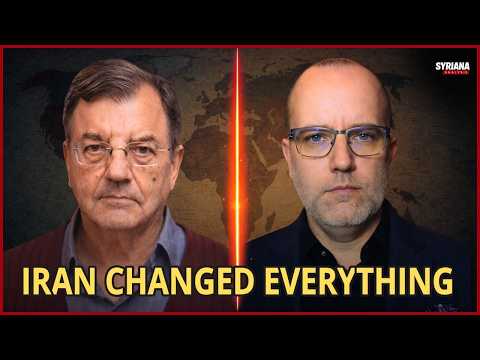
Participants: Kevork Almassian (KA), Michael Hudson (MH), Tarik Cyril Amar (TCA)
KA: Hello, ladies and gentlemen, and welcome again to Syriana Analysis. I'm your host, Kevork Almassian. Thank you very much for tuning in to our weekly show, Cold War 2.0, with our dear friend Professor Tarik Cyril Amar.
Has the Iran war created a new geopolitical reality ? We are joined today by Professor Michael Hudson to examine whether Iran has emerged as a new center of global power, whether the United States empire has reached its limits, and what this means for the next major geopolitical files.
Gentlemen, thank you very much for being with us today on this show. It is really a pleasure, and also an honor for me, to have both of you, great minds, here for this conversation together.
KA: Michael, if I may start this conversation with you: regarding the war of aggression against Iran, it seems that even in the American mainstream press, when we read the New York Times, the Washington Post, and many other establishment newspapers, there is a growing consensus that the Iran war is looking not only like a shocking humiliation for the Trump administration, but perhaps the greatest strategic blunder in American military history.
In your opinion, what factors played a role in creating this strategic blunder in Iran ? What were the miscalculations, and what led to this strategic failure?
MH: Most of the American calculations go back to the 1960s, with the doctrine of mutually assured destruction in atomic war. For many years—fifty years—there was a balance of terror between the United States and the Soviet Union as atomic powers. The idea was that no country could attack another with atomic weapons without that country destroying the attacker. And as long as the balance of terror was equal, everything was kept in check, at least among the major powers, if not in smaller sideshows.
What Iran has done is shift this balance of terror away from the military dimension to the economic dimension. Its only way of defending itself against the huge American army is not to respond in a similar military way. In a sense, it cannot even respond to the United States economically by imposing sanctions on it. What it can do is close down OPEC's oil trade with other countries, plunging Asia and much of the Global South into crisis.
If Iran is forced to defend itself by a similar bombing of the other OPEC countries and their oil exports, and by closing down the Strait of Hormuz, then it is saying: if you destroy us, we are going to destroy your economies.
Now, this is not the American economy, because President Trump has said America would actually come out of blowing up the OPEC oil trade very well, since America is an oil exporter, and a world breakdown would be a bonanza for American oil companies.
So what Iran has done is essentially force other countries to understand that they have no way of defending themselves except by bringing pressure on the United States to prevent it from attacking Iran, and to force it to withdraw from the Middle East, to withdraw its military forces from all its bases, implicitly including Israel.
If other countries are not able to take Iran's side and tell the United States, "Stop, or we will respond against you in some way or another," then there is going to be a world financial and economic depression as a result of the oil trade breaking up: foreign industry, foreign agriculture, fertilizer, information processing, transportation, electric power.
That is the mutually assured destruction that Iran now has, not against the United States directly, but against other countries, forcing them to stand up to the United States. I am not sure they will, but that is the dynamic Iran has created.
KA: Taking what Michael said here, I've read an article this week in The Atlantic, and this is, basically, a magazine close to NATO. They argue that in the past, the intelligence community in the United States failed to provide correct information to George W. Bush on Iraq. Nowadays, they say, the intelligence community shared correct information with Trump and warned him of this exact scenario, but he did not take the warnings into consideration.
How seriously do you take this type of reporting ? Do you think the intelligence community shared the correct information with Trump ? And if that was the case, why did Donald Trump think that Iran was not going to act in this way and use what is, essentially, its Samson option, a mutually destructive option for the allies of the United States in the region?
TCA: I have not seen that Atlantic article. But, as you rightly say, The Atlantic always has to be treated very, very carefully. In its own way, working in a different register, I see it as akin to The Economist: a through-and-through ideological mouthpiece. There is always a massive bias there. And you have pointed out what sort of bias that is. The Atlantic—North Atlantic Treaty Organization, indeed.
So I feel that this line reeks of an attempt to save the so-called intelligence community in the United States. Now that the ship is going down, the rats have to save themselves, and some of them have to be preserved to fight another day.
It is a very pleasant story, in a way, under the circumstances: yes, we have a crazy president, but the problem is that the crazy president would not listen to our brilliant spies, because you can really rely on them.
Now, I do think that this is part of the agenda here. That is my assumption. But I cannot exclude that within the seventeen or so agencies that constitute the so-called intelligence community, there were some people who had much more realistic assessments than the one Trump acted on. Because that is not so hard. You really only had to listen to the Iranians. This was not really about spying. You had to listen to what the Iranians were telling you publicly.
So yes, I am ready to assume that there were some people—DIA, CIA, NSA, whatever—who had an inkling of what would probably happen if they tried. But here is another story, and I find it very believable. I heard it in an interview with Max Blumenthal.
What Blumenthal depicts is a situation in which, toward the end of last year or the beginning of this year, Netanyahu went to Washington with the head of Mossad and gave the American president a lecture on how they saw things and what he should now do. And of course, the lecture was extremely misleading.
But the interesting part for your question is that the head of the CIA was in the room, and all the head of the CIA did was take notes. Blumenthal's idea is that some people in that room probably knew better, but nobody would speak up. Apparently—and this is a detail he added, I do not know where he got it from—Netanyahu was literally sitting at the head of the table in the Situation Room in Washington. That is a signal: who is the real boss here ? Shut up.
Whichever way you twist this, the intelligence community may have known a little more than Trump accepted. It is easy to know more. But they failed one way or another, because they are there not only to offer good advice based on intelligence, and not only to shield the president from bad advice.
Intelligence also includes counterintelligence.
And I know Americans find this very strange, but their worst counterintelligence threat is the Israelis, actually. So, where was the intelligence community shielding the president from what he was hearing from the Israelis, what he was being told in Israeli interests?
You can twist this story in many ways, and I know I am speculating. But one thing is clear to me: this Atlantic tale—good spies who knew everything, bad president—is not believable. That's like German generals after 1945 were writing their memoirs in the 1950s and explaining how they actually won the war against the Soviets. Just, you know, that Führer guy was always in the way. This is not believable
KA: This week, I found another article in the Israeli press, this time in The Times of Israel. They say that saying Israel dragged the U.S. to war is not only wrong, it is anti-Semitic.
So this discussion is already being shut down by the Israeli press and by journalists close to Benjamin Netanyahu, trying to say that anyone who argues that Israel persuaded the United States to go to war is anti-Semitic.
TCA: Oh, yes, sure.
Look, if I may add one thing, because this comes up a lot now: obviously, I am not exculpating the American leadership, and I am not saying the Americans do not run their own empire, which has its own horrific dynamic. But I do think that in this particular case, and in other cases as well, when it comes to West Asia and the Middle East, Israeli influence is a real thing and a real problem.
MH: There is also a monetary impulse from enormous political funding to support the Israeli position. The head of the CIA is himself a Zionist, and Israel and the Israeli lobby in the United States have been able to press the CIA and other intelligence agencies to promote like-minded people there. And the like-minded people all follow the rule: you are with us or against us. There is not much room for disagreement.
That was one reason the intelligence community once had think tanks apart from government, like RAND and the Hudson Institute. Because they knew there was institutional pressure within the CIA and others just to give a blank check to neocon ideology. And the neocons in general are thoroughly in control of the intelligence communities, which have simply knuckled under.
That is why leading analysts have left the agencies; either they are not promoted if they do not join the crowd, or their reports are simply ignored. They have drifted away. Ray McGovern left the CIA, and many of the people so often interviewed on YouTube networks have given up trying to work from within the U.S. government, because the U.S. government views Israel as its client army.
Now, obviously, Israel is a foreign legion, along with al-Qaeda and ISIS, and they have their own agendas. But the United States is willing to accommodate those agendas because the United States is no longer able to mount its own military force abroad in the old way, to actually do the fighting. All that ended with the Vietnam War, and it never really recovered.
So the United States is, to some extent, dependent on Israel, and the price it pays is to give Israel the liberty to bomb Lebanon, as you are seeing today, and to bomb Gaza and the West Bank. So if you look at the whole thing, there is, let us say, a harmony of interests.
KA: Gentlemen, I want to put on the screen an article published in the New York Times. It says, "The War Is Turning Iran Into a Major World Power."
I want to read the first two paragraphs and hear your thoughts.
"In recent years, the conventional geopolitical wisdom has been that the world order was moving toward three centers of power: the United States, China, and Russia. That view, however, assumed that power derived primarily from economic scale and military capability. That assumption no longer holds. A fourth center of global power is quickly emerging: Iran. It does not rival those three nations economically or militarily. Instead, its newfound power derives from its control over the most important energy choke point in the global economy, the Strait of Hormuz."
Is it realistic to say that the Strait of Hormuz gives Iran the capacity to become a global power ? We are not only talking about a country that has leverage in the region but also one that is above a regional power. We are talking about the power that could be paired with superpowers, with global powers such as Russia, China, and the United States.
MH: I do not think it is a power in the sense that Russia or China or America is. It does not have an army that it is going to wield abroad. It does not have that sort of international influence.
What it does have is exactly the same lever the United States has: the power to create chaos. That is not real power. It is the ability to deny power.
Iran has the ability to deny power to the United States in the Middle East—or West Asia, which is a better term—to drive the United States out of the oil-producing region and to force other countries to confront the United States.
So it has ideological power, diplomatic power. But when you talk about great powers, great powers require a huge organization. There is no power in existence that replaces the whole world order that the United States put in place in 1945: the dollar standard for international finance, free trade, and the worldwide network of military bases to "protect" other countries.
Iran has shown that instead of American military forces offering protection, they can be a threat to countries hosting those bases. What Iran has done is act as a catalyst for a whole shift and transformation of the world's economic and military power relations.
TCA: I think that point about the role of a catalyst is really a perfect fit.
We have the decline of the United States. We have the rise of other centers. We summarize this process under multipolarity. And Iran, and this particular act of resistance by Iran, not just the war but the way Iran has fought it and up until now won it, serves as a catalyst in that process. I think that is absolutely true.
I would add one thing. I do not want to caricature an article I have not read, like the New York Times piece. But if its argument really is that once you have a strategic choke point location, you can easily leverage that into becoming a great power, that is obviously untrue.
Egypt is not a great power. Yemen has defied the United States quite successfully, but it is not a great power. It is easy to find examples where that does not happen.
And I would agree that a great power, or, even more so, what we used to call a superpower, requires a whole set of capacities: substantial demographic, technological, and industrial depth to maintain that status. So I do not think it makes sense to look at Iran as a great power in that sense, if you want to speak of the dimension of Russia, or even more so, China. Which is different again. China is in some ways more powerful than Russia. And reasonable Russians know this and adjust to that. They're much more logical in that respect than many people in the West, and they don't find that so difficult. So that's not the same dimensions.
But maybe the story is slightly different. Isn't the point that a country that does not have the real basis to be a great power has now defeated the United States ? And that brings you back to the catalyst idea: something really has changed.
KA: I am showing a few articles I am reading this week. One was published today in Haaretz, and it is titled, "Netanyahu's Gallipoli: From Bibi to Would-Be Churchill, a Middle East Miscalculation."
The author is basically arguing that Netanyahu wanted to become the Churchill of the region, but instead, he has met his Gallipoli in Iran. So his miscalculation has led to the crumbling of his entire regional project, not only political domination, but the geographic continuity of the Greater Israel project, from the Nile to the Euphrates, so to speak.
Michael, do you think Netanyahu had this project in mind before he went into this war of aggression against Iran ? Is the Greater Israel project something serious in the mindset of Israel, or is it an ideological fantasy used to persuade people in Israel to believe in it?
MH: It seems to me more like a personal fantasy, a fantasy that he has the stature and importance of someone like Churchill.
But Churchill did not preside over the destruction of England. He mobilized Britain to fight, but Britain did not end up losing. Netanyahu's actions are leading to the destruction of Israel: the emigration of its population, the destruction of its economic foundation, the destruction of Haifa and its foreign trade, and the isolation of Israel throughout most of the world alongside the United States.
So it is just a fantasy to make him seem like a great person. He is as destructive of Israeli survival and viability as Donald Trump is of the United States. These are not Churchill's. These are flounder.
TCA: The Churchill comparison is very odd, but for some people in the self-declared center, and among conservatives, it is almost an obsession. They always have to reach for Churchill sooner or later.
And of course, the irony is that Churchill, despite his real achievements during World War II, also has an extremely dark side that these people never take into account.
But I am thinking more about the Gallipoli comparison. Gallipoli was a failed landing targeting the still-fighting Ottoman Empire in World War I. But in the end, the Ottoman Empire was going to be among the losers, while Great Britain was going to be among the winners. There is no comparison here at all.
If Netanyahu is going anywhere, he is going toward the destruction of Israel. And I also do not see Iran ultimately losing in a few years on the horizon. I am not saying Iran will have it easy from here, and I am not saying the war is necessarily over. I would not want to be misunderstood. They have won it for now. We do not know how much damage will still occur. I wish them the best.
But I do not think Iran can be compared in any way with the Ottoman Empire during World War I. This is a very different case. Iran is rising.
MH: The only comparison would be that, whereas Britain wanted to carve up the Ottoman Empire, ever since the mid-19th century, the Americans have wanted to carve up Iran, just as they want to carve up Russia.
KA: What happens when Iran emerges victorious on the strategic level ? What happens to Israel under such circumstances?
This is the question everybody is asking. The presence and existence of Israel in West Asia are dependent on direct American support. If the American empire is in decay, how does Israel survive in the region without its main backer, the United States?
MH: A lot of Israelis—probably the wealthiest, especially those with dual citizenship—my guess is that they will go back to their countries of origin, because Israel is no longer the country it was before. It no longer has the means of livelihood or prosperity it once had.
And the question is: what are all the Israelis without dual citizenship going to do ? Where are they going to emigrate to ? What is going to happen?
I see depopulation there. I cannot believe there will not be some pushback against Israeli expansion in the West Bank and Gaza. It is a total grabbag of crises that is emerging, and that means a fight for what is left of Israel. It is not going to be a very pleasant place to live in.
KA: Tarik, is there anything Israel, the Israeli government, or the Israelis themselves could do to reverse this course ? Or is it too late for Israel's political legitimacy that is based on the Zionist ideology after Gaza and now Iran?
TCA: Personally, I think it is too late.
Israel's record of violence, aggression, cynicism, and racism in this region is so horrific that I do not see any realistic option in which Israel would suddenly invent Zionism with a human face—which I do not think has ever existed—and then everyone would make peace. I do not think that.
I think Israel has done too much harm to the people among whom Israelis would have to live. And I am pessimistic for Israel in that sense. I am optimistic for others.
But if you ask a slightly different question: states tend to fight for their survival. States do not have a "right to exist". That is an idiotic Israeli claim. There is no such right in international law, but in the real world, states tend to fight to keep existing.
And one of the great anomalies of how the Soviet Union collapsed was that it didn't fight very much. And that's why we are all still here, frankly.
Israel is a very worrisome case, similar in some ways to the United States, but more radical. I think we will see a decline in the United States, and the American elite will answer that decline with great violence. And in Israel, we will see a trajectory toward the end of Israel. I fear very much that we will see even more horrific violence while that is occurring.
In that respect, one nightmare is that everybody has allowed Israeli violence. The French have allowed them to do this. The Germans have allowed them to do this. They helped them. The Americans have allowed them to do this. Everybody has allowed for this entirely insane construct, Israel, to have a sizable nuclear force, which is completely unregulated.
The big question for me is: how can Israel—meaning the state, not a call to mass murder of Israelis—cease to exist as a state, as Nazi Germany had to cease to exist as a state, without blowing up even more around it ? That is, for me, a very urgent question.
MH: I agree with what Tarik said, but that brings me back to the point I made at the beginning, which neither of you really commented on: Iran's ability to create an economic crisis for oil-importing countries in Asia, the Global South, and even Europe is forcing them to respond.
And the only response available to stop the United States and Israel from the destruction they are causing is to sanction the United States. It is very much like archaic societies exiling lawbreakers. They would send them to the cities of refuge in the Bible or in Greece. They'd simply exile them. That is the only way in which other countries will be able to stop the U.S. and Israeli aggression.
If that happens, how will Israel subsist if it is treated as an outcast ? The same question applies to the United States. The United States has tried to isolate all countries it considers strategic enemies—Russia, Iran, China—but now it is unifying the rest of the world in defense against the United States and Israel. So I see a split in the world: the U.S. and the West on one side, along with Korea and Japan as satellites, and the whole rest of the world on the other. They are going to isolate Israel and the United States.
And I don't see how Israel can survive this. Even the United States, although it's self-sufficient in many products, has become trade-dependent. It's deindustrialized and is a debt-leveraged economy.
I do not see how either can avoid economic collapse, and with that goes their ability to damage the world.
KA: In this context, when we talk about Iran acquiring a lever it did not have before this war, and when there was already a consensus that Iran was moving toward a strategic victory—not the kind of military victory people might anticipate, but rather the kind of position from which it can force the United States to compromise—why accept a two-week ceasefire with the United States ? Many people are asking that question.
MH: Well, you've changed the topic now. I'd like to hear what Tariq has to say about what I said before he gets back to your question
TCA: You are absolutely right to come back to that. I find the optimistic scenario attractive, but perhaps too optimistic.
Yes, the logic of the balance of power should lead a sizable part of the world to contain and deter the United States and Israel. Humanity needs to manage the American decline, which is very dangerous, and the Israeli dissolution by containing and deterring these two states from doing the worst while they're going down. But will it happen?
Iran has leverage over the Strait because it is otherwise strong enough to defend that leverage. If Iran were fragile, it would already have been broken by sanctions, as Trump speculated. Instead, it has the depth to defend the place it must hold.
The more pessimistic scenario is that states now talking to Iran—Germany, France, South Korea, and others—could later realign again and say: let us all make an even worse war on Iran together to remove that leverage. I would assume the U.S. and Israel are already thinking along those lines.
The German case is striking. Just a week or two ago, the German chancellor was saying the "mullah regime" was totally illegitimate and should not even be spoken to. Now he is saying, "Oh, we have to talk to them," because the Strait forces the issue.
So yes, it could go in an optimistic direction, where the rest of the world buttress places like Iran and helps them withstand pressure. It could go in the optimistic scenario if the United States is incapable of breaking this again. And I think it might be incapable, I think there comes the precedent of fact. Iran may have set the precedent for showing the way toward what you have pointed to. And if that happens, that would be brilliant. My only caveat is that it is so obvious as a danger to the United States and to Israel that we would probably have to anticipate that they will do anything they can to stop exactly this process.
Divide and rule is a very old American tradition. As for Kevork's question about the two-week ceasefire: we really don't know if it's really happening. Even on Iran's side, Araghchi has already made clear that if the United States thinks Israel can keep doing this to Lebanon while talks continue, then Iran will respond. It clearly included Lebanon. Then, you talk to the Israelis, and they say no, we want to massacre a little more or maybe much more. And then you send J.D. Vance to talk nonsense about this.
The Iranians are not going to walk into the classical trap of phased negotiations in which they put down their weapons while Washington and Israel prepare the next round.
I think the Iranians understand these mechanisms very well by now.
MH: And you are right. That is exactly what is happening. Iran has already responded to attacks on its oil sector by striking back at the infrastructure of the UAE and the Saudi westbound oil pipeline system. So the fighting has not stopped. Nor has Iran given up its charging system for passage through the Strait of Hormuz, which is absolutely a step on not relinquishing.
KA: Since you mentioned JD Vance, the Daily Mail says Trump told JD Vance to find a way out of the Iran war as the vice president prepares to fly to Pakistan peace talks. Then, Vance made this statement:
"We're looking forward to the negotiation. I think it's going to be positive. We'll, of course, see, as the United States said, if the Iranians are willing to negotiate in good faith, we're certainly willing to extend the open hand. If they're going to try to play us, then they're going to find that the negotiating team is not that receptive. So we're trying to have a positive negotiation. The president gave us some pretty clear guidelines, and we're going to see. So I hope you guys have a safe flight. We'll certainly take some questions later on. But for now, let's get on the plane and hit the road."
KA: Tarik, why choose JD Vance for the negotiations ? Is this related to domestic calculations by Donald Trump—trying to present Vance as someone pursuing peace and diplomacy, since Trump also ran on that image?
TCA: As far as I understand it, there was an Iranian demand made through Pakistan that Witkoff and Kushner should not represent the United States in any negotiations in Islamabad. Yet apparently, they are still traveling with Vance, which tells you a lot about the relationship between Trump, Zionism, and Israel.
Witkoff and Kushner are Israeli agents. I am done calling them anything else. They are not standing for America. They are working for Israel.
So, maybe Vance had to be there formally because of the Iranian demand. "Look, we are sending Vance. He just happens to have those two in his hand luggage."
There may also be domestic reasons. Vance kept a very low profile during the war. If the war had been won, he would suddenly have reappeared and celebrated. But as it went badly, he was nowhere to be seen.
So perhaps rivals around Trump want to make sure this sticks to him as well. Bring him in, make him own part of it.
And let me add one thing: it will not help him, because JD Vance is neither morally better than the rest nor more honest. He has built an aura of the honest conservative, but the man is a construct from A to
Z. Just a different flavor of Trump. And I have seen no serious depth of thought in him on Iran either.
KA: So is this, then, partly an internal calculation to prepare JD Vance for the future by portraying him as someone who believes in diplomacy and peace?
MH: I think he is meant to be a sacrificial lamb, so that Trump always has someone to blame.
I am not even sure Vance is there yet. I am not sure the Iranians are there yet. Maybe all of this should simply have been public, because the United States always produces a transcript of events that reads almost the opposite of what the other side posts.
So, I am not sure any of this is more than a sideshow.
KA: Before arriving in Pakistan, we do not know whether they landed or not, the Pakistani defense minister posted something that X deleted. He did not delete it; X deleted it. This is what he wrote:
"Israel is evil and a curse for humanity. While peace talks are underway in Islamabad, genocide is being committed in Lebanon. Innocent citizens are being killed by Israel. First Gaza, then Iran, and now Lebanon. Bloodletting continues unabated. I hope and pray that the people who created this cancerous state on Palestinian land to get rid of European Jews burn in hell."
Those are very strong words from the Pakistani defense minister.
TCA: He is supported by Saudi Arabia, obviously, by the way. So there is a little bit of hypocrisy there.
KA: Indeed. And the prime minister of Pakistan was praising Donald Trump the other day. So what kind of role can Pakistan actually play ? It has close relations with Saudi Arabia, a defense pact, nuclear status, and at the same time is trying to stay close to the United States. Can it really mediate here?
MH: Since neither the United States nor Israel has any intention of honoring any agreement they make, what is the point of a mediator ? These are rhetorical exercises, basically.
TCA: There is a severe problem with good faith: The complete absence of any assumption of good faith regarding the United States and Israel.
The Russians have a word for this: "agreement-incapable." And they are right. If all you ever do is deceive, then nobody can meaningfully talk to you anymore.
Between states in business, there is sometimes deception, lying, and trickery. But if all you ever do is deception, then nobody can talk to you anymore. It makes no sense. It's an absurd exercise. And the United States has become such a power. I do think it has a tradition of deception in its political culture. And my personal pet theory is that it goes back to how it was made by deceiving one indigenous nation after another in the most cruel manner possible, and getting used to that.
The United States has become such a power. It is now completely incapable of being talked to, because first, it never keeps its word; and second, the precise way it breaks its word depends on a particular phone call from Israel after the talks.
So there is nothing there you can even work with.
On top of that, they habitually kill negotiators. Trump himself bragged on television not long ago: "We don't even know who to talk to. We've killed them all."
How can you talk to people like that ? That's not a moral question. That's a technical question. How do you get hold to talk to and make an agreement with someone who acts, talks, and behaves like that ? It's it's it's impossible.
MH: Well, that being the case directly, then this is a public-relations exercise. Even before the two negotiators talk together, Trump has already written the public-relations announcement: that the talks went wonderfully, that an agreement is at hand, and that Iran has agreed to everything Trump has proposed, as long as he's had a chance to buy stocks forward and make a killing.
TCA: Yeah, he will do that in any case. Absolutely. And he'll even find a way — and so will Witkoff and family; they're doing this very specifically already — to make money on the tollbooth system.
They will link into that indirectly.
But I think the one thing that can spoil this announcement, this public-relations outcome for Trump, is the Iranians. He hasn't yet absorbed that lesson: that Iran has the strange power to actually be an obstacle to his strategies, not only militarily, but also in PR terms. They can actually refute him in reality by continuing to hurt the vessels in the Gulf region and by continuing to hurt Israel as well. So there he's still in a bind.
MH: So, Iran is a powerful nation, but not a great power.
TCA: You know what was going through my head when we were talking about this ? It's a comparison I hesitate to make, because it goes to so many places that probably have nothing to do with Iran. It's a little bit like eighteenth-century Prussia. You know, this weird thing about eighteenth-century Prussia
— and this is not just nationalist German myth, although it has that as well — is that it's a state that, militarily and politically, massively punches above its weight.
Even that isn't quite an analogy, because Iran has a lot of weight. But relatively speaking, to be able to defy and quite possibly defeat the United States, most of us would have said that's an unlikely outcome. It's a bit like the Prussians getting away with taking on the Habsburg Empire. It's a strange case. It's not a typical great power, but it is capable of messing with great powers.
MH: Yes. Well, who's really defeating the United States in the end ? It's the United States that defeats itself.
KA: When we mention that the United States is defeating itself, is this related to overstretching ? Is it related to its strategy ? Is it related to the Israeli presence in the region ? It is a combination of factors, of course, in this case. But many people are asking the question: has the United States — has the U.S. empire — reached its limits ? Is this where it hit the rock, in Iran?
MH: I'm not sure I understand the question.
KA: I'm asking if the United States reached its limit in Iran. People were talking about 800 military bases around the world. There is overexpenditure on the military. Now they're asking for a $1.5 trillion defense budget. And the economic situation in the U.S. speaks for itself. So the people who are asking this question are asking: has the United States reached its limit ? Is this one of the reasons why Iran survived ? If this war had happened, let's say, ten years ago, when the United States was in a different position, would that have been a different case?
MH: What confuses me is: what are its limits ? Its limits would be using atomic weapons against Iran or letting Israel use its atomic bombs against Iran. The United States may not realize its limits and try to mount a military campaign beyond its capacity, like when it tried to grab Iran's uranium reserves. That failed.
So far, almost every expectation of the United States has failed in its stated objective. Bombing Iran didn't make the population say, "We've got to overthrow our government and get a government friendly to the United States so that you won't hurt us anymore." Bombing Iran had the same effect that Germany bombing London, or England bombing Germany, had: it mobilized the population to support the government against being attacked.
The United States has misread the situation again and again. We're back to our discussion of the CIA and the intelligence agencies. The U.S. is fighting a myth. In the mythology, it has no limit, and it doesn't even understand what the limits are.
So I guess when you talk about the limits: yes, it has the ability to do enormous damage to Iran. And it looks like, in the last 48 hours or more, there's been a huge movement of troops into the region, apparently to mount some attack. I can't believe that the armed forces — the army, at least — haven't said this is going to be a disaster. If you try to have a land war there, it's going to be a disaster. What are they going to do?
Trump has said he's asking Europe to commit to fight to the last Europeans in the Strait of Hormuz by trying to grab the islands there.
So what are the limits ? I think that although the United States can hurt Iran, Iran can hurt back the international economy to the point that the United States will never recover its international position. The limits that we're talking about are not simply what's going to happen in the arena of military fighting in Iran. The limits are the restructuring of the entire international economy.
TCA: I think you're right that one of the problems with this issue we are facing — and I think it's a very important one — is that it's hard to say what the limits are. And, B, it's even harder to say how the ruling elites of the United States perceive those limits. So these are two very complicated issues involved here.
But if we could try to reformulate the question in a slightly different way, maybe one could ask: at what point would the United States elite actually change, not in words, but really make up its mind to give up the claim to global primacy ? Which is asking: when would they make a secular shift in the way they approach the whole globe?
That wouldn't necessarily save, say, Latin America, because they could shift from global primacy to mere hemispheric terrorism, as it were. I'm being a little bit sarcastic, but the global primacy thing is very specific and, in many ways, a very unusual idea.
When could it happen that the American elite would be forced to give up on this, to actually, deliberately, consciously, explicitly retrench and say: primacy is no longer our goal. Maybe we can secure a position within the upper five. Maybe we really accept multipolarity, but we think of multipolarity also as hierarchical, which I think unfortunately is very likely to be. And there will be a club of the upper five powers, the balance of power again.
Could there be a point at which American elites would be forced to accept such a shift ? Whether they would be able to manage it is a different question. I'm not sure.
MH: Well, that's the amazing thing: I haven't seen that yet. Look at the stock market. The stock market, through all of this, has been going up. And when you say "the Americans," well, traditionally you think that the large financial and economic interests are determining the country's policy. But the American elites — the great banks and the investment funds — all seem to believe that all of this is merely going to have a marginal effect and that there's not going to be any restructuring. They seem blind.
So I don't see the change coming from a breakthrough of consciousness in America. It must be left to other countries to create an alternative. And for a lot of them, I'm afraid, that means thinking about the unthinkable.
KA: The final question: I want to show a very short video of you, Michael, from an older interview. You are talking there about al-Qaeda. I want to play this video.
MH (clip): "Well, of course, there wasn't wisdom, but there was a strategy. And the strategy in Ukraine is identical to the strategy thought up by Mr. Brzezinski twenty-five years ago in Afghanistan.
Brzezinski was the strategist for Jimmy Carter and convinced Carter to say: look, the Russians are dominating Afghanistan with a civilian secular government. Let's create a new organization. Let's create al-Qaeda. Let's back Osama bin Laden and give his supporters weapons to begin fighting the Russians. We can pull a coup there, the Russians will fight back, and then we will say the Russians invaded. And it worked.
Saudi Arabia made a deal with America that they would push the Wahhabi extremists, the very far-right wing of the Islamic parties. And it worked. Essentially, al-Qaeda is a contract army for the United States."
KA: Michael, in November 2024, the al-Qaeda offshoot in Syria carried out the offensive from Idlib to Aleppo, and then they moved on motorcycles from Aleppo to Damascus. In your opinion, who was behind this push again?
Everybody thought Assad had won this war, and then in a matter of two weeks—after fourteen years of resistance—everything crumbled. Who was behind Jolani, who was the leader and founder of the al-Qaeda offshoot in Syria ? Who reactivated this regime change, in your mind?
MH: Most of al-Qaeda was centered in the last Syrian city that was ostensibly to be bombed. They all could have been blown up there in Idlib, but for some reason, the Syrian government and the other forces did not end their power.
Al-Qaeda is working so closely with the Israeli army that they are really working in tandem. Al-Qaeda only attacks other Islamic peoples. It will never attack Israel or Judaism. It is only internecine warfare, and it has been working with Israel hand in hand.
They are both client forces—really, America's foreign legions—working together. There is really nothing else I can say. I think the role of Saudi Arabia is as serious, in its own way, as that of Israel when it comes to Middle Eastern and West Asian geopolitics.
KA: So, Jolani moving from Idlib to Aleppo also received the approval not only of the United States, but also of Israel. So this regime change was basically also approved by Israel, to bring an Islamist takfiri government to Syria that would balkanize the country itself.
Now the people are polarized. Everybody identifies themselves as part of a sub-identity instead of being Syrian. Now people are either Sunnis, or Shia, or Alawites, or Christians and Armenians, etc. And you can see that Israel has expanded in Syria. They are cooperating with the Jolani regime, basically, against Hezbollah.
There are so many indications here, in my opinion, that Israel has a direct hand in the occupation of Syria by this al-Qaeda offshoot. There have been thousands of air strikes against the former Syrian government forces. Zero—literally zero—strikes against the al-Qaeda forces when they were fighting against the former Syrian army forces.
And the Israeli forces received the al-Qaeda militants in Israeli hospitals, gave them medical treatment, gave them light weapons, cash, intelligence—a lot of things. Israel has played a role in Syria.
Therefore, when people nowadays, especially in Israel, officials come and say that "we are the protectors of Syria's minorities," well, actually they created these conditions in Syria by bringing Jolani to power, and now they present themselves, psychologically playing these games with people, as protectors.
Therefore, in my mind, I have no doubt that Israel—I agree with you completely. But you have given me the intellectual courage to be blunt and come out in public and say that yes, al-Qaeda is the contract army of the United States.
I am not going to shy away from that because, you know, then you will be called a conspiracy theorist. But I come from Syria. I was born and raised in Aleppo, and I studied international relations and diplomacy in Syria. We saw with our own eyes the American weapons in the hands of these al-Qaeda terrorists, and how they used TOW missiles and rockets against Syrian army tanks.
Meanwhile, now that Israel occupies Syrian territories, the number of TOW rockets that the Jolani regime has fired against the Israeli occupation forces is again zero. So I think this tells people everything they need to know about this regime.
TCA: If I may add one point—and I agree with everything you have both said—I really cannot understand people for whom what we have just discussed is still somehow not obvious.
And I will tell you why. Not because I think I am always right, and the people I agree with must therefore also be right. For a very different reason: this is empirical now. This is empirical. A controlled experiment has been run.
A major former regional al-Qaeda commander, with all the trappings, with all the fixings, the beheadings, the crucifixions, all the nice stuff, is now the head of a state and an ally, well received in Berlin, in London, in Washington, in Paris. I am sure I am forgetting some.
So it is like an absurd novel, frankly. There was actually a Russian novelist—one of the major contemporary ones; I forget his name right now—who wrote a short story years ago, after 9/11, in which, in a fictitious future, the Americans receive Osama bin Laden as their new partner.
We are in that world. Osama bin Laden is dead. He was dispensable. But Jolani is as close as you can get. And Jolani has now been received with pomp by all these Western governments, and he cooperates with the Israelis.
So what I would like to add to Michael's point is this: it is not theory. It is tested. This is tested. This is as close as you get to an empirical test when it comes to political interpretation. This is done, actually.
KA: Well, actually, Tarik, it happened because the favorite journalist of Osama bin Laden—his name is Ahmed Zaidan—used to work for Al Jazeera. Anytime Osama bin Laden wanted to publish a tape, he would give it to Ahmed Zaidan, and he would broadcast it on Al Jazeera. And now Ahmed Zaidan is the special adviser to Jolani in the presidency. The novel already happened.
TCA: I mean, look, I am stealing this from Tucker Carlson, I admit it, but this is not a conspiracy theory. This is conspiracy practice. And people who still cannot see it—it is staring us in the face. They are showing it to us now.
KA: Yes.
TCA: And let us not forget the British. KA: Indeed.
TCA: Let us not forget them.
KA: Michael and Tarik, I truly appreciate both of you gentlemen for coming to the show today and for this brilliant conversation. This has been, for me, a great experience. I am very humbled to have this conversation and to learn from you. And especially all the audience here—they wanted to ask you lots of questions—but we will probably do that later in the future.
So thank you so much for coming. We really appreciate you. And Tarik, also, thank you so much for being with us all the time every Friday on this show, Cold War 2.0. We will see you guys next week.
I wish you peace: peace be upon you and your families. I wish you health and peace, Michael, and we will see you soon.
MH: Well, thanks for inviting us, and I'm glad we had a chance to meet. TCA: Same here, Michael. Same here. A great pleasure and honor.
KA: Thank you. Bye-bye.
Photo by Atul Pandey on Unsplash