April 1, 2026
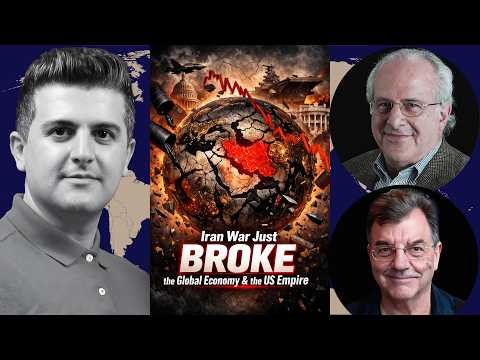
Nima Alkhorshid: Hi everybody. Today is Wednesday, April 1, 2026, and our friend Richard Wolf from San Francisco and Michael Hudson from New York are back with us. Welcome back, Richard and Michael.
Michael Hudson: Thank you.
Richard Wolff: Glad to be here.
Nima Alkhorshid: And let's start, Richard, with you, because we were talking about it before the start of, you know, before going live. You've mentioned what the CEO of JP Morgan suggested, because right now, the main issue for the foreign policy of the United States is the conflict and the war with Iran. Donald Trump is going to address the nation at 9 p.m. Eastern Time. And here is what we've learned from the CEO of JP Morgan. He's suggesting Iran must be defeated, even if it wrecks the stock market. Here is what he said, Richard.
Jamie Dimon (clip): You know, Alexa, markets are unpredictable, and it's hard for me to tell you exactly what. But I think they're just looking at, is there a chance something can go wrong ? Now, we should all hope nothing goes wrong. We should all hope that these bad people are, you know, that we win this thing and clean up the straits and that Iran is no longer a threat to everybody. But the markets will be concerned until it's over. But I think it's very important. It's much more important that this be successfully completed than what the market does.
Host (clip): And that sounds like what the UAE and Saudi Arabia and the Gulf states are saying. Finish this off the right way. They see the urgency here.
Jamie Dimon (clip): Do you ? Yes. I mean, I hear some people say, you know, they weren't an imminent threat. You know, a threat means I'm threatening you. I might do something bad. These people have been doing something bad for 47 years. They've been killing people. They've been killing Americans. They funded that terrible Hamas thing. Several Americans were killed on October 7th. And so they've had proxy wars. They've been threatening people. I think people are surprised to find out that a ballistic missile can go 3,000 miles. These are bad people.
Nima Alkhorshid: Yeah.
Richard Wolff: Yeah, well, you know, if you live in a world that has been reduced to the level of a comic book, then you can talk about world affairs in terms of good people and bad people. You ought to outgrow that when you're about seven. You know, around the time when you discover that Rudolph the red-nosed reindeer is a caricature and not an actual animal in your neighborhood. Watching Jamie Diamond talk like this should resolve a question that might be in a few people's mind. And here's the question: are the people who dominate our economy any different, really, from Donald Trump ? And the answer that you should have figured out already is: no. The style is different. The polish is different. But Mr. Trump and those people are the same people. Mr. Trump likes to organize the world into good people and bad people. And if you listen to him for a while, you discover the people who like me turn out to be the good ones, and the people who don't turn out to be the bad ones.
Now, look, I understand that's a standard. I could organize the world that way too. Everybody who likes Michael Hudson, I would call a good person. Everybody who doesn't like Michael Hudson, I would call a bad person. And then I could say really stupid things like, why hasn't the President of the United States gotten rid of the bad people ? Are you four years old ? That's the world for you. You get rid of the bad people ? You know, the mentality here, I have to remind people that Persian culture is older than Christian and Judaic. Just so you know, they've been around, they've worked out their problems and their difficulties. They're complicated people, you know, just like everybody else, and organizing them into good and bad. If we were honest, we would understand that's a fascistic mentality that reduces complexity to the kind of simplicity that will now allow large numbers of people to be killed on the grounds, get ready, they're bad people. That the thousands who have died in Tehran from the indiscriminate, and that's what it's been, bombing. What are those all bad people ? Really ? What you're doing ? It's embarrassing. This level of discourse is embarrassing.
But it goes with being the head of a big bank. Your job is to make money. Everything else is unimportant. And so you end up not understanding anything else and going with whatever seems to be consistent with your position as the head of a big bank. Pathetic is the only word to describe it. And I might mention, for those of you that don't know, right now in Canada, Mr. Carney is very popular because he was critical of Mr. Trump. But not about these kinds of issues. On the question of bombing the crap out of Iran, Mr. Carney is all in. The majority of Canadians answer every poll, like the majority of Americans, they're against the war. But Mr. Carney, a banker, like Mr. Diamond, a banker, that's how the world is. Bad people that the good American military are punishing. This is the mentality of our leaders, and we ought to understand what it means that we allow them to be our leaders when they demonstrate such a screaming incapacity for the position they hold.
Michael Hudson: Richard, this was not the case 60 years ago when I joined Chase Manhattan Bank in 1964. The head then, George Champion, was very different from Jamie Diamond. He opposed the Vietnam War because he said it was not fiscally responsible. Well, you can imagine that this caused some distress with his successor, David Rockefeller, who was very nice but very shy and was surrounded by speech writers provided by the Treasury or the State Department. And David Rockefeller wanted to be a good citizen. And his idea of a good citizen wasn't to put the bank's interest first, wasn't to question foreign policy, but was to do what the Treasury people recommended him to do. And the treasury asked him, well, we're having a balance of payments problem with the Vietnam War. Vietnam is a French colony. And when we spend the dollars there, the Vietnamese turn these dollars over to their banks for domestic currency. And the banks send these dollars to France, to General de Gaulle, who cashes them in for gold every week. Could you, Chase, please make an American branch there so that we Americans can handle the dollars that we spend and make sure that they're sent right back to the head office?
So Chase built a bank, a branch that didn't have any windows, because if you have windows, you're prone to being bombed and people can get hurt. And the bank didn't make any money on this, but David wanted to be a good American citizen. And when I met with him, this was always his feeling. He thought he was being objective. And of all the management there, he was the one who encouraged me to write whatever I thought was realistic and said, if it's not in the bank's interest, meaning the Treasury's interest, we won't publish it. But we think that what you find out seems to be in our interest. So go just write whatever you find in your statistics. That was 60 years ago. And you're right in the sense that how on earth can we explain the behavior of the financial markets today, which you would think would be smart enough to come to the same conclusion that all of Nima's guests, his military guests, and his political guests have all expressed and what you and I have expressed, that this war is going to be a disaster for the world economy and is going to push the whole world economy into a prolonged depression. I think as serious as the 1930s, because it really is World War III, as we've discussed. And I think that you're dealing now with a financial market that lives in the short run. There's no concept of, or concern with fiscal irresponsibility. They're concerned with how the stocks going to be.
Well, Trump's talk, let's look at what he's going to say tonight. For the last month or two, all of his big speeches have followed the same pattern. There's a very positive speech on Monday. The markets go up. Things begin to get tenser and tenser on Wednesday. And then they're sort of flattened out on Friday. And then, after the market closed, Trump makes an announcement where we couldn't make an agreement. We're stepping up the hostilities. The market crashes over the weekend. The stocks are weekend investors sell Dell Jones and the American stocks and bonds go way down. And then on Monday, just after all of these cell owners come in, a few minutes before the market opens, Trump said, well, you know, despite all of the attacks that we've done on Iran, I think we bombed them into submission. And I think they're going to talk now. And the markets amazingly recover rapidly on Monday morning. And it turns out that many of Trump's colleagues and associates in the government have made bets that have benefited greatly from buying futures contracts on these on the recovery. And this has happened again and again and again.
So you're having the markets live on short-term responses to Trump's speeches on the simplistic principle, the trend is my friend. They're not looking at the ultimate causes. They're not looking at the logic like we've been talking about. They're just trying to rob run the trend up and down. So, let's look at what he's going to do tonight and announce, because normally we're on Thursday and we say we explain what happened the day before. This time, I want to explain what's happening before it happens. I think that, at six o'clock, three hours just before Trump gives a speech on national television, there's the whole rocket to the moon takeoff. A huge, they're going to have four astronauts, two white men, a woman, and a black man together flying around the moon as a big, well, the U.S. is back in outer space. That's going to be sort of in Trump's mind, well, a spur of patriotism from the networks.
Then comes Trump, and I think he's going to try to make positive news and say, I'm giving, we're really talking to someone in Iran. And it looks like it could be their prime minister. We don't know who. It could be anyone in the network that wants to end the war. And Trump will interpret their statement as: I'm hearing from Iran that they want to settle. And so I'm giving him 24 hours. We have a whole armada of ships and the Air Force. And I'm pretty sure they're going to settle. We're really close to it now. Thank heavens. And the market, of course, on Thursday is going to go way up. And the stock markets are closed on Friday because it's Good Friday. So for three days, the markets will be closed.
So tomorrow is the end of the week for the stock market run-up. It'll end on a positive note. But then on Friday evening, American time, Saturday morning, Iran time, Trump will say, well, they didn't give in. Now comes the bad news. Now comes the Kerplump. And they're going to bomb Iran very heavily. And the usual result will happen. A lot of short selling of stocks. Stock market will really, really crash by Monday morning. And this gives Iran three days to respond. And if Trump does what he's threatened to do, and that is by hit them by missiles,
I don't think there will be any landed attacks, certainly not at Hormuz. There may be a special forces attack, but it'll be a huge missile attack on just what Trump has threatened to do: on their refineries, their oil production, and their electric production. And then Iran will do what it's promised to do. And unlike Trump, Iran so far has always kept to exactly what it said it's going to do. It's going to say, well, we're in an existential fight. If you try to take out our oil exports, then our production capacity, we're going to take out the production capacity of all of the Arab emirates in the OPEC countries. We'll close it down. You're not going to be able to knock us out just so the United States can grab, say, only pro-American oil exporters can export. We're going to close it all down. And we're making this announcement so that the rest of the world, the leaders of Europe, the leaders of Asia, and the global south countries, will realize that when we retaliate in kind and due to the Arab attacking countries, the lackeys of the United States, what they have done to us, that these other countries are going to be in a depression that is going to be for them a crisis worse than the 1998 Asia foreign exchange crisis. It's up to you guys to prevent the United States from trying to control you.
And after all, what does the United States want to do with the OPEC oil ? It wants to simply use the same leverage over you that Donald Trump has used with his tariff policy to say, well, we have the power to turn on or off your energy supply. And now that OPEC and his oil have all been bombed, well, we're pretty much in the driver's seat. We can decide whether you get U.S. oil or not. And the only other supplier of oil is, of course, Russia. And that's not in our orbit.
But we can decide, as we've been doing, whether Russian oil will be permitted to alleviate the oil crisis from Europe to East Asia or not. So the United States will use the Iranian attack and response to say, well, with OPEC out of the picture and with us in the United States controlling Venezuelan oil that we've just done, acquired U.S. oil and our allied oil producers, we have reestablished the foundation of American foreign policy by controlling the world's oil. And it's true that the United States economy is going to be disrupted, but the United States, being an oil producer, is in a much better position to withstand the shock than our other countries.
As the world price of oil goes very high for countries in distress, this is going to create a price umbrella for American oil and gas producers. It'll be a bonanza for the American oil industry, just as the 1974 OPEC quadrupling of price was a bonanza for the American U.S. oil firms and the oil industry. And I can assure you at the time, I was closely working with the oil industry, and they were overjoyed at all of this. And it was they who were pressing for OPEC to do exactly what it did because the arrangements, as it turned out, were made under the conditions where OPEC became a U.S. satellite. Iran wasn't a U.S. satellite by knocking out Iran and OPEC. It may be that, after the two years it takes to physically rebuild OPEC's oil production and gas production, it may be then that it'll be on Iran's terms. I think it will be. Every country in the world that has a canal, Egypt with its Suez Canal, Panama with its canal, and other canals, every country charges an export fee on its canal. Iran is the only country that has not charged an export fee because it, with the support of the old Shah of Iran, said, well, the canal is international waters.
Well, it's not international waters. It's Iranian water. And Iran used to control both sides of the Gulf until, I think, in the mid-17th century, the East India Company gained control of the strait when it was basically a link to the foreign trade with India and took this, prevented other countries from getting any money from the canal because England didn't control it at that time. Well, finally, this British seizure of the strait is going, and the aftermath of making it international is going to be ended, and Iran will be a normal country controlling its normal canal. The United States can live with that because Trump's administration will be over by then. That'll be somebody else's problem. And as I said, the management of politics and of the stock market lives in the short run, not the long run.
So that's my forecast of what's going to happen in the next few days and weeks and the aftermath.
Nima Alkhorshid: Richard, just reading what Donald Trump posted moments ago, you know, he said that Iran's new regime president, much less, much less radicalized and far more intelligent than his predecessors, has just asked the United States of America for a CSER, which is a total lie. Later on, Iranians came out and said he's lying. But what's so amazing to me is that he's talking about Iran's new regime president. He was the same president before this war started. And right now, he's somehow feeling it's a new president dealing with him. Go ahead, Richard.
Richard Wolff: Who does he mean?
Nima Alkhorshid: He, Donald Trump. This is the post of Donald Trump calling the president of Iran the new regime president.
Richard Wolff: Oh, I see. It's the same guy who was there before.
Nima Alkhorshid: Exactly.
Richard Wolff: Yeah. Well, you know, like Jamie Diamond, he lives in the world of good people and bad people. And so if you behave properly, he puts you in the other group. You're the good people and you're not the bad people. Whom did he kill ? A bad Ayatollah. And who's there now ? A good president. That's it. Don't expect any nuance and any complications. I agree with everything Michael said. I understand his prediction. It makes perfect sense. However, Mr., I mean, at this point, we have heard him say he's been in negotiations for at least four or five days. And across that time, the Iranians have let it be known that nobody is negotiating with him. He may be talking to some Pakistani intermediaries, but it is pure mass media make-believe to accommodate Mr. Trump to keep talking as though maybe somebody is talking to him, even though whatever official statements come say, we are not.
Therefore, I think it is quite problematic that he will be very frustrated that he will declare a victory of some sort because he has to get out of there. But there will be criticisms all over the place that the victory isn't a victory at all and that the Iranians now have every right to, for example, charge a fee the way Michael implies by treating it like it's a canal, it's a passage. You will note that they have said that there might be the charging of a fee or they may already be charging a fee in a way they didn't before. I'm not 100% clear on whether it's gone into effect. But it will be then the Asians and the Europeans who will be affected by however long the straits stay closed or by however big the fees are. And for them, therefore, this whole adventure in which they had no role to play other than spectators is going to end up hurting them. May not hurt them as much as a closure of the strait indefinitely. That would have hurt them more.
But it's going to hurt them already by the month that it was closed. That's hurt them. Energy prices have spiked everywhere in the world. And given the way private capitalists work, they're not going to bring the prices down to the point they were before. That would be to not take advantage of an opportunity. They're not going to do that. They're going to stay with it. In fact, if you understand how economies work, the rise in energy prices has already lopped over into the rising prices of everything else, which being inputs to the energy industry will come back and you'll get a cycle of price increases. My guess is independent of anything that happens at this point. You've set that process in motion.
So the end result for me is the Asians and the Europeans will have watched a war they did not want in which they did not participate, whose only result is further difficulties for them in order to indulge Mr. Trump's efforts to remain in office. And that will be the same kind of experience that the tariffs were. A display of American power at the cost of the rest of the world, which will become more and more determined to make a thousand adjustments, which they're already doing, to reduce their interactions with the United States, to ensure them and insulate them from further Trumpian activity. They've been burnt by the tariffs. They've been burnt by this war. They don't want to be burnt again. And that's the process we will watch unfold in the months ahead, no matter what he does tonight.
Michael Hudson: Then what's so amazing is they're not doing anything to stop it. The passivity of it all, the inability to even think about creating an alternative and to seek allies into creating some kind of institutional opposition or alternative. I don't see any European or Asian or anyone else bringing charges against Donald Trump as a war criminal for mounting an undeclared war, for bombing civilians, for bombing basic needs. I believe, he's going to bomb the oil facilities. The only way in which the United States can fight a war that it doesn't lose on the land is not to have any land invasion at all. I don't think that there's going to be an invasion of Karg Island because I think the army has said to Trump exactly what Nima's commentators have told him, that the NA troops on these islands will just be sitting ducks.
So they're not going to invade. And Trump thinks, well, I don't have to have troops on the island to stop Iran from exporting oil. All I have to do is bomb the oil producers or somehow come in and grab the oil, which is what he really wants to do, just like he advocated grabbing the oil in Iraq. And from Iraq's point of view, Iran's point of view, I don't see how there can be any agreement at all for the same reason that there can't be an agreement between Russia and NATO over the Ukrainian war. There's a third party here. And in Iran's case, it's Israel.
Netanyahu, who has said, even if there's a deal that America makes with Iran, we're going to keep fighting. We're going to seize South Lebanon. That's going to be part of Israel. We're annexing it. And most of the people in South Israel and South Lebanon are Shiites. And we've worked with the Arab monarchies and sheikhdoms, to kill all of the Shiites. We're going to make, and the Shiites have moved into safe villages where they were free from the old Falange Lebanese government. And now Israel has been bombing them, trying to make the Shiite population in Lebanon look like Gaza, just like they're trying to do with the West Bank. This makes it impossible for Iran to think that the war will stop just because the United States isn't bombing it. Just like in Ukraine, Ukraine can say, all right, we're not going to fight Russia anymore, but now it'll be NATO that's fighting Russia. It'll be the Baltic states blocking Russian trade in the Baltic Sea. It'll be other NATO states, Britain, France, and Germany, giving missiles, maybe atomic missiles, to be shot from the Ukrainian battlefield.
So the United States can say, we're out of it. It's all up to other countries. We can't control them. And that's the counterparties, Russia and Iran, will realize that, well, this is just playing with words, that there is no real peace. So I don't see how Iran can make any agreement at all with the expectation that if there is a ceasefire or a temporary move, that's simply the United States putting in place rearmament to fight Iran even more the next time around. This is what Iranian spokesmen have said. And regarding the president of Iran, who I wrongly called prime minister before, the president of Iran doesn't have control over foreign policy. It's the Ayatollah and the Iranian government, the religious government, that has control over Iranian policy. So it doesn't matter who he finds that would like there to be peace, as obviously anybody would, it doesn't matter. These are not official voices. These are simply voices that Trump has plucked out of the air.
So, basically, the Iranian response is that none of this has been about what the original stated U.S. cause of the war was never about Iran's plan to make an atomic bomb, because there weren't any plans at that time to make an atomic bomb, as the CIA had made very clear. And it's not really about Hormuz. It's always been about America's attempt to end up recapturing Iranian oil. And if it can't recapture it, it will destroy it. That's the U.S. policy. What we cannot control, we will destroy. So there is nothing left in the world outside of our control. That's the American military doctrine. And other countries seem to be acquiescing in this, not realizing that American control of OPEC is going to be much worse for them than Iranian control of OPEC oil would be, which at least would be normalized trade as opposed to weaponized oil trade, American style.
Nima Alkhorshid: Michael, let me just, Richard, some breaking news here, because before Michael asked me if Iran has attacked any of these Amazon, you know, big companies in the Arab states here. Just we learned the Financial Times just confirmed that Iran attacked Amazon cloud infrastructure in Bahrain. And here is, you know, the Iranian president is going to release a letter to American people prior to Trump's address. And just before, here is the cover of The Economist. It says, shows she in the background: you know, never interrupt your enemy when he's making a mistake.
Michael Hudson: Yeah.
Nima Alkhorshid: Go ahead, Richard.
Richard Wolff: Well, I was going to ask Michael: if he's right, if the United States, out of frustration or for whatever other reason, destroys Iran's oil, you're going to send the price of oil, at least in the short run, through the roof if you do that. Now, doesn't that pose pretty serious problems, not just for Asia and Europe, for sure, but even for the United States, the price of gas here, and Mr. Trump's re-election?
Nima Alkhorshid: Michael?
Michael Hudson: Yes. If there is any election, I think when you're talking, the election that was six months off, Richard, that's so long term for the Americans. I think that the American policy has always been: let's smash things up and make a grab bag. And we can usually maneuver to come out the winner because we're in the stronger position because we're more self-reliant and independent. And other countries aren't. And I think the fact that the American economy will not have as many shortages as other countries can do, and this is really going to be different from the kind of depression that you had in the 1930s. Then, you know, I think we need a new vocabulary to discuss what we're talking about. The word depression, it's like here's a growth and there's just a little bit depression and then a resume growth.
Well, it turned out that once the term Great Depression came in, nobody wanted to use that anymore. So then they had a new word, recession. Well, again, just a little bit down, then it returns. That's not what's going to happen this time. We're not in a depression or a recession. All of a sudden, the economies are going to go vertically down. Here's the long-term grin. It'll be a crash. The business cycle isn't really a cycle. It's not a smooth up and down. It's a rise and then a crash, always very quickly. But this crash is going to lead to the closure of major industries, fertilizer industry, chemical industry that's made out of gas and sulfur, the computer chip industry that's relied on helium. America has all of these things in abundance. Other countries don't.
This I think Trump will be able to say for the Republicans when the midterms come, well, it's true that American economy is turned down because Iran made us do it, but look at how much better off we are than Europe and Asia. Look at the rest of the world in such crisis and look how much better, under my management, the American economy is recovering. That's going to be the line that he has. It's worse everywhere else because I've protected America. I think I can't imagine any other slogan that he's going to do to promote himself. And of course, the rest of the world is going to be floundering and thinking, how are we going to recreate a new system in which we're dependent on America for oil, for information technology, for all of the things for food now that there's a food crisis, all of the things.
And Richard, you said that what the market is saying, that oil prices are going to create an inflation. I think the oil crisis is going to create a deflation. Oil prices are going to go up, sure. And because they're going up, consumer spending, consumers are a polite word for wage earners. The wage income is because it has to be spent on oil and gas, on its electric bills, on driving its cars, on heating its houses. This is going to leave much less money for spending on the goods and services that labor produces. And there will be a deflation in all the markets except for oil. And there will be one of the characteristics of deflation: prices go down, incomes, well, it's really incomes go down. What's deflated are incomes. And less income means less ability to buy things and supply and demand. That means other prices are coming down. And this benefits finance capital and industrial capital, because now there will be unemployment up for all of these companies that have had to close down because they couldn't afford the high energy prices. Wages will go down. The class war is back in business, as we've said. This is what's going to happen. And other countries are going to be facing for them a whole restructuring that can only be resolved by working with other countries to create a whole different international economic and financial and trade system outside of the U.S. role as a wrecker that is the key to American foreign policy. We will wreck your economy if you don't follow our foreign policy.
Richard Wolff: Well, I understand your argument that that is the view that on Wall Street, at least these days, goes by the old name stagflation, the notion that somehow you could have a recession or downturn in real activity at the same time that you have, at least for a while, rising prices. But you're right, it could be a deflation.
You know, during the Great Depression of the 1930s, we had deflation, we had falling prices that were a very crucial part of that whole experience. People don't want to go back there, but in fact, prices rose far enough that the fall in wages was a lot less dire an experience, bad as it was, than it might have been if the deflation hadn't, in fact, happened during that period of time. I see the possibility of all of that, but I guess I also see activity around the world. The cover that Nima just showed us, right, with Xi Jinping smiling so he doesn't interrupt the mistakes of his enemies. You are creating, and you can see it, by the way, very sharply in the Canadian-American back and forth, that the Canadians are taking serious steps to insulate themselves because they are so overwhelmingly dependent on the United States.
Maybe it's reasonable that we would see there the dramatic behavior that Michael is talking about, that's being prefigured because they have to quickly move in that direction or else they will be forever hung up on their dependence with the United States at a time when the leadership of the United States, having sunk to the level of Jamie Diamond, the Canadians find themselves among the bad people of the world who then suffer the punishment that Mr. Trump heaps on bad people around the world. They don't know what to do with that. Having been pro-Trump all along, they are now on the wrong end of that game and really don't know what to do other than, and this is to Michael's point, build relationships with China. I noticed they signed with Mercosur in Latin America. They're trying every which way to divest their dependence on the United States. The irony, of course, is that the more successful they are, the nastier they can expect the American government to become.
And so, in a peculiar way, they may increase the likelihood that he will do something extraordinarily stupid about making them the 51st state.
Michael Hudson: Well, he sure made a lot of offers for various parts of the world to be the 51st state. I mean, it's almost become a humorous joke from Greenland to Canada to Iran, Panama, Panama. Yes. Yes, it's just amazing. Well, the fact is that much of the world, maybe Canada, too, is going to end up looking like Germany after it stopped importing Russian oil and gas in 2022. Canadian auto trade has been interrupted by Trump's tariffs, and Trump's tariffs continue to act as a disturbing factor.
I think that we still have the fact that Trump is supposed to go to China in a few weeks, and that's really the key. All of this, I think, Trump had hoped would be so successful that he could go to China with a victory and then tell China, well, now that we've closed off OPEC oil, you know, I think that really hurts your economy because you are so dependent on OPEC oil. And we're letting you buy Russian oil for the time being because, you know, we don't want to hurt you. And of course, we expect to give back for that. And the give back is you'll begin selling us the raw materials we need, the rare earths, the gallium, all of the other materials that you've been suspending for military. And I don't think this will work. I think China will say, well, I think, yes, you've hurt our economy, but you've hurt other economies more. And I think that you've hurt the world so much that now they want to move into another orbit. And already, beginning about three years ago, OPEC countries had begun to sell oil for Chinese RMB. And I think that they've already begun that sort of petro-dollar lock-in to be pricing, at least pricing in dollars is over. And you'll notice a change in the vocabulary of how they're discussing the Middle East and East Asia.
Back in the 1990s, when I was writing on archaeology, people used to call it the Near East. Well, then, I guess 10 or 15 years ago, the word changed to Middle East. But in the middle of what ? Well, all of a sudden, in polite company, such as the discussion on Nima's show, they call it West Asia, which is what it really should be. That's what it was throughout most of history, West Asia. And that term, I think, this West Asian economy is going to be centered on Russia, China, and Iran. They are going to emerge. They're going to rebuild their economies, and they'll rebuild it without the West, without the United States and Europe. And they will have their own version of international law and justice and politics that is specifically Asian, not Western. And I think that's the big structural change that we'll see. And economists don't talk about structural change. They talk about just the trend will continue. Everything is marginal. I mean, you made fun of the marginalists for years. Everything's marginal, no structure. Well, now we're seeing the end of marginalist economics when it comes to geopolitical forecasting.
Richard Wolff: Yeah, because the marginalists had to assume that the structure was fixed, otherwise, the focus on the margin would make no sense. Even when you teach margin versus average, that's the story. You don't say it, but that's what you're conveying to students: that there's a legitimacy in ignoring the largest structure. That's why they only teach a capitalist economics. And when you try to introduce something else, they look at you, the students have no idea what you're talking about because you're really in another universe that they've never been told exists, let alone been helped to explore. And yet, all of the crucial issues are, in fact, structural. I'm wondering out loud for us to discuss, if not today, well, then in a future, what now happens not in the immediate future, not in the great distant future.
But there was the beginning over the last 15 years of another direction. And for lack of a better term, we called it the BRICS. Well, what happens now to the BRICS, since, if I'm not mistaken, both Iran and Saudi Arabia, for example, were members of the BRICS and are now effectively at war with one another, you're going to have some sort of crisis inside the BRICS as they try to figure out what for that project, what is the meaning of what has happened in Iran and is still going to happen in Iran for that whole project?
Michael Hudson: I think the BRICS really consist of three countries as the brain and the spinal cord and that's China, Russia, and Iran. Iran has turned out to be the strongest politically of all these countries because it's the most threatened. But the rest of the BRICS countries have such a bill-shaped curve from including many right-wing governments, from democracies to dictatorships, that they're going to be followers. They will be given the choice. Which leaders do you want to associate your economic system with?
With the United States leadership that has plunged you into your current crisis, or with China, Russia, and Iran that are trying to provide an alternative. And countries like India are going to have to make a decision. Countries like Turkey are going to have to make a decision. And the Global South countries, I think, will be responsive much more to China, Russia, and Iran because joining this Asian group will enable them to make a break with the West and all of the legacy of the foreign debt and the foreign ownership of their raw material resources that they control and that they can change the economic system. And let's look at this has to do with what you just said about marginalism. The marginalist movement begun by Austrians and the Brits in the late 19th century is an alternative to classical political economy. And classical economics, as you and I both taught for half a century, was traumatized by the fact that Marx pushed it to its logical conclusion of value theory, price theory, and rent. And saw that just as Ricardo had warned that, well, land rent is going to leave the landlords having land and natural resource rent to high prices that are going to leave no room for profits.
Then Marx added, well, that's the same what the financial system is doing unless capitalism transforms and industrializes the banking and financial system, which, of course, it didn't do. And the marginalists said, no, no, don't talk about this structural change or political change. Let's just assume that the world isn't going to change. Well, we mount an anti-classical, a counter-revolution against the industrial capitalists' radical program of getting rid of the rent seekers, getting rid of the landlord class, getting rid of the monopoly class to lower the prices, to make industrial countries more lower cost and competitive with other countries, and following the German lead and making money in banking a public utility to serve industry instead of the predatory British-Dutch American banking style. So I think that this is, I think you're going to have people who have an awareness of long-term economic history coming to the fore. It's just there isn't any room for them in the economics profession.
Richard Wolff: Well, I think we're getting to the crisis point where perhaps that kind of thinking once again comes forward because the other one is at a dead end. I mean, the failure of neoclassical economics to be sitting on a prosperous economy is going to become unbearable for that paradigm to survive, I suspect.
Nima Alkhorshid: Thank you, Richard, Michael. Great pleasure, as always.
Richard Wolff: Thank you very much. Talk to you next week.
Michael Hudson: Yes, it's good we got into this area.
Nima Alkhorshid: See you soon.
Transcription and Diarization: scripthub.dev
Editing: ced
Photo by Azzedine Rouichi on Unsplash