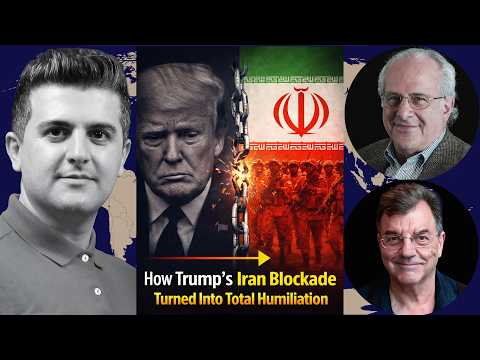
Nima Alkhorshid: Hi, everybody. Today is Thursday, April 16, 2026, and our dear friend Richard Wolff and Michael Hudson are here with us. Welcome back.
Richard Wolff: Glad to be here.
Nima Alkhorshid: Let me start, Richard, with the blockade in the Strait of Hormuz, which is the new policy of the Trump administration. The main objective of the blockade is to limit Iran's capability to export oil and other energy components.
Here is what we've learned so far from tankertrackers.com. They have reported visual confirmation that Iran has shipped out 9 million barrels of crude oil. This export came from the Gulf of Oman since the blockade of the United States. They had another 2 million barrels departed three days ago. This shows how the blockade is working somehow for the United States.
But today we had a briefing by the Secretary of War of the United States, Pete Hegseth. Here is what he said.
Pete Hegseth (clip): As our negotiators have said, you, Iran, can choose a prosperous future, a golden bridge. And we hope that you do for the people of Iran. In the meantime, and for as long as it takes, we will maintain this blockade, successful blockade. But if Iran chooses poorly, then they will have a blockade and bombs dropping on infrastructure, power, and energy. And at the same time, Treasury Secretary Scott Bessent and our friends over at Treasury are launching Operation Economic Fury as well, maximizing economic pressure across the entirety of the government. To Iran, choose wisely.
Nima Alkhorshid: So, what does that mean ? The economic fury in three days, the sanctions that they lifted from Iran and Russia, they're going to put it back. They're basically talking about putting the sanctions back on Iran and Russia. Your understanding, Richard, of this blockade on the part of the Trump administration in the Persian Gulf?
Richard Wolff: For me, I have stopped trying to do what I normally do, which is understand the logic as best I can governing the flow of events. I mean, it's partly what I think, you know, all thinking people try to do that. You make sense of the material coming at you so you can tell a coherent story about it. But that always presumes that there is some kind of coherent strategic or other program underway here. And I don't believe that anymore.
I'm looking at people who are literally winging it from day to day, from hour to hour, very poorly advised. It's crystal clear to me that they did not understand the solidarity of Iranian people behind their regime. All of these fantasies about the Iranians rising up and the divisions of Iranian society, making them complicit in a way with the United States, so that you could imagine the United States doing away with a decrepit government and nobody else much cares.
You could see that they had that in their mind because that's what they think. By the way, they're wrong, but that's what they think was the case in Venezuela. They were kind of extending it. And they were wrong.
Secondly, they were wrong when they didn't understand that the Iranians have capabilities with missiles and drones, far exceeding what was ever spoken about in terms of what you needed to expect from them. That's why you keep hearing these crazy affirmations. We have removed their navy. Okay. We have removed their army. Okay. If you remove them, so what ? What we know is that they were able to hit all 13 of the American military bases in the Gulf area. They were able to penetrate, destroy some of them, and to penetrate all the defenses, David's Sling and the Iron Dome in Israel, so they can hit back.
We are now going to what ? Blockade their ships, do an economic fury, reinstate sanctions. Those sanctions didn't work very well in the first place. They're not going to work better now. In fact, you impose sanctions now, you're going to be doing it after they've had years of experience in how to evade and avoid them. They're going to have fun with you.
I want to remind people of geography. Russia and Iran share an enormous coastline in the Caspian Sea. Whatever they need to move between their two societies can be and will be done, if not in other ways, then through that shared ocean passage that nobody can impede.
Then I want to remind you that Russia and China have an even greater immediate land border. So if China has, as Paul Krugman told us in his column yesterday, a manufacturing base larger than that of the United States, Britain, France, and Germany combined, then we know that China has the wherewithal to produce drones and missiles forever. Move them to Russia, who can give them to Iran.
But you're not going to stop that. Your economic blockade cannot stop that. Yes, you may, for a while, limit the Iranian export of oil. Although my guess is, pretty quickly, they will understand that they may need to use the Caspian Sea and Russia and China as alternative ways of getting Iranian oil into the world market. Shouldn't be all that difficult. It takes a little time, but it shouldn't be all that difficult to do. And in the long run, it's a safer bet for Iran because who knows how often the United States will do it.
Finally, this might be, as some have suggested, a decision of the United States to confront China, since the oil that is coming out of Iran is going to the Far East, if I understand correctly, Japan, South Korea, the Philippines, and China.
But this would be the worst conceivable moment for the United States to have a confrontation with China. This would be even crazier than what they've already done with Iran. Our ammunition is very low from what everybody, including the United States government, admits. The second-biggest political party in Taiwan, the leader, just went to China to work out a deal. So the enmity there is minimal compared to what it once was.
Changes are happening. And the whole world is reacting negatively to the United States. If the tariffs didn't bother them, well, then the war in Iran has. I've never seen a greater hostility to the United States coming out of all across Europe in the last six weeks than I have seen now. Never seen that in my lifetime. Now, those are intangibles, but that doesn't mean that they're not very important. To support the United States now in some kind of difficulty with China is a harder struggle to achieve than it has been at any time since the Chinese Revolution in 1949. This is stupefyingly stupid what they're doing.
Back to my beginning, I'm no longer relying on what I just said. It may be stupefyingly stupid. But then look at what we just saw. The President of the United States is excoriating European allies for not helping the United States, who did not consult with them at all before the invasion, excuse me, before the attack on Iran.
Iran's missiles can hit most European cities so they are at risk. Iran decided to react to the American bases in the Gulf and to Israel. Okay, but they could have decided to attack the allies of the United States, particularly, for example, Britain, which allowed the United States to use its military base in Cyprus to wage war on Iran. You didn't consult with people you put in the middle of a war, and then you're angry that they don't support you.
In my judgment, NATO doesn't exist. I know it's still there, but this is the declaration by the United States that on balance, no NATO is better than any possible existing NATO. It's not even worth subordinating the others to the United States. Just get rid of it. That's basically the attitude.
So I don't find any of this other than Mr. Hegseth bloviating yet again, perhaps with the Treasury Secretary joining him, that they can make it all the verbiage they want. They're in a very weak position, but they are capable of imagining something else and taking steps I can't predict because I can't figure out any logic that I can package this in.
Michael Hudson: Well, I want to comment on what you were saying about what Hegseth had said about the financial sanctions.
The Iranians are not blocking Hormuz, and they never have. They're charging fees to go through it, permitting the ships to go through. It's the United States, as Richard has said, that is blocking the trade.
The main enemy in all of this, as Richard said, is China. The new financial sanctions that the Treasury have imposed are against China and other countries, not against Iran. The sanctions are against the importers of Iranian oil.
The Associated Press had a fuller report about what Bessent told at his White House briefing that you showed. And what Bessent said is the new moves will be, quote, the financial equivalent of a bombing campaign. The campaign, as you said, was to destroy all of their bridges, all of their economy. And these sanctions are secondary against countries doing business with people, firms, and ships under Iranian control, including the United Arab Emirates and competitors like China.
This is an escalation of sanctions that are imposed on really the whole rest of the world, to try to get their oil from Iran to avoid the financial winter that's being threatened by a cessation of Iranian exports. So, what Bessent told countries is that, quote, we have told countries that if you are buying Iranian oil, that if Iranian money is sitting in your banks, we are now willing to apply secondary sanctions, which is a very stern measure. The Iranians are going, this is an attempt to punish the countries that are having any dealings with Iran at all.
Essentially, this is telling China: we want you to follow our policy in not importing any of the oil that you need because we want you to join our sanctions. Well, that's obviously a fantasy.
This also makes it impossible for any kind of a peace deal to be negotiated, because one of the Iranian preconditions for any deal is that the United States is going to lift its sanctions. Obviously, the United States has said we're not going to lift the sanctions. And remember how Vance started the negotiations with Iran in Pakistan last weekend ? He said, this is our final offer. Well, if you begin a discussion by saying this is our final offer, there's nothing to negotiate. And that's exactly what it was.
What the United States has been doing, apart from the sanctions: Wilkerson, who you've had on your show quite appropriately many times, says that the United States is bombing China's rail networks, that it's trying to make a connection to Iran.
Now, remember, way back in the 19th century, around the 1870s and 80s, the very first Western attempt to get access to Iran was by the founder of Reuters new service, Reuters himself, who said that Iran is important as a transport point. He wanted to get a railway concession to Russia and on the way to China, seeing how important that was. That really is the key. All of this is about China.
What is Trump trying to do in this maneuvering ? He's going to China, supposedly, within two weeks. I can't imagine that that's going to happen. He said President Xi will hug him because he's so happy that America is going to let China permit China to import Iranian oil. Well, we know that right now he's stopping it.
So what is his plan ? Richard said that it's impossible to figure out what the plan is of somebody who's winging it every day as Trump is trying to do.
But I think Trump has a fantasy behind the plan. And the fantasy is that he'll go to China and say, well, you know, we've blocked your oil for the last few weeks. (It's as if Trump doesn't know that China has already vastly increased its oil reserves.) He wants to say, well, we'll permit you to import Iranian oil. And maybe even other countries can import Iranian oil. But you have to give something back. You have to drop your export controls against rare earths and against all the other commodities we want and the computers. You have to drop all this.
And by the way, we've imposed 50% tariffs on you. You have to accept all this. This is abject fantasy. So, that is what it's really all about.
I think the only way that you can interpret what's happening and make sense of it is to take a step back and see that what is guiding Trump's policy is basic assumptions of Americans' national security strategy, as was spelled out last December in the national security report. The United States views any other country's growth as enabling it to be independent as a threat to itself. The United States cannot be secure if other countries are secure enough so that they don't need to adopt American foreign policy. That's the basic principle right there. And it looks as if any other country's independence is a threat to it.
The question is, therefore, what are other countries going to do ? Because the rest of the world, from Asia, even Western Europe to the global south, are caught in this backwash of blocking the oil trade that is going to cause this financial winter for them if it goes on for more than a few months, which it looks like it's going to now, because there's no reconciliation with China. China is not going to say, well, okay, we're going to give in, we're going to permit the trade to occur once again, and we'll export the raw materials and the earth that you need for your military to make the bombs to destroy us. This is crazy.
Iran's strategy in understanding that this is the American strategy is: well, okay, other countries are permitting the United States and Israel to attack us and threaten what Trump says is to destroy our civilization by wiping out our means of production and our power plants, for what Trump says, it's going to be that it'll take them 30 years to recover. Other countries are permitting this.
There's only one defense that we have. We cannot by ourselves, as Iranians defeat the United States. Obviously, it has more power to get at least some of its missiles through. And then you have Israel's 200-atom bombs that are being held in advance.
What Iran can do is say, well, as soon as we're attacked, or if we try to get one of our ships through by attacking an American ship and they respond, we're going to bomb the remaining U.S. bases in Saudi Arabia and the Emirates, and we're going to bomb the port that Saudi Arabia is using on the Red Sea so that it doesn't have to use the Hormuz Strait. We're going to bomb it. So there's not going to be any oil exported from any of our neighboring Arab OPEC countries. We're going to bomb their facilities too.
We're not going to take it alone. We're going to bring down the rest of OPEC countries near us with it. And we realize the threat that we hope you countries realize, including Japan, Korea, Western Europe, and other Asia, that what the American sanctions and the American war against us are forcing us to do to defend ourselves are going to do with you. They're going to close down your economies for oil.
When you don't have oil and fertilizer and sulfur and the helium that's already been destroyed in Qatar, then you're going to make a break in the whole chain of industrial commodities that's needed to keep your economy going. Other industries: your plastics industry and industries using plastics, your transport industry using oil, especially your travel airline industry that's suffering already throughout the whole world, now with a shortage of airline fuels.
All of this is being threatened by America's attack on us that is forcing us to try to defend ourselves by alerting you to the fact that you are ultimately caught as collateral damage in all of this. Aren't you going to do something to stop the United States ? We can't by ourselves. We are trying to alert you.
Last night and the night before that, the stock exchanges in Korea and Japan are going up very sharply, not down. The world is not willing to think the unthinkable. It seems other countries that are affected as collateral damage are unwilling to realize what the result of this U.S.-Iranian fight that's going to end up closing the oil trade is going to do for the entire world.
That's what's so crazy about it. People seem paralyzed to realize that the only way that they can avoid a depression that's going to be as serious as the depression of the 1930s is to actively stop the United States by imposing sanctions on the United States itself, by refusing to go along with this. That's what's so crazy about this.
It looks to me like Larry Johnson, for instance, today said that his informants within the Defense Department say that the U.S. has just moved a lot of extra troops right into the region. It's very hard to keep these troops and the ships there for a long time. He thinks this weekend is going to be an attack. And you'll know that there's going to be an attack if the U.S. says, let's have negotiations. That always means, you know, we can kill the negotiators and then attack you with a sucker punch.
So that's where we stand now.
Nima Alkhorshid: Richard, how do you see the war somehow ? Because looking at the tone of Pete Hegseth, he says in the initial part of his sort of addresses that they're getting somewhere with the negotiations, but nobody's positive about what's going on between Iran and the United States so far. Do you see the war escalating ? Do you see the war continuing the same way with the ceasefire, extending the ceasefire or something like that ? Or what is your understanding of the current situation?
Richard Wolff: Well, I go back to my notion of winging it. I don't think they have a clear notion. They're trying everything they can think of. And if something seems to work, whatever that word means, if something seems to be going, then they'll do a little more of that.
They want to threaten, and they bring more troops in. Given everything I've been told by people like Larry Johnson, too, you need way more troops than they have now in that region to be able to do anything. Iran has a big army and you're going to have a big problem. And if you remember, we had half a million troops in Afghanistan. We had half a million or more than that in Vietnam and so on. It is not so clear what they can do with or without troops, number one.
Let me give you another example of this. In Europe, a number of commentators have asked the following question: if the goals of the blockade were more or less the same ones that were governing the attack, the nuclear material issue, the Strait of Hormuz opening, and all of that, then why, in God's name, did you not try the economic fury before you went to the military fury?
In other words, a blockade wouldn't have killed five or ten thousand people in Iran. A blockade would have been much cheaper to operate than what they have done. So, why would you not try the economic blockade to see if it worked ? You could still threaten, as they were doing anyway, that if it didn't work, if they didn't come to the table, you would then do the military.
But what in God's name would make you choose to do the military first and only turn to the blockade when the military didn't work ? I mean, this is money. You do the cheaper, less damaging politically and ideologically. My god, why ? Why ? Ayatollah Khamenei was against developing nuclear weapons. He had been for many, many years. He may have been the only thing holding back Iran from doing that anyway. So that's a fuzzy issue. But why did you do the economic blockade second?
Now you have an economic blockade. And again, you're threatening, you may go back to military if this doesn't work, but that should have been the first step, not the second step. That would have shown we don't want to hurt the Iranian people. We just want to. You could have told that story. You didn't.
I don't see a logic here. I don't see strategic clarity. I see a complete misunderstanding of what they were up against, a disaster over 40 days. And so, now this is a fallback position. And while I understand what Michael is saying, I would add that this is also about appearing not to have lost in the first 40 days by doing something, something that can be presented as anti-Iranian or continuing to fight or something that, look at the way Hegseth or whatever the hell his name is.
Look at his posture, you know. "He needs to be in charge." He and Trump need to be in charge. So if they have to back down, if they have to, say, cease-fire for two weeks, then they have to come up with something else to look to be fighting. So now they're looking to be, "we're going to challenge China, we're going to sanction the world." There he is again. He was going to tariff the world. Now he's going to sanction the world. Look at him.
This is a desperate effort to keep doing something that doesn't work. And he's very frustrated because it doesn't work. The tariffs didn't work. They really didn't. It costs way more than they have gained. You know, the income to the United States Treasury is about $150 billion from a year's worth of tariffs. That is terribly inadequate to deal with the deficit. And with his promotion of greater military, that's what he's going to do. He's going to be the president who is in charge of a big military.
That's all he's got. And that won't handle things like the Strait of Hormuz, and it won't handle the combination of Iran, Russia, and China. They can't do it. Short of nuclear weapons. And that, of course, sits there in the background.
Michael Hudson: But it's all on the Iranian side, not the American side. And that's why I'm trying to focus on what needs to be done. The Iranian side is essentially to show the other countries that you have to act together on this, that if you do not act to protect us, there's going to be a crisis that's going to affect you.
Donald Trump has come right out and said he has a plan B. And I think we have to look at his very reasonable, seemingly, plan B. He said, well, suppose that there is a world depression, and suppose that, yes, suppose we are successful in closing off Iranian oil. We're going to end up on top because Trump says America is self-sufficient in oil and gas.
In fact, what's going to happen if the result of the attack on Iran and Iran's response is to stop the oil trade ? You're going to have world oil prices up to $200 a barrel is sort of the usual estimate, with diesel fuel going up much more, kerosene and airplane fuel going up much more. You're going to have higher prices for liquefied natural gas.
What Trump has said is this is going to be a bonanza for American gas companies thanks to our fracking. We have plenty of liquefied natural gas. Indeed what's happened in the last few months, especially the last month, is an enormous increase in exports of American LNG and oil. And the reason why these exports have not caused a shortage in the U.S. market is the United States government has been releasing its petroleum reserves into the market.
Essentially, the government releases its petroleum reserves into the market, causing an oversupply that American oil companies and gas companies export to European and Asian and global South buyers at enormous profits. And Trump believes that the United States will be less injured than other countries.
That's winning. You're winning if this causes a crisis there. And Trump says, well, if they're all in crisis, we have control of the choke points so that we can alleviate the crisis. We can say, all right, we'll let you trade with Iran again. Here's what you have to give up. And here's what Iran has to do, to do all this. This is the fantasy that Trump has.
What is being left out of all this, as I often say on your show, Nima, is the financial dimension. I mentioned before that a shortage of oil is going to cause a shutdown of many industries in Asia, in Europe, in the global south. This is going to lead to unemployment. The government is going to have to save its population at large and its homeowners by enabling them to light their homes and heat their homes without doubling or tripling their electric bills.
So, the government is going to have to give subsidies. This is going to force an enormous amount of government spending, in addition to the government having to have its balance of payments deficit rise to pay for imports of oil and gas wherever they can get it. This is going to leave these governments without the ability to pay their foreign debt, but it's also going to leave the companies that are shut down with inability to pay their corporate debts because they've had to shut down operations and they're not able to earn the income that they had planned to pay their bankers and their bondholders and their other creditors.
There's going to be a whole reverberation of the financial debt pyramiding that's occurred. And just as in 1929, the United States was the most heavily debt-leveraged economy in the world, which led it to become one of the most intense sufferers of the Great Depression.
Trump says, well, this isn't going to affect the U.S. economy. But when you take into account the U.S. plans for a trillion and a half dollars to rebuild the American military machine and the additional $200 billion that it costs to replace all of the bonds and the bombs and the missiles that have been used up in the fight against Iran, you're going to have an enormous deficit.
What Trump will then say is: well, to pay the military, we cannot afford Medicaid, we cannot afford Medicare, we cannot afford to pay for home babysitting services and all of the social spending that federal governments in America are supposed to have done for the last century. Financing this war along the terms that Trump has planned will require a whole cutback, a whole social crisis for anyone who's not a millionaire. A crisis, if you have to depend on money that you earn in a job to light your homes and to pay your bills, as unemployment spreads here, you're not going to be able to do it. The crisis is not only going to be felt abroad, but in the United States too.
Just as the stock markets in Asia say, this is too big a problem to think about - let's just hope that America can pull it all off. America can't pull it off. And the domestic stock market is just as blind, thinking America can pull it off, and it's not going to be able to.
What's going to happen when the dust settles, Iran's going to end up joining China and Russia as a world power, not as an export power, particularly, not as a world investor, certainly not as a military power. But Iran is the only country that is spilling out and understanding how the U.S. policy is part of a world economic system and is affecting the entire world.
Looking at how the overall system works, Iran is able to make any policy in terms of understanding how interconnected this whole international trade and financial and military system is. And the result is, you know, what can other countries do ? They don't have much time.
No other country has stepped up and accused Donald Trump and Hegseth of being war criminals. But Trump has bragged, I'm a war criminal. I can do whatever I want. We in America don't have to follow international law. We have our own rules-based order. That's why we've always insisted on veto power in any institution that we join. The United Nations, the IMF, and the World Bank will never let other countries tell us to do as they're trying to do by quoting the UN Charter imposing international law and the rules of civilized war.
This is the only way that other countries can end up responding. And this is why they can't think about it so far.
You have to replace all of these institutions that are under U.S. control or at least U.S. blockage. You need a reformed or a brand new United Nations. You need an alternative to the International Monetary Fund to handle the financial crisis that's going to result from the crisis that Trump's attack on Iran is causing. You need a new World Bank to help finance other countries' investment on becoming self-sufficient in their agriculture and industry, not simply more dependent on U.S. exports, which is what a key aim of the World Bank has done. That's always been really an adjunct of the U.S. Defense Department.
The world has to wake up, and it's not. The U.S. says, we're in a fight, a clash of civilization, our democracy. We're supporting world democracy. We're supporting democracy in Israel. We're supporting democracy in Ukraine. That's what we're doing.
Obviously not. This is not a clash of civilization. This is a fight led by the United States against all of the basic principles of civilization, as they've been developed in the last few centuries. That's what's really at stake in all this. And the working out of this is exactly what Iran is seeing. And, apparently, no other countries are willing to confront them yet.
Richard Wolff: It's very important that we confront Mr. Trump when he says, as Michael has quoted him quite rightly, we can bring a global depression because we're strong enough to get through it. We have oil and gas.
Let me respond. Yes, you have oil and gas, but here's the problem: Russia, China, and Iran together have as much oil and gas as you do, plus a manufacturing sector that you don't have. So you're not having an equal fight. You're having an unequal fight, and you're going to lose. It's just as impossible to run a modern economy without a manufacturing base as it is without the energy. The two go together anyway. The United States is going to cripple...
Nima Alkhorshid: Richard, sorry for interrupting. Just to mention that here is what Wall Street Journal reported, confirming what you've just said. The Pentagon is talking with car manufacturers about producing missiles. And the war has got the United States somewhere. The Pentagon is so low on munitions after messing with Iran that they are now begging Ford and General Motors to turn their car factories into missile plants. Confirming what you've just said, go ahead.
Richard Wolff: Yes, you're going to have an emergency plan. You're going to have to try to correct for the loss of your manufacturing base, but you do not do quickly what it took you 40 years to lose. Those companies are not coming back. You can create incentives and you give them, which I'm sure they will, give them ridiculous prices for these weapons.
But your commentators, among others, pointed out that they were already dangerously low in munitions because of Ukraine, even before their fight with Iran began. It's worse now, so you can see a headline like that. But they're going to be playing catch-up. And you have to understand that, particularly in the realm of manufacturing, catch-up doesn't happen very quickly. In other words, Russia and China and Iran, having the advantage now of a developed manufacturing sector, are going to milk that advantage more and more.
The United States is going to have a harder and harder time competing in the world economy. Why ? Because the Russians and the Chinese are going to use their manufacturing advantage to push for the production of all the modern goods, rail transport, and auto transport, on and on and on. You do not want to enter a fight like that with a headline like what you just showed up.
By the way, the Pentagon is already the cause of a mammoth increase in deficit spending over the next 12 months, a therefore mammoth increase in the national debt. The Supreme Court has taken away the tariff rights. It wasn't working very well. Now it'll generate nothing or very little money.
So, you're in a very dangerous place that's going to raise interest rates. Notice Mr. Powell at the Federal Reserve has let it be known in recent days, getting him in trouble with Trump, that they're not cutting interest rates anymore. They are now talking about raising them as a preparedness for the inflationary consequences of rising oil and energy prices.
All right, so you're going to make the profitability greater by government contracts, but you're going to make it less by raising interest costs, which are very serious for American corporations. You're entering a competition with China under circumstances that are bad, and you're actually going to make them worse by allowing a global crisis, which the Chinese and Russians and Iranians can meet with energy and manufacturing. You're going to meet with energy, no manufacture.
I'm exaggerating, but this is not smart. This is: no, we don't care. You better care. This is: we don't care from the basis of stupidity, not the basis of a rational calculus. They're not smart.
At the very least, you shouldn't do this for another 10 years, and then you ought to have a crash program of industrialization over the next 10 years. And they're not about to do that. They're not taking any of this. Cutting back on infrastructure, cutting back on a national health service, that's crippling American industry. It can't compete. It has to pay everybody's health insurance.
We are a declining empire, and we can twist and turn and posture and bloviate. We're not changing the declining empire. Everything Britain did for the last two centuries did not prevent the end and finish of the British Empire. And we are not going to make a different history in this period when it's our turn to have the decline.
We had better come to an agreement with China and Russia because they are the rising sun, not we. And you can pretend all you want, but that's the reality. And you better deal with it. And they're not. And this war in Iran or the blockade, these are all efforts. The United States has been trying to stop, block, slow down Chinese economic development for the last 40 years, has tried everything imaginable, and I'm sure many things we don't know about. It didn't work. It just didn't work. And this is not going to work either.
Michael Hudson: Well, Richard says the United States is going to lose. I'm glad he brought up the British Empire because, in today's editorial page in the Financial Times, there's a wonderful article: Iran is America's Suez Crisis.
Seventy years ago, there was a crisis over the Suez Canal that broke Britain's power. Britain and France wanted to get rid of President Nasser, as did Israel, for his nationalization of the Suez Canal and for his refusal to remain just a client colony of Britain and France, who would become his creditors in the 19th century.
What happened was that Britain thought up a plan. Let's get Israel to invade Egypt, and then we will come in ostensibly to do what America is saying to do in response to Israel. We're going to restore order. We're just going to make sure that we're going to stop Israel from destroying Egypt and that we're going to move troops in. And the idea was the troops were then going to unseat Nasser and put a client dictator in charge of Egypt.
That didn't work because President Eisenhower did something, which the article said is the only successful application of American economic sanctions that ever worked. Eisenhower blocked the International Monetary Fund from bailing out Britain from its balance of payment and the costs of trying to fight to control Suez, and refused to support Britain. The result is that the British and France lost, Nasser won, and that ended Britain's power right there. Seventy years ago, all about the fight to control the canal that the Western powers lost to Egypt, just as it looks like the United States has lost to Iran.
All along, as we've mentioned before, for 50 years, people have talked about Iran's basic trump card and control of the Hormuz Straits. That's exactly what it's done that you'd think it all could have been worked out. All of this was all spelled out before, without anything.
I want to make one other comment that Richard rightly brought up. What's the effect of all of this 1.7 trillion military industrial budget deficit on the United States ? The Federal Reserve follows the usual propaganda of the bank saying, oh, it's going to be inflationary, raising the price of oil. He gets it backward, as does mainstream economics. This is deflationary, not inflationary.
Yes, oil prices are going to go up. What's that going to do ? It means a closing down of industries that cannot afford the high oil prices. It means unemployment. It means a vast shrinkage in the domestic market. That's what a depression is. The Great Depression was not inflationary. It was deflationary.
But modern monetary theory doesn't realize what's happening. At least Scott Bessent has written articles saying, how have we been financing all of this deficit ? This borrowing that America has to do, what the government ostensibly has to do to finance is to issue bonds. These are not bonds issued to the financial sector. They're all financed by the Federal Reserve printing the money.
There's been a vast increase in Federal Reserve holdings of this debt. The Federal Reserve has just financed the debt by financing the financial sector so that it can afford this enormous debt-leveraged debt overhead run up by private capital. And all the private capital firms, now all of Wall Street, starting with Jamie Dimon all the way down, have said there's going to be a crash in the financial private capital sector.
That's going to bring down a lot of pension funds. They're not going to be able to pay the pensions that they expected, because they all thought that participating in a Ponzi scheme is going to be able to win out in the end. And in the end, Ponzi schemes collapse. That's what the American financial economy has turned into.
What will bring the trigger that will bring down the Ponzi scheme, and it's always brought down by a trigger, is going to be the crisis caused by Iran and the disruptions of industry caused by the rising oil prices that have resulted from this disruption.
Richard Wolff: Just to comment: it's always an open question whether a rising price of any input is able to lead to rising prices down the line or is able to lead to deflation because it destroys the demand side of the story. That depends on the specifics of this situation.
But Michael may very well be right. If you raise the prices to try to recoup what you spend extra on energy, then American exports can kiss their markets goodbye because the world has plenty of alternatives. It will not buy rising priced American goods. That will hurt it terribly. That will do more damage to whatever remains of a manufacturing sector in this country, which isn't all that much.
Whatever remains of the one dynamic sector we have, which is high-tech: the Chinese are now competing pretty much neck and neck, and they will have a better period moving ahead than the United States will, carrying all the burdens of the deficit and of the rising energy prices.
This is not a good situation to be messing around with economic fury. You know, this is blah, blah, because your situation is difficult. You are becoming desperate.
When the president says we can do well in the world with rising energy prices, and I have to say, wait a minute, you have energy, but you have no manufacturing. China and Russia together have energy and manufacturing. Therefore, you're not in a good position. You're in a weak position. I shouldn't have to say that. I shouldn't have to be one of the few voices, Michael and I, doing this sort of thing.
How is it possible ? Michael asks, how is it possible for the rest of the world not to understand that Iran is saying, what other little countries are going to be saying in the years ahead?
You have to help us as another little country because we're not going to go down without a struggle, and that struggle is going to hurt you all. We're not going to go down in Iran. We're not going to fold without making the biggest noise we can, which they've already done. I mean, they've done that in the last 40 days. They closed the strait, except for the ones they let through. When I look at the map of all those tankers in the Gulf of the Persian Gulf and then on the Arabian Sea, on the other side, they have succeeded. They have shown what they are able to do.
The parallel with Suez is obvious, of course. The Panama Canal and its position and role should be obvious. That is a strange country created to give the United States the indirect control it now wants to make direct again; hence, Mr. Trump.
This is an attempt to stop history. This is the equivalent of the famous story of the person, the little child, who puts his finger in those famous dikes in the Netherlands. You know, they're supposed to hold back the ocean because they're called the low countries because they're below sea level. You put your finger in here, then the hole opens over there. And then when you have no more than 10 fingers, then the flood comes.
You can't do this. This is a strategy of desperation instead of sitting down with the Russians and the Chinese to work something out because it's better. And if that happens at the sacrifice of Israel, which is what I personally think is coming down the pipe, then that will be a price that most of the world will readily pay.
Michael Hudson: Well, Richard's key words were: the U.S. wants to stop history. Its strategy is: the U.S. wants to destroy any industry or any country that it cannot control. This sets it against the entire rest of the world. And the rest of the world has not so far fought against this.
I guess what we're all expecting is if nature takes its course, finally other countries will fight back and say, we don't want to be controlled. We want our own sovereignty. That's what the United Nations was supposed to assure under its charter: sovereignty for all nations and non-interference with other internal affairs of nations. Attacking a country without a declaration of war is against the laws of war. Focusing attacks on civilian assets is against the rules of war.
The United States has not tried to attack Iran's means of production so far. Only its civilians. It wants to hurt civilians because it believes that that will demoralize them instead of mobilizing them.
All of these assumptions are indeed the big context for all of this unfolding. And at some point, there has to be reasonability and logic. And so far, Iranians are the only people that are expressing all of this. Await other countries.
Richard Wolff: A final thought. Again, my review of the European press that I do anyway tells me that what Michael says is true, but the mood and the popular attitude towards the United States are already heavily changed. The tariffs did that; this war is doing that. There's a whole sequence of events that are making at least the Europeans hostile and bitter.
The United States and Mr. Trump in particular are beginning to get the treatment that used to be reserved either for Hitler in the past or for Putin in the present. This European fetish of Putin is the great danger. That's now running neck and neck with Mr. Trump is the great danger. It's not that they've given up on demonizing Putin, they haven't, but they have now added a demonization of Trump. And since the truth is that Trump is in a much greater position to hurt them than Mr. Putin is, it's tilting badly for Mr. Trump.
Michael Hudson: Who is Europe ? Is Europe Starmer and Macron and Merz, or is it the voters?
Richard Wolff: It's the voters and it's the desperate effort. For each of those three, you see poll numbers that are worse than Mr. Trump's. Many of them are hovering between 10 and 20 percent of poll support. They are disasters. There's no way Mr. Macron will be re-elected unless there's a fluke. The same with Starmer and the same with Merz. And the irony is the one exception might be Meloni, but that's because she's now taking the lead in attacking Trump. She can use Trump's attack on the Pope and she uses it to sort of build her support. But it's a support wrapped up in anti-Trump.
Transcription and Diarization: scripthub.dev
Editing: TON YEH
Review: ced