By Ira Katz
May 8, 2026
I recently went to see the historical drama Les Rayons et les Ombres. This film tells the story of the journalist Jean Luchaire (1901-1946), his daughter and movie star Corinne (1921-1950), and Otto Abetz (1903-1958), the German ambassador to France during the occupation. Luchaire and Abetz became friends in the pacifist movement between the world wars, campaigning for friendship between France and Germany. They were also very supportive of Jews. The movie depicts how, notwithstanding their previous views, Abetz became a Nazi and Luchaire became a collaborator. Corinne was simply swept up into the decadence of the culture.
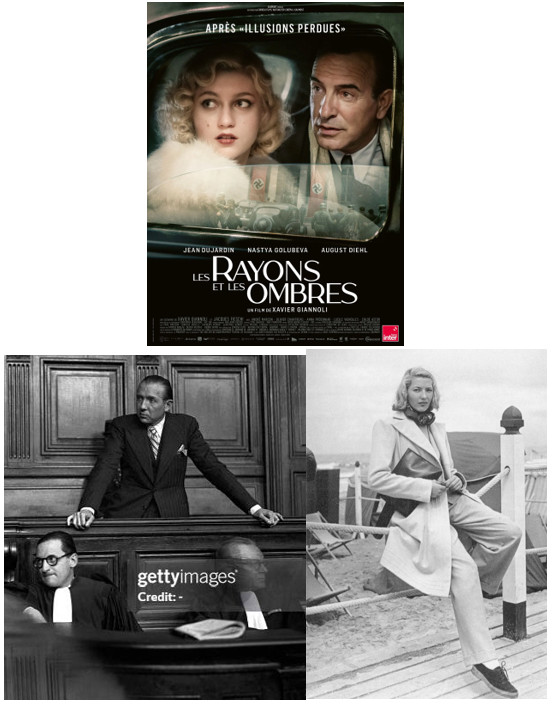
The real life Luchairs were more glamorous than the actors who play them in the film.
The day after I went to the film I saw this announcement for the book launch of the Romanian version of Intellectuals and Fascism in Interwar Romania: The Criterion Association (Modernity, Memory and Identity in South-East Europe) : Bejan, Cristina A.: Amazon.fr: Books.
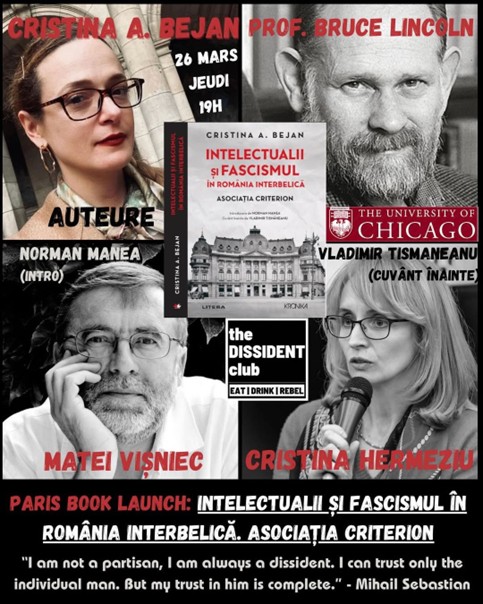
Matei Vișniec is a Romanian/French playwright, Bruce Lincoln is a professor at the University of Chicago who worked with the Criterionist Mircea Eliade, and Cristina Hermeziu is a Romanian journalist based in Paris.
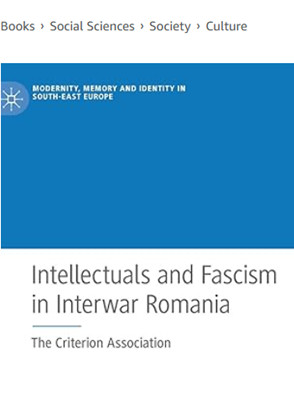
The English version of the book.
The author, Cristina Bejan, is a friend who moved to Paris a few months ago with her husband. She had given me this book, but I honestly put it on the shelf without thinking about it. Now, with the Luchaires' history in mind, I was intrigued by the subject. In fact, this Romanian history is fascinating and is worthy of a cinematic treatment itself.
The book recounts the "young generation" of intellectuals that came to prominence in a resurgent Romania after WWI. Romania had done well at Versailles, significantly increasing its territory. There was a desire to Make Romania Great Again; more accurately, to just make this small country in east Europe great for the first time. The young intellectuals were formed by a charismatic professor at the University of Bucharest, Nae Ionescu. His lecture style as described by Bejan was reminiscent of Jordan Peterson, without notes making one-to-one connections with the audience.
The young intellectuals created the Criterion Association, which in itself was about "friendship, culture, being an intellectual, art, gender and identity, and religion. Above all, it is about the heights of what Romania could achieve and the depths to which it sank." "The association was founded by philosopher, critic, and cultural innovator Petru Comarnescu after he returned from completing his PhD at the University of Southern California.... Criterion's membership included historian of religions Mircea Eliade, Jewish playwright Mihail Sebastian, and absurdist playwright Eugène Ionesco. Criterion also had a robust female membership, including dancer and choreographer Floria Capsali, and actress and director Marietta Sadova." "Criterion was initially a democratic concept inspired by Comarnescu's time in the United States. The organization was arranged democratically and the structure of the symposia (with a pro and a con speaker) guaranteed that both sides of a topic were addressed." "Its collective character was critically (sic) to Criterion. The group constituted a friendship circle and the association operated cooperatively" There were romantic interests and frequent late night drinking sessions; they even played volleyball together. [Quotes from Bejan and Wikipedia]
In the early 1930s the intellectual symposia organized by Criterion were a sensation to the Bucharest intelligentsia. Bejan does not give figures, but they appear to have been profitable; which is amazing if true. The Criterionists were naive, and perhaps arrogant, that their subject matter and success would not step on the toes of the government and intellectual competitors. But their biggest problem was the mind virus of far-right fascist political action embodied in the Iron Guard. The open ended topics and organization of Criterion were incompatible with the Iron Guard. Nevertheless, several of the Criterionists became affiliated with this organization. Presumably, the passage of Nae Ionescu to the Iron Guard had an important influence on the younger Criterionists. These contradictions broke apart Criterion. The collaboration of the Romanian intellectuals with fascism makes the new Romanian edition controversial. Hence the interest in the Paris book launch.
Of all the Criterionists the most impressive to me is Mihail Sebastian; not because of his intellectual accomplishments but because of his integrity. He was a cosmopolitan, irreligious, man about town. But when overt discrimination of Jews began in Romania, instead of denying his Jewish roots, he took ownership of them thus bringing discrimination upon himself. Sebastian was a protege of Ionescu, so as Ionescu turned to the Iron Guard and anti-semitism it strained his relationship with him. This led to the incident regarding Sebatian's book about his Jewish heritage, as described by Wikipedia below.
During the period when Sebastian and Ionescu were still on speaking terms, the latter had agreed to write the preface of Sebastian's book De două mii de ani ("For two thousand years"). Ionescu's introduction shocked Sebastian, who "loved and admired Ionescu", as it included several overtly antisemitic statements. Mircea Eliade recalls the incident in his autobiography:
"Judah suffers because it must suffer," Nae had written. And he explained why: the Jews had refused to acknowledge Jesus Christ as their Messiah. This suffering in history reflected, in a certain sense, the destiny of the Hebrew people who, precisely because they had rejected Christianity, could not be saved. Extra Ecclesiam nulla salus.
Eliade notes that this incident marked a profound departure for Ionescu, who in the late 1920s had suggested to Eliade, who was then his student, that he had been tempted "to give up both journalism and politics and devote myself entirely to Hebraic studies". Sebastian, though dejected by the incident, opted to keep Ionescu's introduction in the book.
It is incredible to me that Sebastian left the damning preface in his book. On Ionescu, Bejan quotes from Sebastian's journal. "His whole heresy stems from a wild and terrifying abstraction: the collective. It is colder, more insubstantial, more artificial than the abstraction of the individual. He forgets he is speaking of human beings; that they have passions, and-whatever one may say-an instinct for freedom, an awareness of their own individual existence."
After his mentor Ionescu betrayed Sebastian, his close friend Eliade did as well when he transitioned to the principles of the Iron Guard. On Eliade his journal reads, "I should like to eliminate any political reference from our discussions, but is that possible?... I can feel the breach between us. Will I lose Mircea for no more reason than that ? Can I forget everything that is exceptional, his generosity, his vital strength, his humanity... Nevertheless I shall do everything possible to keep him." Once again, I am impressed by Sebastian's integrity, in this case to his belief in friendship.
In our own time, when discussion on so many topics such as Trump, Covid, Russia, Iran, and Gaza have ruptured families and friendships, the example of Sebastian should be a model.
I first met Cristina Bejan through her father, Dr. Adrian Bejan, who was born in Romania. The father had been my teacher and friend at Duke during my PhD and my postdoc there, and to this day. Besides her work as a historian, she is a poet and playwright. The book is the published version of Bejan's PhD dissertation at Oxford where she was a Rhodes scholar. Thus, the writing is academic; nonetheless, the engaging topic makes it a good read.
While I was reading about the breakup of the Criterion Association I became aware of serious issues within an organization important in my life, the Mises Institute, through an article by the Bionic Mosquito: My Friend Hans. In it he reposts the article by Dr. Hans Hoppe, Mises Institute: Quo Vadis?. Later I read the article by Stephan Kinsella, My Years with the Mises Institute. From these articles I only know one side of a story that surmises there is dysfunction within the institute. In particular, Dr. Hoppe has been dismissed from his honor of being a Distinguished Senior Fellow of the institute. I write as a very minor donor (I attended the Vienna Supporters Summit in 2011), I have been a partaker of institute materials for more than three decades, and I have submitted articles to LRC for more than two decades. I have nothing but the best of intentions for the institute and all parties involved, especially Lew Rockwell and Dr. Hoppe. I emphasize, I know nothing at all except what I have read about what is going on. I feel the pain one has when good friends suffer a divorce. My conclusion, in the spirit of Mihail Sebastian, is that it is important for the health of the institute to explain to all institute participants by whom and why the decision was made to purge Dr. Hoppe. And moreover, to bring him back within the fold.