May 12, 2026
On Friday's episode of The Peter Schiff Show, Peter takes apart the latest employment numbers and warns that financial markets are already discounting an ideal outcome few can reasonably expect. He walks listeners through why headline job gains are misleading, why stock valuations rest on optimistic assumptions about war and AI, and why the nation's debt picture is far more dire than most realize.
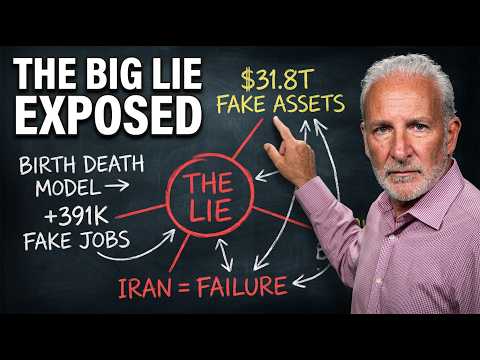
He opens by questioning the official jobs tally and the model that props it up, arguing the numbers are inflated by statistical guesses rather than actual payrolls:
First of all, before I even get to the household, even in the establishment survey, it acknowledges that of the 115,000 jobs that were created supposedly in April, 391,000 jobs came from the birth-death model. That's three times the number of jobs that were actually created, which means if they didn't have a birth-death model, we would have lost a couple hundred thousand jobs. And maybe we did lose a couple hundred thousand jobs in April because the birth-death model jobs are not real. They're guesses. And what we know from prior guesses is that they guess too high.
He leans toward the household survey as a truer reflection of labor market reality, noting a steady pattern of job declines that the headline figures hide:
I mean, my money would be on the household survey. Just, you know, it just smells like a better number given what you observe. According to that survey, net jobs have now declined every month of 2026, every single month. So all the positive jobs numbers are actually negative and the average decline per month. This is not the total for the four months. The average number of jobs that have gone away in each month is three hundred and forty three thousand jobs.
Peter warns investors that markets have already traded past reasonable expectations about the outcome of the war and its economic reverberations, pricing in falling oil and lower bond yields as if peace is guaranteed:
I think the markets have already priced in victory that we won the war, but not just that we won it because obviously, if you're just gonna count up the number of planes that were destroyed and ships that were sunk and people that were killed, if you're gonna tally up all that stuff, obviously, we were gonna win the war if that's how you're keeping score, right ? But the markets are looking beyond just the end of the war, but they're looking for a collapse in oil prices, a drop in bond yields, everything's back to normal, everything is great. And so I think the markets have already priced in the most optimistic of scenarios with respect to the war. So we're priced for perfection that we are not going to achieve. Who knows if the war is actually over?
Turning to corporate cost-cutting, Peter defends layoffs as a harsh but necessary tool businesses use to stay competitive and protect remaining jobs:
Why don't you give him [Jeff Bezos] credit for the jobs he still provides rather than the few that he has to cut back on in order to keep the business viable ? I mean, all businessmen have to keep their costs down to stay competitive, to stay in business. And the people they lay off help make sure that the other people don't lose their jobs, right ? Because if a businessman takes his eye off the ball and doesn't trim the fat out of the payroll and becomes at a competitive disadvantage, the business could fail and everybody could lose their jobs.
Finally, he steps back to the larger fiscal picture and reminds listeners that public debt already exceeds GDP, and that measured liabilities leave out far bigger contingent and unfunded obligations-Social Security and Medicare among them:
What happened in the last week is debt held by the public now exceeds the size of the economy. That excludes the debt held by the government because we've been ignoring the debt that the government owes itself. So if you count all the debt, the whole 39.2 trillion of funded debt, and that's just the funded debt, that's where the government has borrowed money and has to pay it back. The actual liabilities dwarf that. If you count all the contingency liabilities, like guaranteed loans that could default, and unfunded liabilities like Social Security and Medicare, you're talking about north of 150 trillion of debt. We're completely insolvent as a nation, right?
This article was originally published on SchiffGold.com.