Hugo Dionísio
China defies U.S. sanctions on Iran, declaring them void. With Russia and Iran, the multipolar triumvirate ends Western hegemony and reshapes global power.
The Western world often watches - without fully grasping its extent - the closing of a historical cycle that has dominated the last eighty years. The moment when China decided to openly repudiate U.S. sanctions on Iranian oil - by prohibiting its institutions and companies from applying guidelines set forth by figures like Scott Bessent - was not merely a mishap in Sino-American relations. Rather, it was an "Archimedean moment" evidenced by Beijing and thus made manifest to third parties. For the first time, the People's Republic of China did not seek subterfuges, side channels, or quiet mitigations to circumvent Washington's will. For the first time, China directly confronted the United States, declaring the nullity of its sanctions on Chinese soil and openly subjecting itself to punishment.
If, until now, China had only responded to sanctions directly aimed at itself - often, to be sure, in an asymmetrical manner, but never risking the relationship of its largest banks with the SWIFT system and the dollar - this time, Beijing decided to no longer tolerate the idea of the extraterritorial effectiveness of U.S. legislation. This decision represents the epilogue of a long escalation of trade confrontation, which China had always avoided with asymmetry, feints, and evasions. In the case of Russian oil or gas, Beijing always chose to pull back its state banks, relying on small regional banks operating in very circumscribed circuits outside the dollar's control network.
Now, if any certainties exist regarding the methodical, rational, patient, and calculated characteristics of the Chinese "modus operandi," it is that this was not an impulsive decision; rather, it is the result of a cold and geostrategic assessment. It would result from a materialist, dialectical, and sustained analysis, under which Beijing would have concluded that the balance of power has finally been reversed in its favor. The decade-long stalemate - that Gramscian "interregnum" where the old world was dying, and the new world was slow to be born (and to compose itself) - has come to an end. The Multipolar Triumvirate (China, Russia, and Iran) has not only survived the siege but has taken the top of the hill. From now on, Beijing and the Global South know that they have three solid pillars upon which to base an alternative economic, security, political, commercial, or social strategy, and they realize that, with mutual support, each of these pillars is quite capable of surviving and sustaining itself.
Next, it is important to know what led to this moment, this turning point. What made the water boil ? What precipitated the shove that will end with the effective demonstration of the West's (USA/NATO/G7 and vassals) inability to contain the expansion of multipolarity, as well as its anchors ? By this I do not mean - and we cannot start from that premise, given the power accumulated in the West over 500 years of dominance and the control of a world architecture constituted by and for itself - that the West will not be able to mitigate, slow down at some point, or even, punctually or tactically, prevail over the multipolar world, containing its construction, consolidation, expansion, and advance. Not at all. But it can no longer defeat this trend!
There are two fundamental pillars whose construction and survival have brought us here: the survival of Russia and Iran from attacks perpetrated over decades by the U.S. and its vassals in Europe and West Asia. Chinese confidence over this frontal clash is based on observing the Western failure to topple the other two pillars of the multipolar order. The pillars that constitute a kind of informal triumvirate, neither elected nor assumed, but constituted by the material reality we observe, all possessing the ability, without risk of perishing and suffering strategic defeat, to repel and confront, with eyes wide open, the power of the United States. They are the only ones, and not by chance. They are because their enemies say so - enemies who have elected them as vertices of a geographical triangle upon which the multipolar confrontation with unipolar power would be sustained. It was no accident that Brzezinski said in his seminal "The Grand Chessboard: American Primacy and Its Geostrategic Imperatives."
The first of these vertices or pillars to undergo and overcome the necessary test was the Russian Federation. The U.S., using NATO and the European Union as operational arms, mobilized its entire arsenal of war resources (what many called "hybrid war"): unprecedented economic sanctions, political destabilization, and proxy kinetic confrontation. A crescendo of conflictual intensity that only increased from the moment the Russians - in reaction to the fall of the USSR and the attempt to destroy Russia itself, carried out under the command of an uncontrolled Yeltsin - decided to stop the disaster and begin the bitter process of reconstruction.
However, despite the intensity of NATO's geographic siege, the strength of NGOs installed on its territory, and the vast amounts invested there by USAID, the truth is that the Russian Federation held on, counterattacked, and recovered an important part of its potential and industrial scale.
For the Global South, Moscow ceased to be a declining power and became a symbol of resistance to unipolarity. From this entire process, the Russian Federation and leaders such as Putin, Medvedev, Peskov, Patrushev, and Sergei Lavrov have become widely recognized and admired in the Global South. As always, with more or less merit, Western plans were frustrated. Twenty packages of sanctions, an energy dead end, a hole without raw materials and without an exit that traps the EU, a military industry 3 to 5 times less capable than Russia's, all associated with economic growth on average higher than that of the EU - these are factors that demonstrate why the stalemate has been reached. The West demands that Moscow acknowledge a victory that it did not achieve on any of the fronts where it fought the enemy.
The second case, the second step of the multipolar triumvirate's ascent to the top of the hill, was Iran. Washington - this time using Israel and the Gulf monarchies - tried to asphyxiate the Persian regime, but the result was the opposite of what was intended: Iran proved to be a technological power capable of surviving decades of brutal harassment, revealing an effective capacity to disrupt the world economy. From this confrontation, and despite all the leading figures assassinated by the U.S., Israel, and certain Gulf monarchies, the Global South observed that Iran is a vastly more important and powerful country than the caricature Hollywood and the regime's press had made of it.
An interesting example of what Iran has achieved is the case of the "Lego" music videos, which conquered the world and are a symbol of the soft power that Iran had not counted on until now. The stalemate we have reached, when Trump is forced to say, "We won, but I admit the Iranians think they weren't defeated," tells us that the U.S. does not know how to get out of the hole it has dug for itself.
By not understanding that, given the bravado it projects of itself - presenting itself to the world as all-powerful and with an almost divine status - it places the victims of aggression in a situation where, to win, they need only not die, Washington turns all possible victories into imminent defeats. They neither overthrew the "regime," nor disarmed it of its most powerful missiles, nor took away its uranium, nor ended its nuclear program, and they ended up clogging the Strait of Hormuz, which had previously been unclogged.
Now, wanting to gather a group of 20 volunteer vassals armed as plumber-uncloggers, we'll see if they don't end up leaving everything without internet, since extremely important submarine cables also pass through there. Iran thanked them and, as a capable, sovereign nation in control of its own destiny, took advantage of the aggression to turn it into an opportunity to become a global power, capable of bringing down the entire world economy.
All of this could only end, as in the case of the Russian Federation, with the aggressors blaming Beijing for their own inability to topple these two pillars of the multipolar triumvirate. In this way, the U.S. and the EU exposed their greatest weakness: military and industrial impotence in confronting powers that are prepared and capable of responding vehemently to the attacks they suffer. If the objective was to punish the Russian Federation and Iran for their presumption in disregarding the deterrent power on which Western vanity rested, then by missing the shot, the U.S., NATO, EU, G7, and Israel saw their entire strategy of "containment" of China - and, by extension, of multipolarity - collapse.
Now, the West seems to need an improbable "Chinese suicide" - voluntary submission - for its plans to work. The U.S. and EU want the Russian Federation to admit to a defeat it did not suffer; the U.S. and Israel want Iran to acknowledge a victory they did not achieve; and both want Beijing to submit to a deterrent power that they themselves have proven to be weaker than they wished to admit. China, which was the ultimate target of this entire strategy, has found an implacable protection where it previously seemed to doubt that any could exist.
To understand why the West failed in this clash, we need to look at the internal erosion of Europe, the preferred vassal of the U.S. While China asserted itself, the European Union plunged into an unprecedented "Strategic Vassalization."
Although official discourse in Brussels and Paris promotes "Strategic Autonomy," the industrial reality tells a story of absolute dependence. The Draghi Report (2024) already warned about the fragmentation of the European defense industry and its lack of scale compared to transatlantic giants. When we look at European industry, we realize that, despite all the investment in armaments, it will be very difficult to escape the omnipresent dominance of the U.S. throughout the value chain. From licenses and royalties tied to industrial property, to export controls due to the incorporation of components, to the dominance of capital expressed in multiple forms (bonds, stock purchases, investment by funds like BlackRock or Vanguard throughout the production chain), or the dominance of finance and the monetary system, the EU is entangled in a web of dependence on the U.S.
This vassalization explains Europe's inability to serve as a real counterweight. European "reindustrialization" is an illusion if the capital that sustains it and the technology that operates it are extensions of the U.S. military-industrial complex. Beijing knows that by confronting Washington, it is confronting a bloc whose European "muscle" is atrophied by its own dependence on the transatlantic master. If the U.S. intends to confront the multipolar triumvirate by dividing fronts among local proxies - the EU and NATO in the Russian case, and Israel and the Gulf in the Iranian case - then, in the Russian case, the strategy would have to fail, because the athlete the U.S. chose to compete is not only crippled but lacks any will of its own. In an era where even machines learn and everything is driven by artificial intelligence, having no will of one's own is a very serious limitation.
The truth is that, until now, we lived in a stalemate. The U.S. tried to prevent the rise of multipolar powers while watching its own position deteriorate. It was a technical draw at the top of the hill. But China's sharp response to sanctions on Iranian oil broke that balance by letting the Global South know that all the events leading up to it inaugurated a new era. An era in which the West recognizes that it cannot defeat its opponents unless those opponents accept their own defeat (as Libya did by abandoning its nuclear program, or Venezuela by failing to prevent the kidnapping of its president and succumbing to U.S. demands).
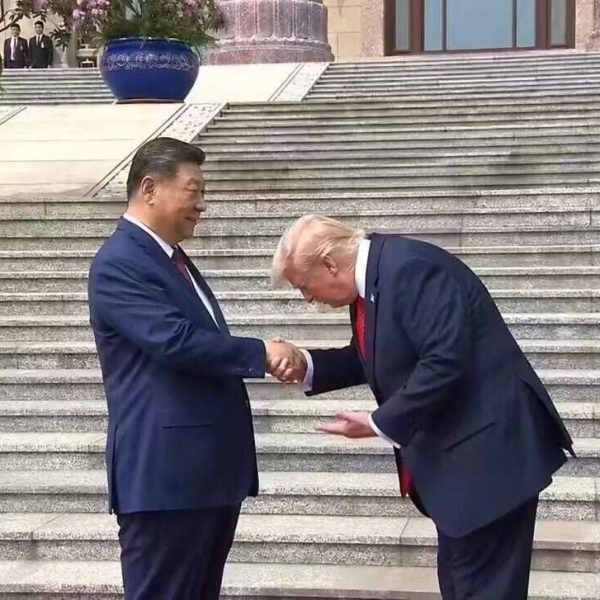
At this very moment, with Donald Trump in Beijing lavishing praise on his Chinese counterpart, the reversal is total. Never has the U.S. been in such a dependent and weakened position before an opponent, not even at the height of the Cold War with the USSR. While the Western media continues to fabricate narratives of a "Chinese crisis," the reality on the ground is one of the victor's confidence. The parade of U.S. oligarchs and the scramble they made for a brief handshake from Xi announced to the whole world one of the greatest ironies in the history of the last 100 years: 35 years after the self-surrender of the USSR and the inauguration of the "end of history" with the victory of capitalism, there is nothing more ironic, paradoxical, and disconcerting than watching an army of monopolistic capitalists in their imperialist phase seeking to enter and save themselves in a socialist power - the greatest world power!
What this reality proves is that the U.S., neoliberalism, and late-stage imperialist capitalism - they all sang victory too soon ! After all, there are other paths for humanity ! The end of history has not yet arrived!