Bruna Frascolla
Arrested by the Sultan, Sabbatai Zevi chooses the Muslim turban over death. His followers create a crypto-Jewish sect, and the false Messiah dies in exile in 1676.
[We are seeing the final part of the history of Sabbatai Zevi. If you've just arrived, see the first and second parts by clicking here and here.]
Sabbateanism drove the Jewish masses mad. According to Scholem, Marxism offered a distorted interpretation of the movement's history, understood as a revolt of poor Jews against rich Jews. In reality, however, among the adherents of Sabbateanism were wealthy Jews and even influential figures in international politics, such as Rafael Supino of Livorno (who accompanied Menasseh Ben Israel on his mission to England), Jerónimo Núñez da Costa (agent of the King of Portugal in the Netherlands), and Daniel Levi de Barrios (former officer in the Spanish army in Belgium). Scholem also pointed out a religious profile of the Jew most attracted to Sabbateanism: the Marrano, the Sephardic Jew who feigned conversion and, therefore, had been instructed in Catholicism. This profile would have a greater propensity for syncretism with Christianity. The imitation of the Marranos went so far that they had devotion to the relics of their own "saint," the martyr Solomon Molcho, who tried to convince Emperor Charles V to reconquer Palestine with an army of Marranos and hand it over to the Jews.
However, the Ashkenazim were not far behind in terms of syncretism. Germany was flooded with Yiddish pamphlets about the Prophet Nathan Levi, who had anointed as king in Jerusalem a certain Sobeza (a name given by Sabatai after passing through the telephone game), who had changed his name, becoming Joshua Helkham. This, in Hebrew, means "Jesus, God-Rised-from-the-Dead."
The last recorded messianic act of Sabbatai in Smyrna was the distribution of royal titles. For unknown reasons, on December 30, 1665, he boarded a boat with three or four rabbis whom he had proclaimed kings and set sail from Smyrna to Constantinople. Given the propaganda of Nathan of Gaza, the expectation of the Jews was that the Sultan would prostrate himself before our music-loving Messiah and hand over his kingdom to him. Thus, the fever for crazy letters with spectacular news increased, and a commission of skeptical rabbis even discovered a fake news factory that sold letters for high prices. The forgers were severely punished.
Upon arriving in Constantinople, Sabbatai was arrested. According to Scholem, the most plausible reason is economic, since the Jews monopolized trade in Turkey (especially foreign trade) and had simply stopped working - even the donations collected were not enough for the Jews to support themselves. The phenomenon presented a form of "rebellion" without an armed threat: the Jews were very brazen in telling the Gentiles that they were going to be their slaves with the coming of the Messiah and so on, but they did nothing but riot in the streets, falling to the ground to "prophesy," or even falling dead because they had fasted too much. Frankly, it reminds of January 8th riots in Brazil (which had a bunch of crazy Pentecostals wrapped in Israeli flags, listening to fantastical news on monetized YouTube channels), and we know that this kind of uproar irritates the authorities enough to put everyone in jail.
Sabbatai was arrested in Constantinople. Nevertheless, news circulated that Sabbatai had not been arrested; that he had ascended to heaven and was replaced by the Archangel Gabriel, who had assumed his form for some mysterious reason to be revealed in the future. Shiites believe that something similar happened with Christ, instead of being crucified.
For some reason, the Messiah (or the Archangel Gabriel?) did not allow his followers to bribe the Turkish authorities to release him. This impressed his followers even more, and they interpreted it as a willingness to descend to the qelipot. Since the Turkish vizier had a reputation for ruthlessness, the Jews feared that Sabbatai would be condemned to death. According to Scholem, however, the vizier must have been concerned about social order: one could not kill the Messiah of the Jews and expect them to return to work.
In March 1666, Sabbatai was transferred to more comfortable accommodations in Constantinople. During his stay, Constantinople faced food inflation due to Jews coming from other eastern cities to contemplate the divine face. The Ottoman guards, noticing that the Jews were now making pilgrimages like the Italians (even visiting the tomb of Sabbatai's mother), had the idea of charging an entrance fee to the prison to allow the pilgrim to look at Sabbatai's face - who only received them in the "illumination" phase, avoiding them in the "concealment of the face" phases.
Faced with inflation and disturbances, in April 1666 the Turkish authorities transferred Sabbatai to Gallipoli, where the Ottoman guards expanded the business and began charging the Sabbateans to allow parties inside the "Strong Tower" where the Messiah resided. This commotion lasted at least until July, and Sabbatai led the movement from prison in Gallipoli, on the European side of the Dardanelles Strait. In this circumstance, he abolished the fast of the 9th of Av.
Then the Sabbatean prophet Nehemia Kohen arrived from Poland. He didn't simply want to look at the face of the Messiah, but to discuss and negotiate. One difficulty for Sabbateanism was the figure of the Messiah Ben Joseph, the Messiah who assists the Messiah Ben David (the major Messiah) and falls in battle. Sabbatai's story, that this Messiah was a Pole killed in a pogrom in 1648, did not make the believers very comfortable. The discussion ended in a fight, and there are two versions: one from the Sabbateans, the other from the Christian observers, which Scholem prefers. For the Sabbateans, Nehemia Kohen and Sabbatai Zevi discussed theology, but the Pole proved incapable of understanding the thought of our Sephardic music lover. In the Christian version, there was a dispute because Nehemiah wanted Sabbatai to recognize him as Messiah Ben Joseph, which Sabbatai accepted, but Nehemiah went further and reprimanded him for proclaiming himself Messiah before he himself (Nehemiah, the Messiah Ben Joseph) had come on the scene. Sabbatai did not like seeing his authority questioned, and the two argued. The Jews were confused, divided, but ended up remaining under Sabbatai's authority and considering Nehemiah a schismatic. To get revenge, Nehemia denounced Sabbatai to the Turkish authorities - and the Jews were so furious that Nehemia ended up asking to become Turkish, thus escaping Jewish jurisdiction.
At that time, conversion from Jew to Muslim in the Ottoman Empire consisted of abandoning the Jewish hat and starting to wear a Turkish turban. It was an easy conversion because it did not require circumcision. However, Nehemia Kohen's conversion lasted only until he returned to Europe, where he began presenting himself as Messiah Ben Joseph and continued to preach that Sabbatai Zevi was the Messiah Ben David.
Apparently, Sabbatai and his followers held parties at the Tower, complete with virgin girls and "favorites." Sabbatai also boasted of having sexual relations with virgin women and returning them "untouched"-in Smyrna, he had requested three virgins and returned them in that condition. To the accusations of depravity were added accusations of sedition.
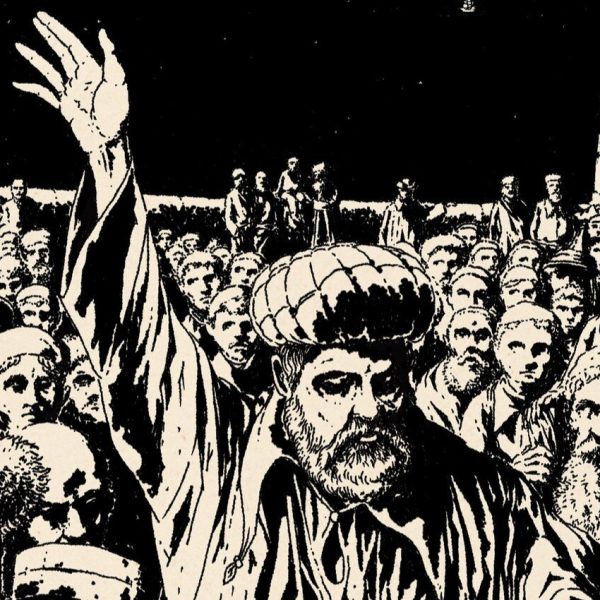
Given that the unrest among the Jews continued intact, the Turks used yet another expedient: forcing Sabbatai to choose between the turban and death. This occurred in September, and Sabatai chose the turban. The event involved a semi-official meeting with the Sultan mediated by his doctor, a Muslim convert from Judaism. Sabbatai did not speak Turkish and needed an interpreter, a role played by the doctor. The meeting was semi-official because the Turks, when they wanted to, used lattices to subtly separate the spaces: the sultan saw and heard everything through the lattices, gave orders, but was not officially in the same room. At the meeting, Sabbatai denied his messianic pretensions - but he always did so in front of gentiles, even if they were enthusiastic Calvinists. (I believe the most famous of them was the Dutch millenarian Petrus Serrarius, a friend of Menasseh Ben Israel.)
The semi-official meeting took place in Adrianople, present-day Edirne, which involved a trip. There was time for the news to spread that Sabbatai was going to meet with the Sultan. So, the Jews spread carpets and celebrated, believing that the Sultan was going to hand over the kingdom. After the apostasy of the Messiah, no one wanted to believe that the apostasy was real or definitive.
But Sabbatai was spoiled by the Sultan. He received a palace, an extra wife, and a pension. The Sultan's expectation was that Sabbatai would lead a mass conversion of Jews to Islam. Conversions did happen, because Sabbatai continued to cause confusion, alternating between mania and depression. And he also continued to be sought after by Jews, who treated him privately as a rabbi. He ordered one of them to hand over his bride - and coveting other man's bride is one of the 36 capital sins. However, something more frequent (or of which we have more news) was ordering the Jew to convert to Islam. Nathan greatly feared going through this, but it didn't happen.
Speaking of Nathan, he offered a solution to the Jews willing to continue believing in the Messiah of Smyrna. If the Messiah came to end the Law and preach sanctification through transgression, then apostasy was consistent with the program. The Jews who followed Sabbatai in converting to Islam formed a crypto-Jewish sect that exists to this day in Turkey, called Dönmeh. The influences of the Dönmeh in Turkish politics, their relations with Freemasonry, and the claim that Atatürk was Dönmeh are today considered antisemitic conspiracy theories by the mainstream.
However, in the 18th century, we know from Scholem that at least one Austro-Hungarian Sabbatean who followed Jacob Frank (a proclaimed a reincarnation of Sabbatai) was ennobled, converted to Catholicism, joined Freemasonry, and took part in the French Revolution. (Cf. From Frankism to Jacobinism.)
Unfortunately, the subject is as intriguing as it is mysterious for historians. As soon as the fever passed and the heretical reputation of Sabbateanism was consolidated, the evidence was destroyed or hidden, and the movement went underground. The very publication of Scholem's work, initially in Hebrew, prompted the President of Israel, Zalman Shazan, to hand an 18th-century Yiddish manuscript to the researcher, who improved the English and later versions of his work. The manuscript was passed down from generation to generation and survived wars. No one knows how many manuscripts are in this condition to this day, nor how many have been lost forever.
Sabatai spent his last days in Dulcingo, present-day Ulcinj in Montenegro. He was exiled there after being denounced for heresies in the early 1670s and died in 1676. The Balkans were the final stage for the Messiah of Smyrna.