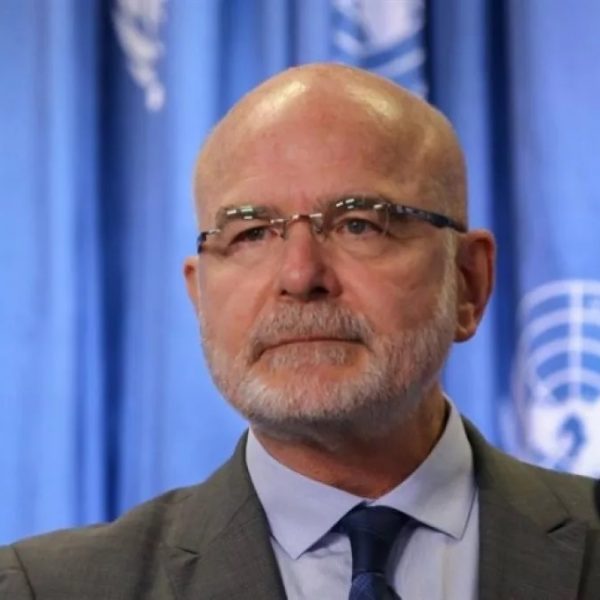
Elsa Persson
He has criticized Swedish minister Carl-Oskar Bohlin (M) and does not believe it can be called vandalism when paint is thrown at buildings in connection with a peaceful demonstration. UN Special Rapporteur Michel Forst has recently become known in Sweden.
The UN Special Rapporteur for the Århus Convention was scheduled to come to Sweden in early April. He was invited by the defense to the trial of 17 activists protesting private jets at Bromma Airport. However, the court rejected the possibility for him to testify on site:
- I was very surprised that a court in Sweden did not allow me to testify. Instead, we submitted a long statement to the court to try to explain what I would have wanted to say in court in person, says Michel Forst in a video call with Dagens Arena.
Prosecuted collectively
Michel Forst became involved in the legal case of the 17 climate activists when one of the accused, Isabelle Letellier, contacted him. This led to him engaging in her case and sending a statement to the court in Sweden.
- My greatest concern is that, in my eyes, she did nothing illegal. It was a peaceful demonstration, and she was merely holding a banner protesting the government's insufficient action on climate.
He believes the court violates international conventions by prosecuting the demonstrators collectively and holding everyone responsible for vandalism:
- This is an individual case, and they should not be treated as a group of demonstrators. It is very clear under international law that similar cases should not be handled in this way.
As Dagens Arena has previously reported, Isabelle Letellier has lived in Sweden since 2010 and has her family and two Swedish children here. According to Michel Forst, it is serious that she was still denied Swedish citizenship based on the criminal charge of vandalism.
- If she is first sentenced to prison and then likely denied Swedish citizenship, that would constitute double punishment, he says.
"Not about violence"
Regarding the vandalism charge, he is doubtful about it, even for the two people who actually threw the paint.
- One can question the term vandalism. It involves water-soluble paint that does not cause damage. In the UK, for example, where they are generally extremely harsh on climate activists, a case was dropped where activists had thrown water-soluble paint. This is not about violence. It is a form of protest protected by international law.
Michel Forst has recently been written about in Swedish media. It started with what is called the "Marie case." It concerns a woman who was fired from the Swedish Energy Agency after information was spread in Fokus magazine and on Svenska Dagbladet's editorial page that she was active in the climate organization "The Rebellion Mothers." A source in the Fokus article identified Marie as a risk, linked to her role at the Energy Agency. A couple of days after Marie learned that her probationary employment would be terminated, the Minister for Civil Defence, Carl-Oskar Bohlin (M), tweeted about the incident and described how he himself had contacted the Energy Agency.
The minister's involvement in this matter led Michel Forst to direct criticism at Sweden, as he argued that Bohlin may have violated a UN convention. The incident led Michel Forst to come to Sweden two months ago to meet with government representatives and discuss how activists are treated here. The discussions with senior officials are described as "constructive during the conversations themselves." But they did not result in what Forst had hoped for.
- Then I decided to publish a statement, which I only do when I see that the government in question does not understand or listen to what I am saying.
International trend
Michel Forst has reacted to what he considers a new way of treating demonstrators in Sweden:
- I was very surprised by what is happening in Sweden. For me, it is a very democratic society where the right to protest is protected by international laws. What I see is that climate activists are being prosecuted for new crimes in connection with protests, such as sabotage, during peaceful protests, says Michel Forst.
Dagens Arena has previously reported on the increase in sabotage convictions against climate activists. But the increasingly harsh treatment of climate demonstrators is part of an international trend. Michel Forst cites countries like France and the UK as examples:
- It hasn't been confirmed by research yet, but for me, it's a kind of laboratory experiment happening regarding how climate activists are treated. States are testing new forms of repression.
Lawyer Pia Björstrand, who defended Isabelle Letellier in the aforementioned case, believes that prosecutors and courts are not as independent from politics as they should be. However, Michel Forst does not want to make such a general statement.
- It's difficult to say because it varies from country to country. It also differs between different courts. What I see is that prosecutors tend to defend public order, says Michel Forst.
Lack of knowledge
Added to this is the lack of knowledge about international laws and regulations among those working within the justice systems. He says that courts sometimes thank him for informing them about the international laws that must also be followed in national cases.
At the same time, he now sees that more and more cases are being tried, including in the European Court of Human Rights. A few rulings have already come, and more are on the way.
- My hope is that the court will provide guidance to member states on how to handle these kinds of protests and states' passivity on the climate issue.
It is easy to get the impression that criticism like that from Michel Forst and UN special rapporteurs in other areas is not taken entirely seriously by politicians. But Michel Forst remains optimistic:
- I have held various roles within the UN since 2008. And I see concrete and positive results in many ways. Of course, it's easy to find examples of poor results or passive governments. But in many countries, we are understood and listened to, and even if we don't get immediate results, countries may eventually understand that they are doing wrong when we return with new cases.
A colleague of Michel Forst who has not been ignored, but rather attacked, is Francesca Albanese, the UN Special Rapporteur for the Palestinian territories. After her harsh criticism of Israel in connection with the Gaza war, she has been subjected to sanctions by the United States, among others.
- Francesca Albanese is a friend of mine. She has been attacked by many governments, including the French, who want her to leave her post, but in my eyes, she is doing a fantastic job. She is truly trying to raise awareness of what is happening in Palestine, which is precisely her mission.
Original article: dagensarena.se