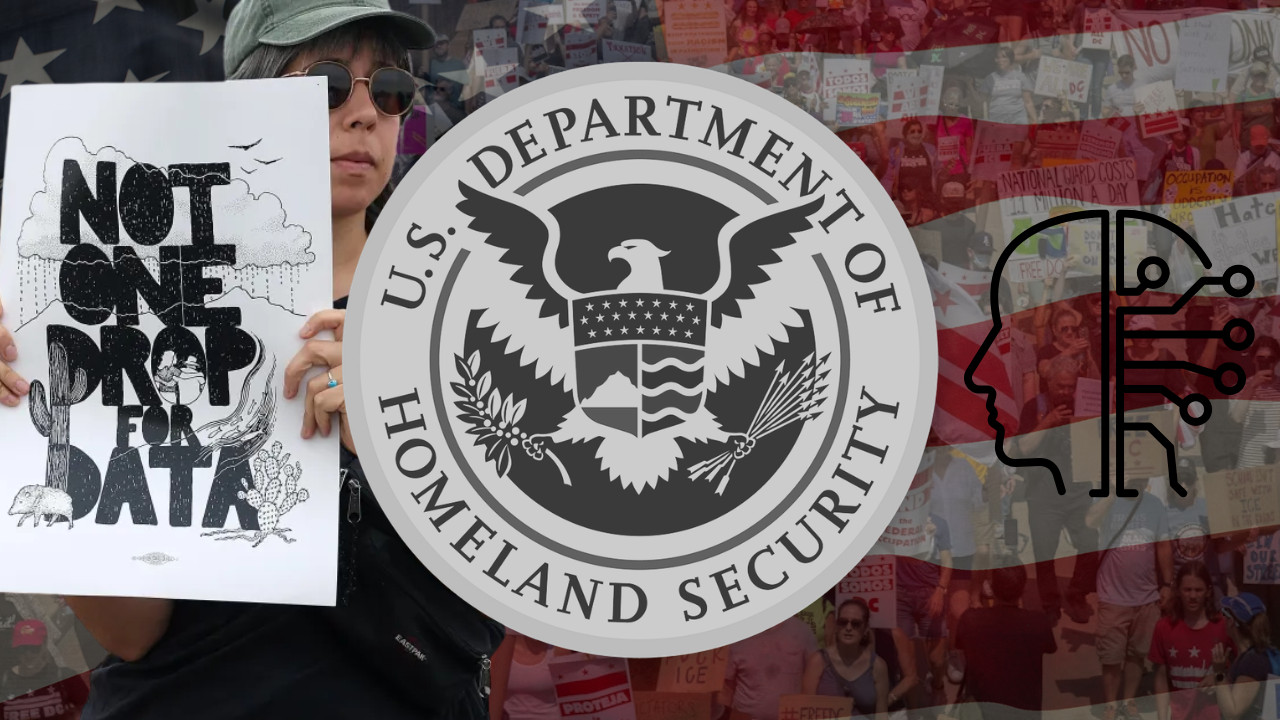
New documents from government agencies such as the FBI and Department of Homeland Security show that Washington is preparing for widespread anti-A.I. riots, as the technology destroys communities and industries across the country. Ironically, the Trump administration is already using invasive A.I. technology to identify and suppress what it calls anti-A.I. "extremists," in the process, sweeping the entire nation into its massive surveillance dragnet.
More than 1,000 pages of leaked documents reviewed by WIRED Magazine show that government agencies are anticipating a huge wave of domestic unrest in the coming years, as artificial intelligence upends American society. Automation-related job losses could shatter entire industries, while the building of gigantic data centers will remove water and electricity from public use, ramping up the price of what little remains.
As one report from the New York Intelligence and Counterterrorism Bureau notes:
"The chaotic atmosphere that may result from emergent A.I. technology in the next five years may fuel large-scale protests that devolve into civil unrest and anti-tech violent extremist activity, especially in large urban areas such as New York City."
An Environmental and Health Catastrophe
Last year, the tech industry collectively spent around half a trillion dollars on the construction of new data centers. These buildings consume near insatiable amounts of energy and water. By 2030, they are expected to represent around 12% of total U.S. electricity consumption. One large data center consumes up to five million gallons of water per day - as much as a small city. It has been calculated that a single 100-word A.I. prompt to a chatbot like Claude or ChatGPT uses over half a liter of water, equivalent to one bottle.
When a data center moves into town, utility prices skyrocket. In this situation, wholesale electricity, for example, jumps by up to 267%. Ordinary Americans cannot compete with the likes of Amazon or Microsoft, and can be priced out of even the most basic necessities of life, causing widespread resentment.
Living near a data center can also be hazardous to human health. Thanks to the low-frequency noises they produce, residents often report chronic symptoms such as insomnia, vertigo, and nausea. Worse still, to meet their enormous energy demands, data centers often rely on gas or diesel generators, which emit high levels of nitrogen oxides, fine particular matter, and so-called "forever chemicals" into the air, further complicating the situation.
A.I. will also have a profound effect on employment. Goldman Sachs predicts that, over the next decade, 300 million jobs could be lost to A.I.-based automation. Sam Altman, CEO of ChatGPT's parent company, OpenAI, has suggested that whole industries may be replaced by his product. "Entire classes of jobs will go away and not come back," he confidently stated in 2019. Facing growing public anger, last month, he walked those statements back, assuring the public that there would be no "jobs apocalypse."
But if these predictions are anything close to correct, it will cause massive economic disruption across America, and send towns and entire cities dependent on certain types of work into potentially permanent depressions. The latest news that Washington is preparing to treat this unrest as akin to terrorism should be of great concern to all Americans.
The Dark Side of A.I.
The public, as a whole, is highly skeptical of artificial intelligence. A recent poll found that only 5% trust A.I. a great deal, while 77% think it could pose a fundamental threat to humanity.
The U.S. national security state, however, has fully committed to A.I., and is using it to mass surveil the public and to identify those not sufficiently supportive of the new technology. In March, FBI director Kash Patel confirmed that the bureau is buying Americans' personal online user data from brokers in order to track the public. The Department of Homeland Security has spent millions purchasing A.I. software that detects the sentiment and emotions of Americans' online posts, and is using it to identify activists and other potential "threats." It has also sent subpoenas to Google, Facebook, Instagram, Reddit, Discord, and other large social media apps demanding they share the personal information and identities of anonymous users who have criticized the actions of the Trump administration. Government officials confirmed to The New York Times that platforms have often complied with their requests.
A.I. giant Anthropic publicly pulled out of a deal with the U.S. Department of War to develop A.I. systems in "classified environments," stating that they feared the technology would immediately be used to carry out mass domestic surveillance in the United States. "We cannot in good conscience accede to their request," they said, explaining their decision. The company was immediately labeled a national security "supply chain risk" by the Trump administration, and the contract was fulfilled by OpenAI.
OpenAI co-founder Greg Brockman is one of Trump's most generous donors, having channeled $25 million to the president's super PAC, MAGA Inc. He has also poured $50 million into Leading the Future, a bipartisan super PAC aimed at promoting pro-A.I. legislation in Washington, D.C., and defeating and silencing lawmakers who wish to curb the influence and power of the new industry.
It remains to be seen to what extent A.I. will actually become a revolutionary technology, but what is clear is that the U.S. government is preparing for major economic and social disruption in its wake. Instead of creating economic bailout plans and social welfare programs to help those negatively affected, however, it is preparing an authoritarian response, looking to crush dissent. What makes this future even more ironically dystopian is that, to do so, it is using the very A.I. that is triggering the problem in the first place.