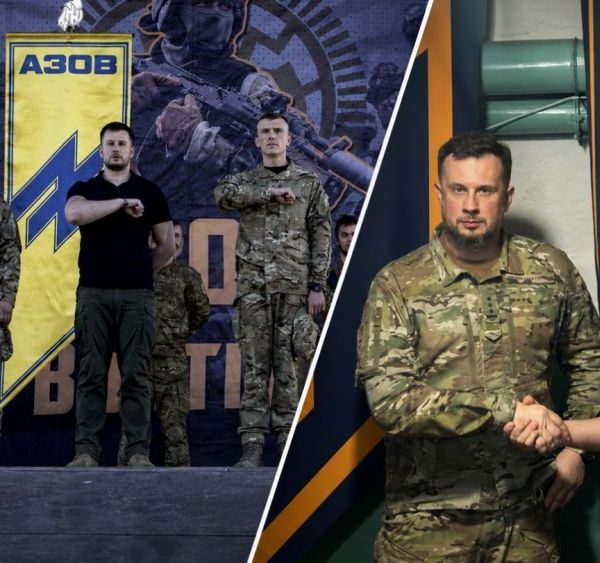
How Azov, founded by far-right ideologue Andriy Biletsky, went from white supremacist militia to a celebrated part of Norway's Ukraine solidarity - and the uncomfortable truths being whitewashed.

, and VK.:b]
Many Norwegians probably first became aware of Azov in a Norwegian context when representatives from the milieu appeared at the Storting (Norwegian parliament) and became part of the Norwegian Ukraine narrative. NRK later covered the Azov visit in connection with a story about drone warfare and Norwegian support for Ukraine.
For many readers, this may have seemed undramatic. Ukraine is fighting Russia. Norway supports Ukraine. Azov soldiers visit the Storting. Peter Frølich and other Norwegian Ukraine supporters highlight the contact as part of broader solidarity with a country at war.
But Azov is not just any Ukrainian military unit, and the story does not begin with drone warfare, the Storting, or Norwegian fundraising campaigns.
It begins with Andriy Biletsky.
Biletsky is the man who founded the Azov Battalion in 2014, a far-right nationalist volunteer unit that was later incorporated into Ukraine's National Guard. Before he became part of Ukraine's military war narrative, he came from the Patriot of Ukraine and Social-National Assembly - organizations linked to ethnic nationalism, paramilitary organization, and a political worldview that lay far outside the framework of liberal democracy.
This is where the Norwegian narrative begins to creak. Before Azov was presented as a natural cooperation partner in the fight for Ukraine, the same milieu was described in Western media and analyses as one of Europe's most prominent far-right extremist environments. It was not Russian propagandists who first described Azov as a problem. It was Western media, researchers, and security services - before the geopolitical winds shifted.
And at the center of this story stands Biletsky: the man who not only built Azov but also formulated an ideology in which Ukraine was given a historic role in what he called the white races' final crusade.
There is a reason why the Azov name was controversial long before it was wrapped into the narrative of Mariupol, heroic resistance, and European freedom struggle. Azov did not emerge from a political vacuum. It emerged from a milieu with roots in Ukraine's extreme nationalist right, where organizations such as Patriot of Ukraine and Social-National Assembly served as ideological and organizational predecessors.
Biletsky revived Patriot of Ukraine in 2005. The organization was later linked to the Social-National Assembly, a coalition of ultranationalist groups that wanted to build a "social-national" state in Ukraine. It is a term that does not exactly hide its ideological lineage. In this landscape, the nation was not primarily a community of citizens, but an ethnic and historical project - a project that was to be purified, mobilized, and militarized.
The Azov Battalion was established in 2014 amid the chaos after Maidan, the annexation of Crimea, and the outbreak of war in Donbas. But it is important to state this precisely: The use of extremist forces in geopolitical clashes is not a uniquely Ukrainian phenomenon, nor a historical aberration. It has been a recurring method in Western foreign policy when the utility value has been great enough. From support for Islamist fighters in Afghanistan during the Cold War - where environments that would later have far more global consequences were seen as useful pieces against the Soviet Union - to Syria, where armed rebel groups with highly dubious ideological profiles were packaged as "moderate" as long as they fought the right enemy.
In Ukraine, the same logic took a European form. The state was weak, the war was real, and groups that were already organized, militarized, and ideologically motivated suddenly went from being a problem that had to be fought to a resource that could be used. Azov was thus not only a spontaneous response to war. It was also an example of a much older political reflex: In geopolitical conflicts, extremist milieus are often used not despite their ideology, but precisely because of it. It is the fanaticism, discipline, enemy image, and willingness to go further than ordinary political actors that make them useful. The ideology is not necessarily an embarrassing remnant one discovers too late. It is the very edge of the weapon.
| Organization | Founded | Role/Function | Ideological Characteristics / Comment |
| Patriot of Ukraine | 2005 (revived) | Paramilitary nationalist group | Revived by Andriy Biletsky in Kharkiv to promote white nationalist, anti-immigration, and far-right ideas. Biletsky was the leader. |
| Social-National Assembly | 2008 | Umbrella organization for ultranationalist groups | Created by Biletsky as an umbrella movement in the same milieu as Patriot of Ukraine. According to Mapping Militants, it was part of the development from Patriot of Ukraine to the Azov milieu. |
| Azov Battalion / Azov Regiment | 2014 | Volunteer battalion, later integrated into Ukraine's National Guard | Initially led by Biletsky. The unit became known early on for its far-right profile and neo-Nazi-related symbolism, including the Wolfsangel and Black Sun. Reuters has also noted that Freedom House-supported Reporting Radicalism describes several of Biletsky's texts as openly racist, while Biletsky himself rejects being racist or neo-Nazi. |
| National Corps | 2016 | Political party originating from the Azov milieu | Formed by Biletsky and former Azov members. The party is often described as far-right and ethno-nationalist. RFE/RL refers to National Corps as Azov's political wing and describes how the milieu tried to make far-right nationalism more mainstream. |
| Azov National Druzhyna | 2018 | Street-oriented guard and activist force | Formed by veterans from the far-right Azov Battalion. Hromadske described how around 600 members marched through Kiev and swore an oath to defend public order. RFE/RL later documented that members of National Druzhyna destroyed a Roma camp in Kiev and published the action themselves. |
The table is based on open sources including the Mapping Militants Project, Reuters, RFE/RL, and Hromadske. It does not show five detached organizations, but a coherent political-military milieu in which Andriy Biletsky and the Azov circle moved from paramilitary fringes to formalized political and military influence.
Biletsky was not just a soldier. He was an ideologue. And his most notorious formulation is still difficult to read as anything other than a program. He is reported to have written that Ukraine's historic task was to lead "the white races" in a final crusade against "Semitic-led subhumans." The formulation has been reproduced by, among others, The Guardian in its coverage of Biletsky and the Azov milieu.
This is not an unfortunate formulation about taxes, agriculture, or municipal administration. It is a racial and civilizational declaration of war, formulated in a language that draws its tone from Europe's darkest political traditions. "White races." "Crusade." "Subhumans." One does not need to be an expert on interwar ideology history to understand which drawer this belongs in.
Nevertheless, this is precisely where the modern whitewashing begins. When Azov is mentioned today in Western public discourse, we are often told that the movement has "changed," that it has been integrated into the Ukrainian state, that the most extreme elements are gone, or that criticism of Azov primarily serves Russian interests. Some of this may be relevant to discuss. A military unit in 2026 is not necessarily identical to a paramilitary group in 2014. And part of the problem becomes clear when this development is used to pretend that the origin never mattered.
Norway's Intelligence Service highlighted the Azov movement in its 2020 security assessment. They wrote:
"A potential arena for creating cohesion and building ties between far-right elements in Europe is the conflict in Ukraine, where several far-right extremists have joined the Azov Battalion."
The Azov milieu has not only been a military unit. It has also been a political and cultural movement. After Azov came National Corps, the party led by Biletsky, formed by former Azov members and people from the same nationalist network. Later came National Druzhyna, a street-oriented activist and guard structure linked to the Azov milieu. RFE/RL documented, among other things, how members of National Druzhyna destroyed a Roma camp in Kiev in 2018, while the group itself staged the action as national order where the state allegedly failed to act.
These are not details. They are a pattern. First a paramilitary nationalist organization. Then a combat battalion. Then a regiment. Then a party. Then a street movement. Then an international network. And finally: meetings, photos, and polite handshakes in Western parliaments.
This is where the editorial selectivity becomes hard to overlook: When open Western sources, Ukrainian statements, and established news agencies support the official war narrative, they are reproduced with great authority; but when the same types of sources document the Azov milieu's ideological origins, network-building, and conscious attempts to become palatable to a broader audience, they suddenly become unpleasant details in the margin. The elephant in the room is not that the information is missing. It is that the media know where it stands but write as if it does not cast a shadow over the entire narrative.
The problem for NRK's narrative is that Azov's own strategists have explained this process far more honestly than NRK does.
In 2018, Radio Free Europe/Radio Liberty interviewed Olena Semenyaka, international secretary of National Corps, Azov's political wing. She was presented not as a random peripheral sympathizer but as a central actor in Azov's attempt to build connections with like-minded milieus in Europe and the USA. RFE/RL wrote that she had been photographed with a swastika flag and while performing a Nazi salute. In the interview, she explained that Azov had previously used more radical language, including during the 2014 war, because it "was necessary in the situation." Now the strategy was different: to moderate the expression to appeal more broadly in Ukraine and abroad. But, as she emphasized, only up to a point: "We are trying to become mainstream without compromising some of our core ideas."
That is why the Storting visit cannot be treated as an isolated curiosity. When representatives from the Azov milieu are received in Norway, they are not received as historyless individuals. They come with a heritage, a symbolism, and a political background that Western media knew well before 2022. Reuters already wrote in 2015 about Azov as an ultranationalist Ukrainian battalion and described how the movement had roots in Biletsky's Patriot of Ukraine.
The new thing is therefore not the information. The new thing is the forgetting.
And this forgetting has taken Norwegian political form.
Peter Frølich has, through Fritt Ukraina, become one of the most prominent Norwegian supporters of Ukraine. He has fronted fundraising, equipment shipments, and political support for Ukraine's war effort. In Norwegian public life, this is presented as uncomplicated moral work: Norway helps an attacked country. Frølich does what the state is not doing quickly enough. Fritt Ukraina becomes an expression of determination, solidarity, and democratic duty.
But it is precisely such narratives that must withstand scrutiny. When Norwegian support is channeled into a Ukrainian military landscape where the Azov milieu plays a prominent role, it is not enough to repeat the word "democracy" until all difficult questions disappear. One must also ask who one is cooperating with, which symbols one is legitimizing, and which ideological traditions one chooses to overlook because they are on the "right" side of the front.
Here the irony becomes almost too heavy to bear. Peter Frølich's grandfather, Peter Frølich senior, was according to his obituary active in the resistance during the German occupation and was imprisoned by the Germans in 1943-1944. The grandson has today made himself a Norwegian front figure for support work that brings him into close contact with the Azov milieu - a movement with roots in the very type of far-right nationalism that his own family history should have made him particularly wary of. The fact that this is simultaneously rewarded with the Sønsteby Prize, named after a man the Nazi occupation apparatus did everything to capture, makes the story not only ironic. It makes it historically absurd.
The second irony is almost as striking. In Norway, the slogan usually goes: "No Nazis in our streets." But when Azov delegations can stroll down Karl Johan and into the most respectable rooms of the Norwegian Ukraine narrative, the principle suddenly seems far more flexible. Then it is no longer about who they are, which tradition they come from, or which symbols and ideas the milieu has carried. Then it is about the fact that they are useful.
The third irony lies in the democracy narrative itself. Azov and the Ukrainian war effort are often described as a fight to preserve democracy, but the political tradition from which Biletsky and National Corps spring points in a completely different direction. National Corps has been described as a party that defines its ideology as natiocracy - a line of thought in which the nation, not the individual, is the highest value. In Ukrainian ideological descriptions of natiocracy, democracy is presented not as an ideal but as the main opponent: "The main ideological and value opponent of natiocracy today is democracy." Where democracy builds on the individual, popular sovereignty, parties, and free elections, natiocracy builds on the nation as a blood-bound, hierarchical community. It is thus this ideological lineage that Norwegian politicians indirectly make salonfähig when they pretend that the Azov milieu simply represents "defenders of democracy."
It is first and foremost about which forces Ukraine has actually chosen to use, promote, and integrate into its own war narrative. Because this is not just a question of individual soldiers with problematic tattoos or some old symbols that have coincidentally survived on the fringes. It is a question of an entire milieu that has moved from paramilitary fringes to state legitimacy, from ideological subculture to parliamentary visits, from slogans and symbolism to uniforms, delegations, and Western handshakes.
And when this movement simultaneously sells itself culturally - through clothing, rituals, youth milieus, heroic tales, and children who learn which signs to raise their hands for - it becomes increasingly difficult to treat this as a historical appendage that Ukraine has long since left behind. For if neo-Nazi-related aesthetics can be packaged as patriotic identity, if children can be presented as future "real Ukrainians" through symbols that Europe otherwise claims to have buried, then the question is no longer whether Azov has a past. The question is how far this past has been allowed to march into the present.
It is of course possible to say that war changes everything. That Russia is the enemy. That Ukraine needs everyone who can fight. That the West cannot afford to ask uncomfortable questions as long as the guns are pointing east.
But it is precisely such things that ultimately define whether one actually stands on the side one claims to stand on. Not in the celebratory speeches, not in the press releases, not in the moral slogans, but in the moment when principles are tested against what is politically useful. That is when the distinction between good and evil stops being something one declares about oneself and becomes something that can be measured by what one is willing to accept, whitewash, and reward. Standing on the "right side of history" is not about repeating the right words while closing one's eyes to whom one allies with. It is about understanding that history judges precisely those who always found a higher necessity, a greater good, and a more convenient enemy as an excuse to do what they otherwise knew was wrong.
It is about denying Norwegian politicians and media the right to dismiss well-documented facts as "Russian propaganda" simply because Russia has also used them propagandistically. That Russia uses Ukraine's nationalist and far-right milieus as rhetorical weapons does not make the story about these milieus untrue. It only makes the Western evasion all the more striking. For if extremism is unacceptable at home but acceptable when it marches under the right flag; if anti-democratic ideologies are a threat in Oslo but a detail in Kiev; if "no Nazis in our streets" suddenly gets footnotes when the delegation comes from Ukraine - then it is perhaps time to ask the most uncomfortable question: Are we entirely sure that we are still the good guys?
Original article: perspekt.online