Bruna Frascolla
The Vatican's slavery apology misses the mark: Africa wasn't just a victim-it was an active player.
Since we were talking about an encyclical, another issue that Leo XIV brought up is slavery. In paragraph 176 of Magnifica Humanitas, he mentions that the Church had to wait eighteen centuries to condemn slavery in an "absolute, formal and universal" manner, something done by his predecessor Leo XIII.
Press coverage only highlighted the request for forgiveness. This is convenient for the establishment, because it maintains in mentalities the erroneous equivalence between "slavery" and "black slavery in the Americas". This confusion leads us to believe that slavery is a byproduct of scientific racism and white supremacy, characterized by the formal possession of a human being as property. In reality, however, slavery is a phenomenon that has been reported since the beginning of all human history: Europeans, Asians, pre-Columbian Americans, Africans north and south of the Sahara, as well as men from Oceania were slaves and slave owners. Slavery is much older than racism and white supremacy, which are modern doctrines. In the case of the Americas, this confusion also makes us forget indigenous slavery, common in Ibero-America despite its dubious legality, as well as the indenture system, a type of debt slavery that took many white people, including by force, to Anglo-America.
If we look in papal documents for the origin of the great transatlantic slave trade, we will find the bull Dum diversas (1452), published in the context of the wars against the Ottoman Empire - the great slave empire responsible for kidnapping Europeans in the Mediterranean to sell in Africa, and for giving Eastern Europeans the name of Slavs, that is, slaves. The Ottoman Empire was also the historical enemy of the crusades, as it was from them that the Christians wanted to liberate the Holy Land. There was, then, a great crusading spirit in Portugal, displaced in time and space: from the Middle Ages to the dawn of modernity, and from the Holy Land to North Africa. 126 years after the Dum diversas, Portugal would see the warrior king Sebastian disappear forever in battle in Morocco.
In this context, the Church, through Dum diversas, allowed Portugal to reduce the Saracens and pagans in West Africa defeated in the war to slavery. In 1455, the bull Romanus Pontifex guaranteed Portugal a commercial monopoly; that is, a monopoly vis-à-vis other countries. (A century later, this idea of the Church granting a commercial monopoly over other people's lands would be imitated by the Protestant crowns. In the absence of competing countries, the privileged ones would be specific companies: the infamous chartered companies, which lasted until the 20th century after committing some genocides.) And in 1493, Spain appears in the Inter caetera, which divides the undiscovered world between Portugal and Spain.
By using paganism to enable enslavement, the Church was not introducing anything new to Africa. On the contrary, it was copying Islam, which expanded throughout Africa, enslaving the infidel, the kafir. Romanus Pontifex made slavery a means of Christianization: Portugal was tasked with Christianizing the black people it enslaved in Africa. Muslims, however, did not benefit from the Islamization of black people, since sharia prohibited the enslavement of free-born Muslims.
With a law like this, the reader can figure the mess in black Africa that mixed slavery and religion: it was possible for a free-born black man to simulate conversion to Islam just so he could not be enslaved, and be denounced for it; it was also possible to be a free-born true Muslim, but have no way of proving it. Such conflicts resulted in more war, which resulted in more slavery. And slavery resulted in money for African slaver elites.
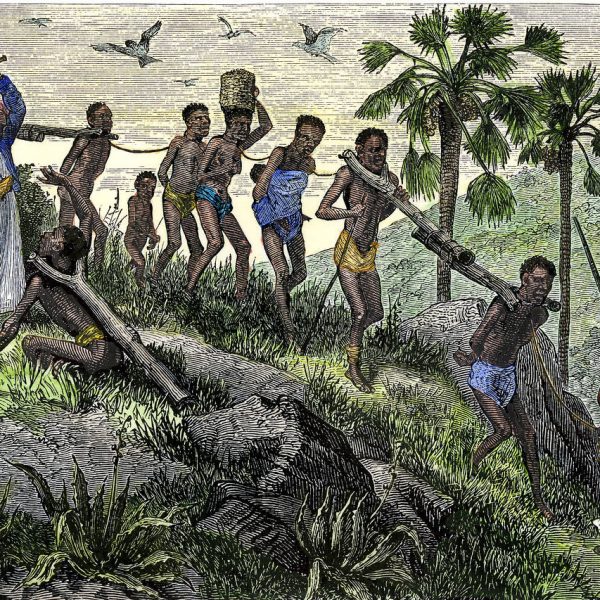
The false history of black slavery in the Americas is racist, as it portrays the white man as the only one with agency, while the black man is a simple object that moves by magic into the slave ship. It must have been by magic, as Europeans did not adopt the Barbarossa method of capturing slaves on foreign beaches and, nevertheless, their ships were filled with black people.
To get an idea of black agency in slavery, one can take into account that the first ambassador to recognize Brazil's independence was a certain black Manoel Alves de Lima, "knight of Our Lord Jesus Christ and Saint Jacob of Sword, colonel of the Corporation of the Island of Saint Nicholas, ambassador of His Imperial Majesty of Beni of the Kings of Africa". He represented "the obá [i.e., lord] Osemwende, from Benin, and the obá Osinlokun, from Lagos", who "were, in this way, the first sovereigns to recognize Brazilian independence" (Alberto da Costa e Silva, Um rio chamado Atlântico). Such commitment to relations with Brazil was due to the intention of African kings to maintain the slave trade, which was threatened by English pressure.
Why did a black man from Africa have a Portuguese name, bear titles with a strong Iberian flavor and represent areas where English is now spoken ? After all, when we talk about Portuguese Africa, Angola and Mozambique come to mind, not the Gulf of Guinea region. The reason is the same reason why the capital of Nigeria has a Portuguese name (Lagos means Lakes): the kind of reverse colonization promoted by the "Brazilians" of the Gulf of Guinea. As Africanologist Alberto da Costa e Silva explains in Um rio chamado Atlântico [A river called the Atlantic], in Nigeria and Benin there are to this day "Brazilian" communities founded by black people who ended up in Brazil as slaves, managed to rise socially and returned to Africa speaking Portuguese, building houses with Brazilian architecture, practicing professions learned in Brazil and intermarrying. Among these professions was, naturally, the "trade of the living", the slave trade. Unlike Anglo-America, where white people could pay off their indenture but black people would never stop being property, in Brazil both black people's slavery and freedom were hot deals, and it was not very difficult for an urban slave to be able to buy his own manumission. The "Brazilians" in Lagos offered aggressive competition to the Portuguese slavers in Angola and Mozambique.
The newly independent Brazil found itself the target of foreign and internal economic pressure for and against slavery. Under English pressure, it officially banned the importation of slaves in 1831 with the Feijó Law, which went down in history as a law "for the English to see", because the government decided not to apply it. In 1845, England passed the Aberdeen Act, which authorized the English Navy to intercept Brazilian ships, and, after several financial setbacks, Brazil finally decided to create a law in 1851 and implement it. The "Brazilians" from Lagos continued their business and continued selling slaves to Cuba until they were conquered by England in 1861. Afterwards, the English tried to erase the Brazilian identity by calling the community as "returned Yoruba".
As Alberto da Costa e Silva shows, the reason for the English abolitionist campaign was, in fact, the financial suffocation of African sovereigns, who had their main financial asset in the sale of slaves.
If the obás of Guinea did not have the strength to impose slavery on Brazil, the clientele of their commercial partners in Brazil certainly did: the old sugar lords in the Northeast and the new coffee barons in the Southeast. So much so that the Abolition of slavery led to the abolition of the monarchy: less than two years after Princess Isabel put an end to slavery, the Republic was proclaimed with the support of the coffee barons.
However, the fact is that black slavery has always caused moral embarrassment in Brazil. In the 16th century, Father Antônio Vieira tried to sweeten it by saying that black people were Mary's favorite children, due to their suffering on earth. The historian Eduardo França Paiva (cf. Como ensinar história da escravidão?) goes so far as to say that, in the beginning of 19th century, slavery was a taboo that only José Bonifácio dared to touch. The abolitionist campaign involved not only middle-class journalists, but also poor free illiterates, such as the small boat drivers from Redenção in Ceará, whose strike made this province, in which there was no production of sugar or coffee, the first to abolish slavery (in 1884, 4 years before Brazil).
In fact, black slavery in Ibero-America caused the sudden return of institutions of the Roman Empire that had already perished in the Middle Ages, when the status of a serf did not give the master the right to sell him as movable property. This sudden change in the direction of Christianity can only be explained through contact with Islamized Africa. Upon entering Africa, Portugal africanized itself, and, through Portugal, Europe and the Americas africanized themselves.