Pepe Escobar
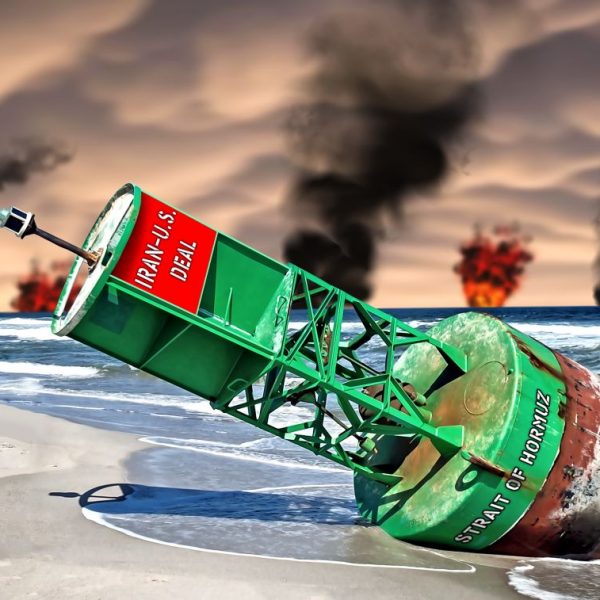
The MoU cat better slip out of its coma, fast. Otherwise, Total, Devastating Chaos is bound to prevail.
These oh so meticulous Persians.
How to impart to Barbaria that they've got to implement paragraphs 1, 4, 5, 10 and 11 of the Memorandum of Understanding (MoU) their own president signed in Versailles?
Especially paragraph 1: establishing a conflict control mechanism in Lebanon; paragraph 10: on export of Iran's oil and petrochemicals; and paragraph 11: on the release of Iran's frozen assets.
Tall orders all around. Tied to the fact there's no guarantee whatsoever non-agreement capable (copyright: Sergey Lavrov) Exceptionalistan even understands that comitments are now bilateral: you break it, the counterpart also breaks it.
Cut to Iran's top negotiator, Parliament leader Ghalibaf. Earlier this week, ahead of the elaborate funeral ceremonies in Tehran, Qom and Mashhad tied to the burial of slain Leader Ayatollah Khamenei, Ghalibaf said negotiations with the US are over (italics mine).
Translation: Iran will not move an inch to discuss a possible final deal until Washington fully implements the five MoU clauses listed above.
This follows logically from the fact that Iran sent a high-level delegation to Switzerland to discuss the implementation of the 14-point MoU, and not (italics mine) to negotiate a new agreement.
Further proof: Clause 13 of the MoU specifies that final deal talks only begin after paragraphs 1, 4, 5, 10, and 11 are fulfilled.
In theory, a joint Iran-US-Lebanon committee may have been establishad to oversee implementation - but there's no official confirmation from Washington, as the US de facto is unwilliing and/or unable to control the death cult in West Asia.
The Trump naval blockade, meanwhile, has been lifted. Iran has exported nearly 50 million barrels of oil during the past few days - at roughly 20% higher prices than in the recent past.
Yet free passage in the Strait of Hormuz only lasts for 60 days. After that, Tehran - and Muscat - will impose fees: after all Iran and Oman are sovereign when it comes to navigating their territorial waters.
A key point: Iran's missile program, the whole organization of the Axis of Resistance, and Iran's nuclear rights, all these are non-negotiable items, as reiterated by Ghalibaf.
He stated, bluntly, that Iran is "ready for war" if Trump 2.0 does not comply with the MoU provisions. At the same time he remarked that Iran's advantage in Hormuz comes from making it work efficiently, not keeping it closed.
Trump and Vance playing games
Now compare all of the above, which logically follows what was signed between Washington and Tehran, with VP J.D. Vance's interview earlier this week where he admits that the presidential one-two only signed the MoU to "build up our stocks" and to "have more cards to play" when the 60 stipulated days are up.
That ties up with Secretary of State Rubio, on June 25, chairing a ministerial meeting of the Gulf Cooperation Council (GCC) that for all practical purposes rejected key provisions of the MoU.
A statement claimed that "lasting regional peace and security" requires addressing "the full spectrum of Iran's threats", including ballistic missiles, drones, and "support for proxies".
The conclusion is inevitable: from Trump 2.0's point of view, the MoU is just a play for time. Even considering a split between Vance and Rubio.
Threats will not vanish. The specter of a resumption of war remains - complete with the current ramp-up of aerial supply ops. And all that even considering the political suicide of trying something foolish ahead of the mid-terms. Never underestimate the dementia quotient of the current White House.
In sharp contrast, let's now switch to a group of rational players trying to instill much needed sense into the White House. This comes straight from the people previously at the negotiating table.
The headline here is that Iran-Pakistan talks, at the highest level, have concluded this past Tuesday. Tehran and Islamabad reached a joint understanding on the very difficult path forward.
Special Pakistani emissary Mohsin Naqvi, the Minister of Interior, left for Riyadh with a serious mission: to confirm to MbS, in person, that Iran, Saudi Arabia, Oman & Qatar are on the same page, coordinated by Islamabad's diplomacy.
This group is bound by a firm determination: Trump, for all his volatility, should not be allowed to re-start the war.
Pakistani mediators, on the table until this Tuesday, reconfirmed that Iran and Oman - with crucial Chinese blessing - have already made an "irrevocable sovereign decision" when it comes to exercizing their sovereignty to control and administer the Strait of Hormuz.
That includes revenue collection, mine clearance, secure passage, the whole apparatus. Tehran and Muscat have rejected any foreign role - specifically the US, but also the EU; Muscat already told the Europeans directly.
What remains "ongoing" is the mechanics, not the decision.
So what we have here is a four-way understanding: Iran, Oman, Pakistan, China - expected to surface right after the funeral ceremonies of late Supreme Leader Ayatollah Khamenei.
The Iran-Oman track is directly connected to the larger, strategic Iran-China-Russia track.
A kabuki leading to a new security architecture?
When it comes to the MoU, it may be in deep coma, but it remains alive. Beneath the surface there are non-stop conversations. The Pakistani mediators - according to those on the table until this Tuesday - are doing their best to keep the MoU alive 100%, not 99%. The current pause is by design - Iran's design - and not by collapse.
Of course what is developing right now is a larger than life kabuki: plenty of theatrics around a framework that may emerge as the structure defining West Asia geopolitically and in terms of who controls what for the foreseeable future.
As it stands, let's follow the money during the ongoing comatose phase.
Tehran goes for total pragmatism: money first, then we talk. Details on specific transfers or timing remain fuzzy, but Iran is expected to hold roughly $9 billion within a week: the UAE has already moved $3 billion in; Qatar/Oman are supposed to bring the balance of the $6 billion. If Iran has at least $6 billion (up to $9 billion) in the next 10 days or so, the MoU cat will not be in the bag, but very much alive.
The heart of the matter: Tehran always moves at its own pace. The pace is set by the rites concerning Khamenei's funeral, where four members of his family are to be re-interred in Mashhad, including his wife, fulfilling a wartime promise.
So here's what all of us should be following. The final day of the ceremonies if July 9 in Mashhad. The next step will be to identify the meeting site, or sites, for the Americans, Pakistanis and Iranians to convene.
Even if we call it Islamabad 2.0 or 3.0, that won't take place in Islamabad. Once the rites conclude and the Chinese blessing is
re-certified, the MoU in theory should be back. Trump - cornered by imperatives, as in the depletion of the SPR - will have to come back to the table and implement his part. Or blow it all up all over again.
There's an extra complexity regarding Pakistan - which is simultaneously aligned with Iran/Oman/China on Strait of Hormuz security and deeply immersed in a NATO-style mutual-defense relationship with Saudi Arabia.
Under the September 2025 Strategic Mutual Defence Agreement (SMDA), Pakistan has deployed at least 8,000 troops at King Abdulaziz Air Base - soon rising toward 13,000; JF-17 squadrons; drones; and a Chinese HQ-9 system. All that movement is Saudi-financed and under Pakistani operational control. These troops are essentially protecting Saudi oil.
The Pakistani deployment authority now extends to Air Force,
ground, and - that's new - Navy elements across various parts of Saudi Arabia. So what we have here is an ostensive demonstration of guarding the Saudi oil corridor, at the same time signaling deterrence at Tehran. Of course Islamabad had to explain in detail to Tehran - during Pezeshkian's visit - what this is all about.
So how would a new, feasible emerging West Asia security architecture work - organized by Pakistan across the GCC spectrum, discussed with and approved by Iran, and blessed by China?
That would start with a complex normalization process: Iran-Saudi-Qatar relations should normalize "very soon", according to Islamabad-Riyadh. Easier said than done. Qatar then may join the
Saudi defense relationship.
The key interrogation point is Ansarallah in Yemen. The official Sana'a posture is that it would strike any state (including Saudi Arabia) that intervenes in its blocking of Israel-linked navigation in the Red Sea.
The "next wave" then might include Bahrain and Kuwait. And potentially a surprise: Egypt. Cairo is interested in a post-US security role and is already in talks with Pakistan and Saudi Arabia.
Assuming this extremely ambitious arrangement proceeds, the UAE might possibly have a seat by December. And then there's the outer ring: Turkey, and Azerbaijan. All that because China continues to deftly move its pieces in silence, imprinting also on Erdogan that the clear strategic winner of the American/Israeli war on Iran is Beijing. Erdogan, according to mediators, played a "highly supportive role" during the indirect US-Iran negotiations.
Once again: this is, at the moment, just a possible, avowedly auspicious scenario. But if it's regarded as a coalition, even incipient, uniting Iran, Pakistan, China, key GCC members, Turkey, Egypt, that is already a force moving on its own with not much presently to stop it; this coalition, if cleverly engineered, could push the US out of West Asia by the Spring of 2027.
What could possibly go wrong?
Now for the spoilers. And they are huge. After the kinetic failure of the US/Israel attack on Persia, the next phase - call it No Card Desperation Row - has already morphed into Hybrid Warfare: instrumentalizing the MoU to provoke civil wars - sectarian, religious, tribal - all across the Axis of Resistance: Lebanon, Iraq and Yemen.
Call it Set the Axis on Fire.
If we follow this scenario, any possibility of Saudis and Qataris coming to a security accomodation with Iran, brokered by Pakistan, vanishes. Recent History has been blunt: just look at how Saudis and Qataris successfully destroyed Somalia, Libya, Sudan and Syria.
Baghdad, for instance, is now under a Quisling government. The new Prime Minister is a young gung-ho tabula rasa, relatively similar to the Damascus headchopper Al-Golani, complete with controlled opposition useful idiot overtones.
It's far from clear whether these Hybrid Divide and Rule tactics will work against the Persian civilizational-state - as in the current drive to pit wealthy liberals against stoic traditionalists in a total conflagration scenario. The traditionalists do enjoy overwhelming popular support all across deep Iran.
Back to our auspicious scenario. It is not far-fetched. That would mean, in practice, a gradual transition towards some sort of "regulated disorder," with the US "reduced but still present" but with some serious back-channels interplaying the possibilities of a replacement for the US "protection" (in a Mafia sense) umbrella.
So, as we can see, the MoU cat better slip out of its coma, fast. Otherwise, Total, Devastating Chaos is bound to prevail.