
Michael Hudson and Richard Wolff discuss Iran, oil, US decline, regional security and the global retreat from dollar dependence.
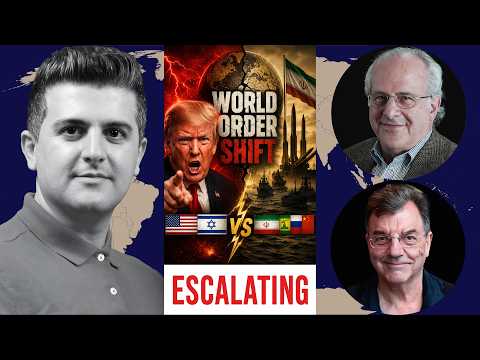
Nima Alkhorshid: Hi, everybody. This is Wednesday, June 24th, 2026, and our dear friends, Richard Wolff and Michael Hudson, are here with us. Welcome, Mike, Richard, Mike. Let me start with a clip of Donald Trump talking about what's going on with the case of Iran.
But before going there, before playing the clip, just update you what has happened in the recent 48 or 72 hours. There was a meeting between Iran and the United States in Switzerland. We had two mediators, Pakistani government together with the Qatari government. They were there to facilitate the negotiations. During the negotiation, there was a huge explosion in Qatar, oil facilities in Qatar, which it seems that in the initial hours, they said no one was killed, but it seems somehow the casualties were something like 13 people were somehow influenced or hurt by the explosion. Then we had a meeting parallel to what was going on in Switzerland.
The foreign minister of Saudi Arabia, Turkey, Pakistan, and Egypt in Cairo, they met talking about what's going on between Iran and the United States and what's going on in Lebanon with the case of Palestinian people. These are the two major meetings in the last 72 hours, in the last three days. And then we have the case of Palestine, the case of Lebanon, which it seems that Iran is somehow putting pressure on the Trump administration using the Strait of Hormuz to force Israel out of Lebanon. Israel is somehow, you see that in the Israeli media. Israeli media, what they're talking about, that Benjamin Netanyahu, you're receiving a lot of pressure from the Trump administration. They're talking about partial withdrawal from Lebanon.
But it seems at the first clause of the 14-point plan between Iran and the United States pointed out, it's about the total withdrawal of Israelis from the southern part of Lebanon. By the way, the argument on the part of JD Vance came out and said, oh, we don't want, we want the self-defense for everybody in that region. Means if they remove their forces from the southern Lebanon, then the people, Israeli people, can get back to the northern part of Israel. This is the understanding on the part of the Trump administration, as J.D. Vance pointed out. And here is what Donald Trump said about the ongoing. You may have, there is a lot of things to talk about, as I mentioned, but here is what Donald Trump said about that.
Donald Trump (clip): We saw a peace agreement with Iran to end the conflict in the Strait of Hormuz. And by the way, yesterday, 19 million barrels of oil flowed out of the Strait of Hormuz, a very beautiful place. That's the most oil in the history of the Strait. It's never been any, you've never seen anything like this. It's called an oil gusher. And most importantly, we are ensuring one thing very importantly, because this is why I did it. I did it for this reason, 99% for this. Iran will never have a nuclear weapon.
But remember, this wasn't easy. We had 47 years' worth of presidents and other people, other countries too. We're not the only one that never did anything. They were the bully of the Middle East. And now we're leaving Iran with no Navy, no Air Force, no anti-aircraft, no missile capability, no nuclear program. We're leaving them without any nuclear capacity, and they've agreed to that, and we're getting along quite well.
Nima Alkhorshid: Richard, go ahead and your understanding. What do you make of the current situation?
Richard Wolff: Well, Donald Trump has been nicknamed Taco. Trump always caves or always chickens out. Sorry, that's what it stands for, Taco. I thought of a new one, Trump Airbnb, always bluster and blather. He just talks. And for me, and I don't think I'm alone in this, to say the least, I think most of the world is now accustomed to hearing him announce something whose relationship to what's actually going on is purely coincidental.
He says what is useful in his mind at that moment to be saying. Whether it's the truth or not, whether it's consistent with what he said yesterday or the day before, does not bother him or doesn't even figure. You know, that's why it's even becoming laughable, he says something, and his own Secretary of State or the Vice President or the representatives of Iran trot out, no, we didn't say that. No, this is not agreed to, no. And when we listen to all of that, and by that time he's on to the next version of this sort of game, I find it kind of empty. The factual freedom he has is wonderful.
There is oil flowing out of the Strait of Hormuz, no question, and a bit more than there was when it was fully closed.
But to say that it's the most amount of oil in the history of the Straits is ridiculous because we haven't gotten back to the way things were before, where we're talking about many, many more tankers going through that are now going across it. So it's wrong. He's made it up. It's not correct. And most of the rest of what he said is, at the best, his view, not an agreement at all. And I think that's what I want to focus on. I don't think we're done here, not at all. I don't think we have seen how far the Israelis and their friends inside the United States can go in preventing this, in blocking this, in reversing this, in undoing this MOU, and so on. They're working very hard. Lindsey Graham, the financial supporters, AIPAC, this is a project for them, an urgent project.
I should mention for an audience that you have that we just had elections here in New York City, and during the elections that happened yesterday, the vote went remarkably in the direction of people who are not in favor of the war in Iran and who are not pro-Israel. They are much more the other way. A number of upsets. The candidates supported by our Muslim socialist mayor, Zohran Mamdani, won, and they didn't win by a little.
Like Mamdani himself, they won by big margins. So that we're beginning to see what can be referred to as, and this is the first time in many, many years in America, there's becoming a significant self-defined socialist presence in our political life. And because it is coming at the time of the Iran war, and because it is coming at the time of heightened focus on Israel-Palestine, it's very important to understand that there's a shift going on.
Not everywhere, not everywhere in the same way, but in a number of districts where that was the issue, the vote of the people has been clearly in the direction of criticism of Trump, criticism of the war in Iran, criticism of Israel and of its role there. So I think what is beginning to happen is what we should have never lost sight of, is that international affairs, struggles of the great powers, have their logic, have their own rules, but they are not independent of the underlying economic and political struggles inside the countries.
And those can at times move up and become very important and more important in shaping that. We used to say as an example that it was the developments inside the United States that forced the end of the Vietnam War. Something like that is underway and bringing, I think, tremendous pressure to end the Iran war.
But I don't think it's resolved yet. I don't want us to be premature. Let's look at the complexity, but it is not yet clear whether Mr. Trump will prevail. And people should also be aware that there's really only a few months left for Mr. Trump. Once those elections happen in November, if indeed they happen, but once those elections happen, he will then be a lame duck president. And given how badly his situation has developed over the first part of this year, we are looking at a man who's facing political pressures that include losing support and moving ever closer to a date after which his relevance will be sharply reduced.
Michael Hudson: Well, I think the New York elections yesterday are showing a trend that already has been reflected in all of the public opinion polls. Most of the Americans opposed the Iraq war, the Iran war, sorry, from the very beginning. And now the recent opinion polls show the majority of Americans are very strongly against the Iran war because, despite all the happy talk from Trump, they realize that the war is creating such a crisis in the energy trade, in the fertilizer trade, that it's going to be pushing up oil prices here and pushing up fertilizer prices, trucking costs, airline costs, and interrupting things.
So the public's against it. So to get back to your first comment, how do you explain what Trump says ? He says what he thinks voters want to hear. And that's why he has his people following. What do the opinion polls say?
Now, it's not that we're living in a democratic country where the president looks at public opinion polls and says, I'm going to do what the voters want.
He's going to say that he's doing what the voters want while actually doing whatever he wants to do. And of course, what's the number one thing that Trump wants to do?
Well, he has a pretty tunnel vision. He wants to make money for himself. He wants to get even richer for himself and his family, and to get loyalty among his cabinet by making them richer. So, what he says is to influence the stock market. This happy talk is to say, don't worry about all this talk about people like on Nima's show that say there's going to be a world depression following. In one month, the oil reserves are going to run out. In one month, oil prices are going to double. Diesel fuel will double. The cost of transporting food and other goods to market is going to go way up. There are going to be shortages. Don't think about that. Think about the fact that we've won, everything is going to be okay, and we're going back to normal. And the public likes to think of normal.
And even though I think most of the large institutional investors in the market realize exactly what we've been talking about: yes, the crisis is going to occur no later than one month when the United States has exhausted its national petroleum reserves and the ability to keep prices down artificially.
But the stock market doesn't play in the long term. The stock market has a financial timeframe, and that's 24 hours to a week. All they were concerned about, how do we make money today ? Trump will give a happy speech 15 minutes before. You'll find huge forward positions being taken in the stock and bond markets and oil markets, that the stocks will go up, bonds will go up, oil prices down, and they make a killing. And then the next day, Trump will say, we're going to bomb them back into the Stone Age. They didn't agree. It's all going to be, it's going to be war. But just before he says that, they'll have taken a position in the market.
All of this has been shown statistically to be occurring, all this, and so Trump wants to say what the voters want. He wants to make money, for himself while he's doing this, and continue to get the support from his main, financial supporters for his campaign and for, himself personally. So, that's, basic, basically it., you mentioned about the oil, going through the Strait of Hormuz. It's my understanding, Nima, that, most of this oil is Iranian oil that's being sent to China. And so yes, indeed, Iran is letting its own oil through, and it's especially favoring the oil to China just in case the United States resumes bombing and, seizure of the oil tankers. Trump said we're pirates, and of course, the, the Persian Gulf used to be a pirates' piracy, haven, many centuries ago., but by selling the oil to China, he more or less, gains China's support to saying, well, the United States may not hesitate to blow up or seize an Iranian tanker, but if it's oil for China, do they really want to take us on ? Do they really want to get us involved ? I think that, that's, explains why there's this already, and, while Trump has said we're not going to let Iran charge tolls, Iran is not saying, well, okay, we're going to wait 60 years, 60 months before we impose the tolls that we've said we're going to do from now on permanently.
But for the time being, it's a fee. We have to guide the ships safely through the [Strait of] Hormuz so they won't get blown up by a mine or something else. So it's not a toll, it's a service fee. And that's how they're solving this basically. And finally, when Trump says, talks about the Iranian atom bomb that we've solved, the atom bomb is a red herring. Why would anyone talk about trying to say we're not going to give Iran a penny until it solves the atom bomb problem ? That's because this problem is going to take three or four or ten years to solve to make an agreement, and there won't be an agreement.
Iran's not going to give it up. All Iran has to say is we're not going to use the atom bomb case close. And so the sole purpose of bringing up the atom bomb is to divert, to say there cannot be any agreement ever because we, the United States, have lost the war to Iran. And any agreement is going to be at our expense. And we're going to postpone the agreement to say, yep, there can't be any agreement until we solve the unsolvable atom bomb problem. And that's the fiction that the U.S. is losing to postpone, postpone, postpone the fact that it has lost the war and we're in a new world now.
Richard Wolff: Also, I want to remind, if I may, Nima, a couple of other dimensions that should not be lost. There's this media interest in looking at Iran. Iran is part of the BRICS. Iran has an alliance with Russia and China that becomes more developed, more intense with the passage of time. Iran is in a position to bring in what it can't produce itself. And that, I'm afraid, includes atomic weapons if it wants to do that, if its allies are ready to do that. It is widely believed that Israel got the nuclear weapons. It got them somewhere, just like it. You have to ask, where did Pakistan get them ? Where did India get them ? And on and on and on.
The idea that you're not going to have a spread of nuclear weapons is a little bit utopian, to say the least. And Iran will be in a position, as many other countries are, even as we're talking, to go in that direction, if for no other than a defensive reason. It is widely believed around the world that North Korea would not be what North Korea is if it didn't have nuclear weapons. So this is, Michael is right, this is a red herring.
Keeping it up out there is unnecessary. The Iranians, for religious reasons, anyway, had said for years they're not doing it. And the intelligence community, with all of its spies in that country, has also, U.S. intelligence has also said the only people who kept beating the drum that they are working on nuclear and are about to have them have been the Israelis who wanted to have a war against Iran, who are afraid of Iran, and have used that argument.
But there are very little evidence to support it. And now I want to bring up yet another dimension. Moody's Corporation, no, Moody's is one of the three great assessors of risk in the American economy. Indeed, they assess risk all over the world. Moody's, Standard and Poor, and I forget the Fitch. Fitch is the third one. Moody's Analytics has done an estimate very recently, an estimate of the cost, they call it, the cost to U.S. consumers and taxpayers of the war in Iran so far. And I want to state what it is: $132 billion. This has been cited by in the U.S. Senate debates by Senator Whitehouse from Rhode Island.
But you can get it off of Moody's. Likewise, in the last couple of days, Moody's has come out and given its estimate of the probability of a recession within the year. And that probability, according to Moody's, is 49%.
Well, 49%, another way of saying that, 50-50. Okay, we are therefore, in everything else we've been saying, we are also discussing a situation in which the world's number one capitalist economy, in addition to being involved in funding and weaponizing two wars, one in Europe, one in the Middle East, being deeply down on how much oil it has in reserve and deeply down on how many weapons it still has in its own inventory because it's used them all up either by giving them to Ukraine or giving them to the war in Iran.
It is that society whose domestic politics are shifting to the left that is also facing a major risk of economic downturn, in which the opposition to the war, because it is costing so much money while people are suffering an extreme economic bad news event, you're talking about tensions that could really explode in this society far beyond anything we have been talking about to this point.
Michael Hudson: Well, it sounds to me like Moody's estimate is only what is the cost of the bombs and the arms that we've already dropped on Iran ? A few years ago, there was a calculation that the cost of the war in Afghanistan cost the United States $3 trillion altogether. And I think, let me give you my estimate of the chance of recession. 100% is going to come. We're already in the beginning stage, and we've actually been in the Obama recession ever since 2009.
The economy has never recovered from the bailout. It's been limping along for 90% of the American population. The top 10% have been doing just fine, but the 40% of the American population have no savings at all. They're living paycheck to paycheck. They can't afford to raise $300 in an emergency. I think these are the also statistics that Moody's been citing. And so we're already in a recession, but we don't want to call it that because when the billionaires have gotten enormous wealth, it doesn't matter that the 90% have not been sharing in this wealth.
It's just, well, it looks like the stock market is booming, the bond market is booming, real estate prices and rents are way up, so the landlords are happy. Where's the recession?
Well, the recession is in industry, consumer goods, living standards, transportation, everything that is the real economy is not recovered. And that is, and agriculture, and that's going to be what is really pressed right now, the default rates, as we said before, are rising in farm bankruptcies are going up. Consumer credit card credit are rising into more than three months in arrears, nearing defaults, automobile loans, general credit card debt, mortgage debt.
They're all over the economy. They're already defaults. And the only thing that is preventing the crash is the fact that the government is desperately releasing this oil from its reserves to try to keep down the prices and saying there's nothing to see here, folks. There's not a depression. They're hoping that somehow they can wait until after the election to let the bomb fall.
And even Trump in the last few days, the Republicans have been sponsoring a change in the election law to tighten up the ability for absentee ballots to be mailed in to prevent Democratic districts of American states from having voters shown up. You're already trying to put in place a vast steal of the election.
And the Republican candidate Massie has said, well, wait a minute, I was just cheated out of the election for the pro the Republican candidate that Donald Trump has been pushing. All of a sudden, at the last minute, there were all these mail-in ballots, and they're all for the Trump nominee. This looks like, to me, a replay of what we're going to be seeing in November. So, so much for the elections. The question is: can Trump gimmick the election rules so that it won't turn over to the Democrats?
And of course, that's what frightens the Democrats about the New York elections that you point out. When socialists are there, are they going to really do what Bernie Sanders has done ? Are they going to give in and say, well, we're Democrats and we have to vote with the Democratic Party ? And if the Democrats support an escalation of the war in Iran and follow their campaign donations from AIPAC and from the Zionist campaign contributors, then we've got to support them.
What are they going to do ? Are they really going to support the Democrats or are they going to abstain from voting and maybe even let the Republicans hold office ? You don't know. Everything is completely up in the air right now. That's what frightens Trump and that's what makes him make up the stories that get more and more, I won't say creative, but more and more extreme and fantastic as he's trying to shape public opinion to say, who are you going to believe ? Your eyes or what I'm telling you.
Nima Alkhorshid: Richard, as we talk, we have Marco Rubio going to Kuwait. Yesterday he was in the UAE. And as I mentioned before, there is some sort of move. Yesterday we had Iranian President going to Pakistan talking about the new security architecture of the region, which was mentioned, by the way, on the part of the foreign minister of Russia, Sergei Lavrov. This is the new reality. It seems that with the ongoing negotiations, somehow Kuwait, UAE, and maybe Bahrain, I don't know if he's going to go the next visit going to be to Bahrain, but it seems that these countries are somehow in the dark. They didn't know the details of what's going on between Iran and the United States.
But Saudi Arabia and Qatar were part of this. Saudi Arabia behind the scene and Qatar actively part of the negotiations. How do you see the whole region reshaping itself ? On one side, they're dependent on the United States because for many, many years, their economy is so much tied up with the economic system of the United States. On the other hand, they have the new reality coming to the surface in the West Asia.
Richard Wolff: Well, I think it's a wonderful example of what we're going to be seeing more of in the years ahead. And here's what I mean. And it has it's not peculiar to the Middle East. It's just that the conflict here between Israel and the United States on the one hand and Iran on the other means that what I'm about to describe is happening sooner in the Gulf area than it is happening elsewhere.
But it is already happening elsewhere, just quite not so dramatically. Here's what I mean. We are living, if you pardon my using the old phrase, in a new world order. The Europeans are fading out of relevance. They are going from the dominant part of the world for most of the last 500 years to a secondary part of the world in terms of the world economy. What is rising is Asia, and what is kind of in the middle, half declining, half not, is the United States. And the United States breaking away from Europe and even from its own allies, more isolated than ever. Canada and Mexico becoming semi-adversarial in their economics.
But what is going to happen now with the rise of China, as all of this is going on in the West, is that every country, every country, every company, enterprise involved in world trade has to rethink its strategy, where it invests, where it advertises, where it will put its storage units, where it expects the market to grow, where it will organize its supply chains. All of that is now in flux. Whatever they had in the way of a relationship to the United States, they are going to reduce it. Why?
Well, not just because of a bomb and not just because of a problem in the Strait of Hormuz. Let's go back to Mr. Trump's tariffs. A tariff on every country virtually that he proclaimed or tried to, which he will eventually get once the Supreme Court gives him the right under whatever law they decide to give him the right to do it. But every country was given a slap in the face. You want to sell goods in the United States ? You have to pay a fee. You know, like the Iranians are proposing. If you're a ship and you go through the Strait of Hormuz, you have to pay a fee.
Well, a tariff is saying to the whole world, you want to sell something in the United States produced in your country, you will have to pay a fee. Likewise to any company. You do something outside the United States and you bring it into the United States, there'll be a fee attached and you will lose customers who cannot afford that fee. They're all rethinking. All that's happening in the Middle East is that they are under pressure to do more of it and quicker.
Why ? Because in addition to their worries about tariffs, and in addition to their worries about where the money is, where the markets are, where the best production conditions are, where their long supply chains go, in addition to that, they are locations for American military bases. And those have been transformed in the last few months from being a medium for being secure to becoming instead extremely insecure. In fact, you're a target. Iranian missiles can, will, and did target you, and they will continue to target you because it is a way of pushing back at the United States.
Well, American bases, here we go now, everywhere in the world have become targets, not yet in the active sense, but in the sense that they are all wondering about what they might do in Asia, in Africa, in Latin America, if the United States turned against them. Could the same thing be?
Well, that's the kind of question that is what I mean by rethinking everything. And yes, when we talk about Middle Eastern security architecture, that's just a phrase to summarize that we want to, we must make changes to what has been the past because the past was just exposed as an inadequate way to go into the future. We have to get rid of these bases. We have to change who we buy from. We have to adjust who we sell to. We have to adjust where we borrow, where we invest, all of it. And it's in a process of transformation, and it will be experienced here in the United States as many small examples of a declining empire, because that's the summary concept of what's happening.
Michael Hudson: Nima, I think your question was about Saudi Arabia, Egypt, and Pakistan getting together and realize there has to be a regional solidarity because we're really all under a threat by the United States. And the United States simply looked at conquering Iran as the capstone of its attempt to control all of Arab OPEC, the Persian Gulf oil. And once they get rid of, they conquer Iran, they could control us all. So we have already let seen the United States use air bases in Saudi Arabia and especially the Emirates to attack Iran.
And you have the U.S. and Israel working on a divide and conquer strategy. And the U.S. and Israel have one other local ally in the region, and that is the Emirates. And the Emirates are trying to oppose any attempt to have regional solidarity there. Just yesterday, they've made the atrocious statement that saying, well, we worry that Iran may end up benefiting when the war is over, by asking for reparations. Under international law, it was attacked by America and Israel. It gets reparations. Let's make sure Iran never gets the reparations.
Let's just say that we need the reparations. Iran shot down the American bombers that took off from our air bases to bomb it, to bomb it. And their defense is what makes them terrorists. The Palestinians are terrorists because when the Israelis are committing genocide against them in Gaza, they fight back. Fighting back is terrorism. The same thing that Ukraine is saying. Russia is a terrorist because when we bomb the Russian-speaking population in Luhansk and Donetsk, they're fighting back and trying to prevent us from bombing them.
Their fighting back makes them terrorists. We are the aggrieved, we, NATO, are the aggrieved party. The United States says we, Americans and Israel, are the aggrieved party because, first of all, the Palestinians are fighting back, then the Yemenis are fighting back, then the Hezbollah and Lebanon are fighting back, and we have the United, the Emirates. Look, the poor Emirates are attacked. Well, the Emirates are the wild card and the main supporters of terrorism in the region. By the region, I mean all the way to Sudan. There's a civil war in Sudan.
And the Emirates are supporting the terrorists in Sudan. They are insisting. They are trying to egg America on. Please bomb Iran. There is a hatred of Iran and a total reliance on the United States because the Emirates have created an economy that is essentially a haven for the world's billionaires. And also, they are providing their energy resources to huge investments in artificial intelligence to make computer systems that are powered by energy, which is what all of the AI industries need.
Well, the Emirates have sort of placed all of their bets on an economic, technological, trade, and financial alliance with the United States. They've made themselves a financial center for cryptocurrency, for the world's criminal class, another Switzerland, for no questions asked, put the money here. Their whole role in Near Eastern affairs, West Asian affairs, and world affairs has been largely corrosive. That is what Saudi Arabia, Egypt, and Pakistan are faced with and trying to prevent. And it's, to me, looks likely that the casualty in all this will be the survival of the Emirates as a bad actor in all of this, as a tool of the divide and conquer strategy. Maybe you have some thoughts on this.
Nima Alkhorshid: Yeah, Richard, we have the Iranian, the head of Iranian parliament in Azerbaijan, in Baku. He said the policy of the Islamic Republic of Iran is based on these fundamental beliefs that the security of the region must be provided by the countries of the region themselves. No country in the region will find its security in the insecurity of others. You know, basically, the same problem in Ukraine with the case of Russia, the same problem against China. You know, you cannot find your security in the insecurity of others. This is the main issue in the West Asia and all other regions, in my opinion. Go ahead, Richard.
Richard Wolff: Well, the problem is, if you take literally what that official, Iranian official said, then you're back to that thorny problem of Israel. You know, if Israel understands its own security as requiring military action, and let's remember, Israel has conducted military action against many countries in the Middle East at one time or another, not just Iran, Egypt, and Lebanon and Jordan and Syria, and I could go on. The security of Israel has been very closely linked to the insecurity of other states.
If you really mean that you're going to set up an architecture in which in some way you've crafted that the security of one is interdependent with the security of all the others and that that's the only seriously, real security that you have, then you are back to how are you going to handle Israel on the one hand, and with Michael's addition, the UAE, if they're not of a mind to think about it in that way, you're going again then going to have, for example, a collection of people around Iran and perhaps Egypt and Turkey on the one hand, and then you're going to have the UAE and Israel and I don't know who else on the other. You're going to have a complicated new splitting in that area.
I don't know how that's going to work, but I think it's precisely those kinds of calculations at the level of politics that will be interacting with all the economic decisions that have to be made in each of those countries as they disconnect, dislink, delink from the United States, partly for their own security, but partly because the United States has shown that it as an economy and as a dominant economy in the world, it has problems which it's trying to work off on their backs by means of a tariff, by means of a trade war, by military means when that's necessary, by manipulating oil markets or other markets, by manipulating the dollar via the interest rates. And so there are all these mechanisms that an oligopoly or monopoly or hegemon, if you want, have at their disposal.
And these countries and the companies within them are trying to figure out how to disentangle themselves step by step from all of these. And I think whether they couch the language as security architecture or they counter it as economic independence or they talk about playing off the G7 against the BRICS alliance, which is also what some of them say they are doing, these are all different forms of disentangling yourself. And it will make the United States more and more trouble for them, for the United States.
But that trouble will be externalized as the United States tries to solve these problems in ways that are costly to these countries. That's the problem of the tariff. That's the problem of these military bases around the world that are now, as I say, becoming what always they were said by the critics of empire. The critics of American empire, way back, even in the 19th century, that what you are doing to establish your empire will eventually evolve into the albatrosses around your neck that are dragging your empire down.
Michael Hudson: I think the key indicator in what's going to be happening is going to be Saudi Arabia. After all, it was Saudi Arabia that was, from the very beginning, the key Arab OPEC country, most closely tied to the United States because it had the most oil and it kept its national savings in the form of US bonds and the U.S. market. Well, the other indicator is going to be Egypt. Egypt has always been very pro-U.S. military, pro-American and pro-Zionist. The whole Arab Spring was staged and manipulated by the CIA to put Sisi in power as Mubarak's designated successor instead of letting there be any real Arab Spring. And so Egypt is sort of, I worry about.
But what Saudi Arabia does that makes it so important is the United States' strategy in West Asia has been to play the Sunnis against the Shia and try to make it a religious war. And Saudi Arabia was the source of al-Qaeda and the Wahhabi terrorists that the CIA created in Afghanistan and used to attack Libya, Iraq, and right now in Syria. So how will Saudi Arabia decide we want peace among the Islamic countries?
We want an end to this religious war in order to protect itself from the non-Islamic countries that is really much more of a threat than the intra-Islamic fighting. That's really, really the key. And the same thing in Pakistan. You have many Pakistan government people who are very, whose connections to the United States and its intelligence services are very strong. And then you have the [Pakistani] negotiators who've been disagreeing with what the President of Pakistan has been describing as what's been happening in the negotiations. And the negotiators said, well, no, it's really not that at all. You're having internal tensions in each of these countries, Saudi Arabia, Pakistan, and I would imagine Egypt also.
But Saudi Arabia, given all of its money, I think it's realizing that saying, just as America grabbed the savings of Iran, our savings are hostage to it. And we need to spend these savings now for our own country because we've financed a lot of our own projects with debt and we're not getting the oil export proceeds that we expected to finance these projects. So now we have to begin selling you securities. And by the way, as we shift our trade more and more to the part of the world that's growing, China and Asia, we're going to have to begin perhaps our diversifying our currency holdings. All of this is going to be the canary in the coal mine that tells you which way the world is moving.
Richard Wolff: Yeah, I think that's true. And again, the only thing I would do is generalize it. I think rethinking where you put your sovereign wealth fund investments, where you put your currency holdings. This question is being asked in every central bank, in every country, as their own businesses keep coming to them and saying, you know, this month we need Chinese currency. We're buying from the Chinese. We need to set up banking arrangements in China because we're buying, we're selling.
We don't need the dollars anymore. We're not doing that kind of business with them. It's too dangerous. We have to diversify our customers. We have to have our supply chains going in this direction rather than that one. All of this is being redone. And the United States is being increasingly left out of the loop. The Europeans, even though they're secondary, still a wealthy part of the world. And they are now desperately trying to carve out some way for them to cope with their decline, which is further along than that of the United States. And you can see it in Mexico and Canada as well.
Mr. Carney in Canada is running around the world, trying desperately to find buyers so he doesn't have to rely on the American market as a major issue for him. He's redirecting the energy resources of Canada over into China because he's afraid of the American tariff wall that could at any time be raised and raised higher and higher.
So I think you're going to be seeing all kinds of adjustments that are going to make precisely each of these countries realize the shift that I'm describing and wanting to get in on that. You know, if the shift I'm describing is underway, the sooner you get your little country or your company in on it, the more you'll get part of the benefit of this shifting economy. And the longer you wait, the more risky you are, in fact, subjecting your own situation to levels of risk that you will normally not want to engage.
And I think that's going to be the driving force. And if we have a major downturn, if Michael is right that we're at the early stages of a downturn, and you can see certain of the numbers pointing in that way, well, then all of what I've said is going to happen faster and more sharply part of our social life in this country. And I haven't even asked whether the hype around artificial intelligence, if that proves to be a bubble, and we have the kind of crash of the AI bubble, the way we had a crash in the early year 2000 of the whole dot-com bubble of the 1990s, well, you know, as I said, we could get to a situation where the downturn becomes explosively immediate.
Michael Hudson: Well, regarding what you pointed out about sovereign wealth funds, where they're going to be, Trump himself, a week ago, made a very interesting statement. He said, we have to, he's fighting against the U.S. Congress and the Zionists that say, don't give Iran any of the money that we've seized. Let's keep it for the Americans. Let's give it to Israel. And Trump said, well, we have to give the money back to Iran because it's Iran's money, not ours. And if we don't give the money back to Iran, people are going to think, if we can grab Iran's money, maybe we can grab theirs. Trump came right out and said it. We have to protect the fact that investments in the dollar are safe.
Well, why is he saying all this ? He's trying to fight against the right-wing Republican and especially Democratic leadership that would criticize Trump for actually meeting the promises that were made in the memorandum of agreement to Iran. Of course, it's Iran's money. And Trump is having difficulty with the Republican Party and with his campaign donors in going along with this.
But his warning is absolutely right. If America can keep the money that it grabbed from Iran and Venezuela and the Eurobank grabbed from Russia, then the savings that other countries have in America are dependent upon them subordinating their own sovereignty and their own foreign policy to U.S. policy. Well, for all of this, time is on Iran's side. Right now, as we said, in one month, there's going to be an inability to hold down oil prices anymore. Prices for oil and airplane fuel and diesel fuel for trucks and fertilizer, everything made from oil, sulfur, all of these prices are going to go sky high.
The depression will be here. There's really no way to avoid it. And at that point, countries are going to say, our failure to have acted before to support Iran has pushed our economy into depression. We are collateral damage of the American and Israeli attack on Iran. We have to create an economic order that this cannot be permitted to happen again. We've got to create new institutions. That's what they're going to be discussing with increasing urgency as we enter the fall as the response as the economies begin to suffer the crisis from the soaring oil prices and the unavailability of oil.
Richard Wolff: If I could just add, Nima, one final thought about this. Michael's point is crucial because, again, Europe, which we need to discuss more, is proof of it. The Europeans seized another $300 billion worth of Russian assets that were in liquid form in a Belgian holding bank, as we all know. They have already used the interest on that to fund the war in Ukraine.
And they have provided loans and other kinds of support for Ukraine. In the process, they did what Michael just mentioned. They proved to the world, do not leave your wealth in Europe, because the European politicians will, for their short-term gain and survival in office, because they cannot let Russia win the war in Ukraine, because they built their entire political careers on that hysteria, anti-Russian hysteria that they have developed, alongside pushing NATO right to the borders of Russia, which they did and which they were told not to do.
They did it anyway, and now they're so desperate to manage their crisis by this war on Russia that they've expanded the Ukrainian war into, that they have now proven to the world, don't ever put your money here. And that's going to hurt Europe. It already has hurt Europe. It is changing. You know, the countries and companies around the world aren't stupid. They know exactly what happened. They can see what the Europeans are prepared to do. They're not going to vulnerabilize themselves by putting their wealth in a European situation.
This is very, very bad for Europe. It's just as bad as von der Leyen, their trade minister for the EU, agreeing to Trump's demand that they buy American energy at three, four times the price of what they were paying before, and that they commit to invest $700 billion here in the United States. The British economy is a disaster, for example. And the Europeans are in deep trouble already suffering tangibly from having made terrible decisions faced with what we're talking about. And the whole world is watching that and working not to make the same mistake.
Michael Hudson: To show you just how terrible they are, in the last few days, the heads of the European Union, along with Merz, Macron, and Starmer, just before he was thrown out of parliament of the prime ministership, urged paying the entire $300 billion of Russian savings to give as reparations to Ukraine. And once they transfer this money, this will not only, of course, most of this money will be respent on buying more American arms and on European arms to fight Russia. This vast escalation of the NATO war against [Russia] is going to be the capstone of this and to prevent any attempt by Russia to do what one of the conditions of its post-war peace has been.
We get reparations from the Ukraine, from the illegal attacks that it made on Russia, the breaking the rules of war by attacking civilians, by attacking children, by all of the law breaking. Europe has moved very strongly as if it wants to refight World War II. And yesterday, President Putin gave a speech to the military graduates of the Russian military academies, making this very point: that Europe is preparing for World War II. Yesterday was the anniversary of the Nazi attack in 1941 on Russia, and Putin said, We're not going to let it happen again. We will be prepared this time. Europe, watch out. Very important speech.
Nima Alkhorshid: Yeah. Thank you so much, Richard and Michael, for being with us today. Great pleasure, as always.
Richard Wolff: Thank you.
Photo by Danial Dez on Unsplash