By Guan Ruohe and Wang Baokui
Recently, NATO has continuously strengthened its military deployment in the High North and the Baltic Sea direction, intensively conducting multiple joint exercises such as "Aurora 26" and "Polaris 26." The "High North" generally refers to the area between 80° north latitude and the North Pole, which is the core distribution zone of the Arctic ice cap and permafrost. Analysts believe that against the backdrop of the ongoing Russia-Ukraine conflict, NATO's strategic center of gravity is accelerating its northward shift, and the construction of its northern flank defense system has made substantial progress, achieving the first routine military deployment in the High North and the Baltic Sea direction since the end of the Cold War. This has significantly strengthened deterrence and defense posture in the region, while also exacerbating regional security risks.
Intensive drills and training build northern flank defense system
At present, with the Nordic countries at its core, NATO is accelerating the restructuring of the northern flank defense command chain. From April 27 to May 13, the "Aurora 26" exercise was held in Sweden. As the first large-scale multinational exercise led by Sweden after its accession to NATO, it involved 18,000 participants. The exercise focused on testing cross-regional logistical support and strategic projection capabilities under NATO's collective defense framework, aiming to lay the foundation for Sweden to undertake the dual tasks of security in the High North and strategic support on the eastern flank.
Notably, the concurrently held "Polaris 26" exercise, while enhancing multinational coordination, added a special test of the command capability of the multinational land force forward-deployed in Finland. Finland's role shifted from "recipient" to "independent commander," marking a reshaping of NATO's northern flank defense structure.
In addition, NATO's largest ground exercise since the Cold War, "Defender of Europe," was renamed "Sword" this year, with its focus shifting from transatlantic force projection to the validation of combat capabilities of forward-deployed forces in the High North and the Baltic Sea direction. This adjustment once again highlights the elevated status of the northern flank in NATO's collective defense.
In the maritime domain, NATO relies on exercise missions to reshape the maritime surveillance and countermeasures system in the High North. From May 18 to 29, NATO's annual anti-submarine exercise "Dynamic Mongoose 26" in the North Atlantic was incorporated for the first time into the "Arctic Sentinel" mission framework. This is a new high-intensity patrol and surveillance mechanism launched by NATO this year, following the "Baltic Sentinel" and "Eastern Sentinel" military operations, with the aim of ensuring year-round uninterrupted reconnaissance and surveillance of the air and maritime situation on the northern flank.
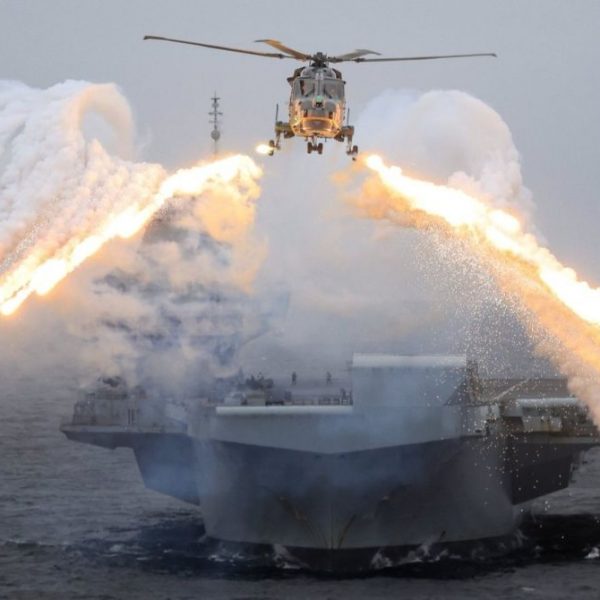
At the same time, an aircraft carrier participated in the anti-submarine exercise for the first time, breaking through the coverage limitations of traditional anti-submarine platforms and initially verifying the feasibility of large surface vessels conducting anti-submarine operations in an Arctic environment. Analysts point out that using this as a starting point, NATO is planning to build an integrated anti-submarine network covering the High North seas with aircraft carriers as core nodes. Military competition in the region may enter a new phase.
Multiple factors drive northern flank strategic upgrade
NATO's accelerated construction of the northern flank defense system stems from multiple strategic considerations. At the beginning of the year, the Supreme Allied Commander Europe of NATO stated that "the Arctic and Northern Europe have become the frontline of strategic competition." Some analysts believe that the northern flank's rise to become a core NATO defense zone is mainly due to the following three reasons.
First, changes in the geopolitical landscape. With Finland and Sweden officially joining NATO, the Baltic Sea has in effect become a "NATO lake," but the newly added border of over 1,300 kilometers has also deepened a sense of insecurity. Russia has concentrated its Northern Fleet headquarters, strategic nuclear submarine bases, and a large number of tactical nuclear weapons on the Kola Peninsula adjacent to the Russian-Finnish border, and has deployed Iskander missile systems in the Baltic Sea direction. In contrast, NATO's new member states are relatively weak in terms of border defense scale and capability, generating security anxiety.
Second, intensifying competition in the Arctic region. As the Arctic shipping routes become navigable for longer periods, NATO urgently needs to consolidate its control over the High North through routine military presence, so as to avoid losing the initiative in the strategic game over the Arctic.
Third, the reshaping of U.S.-Europe relations. The United States' tough stance on Greenland has forced Nordic countries to accelerate strategic autonomy. By proactively taking on northern flank defense responsibilities, Nordic countries can, on the one hand, fill the power vacuum left by the shift of U.S. strategic focus, and on the other hand, help "Europeanize" the northern flank security agenda, injecting new momentum into European defense integration.
Over the past year, NATO has continuously accelerated its military layout in the High North. It has established forward land forces to fill gaps in border ground defense. At the end of 2025, NATO launched a plan to deploy a forward multinational land force in Finland's Lapland region, with a wartime strength of up to 4,000 to 5,000 personnel, expected to be fully formed by July this year, capable of coordinating with the Finnish Defense Forces to undertake Arctic defense missions. It has also established the Bodø Joint Air Operations Center to build a command hub for Nordic air operations. In October 2025, NATO officially opened its third standing joint air operations center in Bodø, Norway, responsible for round-the-clock surveillance and operational command of the airspace over Northern Europe, the Baltic Sea, the Barents Sea, and the North Atlantic, in order to reduce the burden on the Uedem Joint Air Operations Center in Germany and others in the Nordic direction.
Risks stack up, exacerbating confrontation and conflict
Now, NATO has deployed forward forces on a routine basis inside the Arctic Circle, achieving a substantial northward shift of its strategic center of gravity. Although NATO claims that this move is aimed at strengthening northern flank defense and responding to threats from the north, its actions have significantly heightened regional security risks and exposed many challenges it faces.
From the perspective of regional security, NATO's enhanced military operations on the northern flank have, first, greatly compressed the strategic buffer space with Russia. Since Finland and Sweden joined NATO, NATO has frequently held live-force exercises near Russia's northwestern border, pressing ever closer, which is bound to provoke Russia into taking countermeasures, thereby intensifying confrontation and conflict.
Second, the risk of misjudgment in the air and maritime domains has also risen. In the air domain, NATO intercepts of Russian military aircraft have long been highly concentrated in the Baltic Sea direction. Now, air policing missions in the region have shifted from regular rotation among member states to long-term coordinated deployment of multinational forces, with significantly increased air activity frequency and continuous forward extension of early warning and detection ranges, further exacerbating the risk of aerial confrontation. In the maritime domain, NATO's exercise scale in the Baltic Sea has continued to expand, with more offensive drills, and these often overlap in time and sea areas with Russian military exercises, blurring the line between "drills" and "actual combat," which could easily lead to misjudgment.
Third, the militarization of the Arctic could easily expand the scope of conflicts and disputes. At present, Arctic competition has evolved into a comprehensive strategic game involving military security, energy development, and critical infrastructure security. Russia explicitly regards the "Arctic Sentinel" operation as a provocation. Without an effective crisis management mechanism, local frictions could easily escalate into full-scale conflict.
At the same time, balancing the northern flank's autonomous defense and the overall security and stability of the alliance also presents NATO with many challenges. Internal differences within NATO over Russia policy affect operational coordination on the northern flank. The forward multinational land force deployed in Finland is jointly formed by the armed forces of Sweden, Finland, Norway, Denmark, France, and the United Kingdom. Given that the three Nordic countries have differences in their stances toward Russia, whether troop coordination efforts can reach consensus remains to be seen.
Cold-weather combat capability remains a weakness for NATO. Most member states lack polar training and specialized equipment, and existing electronic equipment and heavy gear suffer from reduced effectiveness under extreme cold conditions. Currently, relying solely on Finland, Sweden, Norway, and the United Kingdom and the United States-a few countries with relatively mature polar operations experience-is far from sufficient, and the alliance as a whole has not yet developed a mature polar combat system.
At present, NATO has made substantial progress in building northern flank defense capabilities, but it remains highly dependent on U.S. military support in key areas such as long-range strikes, strategic projection, and anti-submarine reconnaissance. Against the backdrop of Europe's still immature autonomous capabilities and the continuous adjustment of U.S. strategic focus, whether NATO's northern flank can rely on its own strength to build an independent and effective defense system comparable to that of the eastern flank-its effectiveness and sustainability-will still face severe tests of time and practice.
(The authors are affiliated with the Joint Operations College of the National Defense University of the People's Liberation Army of China)
Original article: military.people.com.cn