Eduardo Vasco
The 1975 Helsinki Accords weren't about human rights - they were capitalism's lifeline. Facing collapse after 1973, the West weaponized "freedom" to open Eastern Europe to capital.
The global capitalist system was in grave danger of collapsing following the 1973 oil crisis. The severe destabilization of the world economy, which had already been developing in previous years, led to the collapse of the economic regime - and, by extension, the political regime - of several countries.
The fascist dictatorships of Portugal and Spain quickly fell, colonial domination in Africa evaporated, and revolutionary movements took power in Angola, Mozambique, Nicaragua, and Iran.
The dictatorship of the proletariat came very close to being established in the Iberian Peninsula - which would have had potentially devastating consequences for the rest of Western Europe - at a time when armed insurgencies were taking place in Italy and Germany. Not even the so-called "Iron Curtain" escaped the revolutionary wave: Stalinist monolithism in Poland proved to be little more than a fig leaf, torn away by the explosive strikes in the Gdańsk shipyards, which pointed to the possibility of a political revolution against the bureaucracy throughout Eastern Europe.
To save its mode of production, the imperialist bourgeoisie found itself compelled to carry out its own surgical, selective, and limited political reforms, creating the impression among workers and other sectors oppressed by dictatorial and colonial regimes that they were now free. Dictatorships would be replaced by supposedly democratic systems, where human rights and political freedoms would be respected.
Adjustments would also be made to the global economic order - and these were the ones that truly mattered: the market economy (that is, the dictatorship of financial monopolies) would become the rule, guaranteeing free enterprise (for those monopolies alone), putting an end to state intervention in the economy in order to open national markets to the full penetration of foreign capital. Hence the need for a brief easing of political strangulation, so as to ensure the free circulation of goods and capital (for the monopolists, of course).
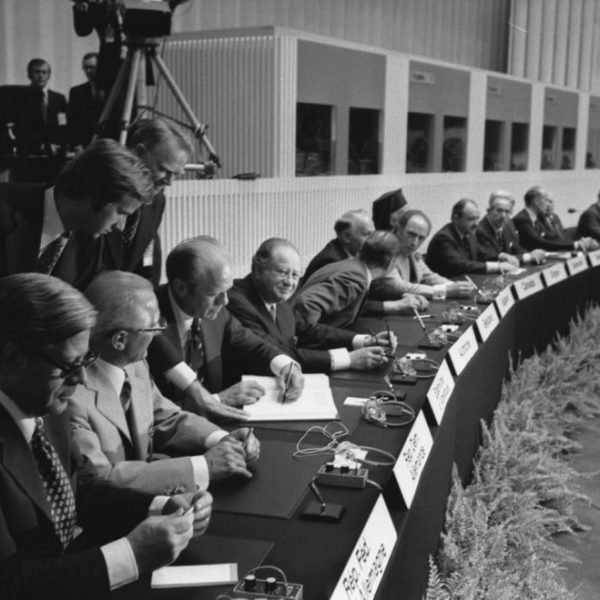
The first major milestone of this new era was the Conference on Security and Cooperation in Europe and the Helsinki Accords in 1975. There, the subordination of the USSR's "socialist" bureaucracy and its satellites to imperialism became evident, bringing the two rival "blocs" closer together under capitalist dictates. The 1973 crisis had intensified the dependence of the Stalinist regimes on the capitalist system, deepening their foreign debt and generating runaway inflation in those countries. A negotiated solution had to be found, even if it meant the final moments of state ownership of the means of production.
One of the central issues at the Conference revolved around human rights. The Helsinki Accords called for multilateral efforts to promote "respect for human rights and fundamental freedoms, including freedom of thought, conscience, religion or belief." Naturally, the "Helsinki effect" was felt only on the weaker side, while the United States and Western Europe continued and intensified the long-term suppression of democratic rights in colonial and semi-colonial countries, promoted coups d'état and wars around the world, and, through the implementation of neoliberalism, dismantled the welfare state and the living conditions of their own populations.
As a Guardian article marking the 50th anniversary of the Helsinki Accords aptly described, they became "an exciting agenda for change." "Gradually this intense activity around human rights in the Soviet empire helped to punch holes in the iron curtain, weaken the regimes and lay some of the groundwork for the peaceful ending of the cold war," observed the democratic, peaceful, and humanitarian author of the article, who also advocates armed intervention by imperialist forces against Russia in Ukraine.
The United Nations endorsed the Helsinki Accords and, from the 1980s onward, began citing them as a paradigm in discussions on human rights. The United States and its satellites invoked the Accords, either explicitly or implicitly, to accuse the USSR and Czechoslovakia, for example, of persecuting humanitarian and democratic dissidents.
In the wake of this new imperialist strategy, Jimmy Carter was elected President of the United States in 1977. Human rights became his banner: the U.S. government began publishing annual reports on violations around the world, strengthened the State Department's Human Rights Office, sponsored denunciations by Soviet dissidents, pressured Latin American military dictatorships (U.S. puppets) toward a gradual opening that would guarantee a "top-down" transition and prevent the masses from taking power, and promoted the creation of international human rights forums.
During this period, international bodies such as the American Convention on Human Rights (1978) flourished. The United Nations began giving central importance to the then Human Rights Commission, created the Working Group on Enforced or Involuntary Disappearances (1980) and the Convention Against Torture (1984), and expanded the system of so-called "special rapporteurs," a model that would become one of the principal tools of the UN human rights system in the decades that followed. And, as I have frequently demonstrated, a tool for regime change against governments considered inconvenient by imperialism, such as those of Iran, Cuba, and North Korea.
Another milestone in the early years of this new era of imperialist policy was the proliferation of NGOs. Previously little known, Amnesty International received the Nobel Peace Prize in 1977 and the United Nations Prize in the Field of Human Rights in 1978. In that same year, a U.S.-based NGO called Helsinki Watch was established, with committees that spread throughout Eastern Europe to monitor the implementation of the Helsinki Accords by the Stalinist regimes. The network expanded across the globe and, ten years later, formally unified under the name Human Rights Watch.
The Hungarian-American speculator and billionaire George Soros began his allegedly philanthropic activities around the same period and with the same objective: opening up the societies of Eastern Europe. To that end, he invested astronomical sums and founded the Open Society Foundation in Hungary in 1984, expanding the activities of his NGOs throughout the region and later around the world. In 1983, the U.S. Congress itself directly created an institution capable of doing "what had previously been done covertly by the CIA": the National Endowment for Democracy (NED), whose main activities revolve precisely around human rights.
In the next article, we will examine the United Nations' double standard regarding human rights in Eastern European countries before and after the fall of the USSR, as well as the relationship between the human rights campaign and the neoliberal wave of recent decades.