Pepe Escobar
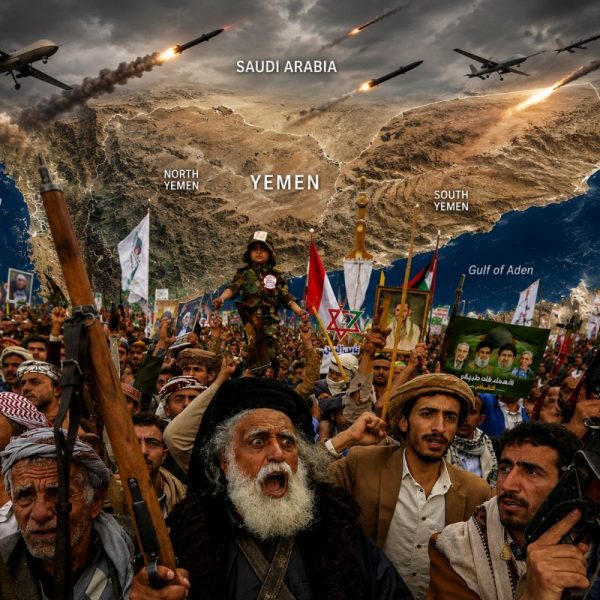
Never underestimate Yemen. Yemen shall resolutely match escalation for escalation. Just as Iran is doing.
The divided lands of Islam never cease to amaze - and deceive - when it comes to their serial stark betrayal of the principles of Islam.
The House of Saud has launched a "coalition" against Yemen - under the pretext of protecting shipping in the Red Sea.
Only shipping from Saudi Arabia is blockaded in the Red Sea by Yemen's Ansarallah. That's "a siege against a siege": Sana'a after all is under an illegal Saudi blockade for over 11 years.
The Bab al-Mandab is not blockaded: only for Saudis. And if you are a Saudi tanker shipping oil to China, you're free to go.
The Saudi-led "coalition" is as pathetic as it comes. Several participant Arab nations don't even have a navy - such as GCC members Bahrain, Kuwait and Qatar, plus Jordan.
The Three Heavyweights are Pakistan, Turkiye and Egypt. NATO is out. So for all practical purposes this "coalition" of Islamic, mostly Arab petro-sheikhs/comprador elites/vassals is tasked to do the Epstein Syndicate dirty work.
All across the lands of Islam, questions will be asked on why there was never any "coalition" to protect Gaza from the death cult.
Yemen will be under siege by virtually all its neighbors. Divide and Rule remains in full effect. Especially Sunni-Shi'ite. All "coalition" members are Sunni-majority.
Yet only fools will believe that the Empire of Piracy and the supranational Epstein Syndicate is not driving this intra-Arab, intra-Muslim, intra-Islam clash, with Washington closely aligned with Riyadh, as in the recent bombing of People Mobilization Units (PMUs) - and civilians - in Iraq.
Bets can be made that the upcoming bombing of Yemen will be NATO-coordinated, using "Saudi" fighter jets for plausible deniability. It's an open question whether Pakistan and Egypt would be part of it - after posing as mediators and supporters of a preace process between US-Iran.
The UAE and Morocco, as the two major absentees, do raise eyebrows. Well, then the plan would become too obvious, because both are certified Anglo-Zionist colonies.
The UAE has built ports and military bases surrounding the Bab al-Mandab - as in Aden, Socotra, Somaliland and Djibouti - on top of bankrolling certified genocide in Sudan, Somalia and Yemen. Morocco is a nest of spies, stormtroopers, and provocations towards Algeria.
Then there's Nigeria and Bangladesh, both so far away from Yemen. But as crack observer AHHfrican has noted, this is all about "psychological oppression"; a combined population of 421 million people should intimidate the Yemenis.
Obviously the Yemenis won't be intimidated, because they know everything there is to know - especially by dealing with Riyadh and Abu Dhabi - about how True Resistance cannot be defeated by psy-war, torrents of lies and economic siege. They consider the imposition of this ragtag "coalition" as a badge of honor.
Never underestimate Yemen. Leader Abdul Malik al-Houthi has already laid down the law yesterday in his weekly speech: Yemen shall resolutely match escalation for escalation. Just as Iran is doing.
What could break Iran's strategic restraint
Iran has not only rejected Oman's 50/50 formula for a joint management of the Strait of Hormuz (yet working-level contacts between Muscat and Tehran continue); it doubled down on the military pressure front, as part of a larger coercive strategy.
Iran is demonstrating in practice that all across West Asia, there is a serious price to pay if you support US military operations, while expecting that your territory, ports, energy infrastructure and commercial routes will be insulated from the consequences.
So this is all about the Strait of Hormuz mixed with the control of the escalatory ladder. And everyone should remember the obvious: Iran is running the clock. And proving its point day after day: a solution against the military architecture surrounding Iran is intrinsically linked to the struggle over the Strait of Hormuz and a new, wider Persian Gulf security order.
Pakistan is now entering severely troubled waters - operating across two sensitive tracks, as admitted by our sources at Transition Protocol .
So we have Islamabad joining the Saudi-led "coalition". Tehran is carefully observing where this goes, and taking notes. At the same time, Pakistan continues to present itself - publicly and privately - as the most active mediator between Washington and Tehran.
This cannot possibly hold.
Pakistani mediators qualify it as a "difficult but deliberate balancing act." Talk about a euphemism. You cannot possibly protect defense and economic relations with Saudi Arabia - including a recently upgraded military pact - while preserving the trust built with Iran.
So far, indeed, Iranian media has not treated Pakistan's position as a betrayal. The mediation channel - although now even more fragile than before - remains open. But that may change depending on how aggressive Pakistan will be against Yemen.
The escalation ladder, with predictable swings, also remains active. A very auspicious reading would suggest that it appears calculated - by both parties - to allow room for indirect negotiations.
There's absolutely no question that Tehran is keeping all military options open - while avoiding, in a clear sign of its diplomatic finesse, a political stance that would make de-escalation impossible.
The same position applies to navigating Hormuz. The transit of a QatarEnergy LNG tanker going to Pakistan shows that Tehran prefers to apply selective control, and will not impose a completely indiscriminate maritime blockade (as Yemen did in the Red Sea; the blockade is only against Saudi shipping).
The Iraqi front will spell out Serious Escalation in no time. Kataib Hezbollah, for instance, has widened its warning and will go against American assets operating from Saudi territory.
This is a serious escalation signal.
In a nutshell: Iran's restraint, as it stands, is strategic, not passive. The battlefield is expanding: this is an interconnected regional war architecture. It's no wonder, because February 28 signified the next stage of the American/Israeli/Zionist International war against the whole Axis of Resistance.
China is deeply implicated. Pakistani intel reconfirmed that Beijing moved a substantial package of air-defense systems to Iran through Gwadar port, a key node of the China-Pakistan Economic Corridor (CPEC). The weapons transfers are taking a maritime route.
They contained a layered mix of MANPADS and more advanced air-defense hardware, featuring up to 400 QW and FN series of MANPADS; the QW-12, for instance, uses a dual-band infrared seeker designed to distinguish real targets from countermeasures.
Iran is also upgrading mobile air defenses via a $580 million Russian package of 500 Verba launchers and 2,500 missiles.
Both Pakistan and China, for obvious national security reasons, and to not directly antagonize neo-Crassus, have publicly denied, over and over again, any weapons transfer.
All bets are off on whether the Trump administration - or neo-Crassus dementia outfit - will accept that the Pakistan and Oman channels may still provide a path back to the negotiating table.
If Washington moves into a "Gates of Hell"-style bombing against Iran's missile, command and coastal-defense infrastructure, Tehran's current restraint will vanish - for good.
And the consequences will be absolutely devastating, involving Gulf energy infrastructure; what remains of American regional bases; unprotectable Saudi territory; and the key maritime corridors connecting the Strait of Hormuz and the Red Sea.