Martin Jay
In recent days, Madrid has gone ahead with a number of policy decisions which, we can assume, have vexed the Moroccans.
Israel's Prime Minister Benjamin Netanyahu in April of this year called Spain anti-Israel before issuing a dire warning over Madrid's stance condemning Bibi and Israel over the genocide in Gaza. "I am not willing to tolerate this hypocrisy and hostility. I do not intend to allow any country to wage a diplomatic war against us without paying an immediate price."
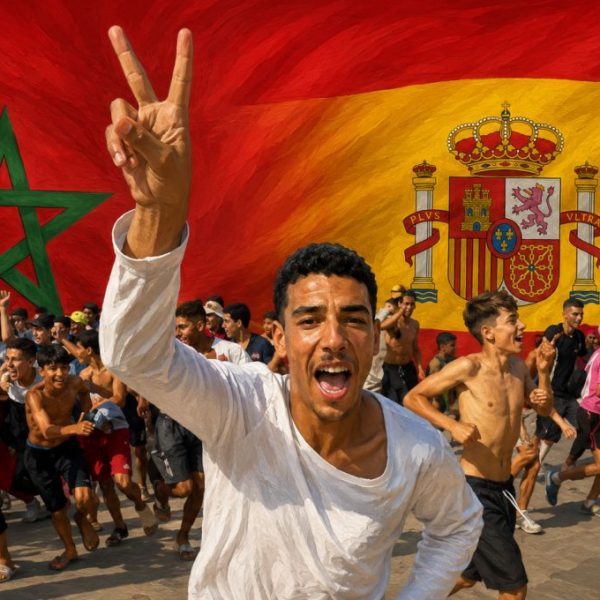
Can we assume the influx of thousands of Moroccans into the Spanish enclave of Ceuta - which could effectively render Spain redundant there, strengthening the UK/Israel control of the Straits of Gibraltar - was a plan initiated by Bibi himself?
The circumstances around this extraordinary event, which was beamed by global news networks around the world, needs unpacking and putting into context. Certainly it is true that Morocco has traditionally used its power to flood Spain with illegal immigrants as a geopolitical tool in the past few years - a rather crude but effective diplomatic ruse which reminds Madrid that even though the country is poorer, it has cards to play when it doesn't get its way. The stunt is particularly effective as it also sends a message at the same time to Brussels that Rabat always has this trick up its sleeve if the going gets rough.
But what happened in the last few days in Ceuta was different.
This time it was not African migrants who had arrived in Morocco and were hoping to scale the fence into the tiny EU enclave. This time it was Moroccans themselves who, it would appear, had been given the nod and the wink to go to the border, where they would find no resistance from police or Gendarmerie if they wanted to pass the fence at the breakwater, or if they preferred to swim. Under international law, if they swam, they were guaranteed legal protections once arriving on the beach in Spanish territory.
Thousands did it and filled this tiny town, shocking the world and certainly getting the attention of Madrid. Was there a message Rabat wanted to send to Madrid, its neighbour and regional partner ? Of course. Not one message, but actually a few - and lacking the diplomatic finesse, it chose this method to drive a few points home.
Relations between Spain and Morocco are very good. In 2022, Spain turned over a new leaf and adopted a new policy towards Western Sahara, supporting Rabat's claim to sovereignty.
Yet in recent days, Madrid has gone ahead with a number of policy decisions which, we can assume, have vexed the Moroccans. Madrid has made a number of initiatives to patch up its rocky relations with Algeria, with gas deals already signed. For these relations between Madrid and Algiers to improve, this can only come at a price, Rabat concludes, and so it resorts to the only practice it knows to send a message that it is displeased.
But if this rapprochement was isolated, perhaps the reaction might not have been so dramatic. In reality, though, there are other factors worth considering, chief among them Spain's recent adoption by a parliamentary committee to offer citizenship to the indigenous people of Western Sahara, the Sahrawi people. How did the Spanish ever imagine that this could make it past a committee vote and head for a decision by MPs without insulting the Moroccan monarch ? Perhaps Madrid can also be accused of perfidious diplomacy with this stunt, which will harm relations with Rabat but probably not derail them.
The decision by the committee in question was probably not well thought through, given the impact it would have with its neighbour, with which until now it has enjoyed good relations. But one has to wonder if this, along with bringing Algeria in from the cold, is the short end of the wedge of this friendship failing. Morocco has the ability to fill tiny Ceuta every day with thousands of its own people, who consider the opportunity to make a life in Spain as a gift to seize, rather than being treated like a pawn by its monarch - as some exiled Moroccans have commented on social media.
For a long time, Rabat has bemoaned Spain's sovereignty of the diminutive enclave and hinted one day that it will be Morocco's. If there were ever a moment when it looked like it was Moroccan territory, it has been in recent days, where an estimated 5,000 Moroccans have filled its public spaces, school recreational areas and tiny alleys. Of course, the events which have made headlines around the world also please Israel, whose leader has threatened Spain and would jump for joy at being part of an axis of power (with the UK) to control who enters and who leaves the Mediterranean - yet another story about who controls maritime choke points in the world. But would Morocco really be part of such a valedictory pact if it meant losing Spain, a valuable partner, ally and trading partner?