Raphael Machado
Migratory flows as seen in Europe over the last 20 years are clearly artificial, Raphael Machado writes.
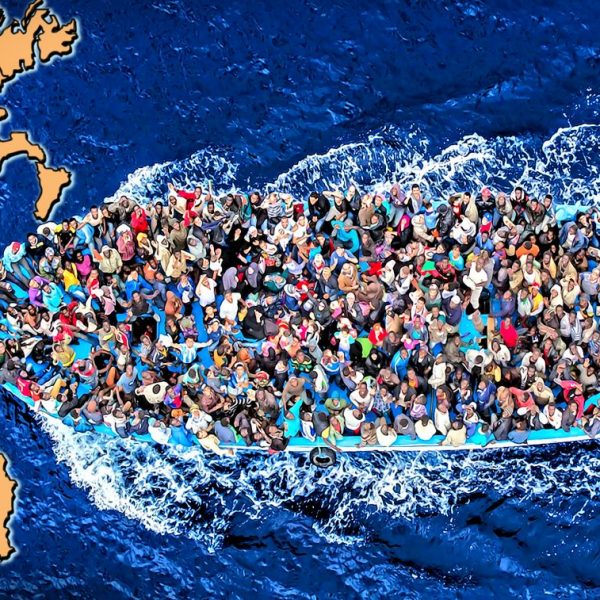
In the past week, images of tens of thousands of Moroccans-at least 60,000-invading the Spanish city of Ceuta, breaking through the border barriers with Morocco, took over social media. The autonomous city, which has only 80,000 inhabitants, had to deal with attempted home invasions and various other crimes by the invaders, who were then confronted by security forces and some self-organized groups of citizens.
These 60,000 invaded Ceuta all together, and some images and videos on social media show trucks dumping immigrants near the Spanish border. Photos revealed Moroccan police officers trying to prevent some invaders from returning to their own country. Still, thanks to the action of Spanish security forces and citizens, most of the invaders appear to have already returned to Morocco-and many of them did so voluntarily shortly after entering Ceuta.
The case had a great global impact, especially in Europe, with several governments reinforcing their own borders and Italy recommending that Spain be removed from the Schengen Area.
Several aspects of this event are noteworthy, however.
First, to lay the groundwork: contrary to the many "progressives" who sympathized with the invasion under the argument of "decolonizing" Ceuta, the reality is that Ceuta is not a colony. The city was conquered by Portugal in 1415, passed to Spain in 1580, and since then it has been an uninterrupted Spanish possession. But even the period before 1415 is linked to Europe. Let us recall that from the year 40 to the year 709, Ceuta was governed, in succession, by the Romans, the Vandals, the Byzantines, and the Visigoths, until it was conquered by the Arabs-who, let us also remember, are also foreign invaders in North Africa. After that, Ceuta changed hands several times between Arab and Berber kingdoms until, as already mentioned, it was conquered by Portugal in the context of the reconquest of the Iberian Peninsula after 700 years of Moorish military occupation and to put an end to Mediterranean piracy.
To speak of returning Ceuta to its "true owners," therefore, makes no sense. If Spanish rule over Ceuta is illegitimate, then all territorial changes, expansions, conquests, and occupations on the planet over the last 600 years are illegitimate.
Nevertheless, Morocco claims Ceuta (as well as Melilla) on rather dubious grounds. First, for the reasons already pointed out. Second, because Morocco as a state is quite recent, being less than 100 years old, and has never owned Ceuta or Melilla. This is not Morocco's only dubious territorial claim; after all, its government also claims Western Sahara, which has been fighting for its independence for decades. Western Sahara is supported by Algeria against Morocco, while Spain defends the completion of the territory's decolonization and the granting of at least autonomy to the region.
Only two countries in the world, however, recognize Morocco's sovereignty over Western Sahara unconditionally: the USA and Israel.
It is difficult, therefore, not to start connecting the dots between the recent events in Ceuta and the entire recent panorama of tensions between Pedro Sánchez's Spanish government and the governments of the USA and Israel. Spain, under Sánchez, has been the most vocally critical country of Israel, especially during the ethnic cleansing in Gaza. Furthermore, the country did not allow the U.S. to use its territory to carry out attacks against Iran. As a result, Spain earned the enmity of both countries, which have been making veiled threats for some time now.
A few years ago, even Benjamin Netanyahu's son made a social media post recommending that Muslims take Ceuta and Melilla.
Another factor that may have influenced this crisis is the fact that in July of this year, Spain and Algeria resumed normal diplomatic relations after several years of rupture. Moreover, Spain decided to increase imports of Algerian gas, as well as putting other possible joint projects on paper. Algeria, as we have pointed out, is a geopolitical enemy of Morocco, just as Spain is.
It is necessary, however, to point out that Sánchez and the Spanish judiciary are also partially responsible for the migration chaos. A few months ago, Sánchez legalized more than 1 million illegal immigrants, in practice demonstrating that invading Spain pays off. Spain's Supreme Court, in turn, prohibited authorities from carrying out summary expulsions of immigrants who arrived in the country by boat. For all intents and purposes, the decisions of the Executive and the Judiciary facilitated the work of agencies that promote migration.
By embracing cosmopolitanism, Sánchez and the Spanish elite have made the country an easy target for the use of migratory flows as hybrid warfare weapons-because that is what this is about. It is time to overcome the humanist naivety that sees mass immigration as a humanitarian phenomenon in which victims of imperialism flee desperately in search of a better life.
In fact, migratory flows as seen in Europe over the last 20 years are clearly artificial, and considering Israel's role in promoting "diversity" and even the action of Israeli NGOs helping immigrants reach Europe, it is difficult to ignore the agents who wield this instrument.