Raphael Machado
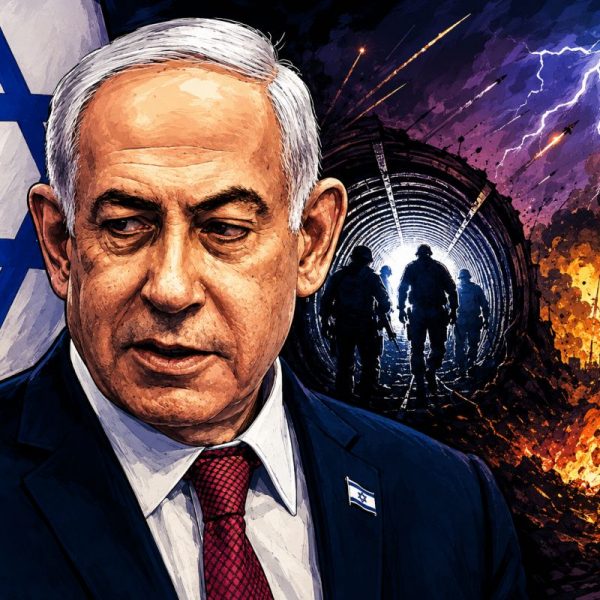
Netanyahu's wars aren't just about Iran - they're about survival.
Netanyahu's international adventures, with acts of hostility and aggression against numerous regional actors in the Middle East, have been the subject of extensive op-ed and literary production, for obvious reasons. Israel's actions in Gaza, the West Bank, Syria, Lebanon, Iraq, and Iran, in addition to its diplomatic maneuvers with Jordan, Saudi Arabia, Egypt, and other countries in the region, have had enough impact to warrant specialists' attention. Indeed, the entire Middle Eastern landscape has been transformed in recent years - in some cases favorably for Israel, but not always, and we need only look at Iranian resilience for proof of that.
But a greatly neglected part in the analysis of Netanyahu's policy is its domestic side, the "home front," so to speak. In fact, these domestic aspects are occasionally analyzed, but only insofar as internal issues directly connect with the wars in Gaza and Iran, such as economic problems, the resistance of ultra-Orthodox Jews to forced conscription, loss of popularity, etc.
Although these aspects are important, there are also others that merit attention, and it is worth at least mentioning them so that we can reflect on what the true link is between Netanyahu's external wars and his attempt to stay in power at any cost.
Before October 2023, in fact, Netanyahu appeared in international news not for anything related to Palestine, but because of a judiciary reform project proposed by Justice Minister Yariv Levin, which aimed to reduce the powers of the Supreme Court and concentrate more powers in the Executive and Legislative branches, including granting greater control over judicial appointments and reducing the capacity for judicial review of administrative decisions.
The proposal, launched in January 2023, shortly after Netanyahu's new government took office, sparked a wave of protests that brought together hundreds of thousands of people weekly, until Hamas's military operation on October 7, 2023. The Hamas attack, in fact, suffocated the popular movement against Netanyahu under the demand for "national unity" against terrorism. The problem, however, remains, with some aspects of the reform having advanced, while others were struck down by the Judiciary.
But if the controversy over the judiciary reform was at least partially stifled, the corruption charges Netanyahu faces remain very much alive in the Israeli public sphere. There are three cases - 4000, 2000, and 1000 - all relating to previous governments (with the first investigations having begun in 2016) and concerning possible schemes of favoritism. In Case 4000, it involves regulatory decisions that favored the company Bezeq Telecom; in Case 2000, negotiations to receive favorable media coverage in exchange for decisions that would weaken competitors; and in Case 1000, the receipt of gifts given by billionaire benefactors to Netanyahu.
Throughout the entire year of 2026, this has been one of the main topics in Israel, as Netanyahu's trial has been extremely publicized, in addition to taking place daily, almost without interruption, for months. There is talk of the possibility of hearing hundreds of witnesses. And the complexity of the case seems to be one of the assets Netanyahu relies on to get off the hook.
All of this brings us to the question of the path toward the next Israeli elections, to be held on October 27, 2026. Currently, Netanyahu's popularity stands at approximately 33-38%, with a large portion of the Israeli population preferring alternative leaders. Added to Netanyahu's administrative and criminal scandals is a perceived inefficiency on the part of the prime minister in dealing with Israeli security issues, starting with the security failure that made Hamas's October 7, 2023, operation possible.
A reflection of this is that Netanyahu's governing coalition is extremely fragile. The parties Noam, National Unity, United Torah Judaism, and Shas have withdrawn from the coalition. Beyond Netanyahu's controversies, one of the reasons for the exodus was the attempts by the Israeli military leadership to force ultra-Orthodox Jews to serve in the armed forces, and Netanyahu's inability or disinterest in confronting that military pressure.
Opinion polls, in turn, present some problems for Netanyahu. Although voting intentions for Likud are similar to the share the party received in 2022, today Likud no longer has the broad alliance that allowed Netanyahu to form a fundamentalist Zionist government. And there, considering that with Likud's 22% voting intention, the Together coalition (of Naftali Bennett and Yair Lapid) has 15%, Yashar (of Gad Eisenkot) has 24%, Israel Beiteinu (of Avigdor Lieberman) has 10%, and the Democrats (of Yair Golan) have 11% - and none of these parties intends to ally with Netanyahu - the Israeli political situation becomes uncertain.
The good news for Netanyahu is that these political forces also have considerable differences among themselves. The Democrats, for example, support the "two-state solution"; Israel Beiteinu favors the unrestricted expansion of settlements in the West Bank; Yashar, for its part, favors maintaining settlements as they are and is more concerned with guaranteeing their security than with their expansion. Even within Together, Bennett and Lapid have reasonably divergent positions, with Lapid being more centrist and Bennett more radical in supporting the annexation of the West Bank. And, generally speaking, the leaders of these parties tend toward intransigence in their positions.
Domestically, Netanyahu has few assets. But on the external front, Netanyahu may consider the war against Iran as a possibility of either achieving victory through a significant blow against Tehran, or at least imposing himself from the perspective of "national unity" in the face of an external threat. Not coincidentally, Netanyahu did the possible and the impossible to prevent peace negotiations between Iran and the U.S. from bearing fruit.
The first hypothesis is unlikely due to Iran's own military capabilities, but agitating Iran as a "bogeyman" that "only" he could resist may be a plausible tactic for staying in power.