By Milan Adams
Preppgroup
August 26, 2026
I don't know if you've ever lived through a major power outage, but I have. I live in a hurricane zone, so I suppose it was inevitable that I would eventually face the full wrath of nature's fury. The storm that hit us wasn't one of those headline-grabbing monsters that brings FEMA agents swarming in with cameras rolling and politicians posing for photo ops. It was what meteorologists call a "moderate" event-just strong enough to knock out infrastructure, just weak enough to be forgotten by the national media within 48 hours. But it took seven days for our power to return. Seven days. One hundred and sixty-eight hours. Ten thousand and eighty minutes of living in a world that suddenly resembled something from another century-or another dimension entirely.
You don't truly realize how much you need electric power until you're left without it. As a society, we are addicted to electricity in ways that would horrify our great-grandparents and confuse our ancestors. Pretty much everything we do uses electricity in one way or another, even activities we think of as analog, unplugged, or "natural." The water flowing from your tap ? Electric pumps. The gas at the station ? Electric pumps. The food in your refrigerator ? Electric cooling. The money in your bank account ? Electronic records. The safety of your neighborhood ? Electric streetlights and surveillance systems. When the power goes out, you notice immediately. The sudden silence of a house without humming appliances is disorienting. The stillness feels like a presence, a weight. And the uncertainty-will it be hours ? days ? weeks?-creates a low-grade anxiety that simmers beneath every decision.
Looking at the way things are in California, Texas, and across the Midwest right now, extended power outages may be something we all need to get used to. The rolling blackouts that have become increasingly common aren't just due to isolated errors by utility companies or government mismanagement-though both play significant roles. They're symptoms of a grid infrastructure that was largely built in the 1960s and 1970s, designed for a population half its current size, and now being asked to handle loads and weather patterns that its designers never imagined. The government blames utilities for not properly maintaining their lines, while utility companies blame government regulations for forcing them to invest money that should have gone into maintenance into expensive green energy projects that haven't yet proven reliable at scale. Meanwhile, extreme weather events are producing more stress on this aging infrastructure beyond its breaking point. With the push for rapid decarbonization across the country, we may be entering an era where forced blackouts become as common in Ohio and Pennsylvania as they already are in California. Once the precedent is established-that utilities can simply shut off power to millions to prevent wildfires or manage peak loads-the dam has been opened. We could see forced blackouts anywhere in the country where there is risk of infrastructure failure, which is essentially everywhere.
I first noticed that the power failed when my computer suddenly shut off. The screen went black. The fan stopped whirring. The silence was immediate and absolute. This wasn't the first time this had happened-power outages in the middle of storms are fairly normal in my area. I figured the power would return within an hour or two, and in the meantime, I could have a snack, read a book, and watch the rain from my porch. But the power didn't come back on. As I sat there for hours, I began counting all the work I wasn't getting done, all the money I wasn't making, and all the deadlines that were slipping away into an uncertain future. In our hyperconnected economy, a day without power isn't just an inconvenience-it's a financial hemorrhage. Freelancers lose billable hours. Remote workers lose their connection to employers. Small business owners watch inventory spoil and revenue evaporate.
Meanwhile, since I live in the Deep South, the temperature was rising relentlessly. It had been 100°F outside before the storm started, and now, with the rain stopped but the humidity locked in, the house was rapidly becoming an oven. I opened every door and window that I could without letting in the mosquitoes that breed in standing water after storms, but there wasn't enough airflow to cool the house significantly. The air felt thick enough to chew. I suppose it wasn't as bad as being up north in the dead of winter. While excessive heat can kill you-heat stroke is a real and present danger, particularly for the elderly and those with cardiovascular conditions-extreme cold is statistically more lethal. People who live in colder climates and who don't have alternative means of heating their homes, like a wood-burning stove or a fireplace with a substantial stock of dry firewood, are genuinely risking their lives during extended winter power outages. The 2021 Texas winter storm proved this catastrophically, when over 240 people died, many from hypothermia in their own homes as temperatures inside dropped to lethal levels.
Without power, we really didn't have much light in the house. Modern homes aren't designed for natural lighting-they're designed with the assumption that electric light will always be available. Most homes don't have enough windows, and mine is no exception. Between the lack of windows and the heavily overcast sky that lingered after the storm, it was hard to do much of anything productive. Reading strained the eyes. Cooking required flashlights. Navigating hallways became an exercise in memorization and careful toe-placement. Fortunately, we had a gas stove with standing pilot lights, so cooking dinner wasn't immediately problematic. We had plenty of food in the refrigerator and freezer, and for the moment, those appliances were keeping things cold through thermal mass and insulation. We just had to make sure we kept the doors closed to preserve that cold, treating the refrigerator like a cooler that we opened only when absolutely necessary.
I had a hard time sleeping that first night, due entirely to the heat. The humidity was oppressive, clinging to the skin like a wet blanket, making every position uncomfortable. For that matter, we had a hard time sleeping all week long. The body needs to cool down to enter restful sleep, and without air conditioning or even fans, our core temperatures remained elevated, leading to shallow, fitful rest and waking constantly throughout the night. If I had been able to string up some hammocks, we could have been cooler-hammocks allow air circulation beneath the body, which significantly improves comfort in hot conditions. But the only place I could have done that was in the backyard, and it was still raining intermittently, with saturated ground and dripping trees. I work from home, so I obviously couldn't work. But neither could my wife. The school where she taught didn't have power either, so she was stuck at home, losing wages she couldn't afford to lose. The kids initially loved it-as children will, they saw it as an unexpected vacation from classrooms and homework. But even if the schools had been open, they would have been stuck at home anyway, as our street looked like a lake. Some malfunction with the stormwater drainage system-probably debris-clogged intakes-had turned our residential road into a stagnant pond three feet deep in places.
The big thing that confronted me that morning was the home's sump pump. Without electricity, the pump wasn't emptying the sump automatically, and water was rising in the basement. I spent hours manually bailing, carrying five-gallon buckets up the stairs and out the back door, dumping them into the yard where the water could eventually drain away. By noon, my back was screaming and my hands were blistered. By afternoon, I had to tell the family we were switching over to emergency procedures. They'd have to use a five-gallon bucket toilet we had set up for emergencies-a toilet seat clipped onto a sturdy bucket lined with heavy-duty trash bags, with kitty litter for covering waste after each use. The smell was immediate and pervasive. Fortunately, we had installed a greywater recycling system years ago, so the water from sinks and tubs went out into the backyard through separate pipes, not into the sewage system. This meant our toilets wouldn't back up from municipal system overload-a common problem in extended outages when pumping stations fail.
As afternoon rolled around, the water flow from the kitchen sink started diminishing, sputtering, and eventually came to a complete stop. We were without municipal water. The pumping station that served our neighborhood had lost power, and apparently, either it didn't have a backup generator or the generator had failed. Fortunately, I had foreseen this possibility and had stockpiled water. My rain barrels were full from the storm, and I had a quality water purification system-filters capable of removing bacteria, parasites, and chemical contaminants. We had enough drinking water for weeks if we were careful. But the psychological impact of turning a faucet and having nothing come out cannot be overstated. It's a primal fear, a severing of the most basic expectation of modern life.
The rain finally let up on the third day, at least for the most part. We were still getting sudden downpours as weather systems continued to move through, but we were also getting dry periods as well. Maybe our street would finally drain and I'd be able to move the cars. But the humidity was brutal-hovering near 100%, making every breath feel like inhaling through a warm, wet cloth. Up until now, the food in the refrigerator had been doing surprisingly well. The insulation was sufficient to maintain cold temperatures, especially since I had kept the freezer full-frozen water bottles and bags of ice had maintained thermal mass. But today was crunch day for that food. I was going to have to start processing it or watch hundreds of dollars worth of meat, dairy, and produce spoil. Time to fire up the smoker. I had a traditional offset smoker that ran on wood and charcoal, no electricity required. I spent the morning butchering frozen chickens and pork roasts, trimming them for smoking, and getting fires started. Too bad the cloud cover was too thick to use solar dehydration for making jerky-another preservation method I had hoped to employ.
Bathing had become a serious challenge. We didn't have running water, and with the heat and humidity, we all needed to bathe daily just to maintain basic hygiene and prevent skin infections. I've spent considerable time in rural Mexico on humanitarian missions, so I knew how to handle this. All it takes is a five-gallon bucket and a smaller plastic container-something that holds about two quarts, like a repurposed yogurt container or small pitcher. To bathe, you get a couple of gallons of water in your bucket and lock yourself in the bathroom, setting the bucket in the tub. You wet yourself down by pouring water over yourself with the small container. Once wet, it's time to soap and lather. Then use the same container to pour water over yourself to rinse. The water is whatever temperature the ambient air has brought it to-lukewarm at best-but you don't want to use more than necessary anyway. I can actually bathe thoroughly and wash my hair with less than a gallon of water. Of course, not all family members were enthusiastic about cold water bathing. I won't mention any specific names, but certain members of the household made it clear that heated water was non-negotiable. That meant heating water in a metal bucket on the barbecue grill-propane, fortunately, since I always keep extra tanks on hand as part of my preparedness mindset. But every gallon heated this way consumed fuel that was now a finite resource.
By day four, I would have been deeply worried about my firewood supply if I lived up north. Most people stack their firewood in the open, which means it would have gotten soaking wet from the rainfall and would be nearly impossible to burn efficiently. In olden times, most people either stacked their wood in sheds or built their homes with wide eaves specifically so they could stack firewood against the house where the roof overhang would protect it. We've lost that practical wisdom. I was still working on smoking the meat from the freezer and canning vegetables from the garden. That's challenging on an open fire-maintaining consistent temperatures for safe canning requires attention and skill-but not impossible. We were using the gas barbecue grill for water heating when we weren't using it for cooking, and I was watching my propane supply dwindle with growing concern. There was enough sunlight breaking through that I could make jerky from some of the meat rather than smoking it all. I had already soaked it in brine in anticipation of smoking, so it had salt content-that's not as good for flavor as a proper marinade, but it works fine for preservation. To make the jerky, I sliced the meat thin and hung it over the clothesline in the backyard, weighted to prevent it from blowing away. This is somewhat analogous to what Native American tribes did on the Great Plains and in the Southwest, except they used wooden racks rather than clotheslines. Still, the principle is the same, and the meat dried well as long as the sun stayed out and the humidity dropped temporarily.
But the real developments of day four were social, not logistical. Neighbors were starting to run out of food and had begun knocking on doors. That's tough—I know many of their kids, had watched them grow up, had coached some of them in little league. Fortunately, we knew this wasn't a TEOTWAWKI event. We knew the power would eventually return, that order would be restored, that this was temporary. So I shared some food with them, giving them rice and beans from my stockpile, as well as some of the chicken that had thawed and needed to be eaten anyway. But I was concerned about what was going to happen in a few more days. People had already broken the windows in the local supermarket and raided it for food on day three. The police were overwhelmed and had essentially stopped responding to property crimes, focusing only on violent emergencies. What's going to happen when that scavenged food runs out ? The average supermarket only has three days worth of food on hand under normal circumstances—less when people panic-buy. That supermarket was now empty, and the next closest one was miles away, probably in the same condition. The math was becoming clear: there were approximately 200 homes in our immediate neighborhood. If each home had an average of 2.5 people, that's 500 people. If I had six months of food for my family of four, that's approximately 720 person-meals. Divided by 500 people, that's less than a day and a half of food for everyone. The math of generosity has hard limits.
By day five, I had reached a devastating conclusion: my preparations for alternative power were totally inadequate. The few solar panels I had purchased—enough to keep phones charged and run a few LED lights—had barely been able to keep up with even those minimal needs given the cloud cover. They certainly couldn't power the refrigerator, let alone the air conditioner. If I had been able to power even a small refrigerator, I wouldn't have had the panic to save my food. If I could have air conditioned at least one room in the house, we could have slept, could have thought clearly, could have maintained our emotional resilience. The sleep deprivation was becoming dangerous—decision-making was suffering, irritability was rising, and the constant physical discomfort was grinding down our psychological defenses. It's more than just keeping cool so that we can sleep better. My wife is heat intolerant—she has a medical condition that makes thermoregulation difficult. We normally have to keep her in air conditioning pretty much all the time during warm months. Without climate control, she had been unable to do anything but lie still and suffer, her body unable to shed heat effectively. I'd been using evaporative cooling as much as possible—wet towels, misting spray bottles, sitting in the path of any breeze. But in 90% humidity, evaporation barely happens. There wasn't any ice, or I'd have been using that for cold compresses. The best I could do was keep her wet and in whatever breeze I could create with hand fans.
People in the neighborhood were starting to talk about "organizing" so that everyone could eat. I knew exactly what that meant—it meant they expected those who had prepared to share with those who hadn't. As best I knew, there were no other preppers in the neighborhood, no one else who had stockpiled food or water or supplies. I didn't know where all this food was supposed to come from, unless they were thinking that I—and perhaps a few others like me—had enough to feed everyone indefinitely. Finally got all the food salvaged that could be saved. But as much as I care for my fellow man, I didn't do it for them. I did it for my family. And the math was brutal: by the time you split up what was in my freezer through 500 people, you've got enough for one good meal. Then what ? Then we're all hungry together, and I've lost the resources that were supposed to carry my family through the crisis. The conversations I overheard that day revealed how quickly people's thinking shifts. On day one, it was "when will the power come back?" On day three, it was "this is inconvenient." By day five, it was "someone needs to do something," with the unspoken assumption that "someone" meant "someone else" who had planned ahead. The psychology of dependency dies hard.
More people were coming around by day six, asking for food. I didn't know these people—they weren't from my immediate neighborhood. Word had spread that someone on this street had supplies, and the desperate were seeking out the prepared. I had been turning them away, mostly by directing them to the FEMA distribution center that was supposedly being set up downtown. But as far as I knew, FEMA wasn't actually present yet. If they were, it was probably just to bring red tape and paperwork. I hadn't seen anyone who had actually received food or water from official sources. The government agencies that people assume will save them in emergencies were proving to be slow, bureaucratic, and overwhelmed. I decided to do some scouting that day, to get a better picture of the situation beyond our immediate area. I took the car out—carefully, since gas was now precious and stations weren't pumping—to see what was happening in the wider community. As best as I could tell, there were a few churches and non-profits up and running, trying to help people with limited resources. That was it. No National Guard presence, no FEMA trucks distributing MREs, no organized relief effort. I took that information back to my neighborhood and tried to spread it around, hoping to direct people toward actual resources rather than my front door.
But the real lesson of day six came during that scouting trip. I almost got carjacked while driving through a commercial district. There has always been gang activity in this area, and I suppose it was inevitable that organized criminal elements would recognize the opportunity that chaos provides. I must have looked like an inviting target—a working vehicle on streets that were largely empty of traffic, an obvious have in a sea of have-nots. Fortunately, I saw them in time—three young men stepping out from behind an abandoned car, one with a tire iron, moving with purpose toward my vehicle. I gunned the engine before they could reach me, swerved around their barricade, and took a series of turns through residential streets until I was certain I wasn't being followed. But it was close. Too close. The radio had gone dead by evening. We weren't even getting information that way anymore. Radio stations are supposed to have emergency power supplies and fuel stockpiles to maintain broadcasts during disasters. So I guess they ran out, or their generators failed, or the staff abandoned their posts to take care of their own families. We didn't even know if anyone out there was paying attention to what was happening here, if the wider world knew about our situation or cared. It sure felt lonely. That night, I slept with a pistol within arm's reach. I had carried concealed for years, but now the weapon was out of its holster, ready. The rules had changed.
Things were starting to get genuinely ugly by the seventh day. People were hungry, and more importantly, their children were hungry. There's something about the sound of a hungry child that breaks psychological constraints that would otherwise hold. Parents who would never steal for themselves will kill for their children. I was starting to see others walking around with guns openly displayed—strapped to hips, slung over shoulders. I carry concealed, so I've been armed throughout this ordeal, but hidden. But I doubted all these newly armed people had concealed carry licenses. They had simply decided that the laws no longer applied, that they would take their security into their own hands. And I had to say, they didn't all look like nice people. Some looked desperate. Some looked predatory. Some looked like they had been waiting for an excuse. Several of them got together that afternoon and came up my walkway in a group of six, moving with the coordinated intent of people who had discussed their plan. They looked like they were planning on taking what they wanted. Since I have a four-foot tall hedge around my front yard, they were forced to bunch up, right there on the walkway—right where I wanted them, where we had the advantage.
I stepped out onto the second-floor balcony while my family positioned themselves at windows, weapons ready but not visible. As I said, the intruders were right where we wanted them—in a kill zone, where we had the upper hand, where they had no cover and no escape route that wouldn't expose them to fire from multiple angles. That was enough to get them to turn back. They shouted threats at the house, promises of return, curses and obscenities. But they left. I'm sure they would come back, just as soon as they were ready, just as soon as they had gathered more numbers or more courage or more desperation. The seventh day was the day I understood, truly understood, that people were going to be the biggest problem. Not the heat. Not the thirst. Not the lack of electricity or the spoiled food or the logistical challenges. People. More people, more problems. The equation was that simple.
Thank God, the lights came back on at 6:47 PM. I remember the exact moment because I was staring at my watch, counting down the remaining daylight, when the hum of the refrigerator suddenly restarted. The air conditioner kicked on. Lights blazed on throughout the house. We had power once again. Things started to settle down almost immediately. Where it had looked like we were going to have a High Noon confrontation in the streets of our neighborhood just hours earlier, civilization reasserted itself with startling speed. People put their guns away. The threat evaporated. Some food trucks showed up—apparently organized by a local church that had finally gotten supplies moving. I saw smiles on faces for the first time in a week. Within 48 hours, it was like it had never happened. People went back to work. Kids went back to school. The supermarket was restocked. The water ran clear. The street was repaired. Life returned to normal, and most people seemed eager to forget the fear, the desperation, the way the veil had briefly lifted to show what lurked beneath.
But I couldn't forget. And I couldn't go back to my previous level of preparation. The historical precedents are there for anyone who cares to look. The Northeast Blackout of 2003 left over 55 million people without power across eight states and Canada, some for more than two days. The 1977 New York City blackout resulted in widespread looting and arson, with over 1,600 stores looted and damage exceeding $300 million. Hurricane Katrina in 2005 showed us how quickly urban centers can descend into chaos when multiple systems fail simultaneously. The 1998 Ice Storm in eastern Canada left millions without power for weeks, demonstrating the vulnerability of infrastructure to weather events. Texas Winter Storm Uri in 2021 killed over 700 people when the isolated grid failed during freezing temperatures. These aren't conspiracy theories. These are data points. The grid is fragile. People are fragile. And the veneer of civilization is far thinner than we like to believe.
So that was my experience. I'm glad it wasn't any worse. But what about you ? Have you lived through something similar ? Have you had the lights go out ? How did you handle it ? How did your neighbors ? What did you learn that you were doing wrong ? And more importantly—what will you do differently when it happens again ? Because it will happen again. Not if. When. The grid is aging. The weather is becoming more extreme. The population is growing. The infrastructure is crumbling. And the people around you—the ones who smile and wave at barbecues, who borrow your tools and bring you casseroles when you're sick—those same people will be at your door on day four, then day five, then day six, with hungry children and desperate eyes and the slow realization that you have what they need and they have nothing to lose. Will you be ready ? Or will you be the one knocking on someone else's door, wondering if they're going to turn you away ? The power will go out again. The only question is whether you'll be ready for what comes after. And whether you'll recognize that the darkness outside is nothing compared to the darkness that lives in the hearts of men when they get hungry enough.
I don't know if you've ever lived through a major power outage, but I have. I live in a hurricane zone, so I suppose it was inevitable that I would eventually face the full wrath of nature's fury. The storm that hit us wasn't one of those headline-grabbing monsters that brings FEMA agents swarming in with cameras rolling and politicians posing for photo ops. It was what meteorologists call a "moderate" event—just strong enough to knock out infrastructure, just weak enough to be forgotten by the national media within 48 hours. But it took seven days for our power to return. Seven days. One hundred and sixty-eight hours. Ten thousand and eighty minutes of living in a world that suddenly resembled something from another century—or another dimension entirely.
You don't truly realize how much you need electric power until you're left without it. As a society, we are addicted to electricity in ways that would horrify our great-grandparents and confuse our ancestors. Pretty much everything we do uses electricity in one way or another, even activities we think of as analog, unplugged, or "natural." The water flowing from your tap ? Electric pumps. The gas at the station ? Electric pumps. The food in your refrigerator ? Electric cooling. The money in your bank account ? Electronic records. The safety of your neighborhood ? Electric streetlights and surveillance systems. When the power goes out, you notice immediately. The sudden silence of a house without humming appliances is disorienting. The stillness feels like a presence, a weight. And the uncertainty—will it be hours ? days ? weeks?—creates a low-grade anxiety that simmers beneath every decision.
Looking at the way things are in California, Texas, and across the Midwest right now, extended power outages may be something we all need to get used to. The rolling blackouts that have become increasingly common aren't just due to isolated errors by utility companies or government mismanagement—though both play significant roles. They're symptoms of a grid infrastructure that was largely built in the 1960s and 1970s, designed for a population half its current size, and now being asked to handle loads and weather patterns that its designers never imagined. The government blames utilities for not properly maintaining their lines, while utility companies blame government regulations for forcing them to invest money that should have gone into maintenance into expensive green energy projects that haven't yet proven reliable at scale. Meanwhile, extreme weather events are producing more stress on this aging infrastructure beyond its breaking point. With the push for rapid decarbonization across the country, we may be entering an era where forced blackouts become as common in Ohio and Pennsylvania as they already are in California. Once the precedent is established—that utilities can simply shut off power to millions to prevent wildfires or manage peak loads—the dam has been opened. We could see forced blackouts anywhere in the country where there is risk of infrastructure failure, which is essentially everywhere.
I first noticed that the power failed when my computer suddenly shut off. The screen went black. The fan stopped whirring. The silence was immediate and absolute. This wasn't the first time this had happened—power outages in the middle of storms are fairly normal in my area. I figured the power would return within an hour or two, and in the meantime, I could have a snack, read a book, and watch the rain from my porch. But the power didn't come back on. As I sat there for hours, I began counting all the work I wasn't getting done, all the money I wasn't making, and all the deadlines that were slipping away into an uncertain future. In our hyperconnected economy, a day without power isn't just an inconvenience—it's a financial hemorrhage. Freelancers lose billable hours. Remote workers lose their connection to employers. Small business owners watch inventory spoil and revenue evaporate.
Meanwhile, since I live in the Deep South, the temperature was rising relentlessly. It had been 100°F outside before the storm started, and now, with the rain stopped but the humidity locked in, the house was rapidly becoming an oven. I opened every door and window that I could without letting in the mosquitoes that breed in standing water after storms, but there wasn't enough airflow to cool the house significantly. The air felt thick enough to chew. I suppose it wasn't as bad as being up north in the dead of winter. While excessive heat can kill you—heat stroke is a real and present danger, particularly for the elderly and those with cardiovascular conditions—extreme cold is statistically more lethal. People who live in colder climates and who don't have alternative means of heating their homes, like a wood-burning stove or a fireplace with a substantial stock of dry firewood, are genuinely risking their lives during extended winter power outages. The 2021 Texas winter storm proved this catastrophically, when over 240 people died, many from hypothermia in their own homes as temperatures inside dropped to lethal levels.
Without power, we really didn't have much light in the house. Modern homes aren't designed for natural lighting—they're designed with the assumption that electric light will always be available. Most homes don't have enough windows, and mine is no exception. Between the lack of windows and the heavily overcast sky that lingered after the storm, it was hard to do much of anything productive. Reading strained the eyes. Cooking required flashlights. Navigating hallways became an exercise in memorization and careful toe-placement. Fortunately, we had a gas stove with standing pilot lights, so cooking dinner wasn't immediately problematic. We had plenty of food in the refrigerator and freezer, and for the moment, those appliances were keeping things cold through thermal mass and insulation. We just had to make sure we kept the doors closed to preserve that cold, treating the refrigerator like a cooler that we opened only when absolutely necessary.
I had a hard time sleeping that first night, due entirely to the heat. The humidity was oppressive, clinging to the skin like a wet blanket, making every position uncomfortable. For that matter, we had a hard time sleeping all week long. The body needs to cool down to enter restful sleep, and without air conditioning or even fans, our core temperatures remained elevated, leading to shallow, fitful rest and waking constantly throughout the night. If I had been able to string up some hammocks, we could have been cooler—hammocks allow air circulation beneath the body, which significantly improves comfort in hot conditions. But the only place I could have done that was in the backyard, and it was still raining intermittently, with saturated ground and dripping trees. I work from home, so I obviously couldn't work. But neither could my wife. The school where she taught didn't have power either, so she was stuck at home, losing wages she couldn't afford to lose. The kids initially loved it—as children will, they saw it as an unexpected vacation from classrooms and homework. But even if the schools had been open, they would have been stuck at home anyway, as our street looked like a lake. Some malfunction with the stormwater drainage system—probably debris-clogged intakes—had turned our residential road into a stagnant pond three feet deep in places.
The big thing that confronted me that morning was the home's sump pump. Without electricity, the pump wasn't emptying the sump automatically, and water was rising in the basement. I spent hours manually bailing, carrying five-gallon buckets up the stairs and out the back door, dumping them into the yard where the water could eventually drain away. By noon, my back was screaming and my hands were blistered. By afternoon, I had to tell the family we were switching over to emergency procedures. They'd have to use a five-gallon bucket toilet we had set up for emergencies—a toilet seat clipped onto a sturdy bucket lined with heavy-duty trash bags, with kitty litter for covering waste after each use. The smell was immediate and pervasive. Fortunately, we had installed a greywater recycling system years ago, so the water from sinks and tubs went out into the backyard through separate pipes, not into the sewage system. This meant our toilets wouldn't back up from municipal system overload—a common problem in extended outages when pumping stations fail.
As afternoon rolled around, the water flow from the kitchen sink started diminishing, sputtering, and eventually came to a complete stop. We were without municipal water. The pumping station that served our neighborhood had lost power, and apparently, either it didn't have a backup generator or the generator had failed. Fortunately, I had foreseen this possibility and had stockpiled water. My rain barrels were full from the storm, and I had a quality water purification system—filters capable of removing bacteria, parasites, and chemical contaminants. We had enough drinking water for weeks if we were careful. But the psychological impact of turning a faucet and having nothing come out cannot be overstated. It's a primal fear, a severing of the most basic expectation of modern life.
The rain finally let up on the third day, at least for the most part. We were still getting sudden downpours as weather systems continued to move through, but we were also getting dry periods as well. Maybe our street would finally drain and I'd be able to move the cars. But the humidity was brutal—hovering near 100%, making every breath feel like inhaling through a warm, wet cloth. Up until now, the food in the refrigerator had been doing surprisingly well. The insulation was sufficient to maintain cold temperatures, especially since I had kept the freezer full—frozen water bottles and bags of ice had maintained thermal mass. But today was crunch day for that food. I was going to have to start processing it or watch hundreds of dollars worth of meat, dairy, and produce spoil. Time to fire up the smoker. I had a traditional offset smoker that ran on wood and charcoal, no electricity required. I spent the morning butchering frozen chickens and pork roasts, trimming them for smoking, and getting fires started. Too bad the cloud cover was too thick to use solar dehydration for making jerky—another preservation method I had hoped to employ.
Bathing had become a serious challenge. We didn't have running water, and with the heat and humidity, we all needed to bathe daily just to maintain basic hygiene and prevent skin infections. I've spent considerable time in rural Mexico on humanitarian missions, so I knew how to handle this. All it takes is a five-gallon bucket and a smaller plastic container—something that holds about two quarts, like a repurposed yogurt container or small pitcher. To bathe, you get a couple of gallons of water in your bucket and lock yourself in the bathroom, setting the bucket in the tub. You wet yourself down by pouring water over yourself with the small container. Once wet, it's time to soap and lather. Then use the same container to pour water over yourself to rinse. The water is whatever temperature the ambient air has brought it to—lukewarm at best—but you don't want to use more than necessary anyway. I can actually bathe thoroughly and wash my hair with less than a gallon of water. Of course, not all family members were enthusiastic about cold water bathing. I won't mention any specific names, but certain members of the household made it clear that heated water was non-negotiable. That meant heating water in a metal bucket on the barbecue grill—propane, fortunately, since I always keep extra tanks on hand as part of my preparedness mindset. But every gallon heated this way consumed fuel that was now a finite resource.
By day four, I would have been deeply worried about my firewood supply if I lived up north. Most people stack their firewood in the open, which means it would have gotten soaking wet from the rainfall and would be nearly impossible to burn efficiently. In olden times, most people either stacked their wood in sheds or built their homes with wide eaves specifically so they could stack firewood against the house where the roof overhang would protect it. We've lost that practical wisdom. I was still working on smoking the meat from the freezer and canning vegetables from the garden. That's challenging on an open fire—maintaining consistent temperatures for safe canning requires attention and skill—but not impossible. We were using the gas barbecue grill for water heating when we weren't using it for cooking, and I was watching my propane supply dwindle with growing concern. There was enough sunlight breaking through that I could make jerky from some of the meat rather than smoking it all. I had already soaked it in brine in anticipation of smoking, so it had salt content—that's not as good for flavor as a proper marinade, but it works fine for preservation. To make the jerky, I sliced the meat thin and hung it over the clothesline in the backyard, weighted to prevent it from blowing away. This is somewhat analogous to what Native American tribes did on the Great Plains and in the Southwest, except they used wooden racks rather than clotheslines. Still, the principle is the same, and the meat dried well as long as the sun stayed out and the humidity dropped temporarily.
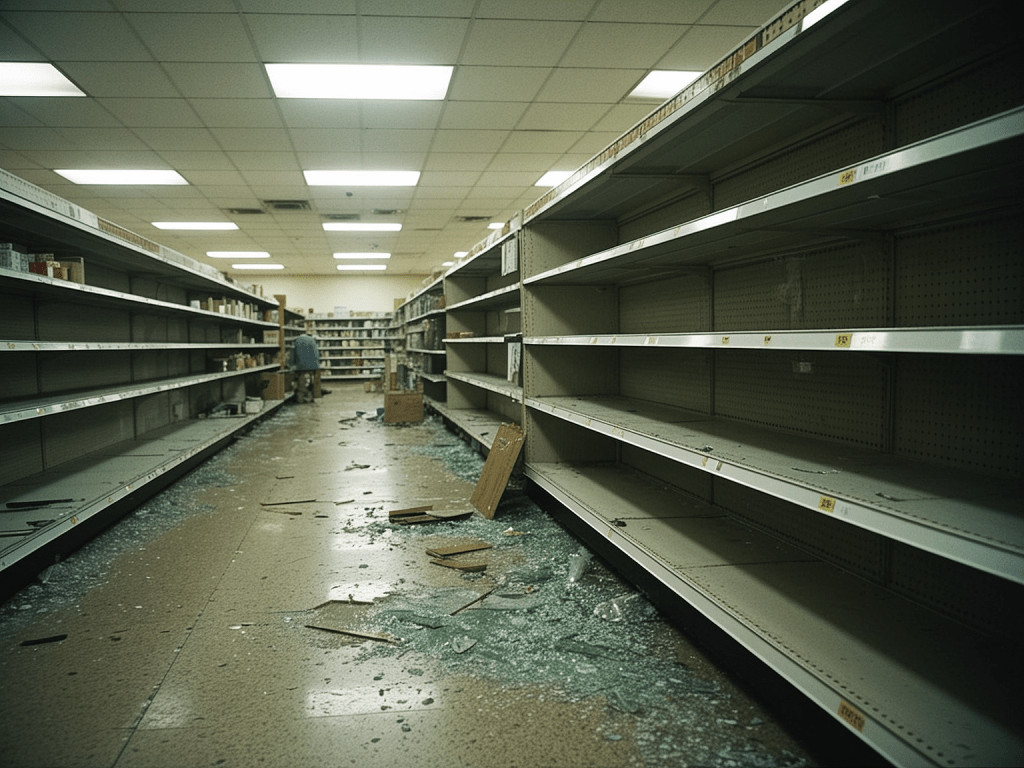
But the real developments of day four were social, not logistical. Neighbors were starting to run out of food and had begun knocking on doors. That's tough—I know many of their kids, had watched them grow up, had coached some of them in little league. Fortunately, we knew this wasn't a TEOTWAWKI event. We knew the power would eventually return, that order would be restored, that this was temporary. So I shared some food with them, giving them rice and beans from my stockpile, as well as some of the chicken that had thawed and needed to be eaten anyway. But I was concerned about what was going to happen in a few more days. People had already broken the windows in the local supermarket and raided it for food on day three. The police were overwhelmed and had essentially stopped responding to property crimes, focusing only on violent emergencies. What's going to happen when that scavenged food runs out ? The average supermarket only has three days worth of food on hand under normal circumstances—less when people panic-buy. That supermarket was now empty, and the next closest one was miles away, probably in the same condition. The math was becoming clear: there were approximately 200 homes in our immediate neighborhood. If each home had an average of 2.5 people, that's 500 people. If I had six months of food for my family of four, that's approximately 720 person-meals. Divided by 500 people, that's less than a day and a half of food for everyone. The math of generosity has hard limits.
By day five, I had reached a devastating conclusion: my preparations for alternative power were totally inadequate. The few solar panels I had purchased—enough to keep phones charged and run a few LED lights—had barely been able to keep up with even those minimal needs given the cloud cover. They certainly couldn't power the refrigerator, let alone the air conditioner. If I had been able to power even a small refrigerator, I wouldn't have had the panic to save my food. If I could have air conditioned at least one room in the house, we could have slept, could have thought clearly, could have maintained our emotional resilience. The sleep deprivation was becoming dangerous—decision-making was suffering, irritability was rising, and the constant physical discomfort was grinding down our psychological defenses. It's more than just keeping cool so that we can sleep better. My wife is heat intolerant—she has a medical condition that makes thermoregulation difficult. We normally have to keep her in air conditioning pretty much all the time during warm months. Without climate control, she had been unable to do anything but lie still and suffer, her body unable to shed heat effectively. I'd been using evaporative cooling as much as possible—wet towels, misting spray bottles, sitting in the path of any breeze. But in 90% humidity, evaporation barely happens. There wasn't any ice, or I'd have been using that for cold compresses. The best I could do was keep her wet and in whatever breeze I could create with hand fans.
People in the neighborhood were starting to talk about "organizing" so that everyone could eat. I knew exactly what that meant—it meant they expected those who had prepared to share with those who hadn't. As best I knew, there were no other preppers in the neighborhood, no one else who had stockpiled food or water or supplies. I didn't know where all this food was supposed to come from, unless they were thinking that I—and perhaps a few others like me—had enough to feed everyone indefinitely. Finally got all the food salvaged that could be saved. But as much as I care for my fellow man, I didn't do it for them. I did it for my family. And the math was brutal: by the time you split up what was in my freezer through 500 people, you've got enough for one good meal. Then what ? Then we're all hungry together, and I've lost the resources that were supposed to carry my family through the crisis. The conversations I overheard that day revealed how quickly people's thinking shifts. On day one, it was "when will the power come back?" On day three, it was "this is inconvenient." By day five, it was "someone needs to do something," with the unspoken assumption that "someone" meant "someone else" who had planned ahead. The psychology of dependency dies hard.
More people were coming around by day six, asking for food. I didn't know these people—they weren't from my immediate neighborhood. Word had spread that someone on this street had supplies, and the desperate were seeking out the prepared. I had been turning them away, mostly by directing them to the FEMA distribution center that was supposedly being set up downtown. But as far as I knew, FEMA wasn't actually present yet. If they were, it was probably just to bring red tape and paperwork. I hadn't seen anyone who had actually received food or water from official sources. The government agencies that people assume will save them in emergencies were proving to be slow, bureaucratic, and overwhelmed. I decided to do some scouting that day, to get a better picture of the situation beyond our immediate area. I took the car out—carefully, since gas was now precious and stations weren't pumping—to see what was happening in the wider community. As best as I could tell, there were a few churches and non-profits up and running, trying to help people with limited resources. That was it. No National Guard presence, no FEMA trucks distributing MREs, no organized relief effort. I took that information back to my neighborhood and tried to spread it around, hoping to direct people toward actual resources rather than my front door.
But the real lesson of day six came during that scouting trip. I almost got carjacked while driving through a commercial district. There has always been gang activity in this area, and I suppose it was inevitable that organized criminal elements would recognize the opportunity that chaos provides. I must have looked like an inviting target—a working vehicle on streets that were largely empty of traffic, an obvious have in a sea of have-nots. Fortunately, I saw them in time—three young men stepping out from behind an abandoned car, one with a tire iron, moving with purpose toward my vehicle. I gunned the engine before they could reach me, swerved around their barricade, and took a series of turns through residential streets until I was certain I wasn't being followed. But it was close. Too close. The radio had gone dead by evening. We weren't even getting information that way anymore. Radio stations are supposed to have emergency power supplies and fuel stockpiles to maintain broadcasts during disasters. So I guess they ran out, or their generators failed, or the staff abandoned their posts to take care of their own families. We didn't even know if anyone out there was paying attention to what was happening here, if the wider world knew about our situation or cared. It sure felt lonely. That night, I slept with a pistol within arm's reach. I had carried concealed for years, but now the weapon was out of its holster, ready. The rules had changed.
Things were starting to get genuinely ugly by the seventh day. People were hungry, and more importantly, their children were hungry. There's something about the sound of a hungry child that breaks psychological constraints that would otherwise hold. Parents who would never steal for themselves will kill for their children. I was starting to see others walking around with guns openly displayed—strapped to hips, slung over shoulders. I carry concealed, so I've been armed throughout this ordeal, but hidden. But I doubted all these newly armed people had concealed carry licenses. They had simply decided that the laws no longer applied, that they would take their security into their own hands. And I had to say, they didn't all look like nice people. Some looked desperate. Some looked predatory. Some looked like they had been waiting for an excuse. Several of them got together that afternoon and came up my walkway in a group of six, moving with the coordinated intent of people who had discussed their plan. They looked like they were planning on taking what they wanted. Since I have a four-foot tall hedge around my front yard, they were forced to bunch up, right there on the walkway—right where I wanted them, where we had the advantage.
I stepped out onto the second-floor balcony while my family positioned themselves at windows, weapons ready but not visible. As I said, the intruders were right where we wanted them—in a kill zone, where we had the upper hand, where they had no cover and no escape route that wouldn't expose them to fire from multiple angles. That was enough to get them to turn back. They shouted threats at the house, promises of return, curses and obscenities. But they left. I'm sure they would come back, just as soon as they were ready, just as soon as they had gathered more numbers or more courage or more desperation. The seventh day was the day I understood, truly understood, that people were going to be the biggest problem. Not the heat. Not the thirst. Not the lack of electricity or the spoiled food or the logistical challenges. People. More people, more problems. The equation was that simple.
Thank God, the lights came back on at 6:47 PM. I remember the exact moment because I was staring at my watch, counting down the remaining daylight, when the hum of the refrigerator suddenly restarted. The air conditioner kicked on. Lights blazed on throughout the house. We had power once again. Things started to settle down almost immediately. Where it had looked like we were going to have a High Noon confrontation in the streets of our neighborhood just hours earlier, civilization reasserted itself with startling speed. People put their guns away. The threat evaporated. Some food trucks showed up—apparently organized by a local church that had finally gotten supplies moving. I saw smiles on faces for the first time in a week. Within 48 hours, it was like it had never happened. People went back to work. Kids went back to school. The supermarket was restocked. The water ran clear. The street was repaired. Life returned to normal, and most people seemed eager to forget the fear, the desperation, the way the veil had briefly lifted to show what lurked beneath.
But I couldn't forget. And I couldn't go back to my previous level of preparation. The historical precedents are there for anyone who cares to look. The Northeast Blackout of 2003 left over 55 million people without power across eight states and Canada, some for more than two days. The 1977 New York City blackout resulted in widespread looting and arson, with over 1,600 stores looted and damage exceeding $300 million. Hurricane Katrina in 2005 showed us how quickly urban centers can descend into chaos when multiple systems fail simultaneously. The 1998 Ice Storm in eastern Canada left millions without power for weeks, demonstrating the vulnerability of infrastructure to weather events. Texas Winter Storm Uri in 2021 killed over 700 people when the isolated grid failed during freezing temperatures. These aren't conspiracy theories. These are data points. The grid is fragile. People are fragile. And the veneer of civilization is far thinner than we like to believe.
So that was my experience. I'm glad it wasn't any worse. But what about you ? Have you lived through something similar ? Have you had the lights go out ? How did you handle it ? How did your neighbors ? What did you learn that you were doing wrong ? And more importantly—what will you do differently when it happens again ? Because it will happen again. Not if. When. The grid is aging. The weather is becoming more extreme. The population is growing. The infrastructure is crumbling. And the people around you—the ones who smile and wave at barbecues, who borrow your tools and bring you casseroles when you're sick—those same people will be at your door on day four, then day five, then day six, with hungry children and desperate eyes and the slow realization that you have what they need and they have nothing to lose. Will you be ready ? Or will you be the one knocking on someone else's door, wondering if they're going to turn you away ? The power will go out again. The only question is whether you'll be ready for what comes after. And whether you'll recognize that the darkness outside is nothing compared to the darkness that lives in the hearts of men when they get hungry enough.