August 26, 2026
Our war against Iran began six months ago this week, and I think that history will surely record it as the most disastrous military conflict in our national history. The debacle ironically came amidst the 250th anniversary of the American Declaration of Independence.
Contrary to our often boastful patriotic narratives, many of our previous wars had certainly been less than victorious. We had fought Britain to a draw in the War of 1812 and achieved the same outcome against our opponents in the Korean War. We had been defeated in Vietnam, and in the aftermath of the 9/11 Attacks of 2001, we had launched wars in Afghanistan and Iraq, eventually losing both of them, the former after an astonishing twenty years of sustained effort.
But none of those latter three defeats had been military ones on the battlefield. Instead, in each case we had suffered endless continuing losses with no hope of accomplishing our original objectives, so after years of fruitless effort, we finally gave up and withdrew in considerable embarrassment. In effect, we only lost by failing to win, and those defeats seemed to produce few if any major negative consequences.
Although we suffered many casualties, squandered huge sums of money, and sacrificed some international respect, in no case did we lose any important strategic assets.
But the Iran War falls into an entirely different category, and does so in several different ways.
The Persian Gulf region and its vast natural resources constitute one of the most strategically vital areas of the world. For more than a half-century we had exerted dominant control over its energy supplies, control that had been greatly strengthened by our victorious 1991 Gulf War against Iraq. This was the major basis of the global petrodollar system, allowing us to maintain our reserve currency status along with all the many levers of power and influence that it provided.
So despite our gargantuan budget and trade deficits, we had the ability to print almost unlimited dollars without incurring massive domestic inflation because others readily accepted them as tokens of great value. Over the last six years, our accumulated national debt has almost doubled to a nearly unimaginable $40 trillion but with only minor domestic ill-effects.
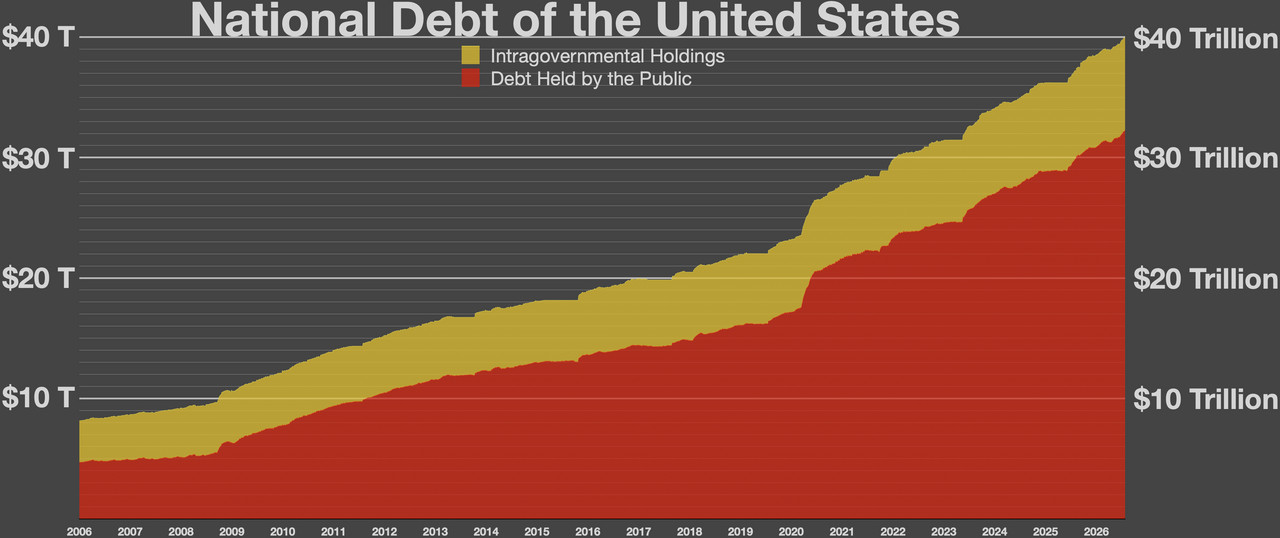
However, this war may be ending our dominance over the Persian Gulf, probably with fateful consequences.
Although the war has continued, we have revised downward our primary strategic objective to something very different than the original goal under which we began the conflict. We are attempting to reopen the vital Strait of Hormuz to unfettered cargo traffic, while forcing Iran to relinquish its new control, allowing us to reestablish our own long decades of dominance.
Thus, we were now urgently seeking to return matters to the status quo before we had fired our first shots, and we are unlikely to achieve that goal. This is almost a textbook definition of defeat, reflecting the huge strategic reversal that we had already suffered.
A couple of months ago, a desperate President Donald Trump signed a Memorandum of Understanding with Iran aimed at ending the war. But the carefully negotiated provisions of that document were so extremely one-sided that they were almost universally regarded as amounting to an American surrender. Once others loudly declared this, our arrogant and mercurial president immediately began ignoring and violating its terms, thus soon reigniting the conflict.
In effect, our country has been militarily defeated but Trump has refused to acknowledge that reality, placing matters in a strange and perhaps especially dangerous situation.
No previous American war had ever been so unpopular from the very first day, and much of that was because Trump and his administration had made no effort to obtain broad public support before he began it.
Official Congressional declarations of war had long become passe, but presidents had traditionally sought at least some sort of political fig-leaf for their planned attacks.
Later historians have rightfully castigated President Lyndon Johnson for having fraudulently persuaded Congress to pass the 1964 Gulf of Tonkin Resolution that he then used to justify our military involvement in Vietnam. When no Iraqi WMDs were found, President George W. Bush was vilified for "lying us into the Iraq War."
But in the case of Trump, those criticisms did not apply. Iran was a country the size of Western Europe with more than ninety million people, so the war was certainly our largest military undertaking at least since Vietnam. Yet Trump made no effort to obtain any sort of political approval but just began the war upon his sole authority, demonstrating the total collapse of our traditional constitutional system.
In some of his braggadocio, Trump has likened himself to Stalin, Hitler, Attila the Hun, and Genghis Khan. Obviously none of those powerful autocrats had ever been required to seek approval for the wars that they initiated, instead merely giving the order on their sole authority, and Trump felt that he could do the same.
One obvious reason that he avoided any effort to enlist support for his planned attack was that it would have forced him to forego the vital element of surprise.
Indeed, Trump later boasted that he had modeled his assault against Iran upon the notorious December 7, 1941 Japanese attack on Pearl Harbor. The necessary element of surprise would have been lost had he sought to enlist the support of the American people, let alone negotiated with Congress to grant him the necessary legal authority. So he never considered taking those steps.
Throughout our long Cold War against the USSR and during the decades that followed, strategists had always considered the military scenario of a decapitating first strike. This concept was widely discussed in the media and even included in the plotlines of countless popular films, television shows, and fictional thrillers. However, prior to Trump, I'm not sure that anyone in modern world history had ever actually carried out such a bold and ruthless operation.
But Trump began the conflict by suddenly killing most of Iran's top political and military leaders in the massive wave of missile strikes that constituted our official declaration of war.
The impact of Trump's unexpected initial attack was further magnified by the circumstances under which it took place. Trump had lured the Iranians into peace negotiations, pressing them for major concessions, and they had expressed their willingness to make these. But such a crucial decision obviously required that their top leadership meet together in one location to debate the proposal, thereby rendering them vulnerable to all being killed in the decapitating strikes that began the war.
Considering those circumstances, I initially gave Iran little chance of avoiding a swift and crushing defeat against the combined forces of America and Israel, and that was the widespread consensus. But as I sketched out late last month, matters soon followed a very different trajectory.
At the time, few observers believed that Iran could survive that massive onslaught. In recent years, our own annual military spending had been more than one hundred times greater than that of Iran, while the renowned Israeli military historian Martin van Creveld had once rather boastfully declared that his own country's armed forces were the second or the third strongest in the world. Caught by surprise and faced with such overwhelming enemy power, Iran seemed certain to crumble, suffering a rapid defeat.
However, contrary to all those expectations, the Iranians absorbed those heavy blows and held up. Drawing upon their huge concealed arsenal of ballistic missiles and powerful drones, they began inflicting serious damage upon some of our local bases, destroying several of our most important strategic radar installations, very difficult and expensive to replace.
Most importantly, the Iranians closed the Strait of Hormuz to unfriendly cargo traffic just as they had always threatened to do if attacked. Trump had disregarded that possibility, assuming that the Iranian government would surrender within a few days and reopen the Strait. But when that didn't happen, he grew frantic over the global economic consequences of the potential loss of 20% of the world's oil supply and equal or larger shares of the world's LNG, fertilizer, and other vital commodities...
As Trump considered his military options for forcibly reopening that crucial waterway, he discovered that none of them were viable. Over the previous decade, we had invested more than two trillion dollars in our navy, with one of its most important missions being maintaining the security of the Persian Gulf waters, but it proved totally useless at that task. Trump deployed many thousands of Marines and airborne troops to the region, but he was told that a ground assault had very little chance of dislodging Iranian control and would only result in heavy American casualties.
So the weeks of intense warfare that followed were almost entirely confined to air operations. America and Israel together launched more than 20,000 strikes at Iranian targets and successfully assassinated numerous additional Iranian leaders. But the Iranians remained unbowed and they fired back with their own missiles and drones, providing no indication that they were close to defeat. Indeed, their munitions appeared inexhaustible, while America's own supplies were substantially depleted by the second week of April...
- America Faces "Tank Bottom" on Oil and on Munitions
- Ron Unz • The Unz Review • July 27, 2026 • 4,700 Words
The Iranian warfighting strategy proved extremely effective.
Their own huge arsenals of accurate ballistic missiles and powerful drones were buried deep underground and therefore almost impervious to American attacks, and this included their production facilities. Meanwhile, the severe depletion of our already ineffective antimissile systems had rendered all our regional assets and bases completely vulnerable to their strikes.
The Iranians had also been methodically eliminating our major regional radar installations, increasingly blinding us to their operations.
This reduced our warning times for missile attacks to just a few minutes at best. As a consequence, we could no longer base our aircraft in the Persian Gulf region since they could easily be destroyed on the ground.
Instead, we were forced to redeploy those assets many hundreds of miles farther away to bases in Jordan, greatly reducing their effectiveness in attacking Iran. But those bases were still within range of Iranian missiles, so they soon came under such unanticipated strikes.
According to the official Iranian news agency:
The IRGC said the missile attack destroyed three American F-35 fighter jets, heavily damaged three others, and killed several US military personnel, including officers and technical and maintenance staff.
The American military denied this, claiming that all the incoming Iranian missiles had been successfully intercepted. However, this hardly seemed consistent with the reality that several American servicemen had been killed, just as the Iranians had claimed, with additional dozens wounded. Total American casualties have now exceeded 750 and might be as high as 900.
Individual F-35s may cost more than $100 million each, so if those Iranian claims were correct, we had suffered a major blow. Those same Iranian missile strikes also forced us to redeploy our $240 million Triton drone to Italy lest it be destroyed on the ground.
Trump reacted with volcanic fury to those successful Iranian blows, promising to "open the gates of hell" with a massive retaliatory attack of unprecedented size.
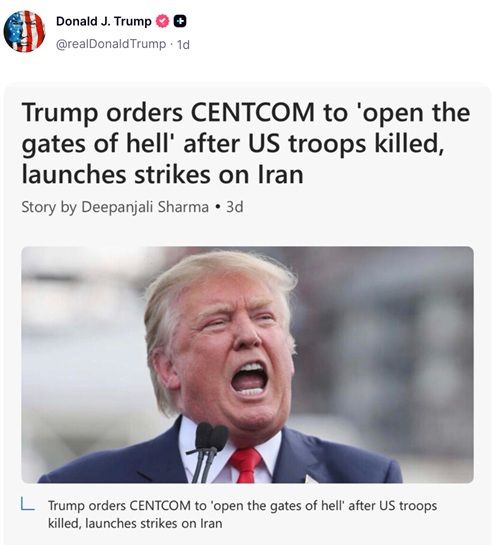
But a couple of days later, the New York Times reported that our low levels of remaining munitions had forced Trump to call off his planned attack:
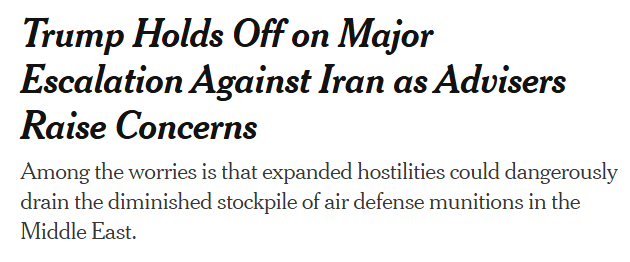
President Trump has set aside, at least for now, plans to sharply escalate the American military assault against Iran, with particular concern that intensifying the war could dangerously drain the Pentagon's already diminished stockpile of Patriot antimissile interceptors and other air defense munitions in the Middle East.
Last week severe shortage of onboard food and other supplies had forced us to withdraw the USS Abraham Lincoln aircraft carrier from the region. This had been caused by Iran's destruction of our regional naval bases, further validating the Iranian strategy.
Iranian missile and drone attacks on a major U.S. base in Bahrain and a port in the United Arab Emirates have forced the Navy to bring supplies for warships like the Lincoln from locations such as Diego Garcia and Singapore, trips that can force resupply ships to sail more than 4,000 miles.
Defense officials have mostly avoided discussing the impact of the Bahrain and UAE closures on Navy ships engaged in combat with Iran, but several naval experts told Task & Purpose that any struggles with the food and supplies at sea likely trace to the closed ports.
One of Iran's major stated objectives had been to drive American military forces out of the Persian Gulf by eliminating our local bases, and to my considerable surprise they seem to be successfully achieving this result.
Given Iran's enormous arsenal of missiles and drones and our own complete lack of effective air defenses, those bases would merely become hostages to future Iranian attacks, constituting American vulnerabilities rather than assets. Therefore, I cannot see the logic of any American attempts to rebuild them, and others have apparently come to the same conclusion.
Founded over a century ago, the Council on Foreign Relations is one of our premier establishmentarian organizations, with its flagship publication being the equally venerable Foreign Affairs magazine. One of the major articles in the current issue was entitled "The End of the American Middle East" and it was apparently considered so important that when it was released a few days ago, it was made freely available without a paywall.
The author was Prof. Marc Lynch of George Washington University, director of its Institute for Middle East Studies and a scholar perhaps best known for coining the phrase "Arab Spring." He opened his article with the following remarkable paragraph:
The American Middle East is finished. The regional order that has prevailed since 1991 has been one of the many casualties of the U.S.-Israeli war with Iran. The American and Israeli failure to dislodge the regime in Tehran has proved the bankruptcy of decades of sanctions and violence. The inability of the United States to protect its Gulf allies from Iranian attacks or to keep the Strait of Hormuz open has fatally undermined the core security bargain that justified its network of military bases in the region. And Israel's increasingly threatening posture and abandonment of any pretense of interest in reaching an accommodation with the Palestinians have ended Washington's decades-long mission of bringing its Arab allies and Israel together into an enduring security partnership.
More than 5,000 words of generally cogent analysis followed, and towards the end Lynch argued that America must drastically change its regional policy:
That starts with renouncing the use of military intervention as a first resort and ending the practice of diplomacy by airstrike. Washington's priority should be defense, not offense. One way to make that intention clear is to forgo the restoration of damaged or destroyed U.S. military bases across the Gulf...
The United States must pursue stability in the Middle East through diplomacy and collective defense, not militarized containment. The Iran fiasco has thoroughly exposed the hollowness of hawkish calls for war and promises of decisive action. It is time for Washington to commit to a diplomatic process that can bring Iran into the regional security system as an invested partner.
On a personal note, less than 48 hours after we initiated our war with Iran, I had published my first article on the subject entitled " Trump's Iran War as America's 'Suez Moment'?" My piece suggested that our attack might ultimately prove analogous to the 1956 Suez War that led to the destruction of British and French influence in the region.
I appear to have been one of the very first individuals anywhere to have drawn that important analogy, with the next such early reference appearing more than a week later according to the Gemini AI, and Prof. Alfred McCoy of the University of Wisconsin-Madison eventually becoming heavily identified with the notion.
Therefore I was very gratified that such a noted scholar as Lynch writing in such a prestigious publication now came to much the same conclusion, using the term "Suez" seven separate times in his article and writing:
It has become commonplace to refer to the Iran war as Washington's Suez moment. There are indeed similarities between today's catastrophe and the failed British-French-Israeli scheme to take the Suez Canal from Egypt in 1956, which delivered a stunning political victory to Egyptian President Gamal Abdel Nasser. Suez became a shorthand for the demise of the European empires and the passage from a multipolar world to the bipolar Cold War-era system.
By publishing Lynch, the CFR may have tacitly endorsed his argument that America needed to drastically change its Middle East policy. But the author acknowledged that such a transformation was unlikely to occur under Trump and must therefore await the arrival of a new presidential administration.
Unfortunately, Trump seemed stubbornly wedded to defeating Iran and restoring American control of the Persian Gulf, unwilling to admit that he had disastrously lost such a crucial strategic asset. With his munitions so severely depleted, a renewed military attack along previous lines seemed unlikely, so his administration has been casting about for other options.
One possibility is an economic attack. Over the last few days, Treasury Secretary Scott Bessent has promised to subject Iran to "the greatest coordinated economic isolation in the history of the world."
On his Truth Social website, Trump loudly proclaimed an "ECONOMIC D-DAY" against Iran:
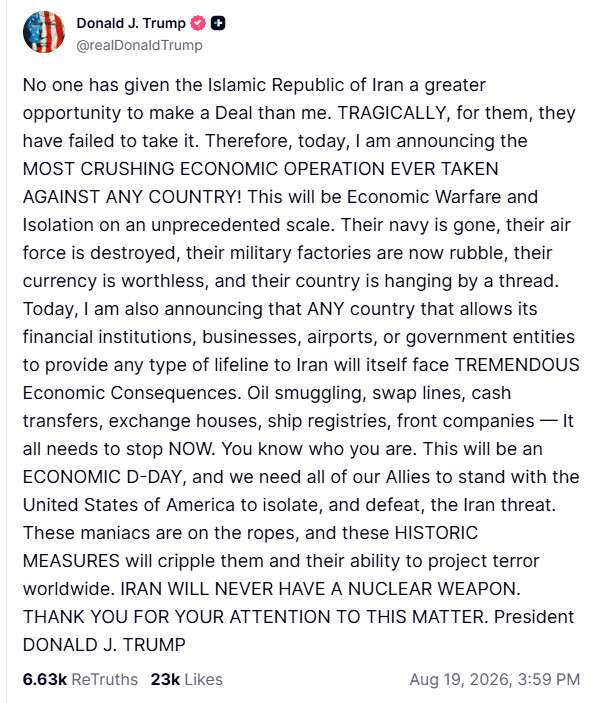
However, few observers expected this new campaign to be any more successful than all the previous rounds of America economic sanctions against Iran, especially since China had already rejected Trump's demands.
Meanwhile, diesel prices have already reached $170 per barrel, rapidly approaching the highest levels in history and putting additional pressure on Trump to somehow coerce Iran into reopening the Strait.
Subscribe to New Columns
The combination of a failed war against Iran and higher energy and fuel costs mean that the Republicans may be facing potential disaster in the midterm elections this November.
For example, Texas is one of the most solidly Republican states, the party's national lynchpin, and Gov. Greg Abbott has held his position for more than a decade, becoming the longest-serving incumbent governor in America. Most of his victories have been by landslide margins, but he is now locked in a very tight race with a Hispanic woman unknown to most of the country.
Alabama Arkansas is another one of our most Republican states, and incumbent Sen. Tom Cotton is now slightly behind his Democratic challenger in the most recent poll.
All of this may be putting terrible pressure on Trump to somehow achieve some sort of victory in the failed war that he unleashed.
So if and when his economic attack fails, Trump might be left with only one exceptionally reckless and dangerous option on the table.
Former Rep. Marjorie Taylor Greene had spent years as one of Trump's most loyal and highest-profile MAGA Republican supporters, finally breaking with him over his refusal to release the Epstein Files.
In April she had denounced him for his blasphemous, profanity-laced post promising war crimes on Easter Sunday morning.
Given her background, she probably retained many sources within the Trump administration and a week ago she claimed that in strategy meetings Trump was seriously discussing the use of nuclear weapons against Iran as his only remaining military option.
I was initially quite cautious in believing this report, but a day or two later it was confirmed by attorney Robert Barnes in an important 50 minute interview with MAGA military analyst Brandon Weichert that I would strongly recommend watching.
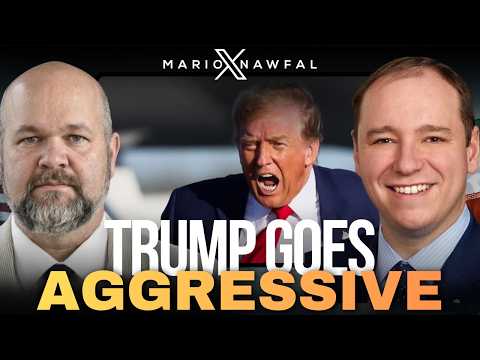
As a long-time and highly-regarded legal insider in conservative and Trump circles, Barnes seems to have outstanding sources within the Trump Administration and he has also been remarkably candid in passing along those disclosures. In the past, others had claimed that our top military officers had flatly refused Trump's orders to prepare nuclear weapons attack plans against Iran, and Barnes confirmed these reports.
According to Johnson “there is seriously something wrong with Trump”:
According to Barnes, discussion of nuclear weapons use had occurred on at least three separate occasions, including this latest instance. There was always the risk that such military resistance might eventually break down, with disastrous consequences.
Both those former committed MAGA insiders expressed their horror at the terrible dangers that our country now faced from "a mad king," and Weichert also contributed a shocking story of his own that I had never seen previously mentioned.
Rex Tillerson had spent a decade as the CEO of ExxonMobil when Trump appointed him Secretary of State in 2017. According to Weichert, just a couple of months into his first term, Trump had suggested to Tillerson that America should use its nuclear weapons in order to strengthen its international position, leading the oil industry executive to conclude that "Trump was f'ing insane." The result was a permanent decline in their relationship and Tillerson's eventual replacement by CIA Director Mike Pompeo in March 2018.
Although at the time I had been unaware of many of these developments within the Trump Administration, in early May I had published an article suggesting something similar.
- Has President Donald Trump Lost His Mind?
- Ron Unz • The Unz Review • May 4, 2026 • 7,200 Words
In that piece I noted that the White House had just released an extremely bizarre video clip showing President Trump saying the single word "WINNING" for an entire hour straight. I found it difficult to believe they would have done such a strange thing without the approval of the president himself.
Can't stop, won't stop.
Soon afterward, Trump expressed his enthusiastic support for the 22 foot golden statue of himself recently constructed and unveiled by his ardent supporters, something that I had originally assumed was just a joke.
Throughout the Cold War and afterward, the world had successfully avoided the use of nuclear weapons for more than eighty years. For America to now use them against a non-nuclear power merely because our unprovoked war of aggression against Iran had resulted in our conventional defeat would be extraordinarily destabilizing.
There would obviously be a huge scramble among other nations to acquire nuclear weapons of their own as the sole means of deterring such future attacks. With America having itself broken the longstanding nuclear taboo, that massive wave of additional proliferation would enormously increase the chances of subsequent use, whether in the Middle East or elsewhere.
The serious prospect that Trump might unleash a nuclear strike seemed a terrible risk. Weichert, Barnes, and many, many others have been desperate to deflect him from that path and perhaps somehow even remove him from power.
Unfortunately, their warnings of nuclear dangers have probably proven ineffective, partly because after eighty years the threat no longer seemed real and immediate to most Americans.
But they might gain far greater traction if they instead focused on an entirely different issue. The Covid epidemic suddenly appeared late in the first Trump Administration and was widely regarded as one of the greatest disasters in modern American history.
As I wrote in an article earlier this month:
During the Covid epidemic, the Economist estimated that the total number of worldwide "excess deaths" due to the virus was probably around thirty million, including well over a million Americans, while the lives of billions more had been greatly disrupted. Britain's Lancet is one of the world's most prestigious medical journals, and soon after the outbreak began it established the Covid Commission to investigate all aspects of the disaster, naming Sachs as its chairman...
Over time, Sachs gradually became more and more suspicious of the Covid origins, and Anthony Fauci's recent Congressional testimony prompted a new interview a few days ago in which he reiterated his conclusions. Sachs explained that there was strong evidence that the virus had been designed, created, tuned, and tested in American laboratories heavily funded by Pentagon grants, though he could only speculate how it then suddenly appeared in Wuhan, China...
Oddly enough, the world's second major Covid outbreak soon began in Iran, where the virus infected and killed considerable numbers of that country's ruling elites. Since speculation regarding that very strange development might point in especially dark directions, Sachs wisely avoided mentioning those facts.

Sachs has now repeated many of these arguments about the true origins of Covid in an article that he co-authored and published a week ago.
It is interesting to note that in his Congressional testimony, Fauci took the Fifth Amendment more than 110 times even though the outgoing Biden Administration had already granted him full immunity from prosecution for any of his government work from 2014 to 2025.
So nothing Fauci truthfully said in his testimony regarding Covid could have put him at any legal risk. That suggests that he may have been concerned about some other sorts of risks.
Regarding what those other sorts of risks might have been, Sachs has strongly argued that the Covid virus was probably created in an American laboratory. If the American public began to believe that this had been the case, there surely would be a tidal wave of outrage, probably great enough to sweep Trump out of power.
Beginning in April 2020, I have published a very long series of articles arguing that there is strong, even overwhelming evidence that the Covid epidemic was the result of a deliberate American biowarfare attack against China and Iran, an attack whose unexpected blowback hit our own country much harder than either of those intended targets.
My most recent article from early 2025 summarized much of this accumulated evidence:
- Five Years and Thirty Million Deaths
- Ron Unz • The Unz Review • January 6, 2025 • 12,600 Words
But some of the most powerful pieces of evidence can be provided in just a few passages that I have repeatedly included:
For example, in 2017 Trump brought in Robert Kadlec, who since the 1990s had been one of America's leading biowarfare advocates. The following year in 2018 a mysterious viral epidemic hit China's poultry industry and in 2019, another mysterious viral epidemic devastated China's pork industry...
From the earliest days of the administration, leading Trump officials had regarded China as America's most formidable geopolitical adversary, and orchestrated a policy of confrontation. Then from January to August 2019, Kadlec's department ran the "Crimson Contagion" simulation exercise, involving the hypothetical outbreak of a dangerous respiratory viral disease in China, which eventually spreads into the United States, with the participants focusing on the necessary measures to control it in this country. As one of America's foremost biowarfare experts, Kadlec had emphasized the unique effectiveness of bioweapons as far back as the late 1990s and we must commend him for his considerable prescience in having organized a major viral epidemic exercise in 2019 that was so remarkably similar to what actually began in the real world just a few months later.
With leading Trump officials greatly enamored of biowarfare, fiercely hostile to China, and running large-scale 2019 simulations on the consequences of a mysterious viral outbreak in that country, it seems entirely unreasonable to completely disregard the possibility that such extremely reckless plans may have been privately discussed and eventually implemented, though probably without presidential authorization.
But with the horrific consequences of our own later governmental inaction being obvious, elements within our intelligence agencies have sought to demonstrate that they were not the ones asleep at the switch. Earlier this month, an ABC News story cited four separate government sources to reveal that as far back as late November, a special medical intelligence unit within our Defense Intelligence Agency had produced a report warning that an out-of-control disease epidemic was occurring in the Wuhan area of China, and widely distributed that document throughout the top ranks of our government, warning that steps should be taken to protect US forces based in Asia. After the story aired, a Pentagon spokesman officially denied the existence of that November report, while various other top level government and intelligence officials refused to comment. But a few days later, Israeli television mentioned that in November American intelligence had indeed shared such a report on the Wuhan disease outbreak with its NATO and Israeli allies, thus seeming to independently confirm the complete accuracy of the original ABC News story and its several government sources.
It therefore appears that elements of the Defense Intelligence Agency were aware of the deadly viral outbreak in Wuhan more than a month before any officials in the Chinese government itself. Unless our intelligence agencies have pioneered the technology of precognition, I think this may have happened for the same reason that arsonists have the earliest knowledge of future fires.
According to these multiply-sourced mainstream media accounts, by "the second week of November" our Defense Intelligence Agency was already preparing a secret report warning of a "cataclysmic" disease outbreak taking place in Wuhan. Yet at that point, probably no more than a couple of dozen individuals had been infected in that city of 11 million, with few of those yet having any serious symptoms. The implications are rather obvious. Furthermore:
As the coronavirus gradually began to spread beyond China's own borders, another development occurred that greatly multiplied my suspicions. Most of these early cases had occurred exactly where one might expect, among the East Asian countries bordering China. But by late February Iran had become the second epicenter of the global outbreak. Even more surprisingly, its political elites had been especially hard-hit, with a full 10% of the entire Iranian parliament soon infected and at least a dozen of its officials and politicians dying of the disease, including some who were quite senior. Indeed, Neocon activists on Twitter began gleefully noting that their hated Iranian enemies were now dropping like flies.
Let us consider the implications of these facts. Across the entire world the only political elites that have yet suffered any significant human losses have been those of Iran, and they died at a very early stage, before significant outbreaks had even occurred almost anywhere else in the world outside China. Thus, we have America assassinating Iran's top military commander on Jan. 2nd and then just a few weeks later large portions of the Iranian ruling elites became infected by a mysterious and deadly new virus, with many of them soon dying as a consequence. Could any rational individual possibly regard this as a mere coincidence?
As I further explained in a 2021 article:
By early March 2020, the Iranian general overseeing his country's biowarfare defense had already begun suggesting that Covid was a Western biological attack against his country and China...
Soon afterward, Iran's Supreme Leader Ali Khamenei took the same public position, while populist former president Mahmoud Ahmadinejad became especially vocal on Twitter for several months, even directing his formal accusations to UN Secretary-General Antonio Guterres. Just a single one of his numerous Tweets drew many thousands of Retweets and Likes.
Iranian radio and television and its international news service repeatedly carried these stories, backed by supportive interviews with a top political aide to Malaysia's former prime minister. But America's overwhelming domination over the English-language global media ensured that this major international controversy never came to my attention at the time it occurred.
The blockade preventing these Iranian charges from reaching the English-speaking world was further facilitated by American control over the basic infrastructure of the Internet. Just one month earlier, Iran's PressTV channel for Britain had been deleted by YouTube, following the earlier removal of its main global channel. Most recently, the American government took the unprecedented action of seizing PressTV's Internet domain, completely eliminating all access to that website.

Wikipedia is also under hostile control, so we should hardly be surprised that ubiquitous source of worldwide information rather implausibly suggests that a single Iranian businessman returning from China was the cause of the Qom outbreak.
For those who prefer getting their information in a different form, here are several of the podcast interviews from years ago in which I laid out these arguments.