By Madge Waggy
MadgeWaggy.blogspot.com
August 29, 2026
Fernando de la Rúa left the Casa Rosada on December 20, 2001, through a side door, boarding a helicopter from the building's roof. It was not symbolic. It was a literal escape from a capital in flames, where 22 people had died in two days of protests, supermarkets had been systematically looted, and banks remained closed with deposits frozen.
Argentina was not a poor country. Per capita income exceeded that of many European nations. Buenos Aires had architecture comparable to Paris, a subway older than many American cities, and a middle class that traveled abroad and sent children to private universities. The collapse came fast. From the first bank runs in November to the declaration of sovereign default on December 23, only weeks passed.
The United States in 2026 faces similar arithmetic, though mechanisms differ. Argentina offers a rare case in economic analysis: a complete narrative with documented consequences, a natural experiment conducted on living populations. Data exists. Testimonies are recorded. Patterns are visible to anyone willing to examine them without assuming American exceptionalism provides immunity.
Frozen Accounts: The Mechanics of a Banking Lockdown
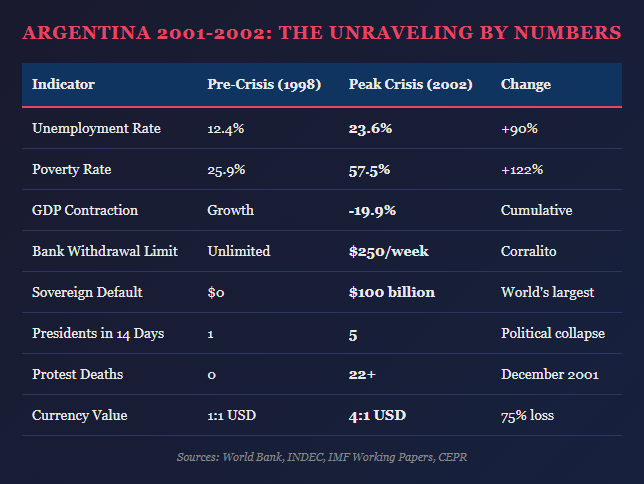
On December 1, 2001, Finance Minister Domingo Cavallo implemented what became known as the corralito-a measure freezing all bank accounts. Depositors could withdraw 250 pesos weekly, approximately $250 at the pegged exchange rate. Dollar-denominated accounts, which many Argentines held as protection against fluctuation, were completely immobilized.
Argentine banks did not fail through classic insolvency. They failed through physical inability to return deposited money to owners. The central bank lacked sufficient dollar reserves to honor the Convertibility Plan's promise. Foreign debt consumed all incoming currency. The result was a liquidity crisis disguised as a solvency crisis, with depositors caught in between.
Cavallo designed the corralito to prevent capital flight. The wealthy had already moved dollars offshore-approximately $20 billion left the country in 2001 alone. What remained in the system represented the savings of those without foreign accounts, without access to international wire services, without mobility to physically transport cash across borders. The corralito trapped these remaining deposits, converting a banking crisis into a political one.
The response emerged spontaneously. Within hours of the announcement, Buenos Aires residents began appearing at windows, banging pots and pans with spoons. This cacerolazo-named for the casserole dishes producing the noise-represented something new in Argentine protest culture. Previous demonstrations were organized by unions or parties. The cacerolazo was middle-class, decentralized, and furious. It announced that the crisis had breached barriers that normally protect comfortable populations from systemic failure.
By December 19, the cacerolazo had moved from balconies to streets. Tens of thousands converged on the Plaza de Mayo. President de la Rúa declared a state of siege, suspending constitutional protections. Police responded with rubber bullets, tear gas, and eventually live ammunition. The 22 confirmed deaths represented only the immediate toll.
The corralito demonstrated how quickly financial trust can evaporate. Argentina's banking system had functioned normally in October. By December, citizens were attacking ATMs with sledgehammers. The psychological transition from depositor to victim took approximately six weeks.
The United States maintains a fractional reserve banking system where approximately 10% of deposits exist as physical currency. The remainder exists as accounting entries, loan obligations, and electronic records. If confidence were to erode simultaneously across a significant population segment, the physical infrastructure to honor withdrawal demands simply does not exist. No nation maintains vaults containing the full monetary supply.
For American readers, the relevant comparison involves dollar hegemony. The United States enjoys the unique privilege of borrowing in its own currency, which it also controls. Argentina borrowed dollars while earning pesos, creating a mismatch that amplified every contraction. American debt is denominated in dollars, eliminating this specific vulnerability. But privilege carries its own dangers. Theoretically, the Federal Reserve can create unlimited currency to service debt, so the constraint becomes political rather than mechanical. Markets, not vaults, determine sustainability.
Indicators That Defy Comfortable Interpretation
Poor interpretations of Argentina's collapse suggest civilizational fragility. We prefer narratives of gradual decline, of warning signs heeded or ignored. Argentina's experience suggests something else: the possibility that complex economic systems can transition from functional to broken faster than policy mechanisms can respond.
Consider the unemployment trajectory. In 1998, Argentina reported 12.4% unemployment-already elevated by developed-world standards. By 2001, the figure reached 18.3%. By 2002, 23.6%. These percentages represent millions of individuals who held jobs, paid mortgages, maintained professional credentials, and suddenly found themselves competing for work that no longer existed or paid wages that no longer covered basic expenses.
The poverty statistics prove more shocking. In 1998, 25.9% of Argentines lived below the official poverty line. By October 2001, the figure reached 38.3%. By late 2002, 57.5% of the population-more than half-lived in poverty. The indigence rate, measuring extreme poverty unable to afford basic food baskets, doubled during the same period.
The World Bank's analysis of income distribution reveals the mechanism. Between October 2001 and May 2002, per capita household income for the poorest decile collapsed by 41%. The wealthiest decile experienced a 23% decline. Both groups suffered, but the suffering was unequal, compounding existing disparities. The middle class experienced something worse than poverty: the psychological trauma of downward mobility combined with the material reality of deprivation.
GDP figures confirm the scale. From 1998 to 2002, Argentina's economy contracted by 19.9% cumulatively. The annual decline in 2002 alone exceeded 10%. These contractions occurred in a country with existing infrastructure, educated workforce, established trade relationships, and no significant military conflict. The cause was financial: debt obligations that could not be met, currency arrangements that could not be sustained, and policy responses that exacerbated rather than alleviated the underlying crisis.
The banking freeze produced its own data. The corralito initially limited withdrawals to 250 pesos weekly-approximately $70 in post-devaluation terms. For families with savings of $20,000, $50,000, or $100,000, this represented a confiscation disguised as liquidity management. The subsequent pesificación-forced conversion of dollar accounts to pesos-occurred at rates that destroyed 70% of dollar value. A $50,000 savings account became, effectively, $15,000 in purchasing power, assuming one could access even the converted funds.
Crime statistics from the period remain incomplete due to overwhelmed police forces and disrupted record-keeping, but qualitative evidence suggests dramatic increases in property crime, violent robbery, and the emergence of new criminal categories. "Express kidnappings"-abductions lasting hours rather than days, with ransom demands in the hundreds rather than millions of dollars-became sufficiently common to require terminology. Residential burglaries increased in previously secure neighborhoods. Organized looting of supermarkets occurred not as spontaneous theft but as coordinated operations involving vehicles, communication, and distribution networks.
The political data tell their own story. Between December 20, 2001, and January 2, 2002, Argentina had five presidents. De la Rúa resigned on December 20th. Ramón Puerta served as interim for two days. Adolfo Rodríguez Saá served for one week, declaring default before resigning. Eduardo Camaño served as interim for three days. Eduardo Duhalde assumed office on January 2nd, finally providing nominal stability. This was not political instability in the abstract sense of policy disagreement. This was institutional collapse, the failure of constitutional mechanisms to produce functioning governance.
Daily Life Under Economic Breakdown
Economic collapse manifests not primarily in statistics but in the texture of ordinary existence. Understanding this texture matters for preparation because it reveals which assumptions remain valid and which dissolve.
Food access changed immediately. Argentina possessed sufficient agricultural production to feed its population; the country exports grain and beef. Yet supermarket shelves emptied because merchants, anticipating currency devaluation and price controls, withheld inventory. The goods existed in warehouses but not in commerce. Prices for available items increased 10% weekly in late 2001, creating incentives for hoarding and speculative withholding. The result was simultaneous abundance and scarcity-grain rotting in silos while urban residents queued for bread.
Power and water services deteriorated as municipalities exhausted operating budgets. Buenos Aires experienced rolling blackouts. Water pressure dropped in peripheral neighborhoods. Infrastructure maintenance ceased because the tax revenue and user fees that funded such maintenance had evaporated along with employment and purchasing power. The physical infrastructure remained intact; the organizational and financial infrastructure to maintain it had failed.
Transportation networks continued functioning but changed character. The subway system in Buenos Aires maintained operations but accumulated maintenance deficits that would require years to reverse. Bus services reduced frequency. Private vehicles became less common as fuel prices increased and maintenance became unaffordable. Simultaneously, the informal transportation economy expanded-unlicensed taxis, shared rides arranged through personal networks, walking.
Housing markets froze then collapsed. With mortgages impossible to obtain and existing mortgage holders defaulting en masse, property transactions ceased. Those with foreign currency or stable dollar incomes could purchase property at fractions of previous values. Those with peso savings or fixed incomes found themselves unable to maintain payments on properties that simultaneously lost value. Eviction proceedings increased but faced practical obstacles-courts were overwhelmed, and the physical removal of families from residences required resources that creditors often lacked.
Medical care became precarious. The Argentine healthcare system, previously featuring both public and high-quality private options, saw the private sector contract as insurance payments failed and middle-class clients lost coverage. Public hospitals absorbed the overflow, overwhelming facilities designed for different patient volumes. Pharmaceutical access became intermittent-drugs existed but distribution networks and payment mechanisms failed.
Education maintained nominal continuity but degraded in quality. Private schools, dependent on tuition payments, faced mass withdrawals as families could no longer afford fees. Public schools absorbed the influx without corresponding budget increases. Teacher salaries, already inadequate, fell further behind inflation, leading to strikes, absenteeism, and the departure of qualified instructors for other sectors or countries.
These observations matter because they contradict certain assumptions about preparation. Stockpiling food provides limited protection if the supply chain fails not through shortage but through distribution breakdown. Currency diversification helps unless the state mandates conversion at unfavorable rates. Physical security measures matter, but crime increases derive partly from desperation among previously law-abiding populations-neighbors, not strangers, become the threat.