By Aysar Yousef
Gaze At This
August 29, 2026
When tracing the origins of modern capitalism, historians instinctively point to Amsterdam in 1602.
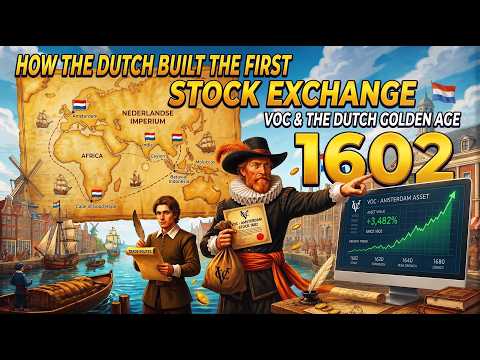
Watch this creative 3D animation for VOC company.
While the Dutch East India Company (Vereenigde Oostindische Compagnie, or VOC) undoubtedly birthed the modern financial system, the architecture they utilized was not created out of thin air. The true foundations of this financial revolution were laid centuries earlier by Arab merchants and Italian bankers along the Mediterranean and Silk Road trade routes.
Consider the bedrock of commercial banking: the bank check. The word "check" is an Arabic word derived directly from sakk (صك)-a written credit instrument that medieval Muslim traders used to settle immense financial obligations across vast geographic distances without the extreme risk of transporting physical gold or silver. As global trade expanded, Italian city-states adopted and refined these bills of exchange during the Renaissance, weaving the first threads of an international banking framework.
When the Dutch sought to dominate the perilous, capital-intensive spice trade, they did not have to invent credit and risk-sharing. Instead, they took these ancient, tested concepts and scaled them into an unprecedented mechanism for capital liquidity.
Explore the vast trade network and maritime innovations of the VOC in this animated documentary
Before the VOC, European maritime ventures operated on a localized, single-voyage model. Investors would pool their capital to fund a single ship, wait for its return, divide the profits, and liquidate the partnership. This model was highly volatile and restricted capital accumulation. In 1602, the VOC institutionalized two radical market innovations that changed the world forever: permanent capital and transferable equity.
Rather than funding single voyages, VOC investor capital was locked into a continuous, long-term enterprise. To compensate investors for this lack of liquidity, the company allowed shareholders to buy and sell their fractional ownership claims on a secondary market. This brilliant structural pivot gave birth to the Amsterdam Stock Exchange. It democratized investment, allowing everyone from wealthy burgomasters to local craftsmen to participate in global trade, creating the world's first publicly traded joint-stock company.
However, for classical economists and advocates of free markets, the VOC presents a profound and cautionary paradox. While its internal financial architecture demonstrated the immense power of market-driven capital accumulation, its external operations were the ultimate expression of state-sponsored mercantilism.
The VOC was not an agent of free trade; it was a heavily armed, state-sanctioned monopoly. The Dutch government granted the company exclusive rights to Asian trade, shielding it from domestic competition. More alarmingly, the state endowed the corporation with sovereign powers. The VOC could wage war, negotiate treaties, mint its own coinage, and construct military fortresses.
Discover how the Amsterdam Stock Exchange was born through this detailed visual breakdown
This blending of state authority and corporate enterprise stifled genuine free-market competition. Instead of creating value purely through voluntary exchange and competitive pricing, the VOC enforced its monopoly through military coercion and the violent suppression of regional producers.
True free trade requires open markets and competition, whereas the mercantilist model relies on state-entrenched monopolies that eventually distort prices and concentrate unnatural power. The VOC's ultimate collapse at the end of the 18th century-crushed beneath the weight of massive administrative overhead, systemic corruption, and uncompetitive debt-serves as a timeless economic lesson.
The financial mechanisms the VOC inherited from Arab and Italian merchants successfully unlocked the power of global liquidity. Yet, the company's reliance on state-backed monopoly over free-market competition planted the seeds of its own destruction.
Watch the creative 3D animation to see the full story of the VOC, from its financial origins to its rise as a global trading power and its eventual collapse.
Trusted Resources
The trusted resources used for this article and for the accompanying 3D animation are provided at the end of the video.
For more videos, please visit his YouTube channel Gaze at This.
Aysar Yousef is an award-winning film director and attended films screening at Al Jazeera Film Festival and Franco-Arab Film Festival in Paris. His YouTube channel is Gaze At This.