September 2, 2026
Founded more than a century ago in the immediate aftermath of the First World War, the New York City based Council for Foreign Relations (CFR) ranks as our oldest and most mainstream foreign policy organization, generally reflecting the consensus views of our DC establishment.
In my article last week, I noted that its equally venerable flagship publication Foreign Affairs had just published a major 5,000 word article by a prominent Middle East academic named Marc Lynch, apparently deemed so important that it was placed beyond the usual paywall. The highly descriptive title was "The End of the American Middle East" and it opened with the following remarkable paragraph:
The American Middle East is finished. The regional order that has prevailed since 1991 has been one of the many casualties of the U.S.-Israeli war with Iran. The American and Israeli failure to dislodge the regime in Tehran has proved the bankruptcy of decades of sanctions and violence. The inability of the United States to protect its Gulf allies from Iranian attacks or to keep the Strait of Hormuz open has fatally undermined the core security bargain that justified its network of military bases in the region. And Israel's increasingly threatening posture and abandonment of any pretense of interest in reaching an accommodation with the Palestinians have ended Washington's decades-long mission of bringing its Arab allies and Israel together into an enduring security partnership.
Lynch went on to argue that the failure of our war against Iran suggested that we should renounce our half-century of hostility to the Islamic Republic. Completely forgoing any future military intervention in the region, America must instead "bring Iran into the regional security system as an invested partner." The Iranians had damaged or destroyed all our regional military bases, but rather than attempting to restore them, we should abandon our longstanding military footprint in the region.
A week later, that same publication carried another article along similar lines by Nate Swanson, the director of the Iran Strategy Project at the equally mainstream Atlantic Council, once again placing the text beyond the usual paywall.
After its military failures, the Trump administration had reverted to a fallback position of all-out economic warfare against Iran. But Swanson's title declared that "Maximum Pressure on Iran Will Fail," and he argued that this new approach would be equally unsuccessful, opening his piece with the following paragraphs:
For 47 years, the Islamic Republic has bedeviled U.S. presidents. The 1979 Iran hostage crisis helped doom Jimmy Carter's reelection bid. The Iran-contra scandal in the mid-1980s badly tarnished Ronald Reagan's foreign policy record. And Barack Obama's 2015 nuclear deal with Iran, the Joint Comprehensive Plan of Action (JCPOA), led to an unprecedented situation in which the U.S. Congress invited a foreign leader, Israeli Prime Minister Benjamin Netanyahu, to Washington to argue against it. In February, when he launched his war against Iran, President Donald Trump declared that he intended to break this embarrassing pattern once and for all. By crushing Iran militarily and effecting regime change, he boasted that whereas other presidents had only talked about the Iranian threat, he was taking decisive action to end it. But six months later, Trump has become yet another U.S. president facing a dangerous humiliation related to Iran; the fallout from his excursion threatens his party's prospects in the midterm elections. Now, perhaps in desperation, Trump is attempting to squeeze an economic noose around Tehran. But as it is constructed, this economic-pressure operation poses a greater threat to U.S. credibility than it does to Iran's economy... Iran acknowledges that it needs sanctions relief, but it is also learning that time is on its side and that, by controlling the Strait of Hormuz, it can impose reciprocal consequences for pressure... The irony of Trump's failed war on Iran-and his stop-start negotiations to try to end it-is that it has so severely weakened Washington's ability to exert pressure on Tehran that no future administration will ever be able to revert to the traditional U.S. playbook.
Swanson's conclusions were particularly notable since he mentioned that he himself had "served on the Trump administration's Iran negotiating team in the first half of 2025."
Raised in a family of Iranian exiles, Trita Parsi came from a background that was less than friendly towards the Islamic Republic. A few years ago, he became co-founder and vice president of the very respectable Quincy Institute for Responsible Statecraft. That organization advocates realism and restraint in foreign policy, with its major donors being leading American foundations, including Open Society, Koch, Ford, Carnegie, and Rockefeller.
And as Parsi explained in a recent interview, "The United States and Israel threw everything they had at Iran and they failed. As a result, the Iranians are far more confident in their capabilities than they were before." Meanwhile, regional trust in America had completely collapsed, with the GCC countries recognizing that America could not protect them against Iranian retaliation.
Iran May Beat the US to the Punch in WAR /Trita Parsi & Lt Col Daniel Davis
Iran May Beat the US to the Punch in WAR /Trita Parsi & Lt Col Daniel Davis
In June, Trump had signed a Memorandum of Understanding that amounted to an American surrender. But even prior to that, I had already anticipated some of the conclusions of Lynch and Swanson, arguing that our emerging defeat by Iran might produce the sort of outcome they have now described.
- Will America Be Expelled from the Middle East?
- Ron Unz • The Unz Review • May 11, 2026 • 6,100 Words
These views seemed to reflect the emerging consensus of our foreign policy establishment, representing a dramatic reversal from the casual assumption of global American hegemony that had always been taken for granted during the decades since the end of the Cold War.
Perhaps more surprisingly, the conclusions of these mainstream experts have even been echoed by those of a far more ideologically-skewed perspective.
Consider Brooklyn-born journalist Jeffrey Goldberg. His personal loyalties are suggested by the fact that although he carefully avoided any American military service, he became an Israeli dual-citizen and then eagerly volunteered as a prison guard for that country.
Along with Judith Miller, Goldberg was one of the leading promoters of the lies regarding Saddam's WMDs that enabled our disastrous Iraq War, costing our country many thousands of lives and many trillions of dollars. And in accordance with our longstanding tradition of punishing honesty while rewarding failure, he was then heavily recruited by the prestigious Atlantic magazine, eventually becoming its top editor a decade ago.
Goldberg's Atlantic has regularly featured the work of PNAC co-founder Robert Kagan who for decades has ranked as one of America's most prominent foreign policy Neocons, with his wife Victoria Nuland also holding senior positions in both Democratic and Republican administrations. But back in May, Kagan had turned heads when he repeatedly declared that our Iran War was irretrievably lost and that our only option was "surrender."
A few days ago, Kagan doubled-down on that verdict, arguing that our defeat had now elevated Iran into becoming the dominant power in the Middle East, with our economic sanctions likely to prove equally useless. Kagan's striking remarks were excerpted and highlighted by the MoA blogger.
For years, Iran confronted a balance of power in the Middle East that tilted against it. The region was dominated by a hostile American superpower, a nuclear-armed and militarily superior Israel, and significant local actors-Egypt, Saudi Arabia, the United Arab Emirates-that were strategically and economically aligned with the United States. Today finds Iran in entirely new circumstances. It has gone head-to-head with the superpower and Israel, withstood a pounding from their most advanced weapons, and more than survived. As a result, Iran has, with American help, completely reconfigured the power structure of the Middle East and the Persian Gulf. The dominant power in the region going forward will be Iran, not the U.S. or Israel. Neighboring countries are already making their adjustments to this new reality. More distant powers will too. For years, the world has been dealing with an Iran constrained. It will now discover what Iran unleashed looks like... Iran's control of the Strait of Hormuz is a more useful instrument of power than a nuclear weapon would be. A nuclear weapon might deter an attack, but control of the strait gives Iran leverage every day, over dozens of countries. With it, Iran can reward friends, punish enemies, extract revenue, force the loosening of sanctions, and make governments think twice before opposing Iranian policies. It can do all of this without firing a shot, and while preserving the ability to threaten violence when necessary. The sanctions strategy that for decades served to isolate Iran rested on international cooperation. Nations that depend on access to the strait-Japan and South Korea, for example-will have to choose between access to a reliable energy supply and participation in American-backed sanctions. Will they choose solidarity with Washington-this Washington-over their economic interests ? In the new order that Iran is creating, a global sanctions regime is likely to be unsustainable.
When someone like Kagan is willing to write such things and someone like Goldberg is willing to publish them, the reality has become totally undeniable even to the most ideologically besotted.
If he wished, Trump could accept this reality. He could acknowledge that he had been defeated by Iran, make a much less than favorable peace with the newly empowered Islamic Republic, and then turn his attention towards other matters. Unfortunately, there are few signs that he was planning to do this. Instead, he appeared determined to double-down on the war that he had so foolishly begun and seek to somehow subdue Iran at any possible cost.
America has substantially depleted its stockpiles of advanced munitions and will require years to replenish them, with this CSIS chart not even including our expenditures during the later July round of fighting.
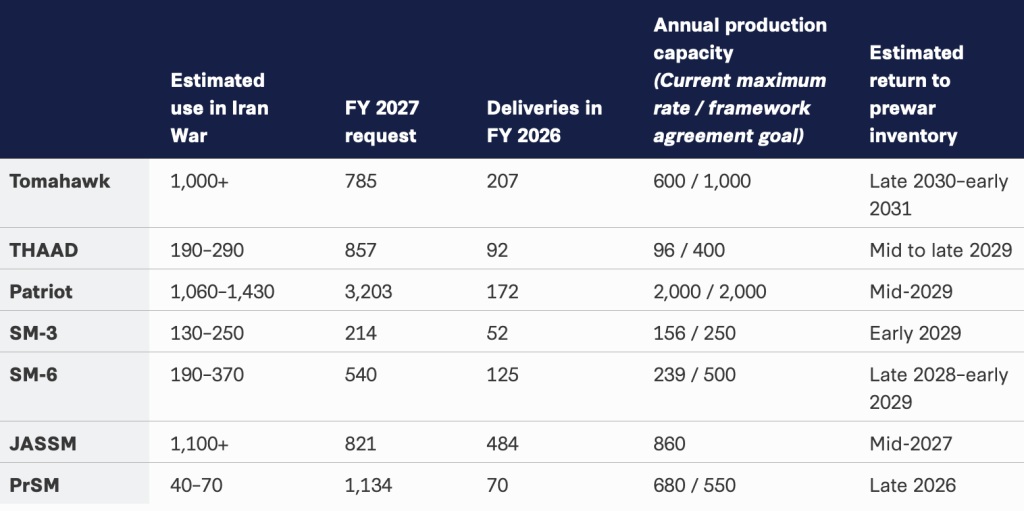
Thus, we have lost most of our offensive capabilities. Meanwhile, our bases and our allies are now completely vulnerable to Iran's enormous arsenal of ballistic missiles and powerful drones, leaving us no effective conventional military means of coercing Iran through renewed warfare.
Therefore, President Donald Trump and Treasury Secretary Scott Bessent announced plans for an unprecedented campaign of economic warfare against the Islamic Republic, warning that any nation doing business with Iran would be removed from the dollar exchange system that we controlled. They rather bombastically declared an "Economic D-Day" against Iran:
But just as Kagan unhappily concluded, such extreme economic sanctions have little chance of being successful.
China buys 90% of Iranian oil and the Chinese immediately declared that they were firmly opposed to any such "illegal unilateral sanctions that lack international law basis and are not authorized by the UN Security Council."
As one of Iran's neighbors, Russia is also an important trading partner, and given that it had already suffered those same American penalties, including seizure of its dollar assets, Russia would certainly not break its trading links with Iran.
The UAE borders Iran and by hosting Iranian banks it has provided another crucial Iranian link to the outside world. But Iran has warned that if the UAE complied with the American demands and cut all economic ties, it would regard this as an outright act of war. With the Emiratis completely vulnerable to Iranian missiles, they would obviously be very reluctant to take such a provocative step.
In an hour-long Saturday interview with former New York Times journalist Chris Hedges, Prof. John Mearsheimer discussed all of these factors, arguing that our new economic attack on Iran essentially represented an act of desperation that was doomed to failure. After all, if such a strategy had any chance of success, it would have been tried much earlier.
In his considered judgment, our Iran War had surpassed the Iraq War of a quarter century ago as the greatest strategic blunder in our entire national history. Trump had no good options for dealing with the consequences other than admitting defeat and abandoning the effort.
Because of our total political subservience to Israel and the latter's extraordinarily aggressive regional behavior, Mearsheimer even argued that most of our Gulf Arab allies may have gradually concluded that America rather than Iran actually represented the greater threat to their vital national interests.
As one of our leading international economists Prof. Jeffrey Sachs has been scathing towards this financial project. He argued that Trump's threats to blacklist much of the world from the financial exchange system we controlled would merely drive more countries into one of the many alternative clearing systems that had been created over the last few years. Our very high-handed attempts to weaponize the our reserve currency and seize the dollar assets of countries that we disliked were rapidly undercutting one of our most important tools of international leverage.
Sachs regarded Bessent as one of our least effective Treasury secretaries. While his predecessors usually focused on the serious problems of our own domestic American economy, Bessent prioritized currency attacks in support of our aggressive foreign policy objectives.
This hardly represented the "America First" doctrine that had attracted the populist right-wingers who put Trump into office. They also cannot be overly pleased that American economic policy is in the hands of a Wall Street financier who had spent most of his career working for the much-demonized George Soros, nor that he had become the first senior Cabinet member enjoying the bonds of gay matrimony. And although the media regularly touted Bessent's credentials as a hedge-fund manager, his actual track-record in that industry actually appears to have been less than highly successful.
Thus, our current attempt to crush Iran through economic strangulation seemed doomed to failure. And once it failed, Trump's only remaining card might be the extremely dangerous use of nuclear weapons.
Even months ago, Trump had already begun hinting that he was considering that possibility.
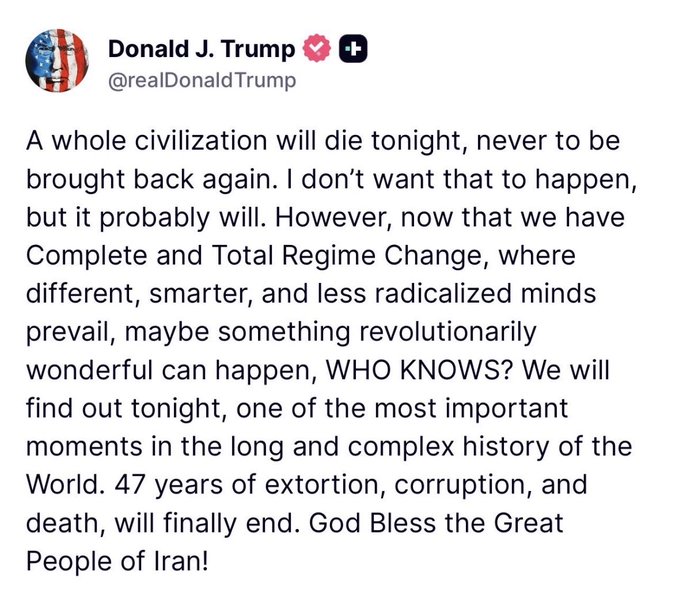
Iran is a country the size of Western Europe with a population of over 90 million, but in April Trump threatened to permanently annihilate the entire Iranian civilization, something that obviously could only be accomplished through the widespread use of nuclear weapons.
More recently, reports emerged of explicit discussions along such lines. For years, Marjorie Taylor Greene had been one of Trump's greatest loyalists, but a couple of weeks ago the former representative Tweeted out such a warning.
I was initially quite skeptical of such claims, but a few days later attorney Robert Barnes confirmed those same facts. Barnes was a long-time insider in Trump circles and still seemed to have excellent sources in the Trump Administration. In an interview he claimed that on three separate occasions Trump had discussed the use of nuclear weapons against Iran, each time being forced back by strong resistance from the military.
Earlier this year, former CIA analyst Larry Johnson had made similar claims, and Barnes now confirmed these.
According to Johnson “there is seriously something wrong with Trump”:
Moreover, as Barnes discussed these matters with MAGA military analyst Brandon Weichert, the latter reported a similar incident in the first Trump Administration that I'd never seen previously mentioned.
Rex Tillerson had spent a decade as the CEO of ExxonMobil when Trump appointed him Secretary of State in 2017. According to Weichert, just a couple of months into his first term, Trump had suggested to Tillerson that America should use its nuclear weapons in order to strengthen its international position, leading the oil industry executive to conclude that "Trump was f'ing insane." The result was a permanent decline in their relationship and Tillerson's eventual replacement by CIA Director Mike Pompeo in March 2018.
As the longtime chief of staff to former Secretary of State Colin Powell, Lt. Col. Larry Wilkerson had spent decades as a key insider in our topmost national security circles. In an interview a few days ago, he also confirmed that the Pentagon was seriously considering the use of nuclear weapons, suggesting that Trump might gradually be reducing military resistance to such an enormously reckless action.
For the last eighty years including throughout the long Cold War, the world had successfully avoided the use of nuclear weapons. For America to now use them against a non-nuclear power merely because our unprovoked war of aggression against Iran had resulted in our conventional military defeat would be extraordinarily destabilizing.
Other nations would obviously scramble to acquire nuclear weapons of their own as the sole means of deterring such future attacks. With America having itself broken the longstanding nuclear taboo, that massive wave of additional proliferation would greatly increase the chances of their subsequent use, whether in the Middle East or elsewhere.
Subscribe to New Columns
On Friday, the latest and most forceful treatment of this topic came from Tucker Carlson, the leading figure in our conservative media landscape. After personally confirming the reports that the Trump Administration was indeed considering a nuclear attack against Iran, he reacted with sustained fury in an hour long podcast.
Carlson argued that any American official who proposed launching unprovoked nuclear attacks should be immediately fired, and that if Trump or any other American president risked the lives of the our entire population by considering such a proposal, he should also be immediately impeached and removed from office.
For years, Carlson had been a friend and a leading supporter of Trump, playing an important role in getting him into office, and this greatly increased the impact of his outrage on an issue that he regarded as so vital to the lives and future of most Americans.
Carlson also emphasized that the lack of any major reaction from Trump's leading Democratic party adversaries had revealed the fraudulent nature of the political system that governed us.
For years, the Democrats had loudly denounced Trump for the most trivial of offenses, even impeaching him when he raised concerns about election fraud. But when Trump now began risking the lives of all Americans by considering nuclear war against Iran, they only reacted with silence, probably because many of their own largest donors viewed that possibility with some favor. Instead of having two different political parties, we were governed by two branches of what amounted to a single uniparty, branches that alternated in office as the disastrous consequences of their policies became too manifest.
Carlson's guest in that show was Joe Kent, the former deputy to Trump's Director of National Intelligence, who had resigned over Trump's betrayal of some of the crucial promises he had made to his voters. As an administration insider, Kent fully confirmed many of Carlson's concerns, and also shared with Carlson his complete puzzlement as to why Trump was acting the way he was with regard to Iran, despite his recognition of the disastrous consequences of these actions.
American discussions of the possible use of nuclear weapons are not taking place in a vacuum and if they are occurring, we should consider the individuals at the top of our military hierarchy. As I emphasized late last year, Trump's Pentagon chief hardly has the sort of personal background that would inspire great confidence in his strategic judgment.
Similarly, some of the top officials that he has appointed to implement his national security policies appear to be completely unprecedented in their outrageous personal history and lack of qualifications, notably including his Secretary of Defense Pete Hegseth whose department Trump suddenly renamed the Department of War in a surprisingly candid executive order.
Although a military veteran of the Iraq War, Hegseth had never commanded anything larger than a rifle platoon, but he had apparently caught Trump's eye as a gung-ho commentator on FoxNews. However, when Trump nominated him, it quickly came out that he had a long and severe drinking problem while the non-profit veterans organizations he led had financially collapsed.
Worse still, while drunk at a Republican conference he had been very plausibly accused of raping one of the women there, who had both told her colleagues about the brutal attack and also reported it to the police at the time, with Hegseth desperately begging her not to press charges and later paying $50,000 for her silence. This nearly led to the defeat of his nomination in the Republican-controlled Senate, but massive pressure from Trump had allowed him to squeak through on a tie-vote broken by Vice President JD Vance, only the second time this had happened in American history.
Once in office, Hegseth violated all security protocols by sharing details about missile strikes with his friends and relatives, an incident that was widely but mistakenly expected to result in his immediate termination.

I'm not sure of the last time any major power has put its military under the control of a totally unqualified, incompetent, and heavily tattooed drunken rapist, and I suspect that even the overwhelming majority of Third World countries would balk at such a doubtful personnel decision.
Under normal circumstances, Hegseth's outrageous behavior would have already long since led to his ouster as had been widely expected. The reason he has survived may have been revealed in a front page Wall Street Journal article on our military establishment. Running nearly 3,000 words and sharing three co-authors, it bore the provocative title "A Private Equity Billionaire Mounts His Biggest Takeover Yet: the Pentagon."
The April piece was a profile of Steve Feinberg, the private-equity billionaire whom Trump had installed as the No. 2 Pentagon official. During his long business career, Feinberg had been notoriously secretive, even going so far as boasting to his shareholders that he would "kill" any employee who got his picture in the newspapers.
Feinberg probably regards an idiot such as Hegseth as a very useful lightning rod. The latter's outrageous public statements and actions monopolize media attention, thereby allowing Feinberg, his nominal subordinate, to operate in the shadows he has always preferred.
As the Journal reported, Feinberg originally got his start under "Junk Bond King" Michael Milken, who was later sentenced to ten years in prison and fined $600 million dollars for financial fraud. Feinberg then founded Cerberus Capital Management, which subsequently became the basis of his personal wealth.
Soon after his appointment, Feinberg persuaded Trump to boost our Pentagon budget a whopping 50% to $1.5 trillion per year. Not only was that figure roughly equal to the total military spending of every other nation on earth, but it was even far higher in inflation-adjusted terms than what we had spent at the height of World War II.
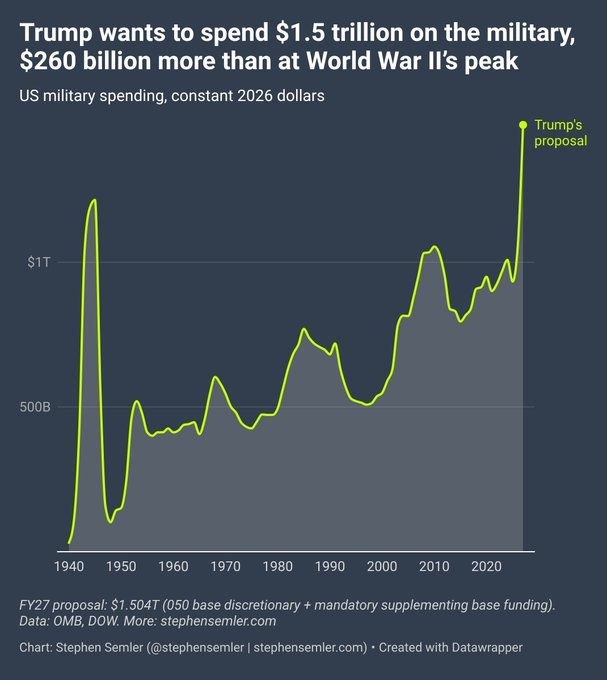
The Journal explained that Feinberg has focused on managing this colossal tidal wave of government money, bringing in some of his top Cerberus Capital subordinates to assist him in that difficult task:
Feinberg has surrounded himself with a close-knit circle of advisers with Cerberus ties. The group includes former Cerberus Managing Director John Gallagher and a deal team called the Economic Defense Unit led by Cerberus alumnus George Kollitides.
The finance experts negotiate Pentagon contracts with defense companies, according to Michael Cadenazzi, an assistant secretary of defense. "They're the ones structuring the deals to make sure that they work," Cadenazzi said at a Hudson Institute event in February. Some industry executives have nicknamed the squad "Deal Team 6."
"This is a Cerberus takeover," said Steve Blank, an adjunct Stanford professor of entrepreneurship and national security. "Private equity has just acquired its largest organization."
Over the decades, Cerberus has owned a number of military contractors and Feinberg promised to comply with the government regulations requiring that he divest himself of his holdings, but he did so in an unusual way.
When he joined the government last year, Feinberg committed to transfer his Cerberus holdings to trusts that benefit his adult children. Asked about potential conflicts of interest, Pentagon spokesman Parnell said, "The Deputy is a man of integrity who has conducted himself ethically throughout his entire career."
Hegseth has received a huge amount of public attention and Feinberg almost none at all. But the third-ranking Pentagon official is Under Secretary Elbridge Colby, grandson of former CIA Director William Colby. Unlike his two superiors, the younger Colby seems a man of personal rectitude, but perhaps not less dangerous for that reason.
The year 1991 represented a major inflexion point in modern world history. In the early months of that year, America defeated Iraq in the Gulf War, with our advanced military technology quickly and easily destroying Saddam's large and battle-hardened army while we suffered only negligible casualties. Then near the end of that same year, the tottering Soviet Union finally collapsed and disintegrated. The combination of those two events marked the beginning of the unipolar moment during which America reigned as the unchallenged global hegemon, exercising a degree of supremacy never previously seen in human history.
Colby was born in 1980 so he had not yet even reached his teens when those twin events transformed his world. As a result, he came of age and has lived his entire life during in that unique period, perhaps even finding it difficult to comprehend anything else. He may regard American global hegemony as a fundamental constant of reality that must be permanently maintained. But that supremacy no longer exists and cannot be restored, and a misalignment of belief and reality might make Colby a dangerous man.
John Mearsheimer is more than three decades older than Colby, and in an interesting interview a few days ago he discussed this sort of geopolitical blindness.
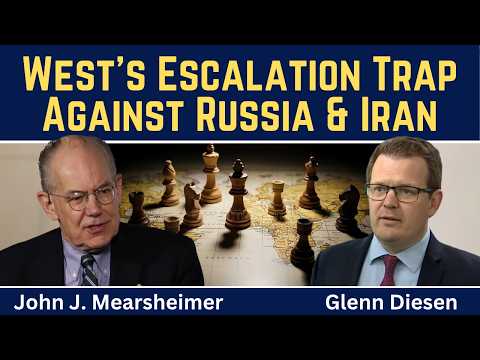
He himself came of age during the bipolar era of the Cold War, but for the last 35 years more than a full generation of academics and political analysts like Colby have been raised under the assumption of a nearly all-powerful America. As a result, Mearsheimer has noticed that many of these individuals often lack any real understanding of multipolar politics or sometimes even simple diplomacy.
This problem has become glaringly apparent in our failures to effectively negotiate with Vladimir Putin's Russia over Ukraine or with Iran or with China, or with any other country unwilling to bend its knee to our will and our dominant ideology. Although Trump has taken this problem of unilateralism to cartoonish extremes, it actually permeates the foreign policy establishment of both parties.
In the case of Colby, media reports have suggested that he was not at all supportive of our attack on Iran, but mostly because he viewed that conflict as a major distraction from his own strategy of confronting China in China's own backyard,.
According to his Wikipedia page, his focus has long been on East Asia, including the need to contain China perhaps even by fighting a limited war with that country over Taiwan. This may obviously have very dangerous implications.
Earlier this month, Colby had visited Southeast Asia, meeting with a number of the national leaders and reaffirming American strategic commitment to that region. With the Middle East monopolizing so much of our foreign policy news, I had been unaware of this.
But one of our columnists is Chinese-born Hua Bin. Soon afterward, he published an article reporting that some of Colby's statements had greatly alarmed Chinese military leaders. He indicated this by the rather dramatic subtitle of the piece: "Elbridge Colby's nuclear threats against China are beyond psychotic."
As Hua explained:
Most observers have anticipated a dial-back in US aggressiveness, given its lackluster military performance in Iran and the prospect of another West Asia "forever war".
The expectation is for the US to maintain "strategic stability" in East Asia while it deals with the fallout of its failing Iran adventure.
Instead, Colby doubled down. He reaffirmed US "unwavering commitment to defend the First Island Chain".
He demanded its Asian lackeys to act as frontline proxies in a conflict with China: raising defence spending, expanding US bases, and increasing weapon stockpiles.
The most alarming message is the lowering of US nuclear threshold.
Colby announced the Pentagon is revising the US nuclear doctrine to "provide more options to the president" as the US regime realizes its chance to win a conventional war is increasingly unrealistic.
China has held a No First Use (NFU) nuclear doctrine since it became a nuclear state in 1964. The revision of US doctrine has only one explanation - it is contemplating a nuclear first strike.
Naturally, the message has caused severe alarms among Chinese military circles.
I discovered that earlier this month China's official Global Times had run an article confirming these basic facts, while on Saturday a senior fellow at The Atlantic Council published a piece in The Hill telling the same story though obviously from a completely different perspective.
Iran is merely a mid-size industrial and military power. The defeat we had suffered at its hands clearly demonstrated that we would have no chance whatsoever of winning a conventional war against China fought near Taiwan or in the South China Sea, locations so close to China and thousands of miles distant from our own shores. We had also depleted much of our global stockpile of advanced weaponry, further magnifying China's advantage in conventional forces.
So if Colby were now emphasizing that we were maintaining our aggressive regional posture against China while also changing our doctrine to allow for the use of nuclear weapons, the Chinese were very concerned that the latter was becoming the basis for our regional military strategy.
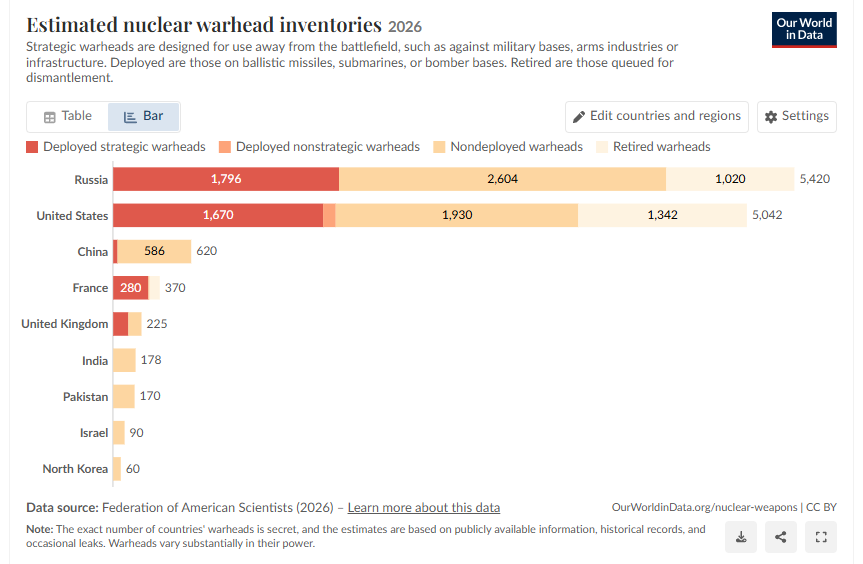
Although China enjoyed a major conventional advantage, our own superiority in nuclear weapons was far greater. America's nuclear arsenal is more than eight times larger than that of China, while we have actually deployed over fifty times more nuclear warheads. If we are now apparently relaxing our policy against the first use of nuclear weapons, it seemed perfectly reasonable for the Chinese to be greatly concerned.
Just six months ago, we had launched a sudden surprise decapitating strike against Iran while in the midst of peace negotiations, killing most of the top Iranian political and military leadership, and following that up with an all-out attack against that country. Was it so totally irrational for the Chinese to fear that at some point we might consider doing the same against their country, but this time using nuclear weapons?
I cannot imagine that Colby himself was contemplating any such thing, at least when expressed in those terms. But I also cannot fault the Chinese political and military leaders for reacting to his statements quite differently.
If we continue to maintain a major military presence and a hostile alliance system in China's own backyard, such Chinese fears of an American nuclear first strike could remain a dangerous factor for the peace of the world.
Back in January, even before Iran's victory revealed America's severe weakness in conventional military forces, I had published an article emphasizing that China already possessed absolute superiority in its own coastal waters, including those in the vicinity of Taiwan.
For more than a century, America's military strength has always been based upon the massive superiority of its industrial power, but these days the potential of even a fully reindustrialized America would be totally dwarfed by that of our Chinese opponent. As I've discussed on a number of occasions, the best simple metric of industrial power is probably the size of the real productive economy, and by that standard China's economic capacity is more than three times larger than our own. Indeed, China already outweighs the combined total for the entire America-led bloc—the United States, the rest of the Anglosphere, the European Union, and Japan...
Using its huge industrial base, China had amassed an enormous arsenal of both conventional and hypersonic missiles while our own air-defense systems were quite ineffective. Therefore, in any full conventional war I couldn't see anything that would prevent the Chinese from using waves of those missiles to immediately sink every American aircraft carrier and other warship in the region, while destroying all our airbases within many hundreds of miles, thereby winning the war within the first 24 hours...
Indeed, the notion that America would be decisively defeated after just a day or so of combat might even be an overly cautious assessment.
Our top military leadership would obviously be loath to see so much of their hugely expensive navy quickly annihilated and they have probably grown alarmed by Trump's very provocative behavior. Therefore, they may have been responsible for the December leak of a Pentagon report indicating that the Chinese could destroy our largest aircraft carriers "within minutes." So according to the Pentagon's own wargames, America might suffer a crushing military defeat within the first hour or two...
With such a large fraction of all American air and naval assets now committed to our war against Iran, any conflict with China would be even more completely one-sided. But I argued that if China followed the correct strategy America could easily be defeated without the need for any actual fighting.
Although it seems clear that China would easily win a conventional war against America's forces near its own home waters, wars often have dangerous, unforeseen consequences, and this is especially true in a world containing nuclear weapons. If we suffered an overwhelming military defeat with very heavy casualties, Trump and some of those around him might be sufficiently irrational that they would take escalatory steps that could set the entire world on a path to destruction. I'm sure that China's own cautious, pragmatic leaders recognize those dangers and seek to minimize such risks...
Therefore, I think that China's optimal strategy would be to restrict its actions to peaceful ones, but do so in a manner that may deal a very serious, even crippling blow to its American adversary.
The Chinese Civil War ended more than three generations ago and since that time, the Communist government of mainland China has been absolutely committed to its One China Policy, under which Taiwan is regarded as merely a temporarily separated province of a single, unified Chinese homeland. Indeed, the Nationalist Chinese KMT party that ruled the island during most of those decades took exactly that same position. The American government and nearly all other nations around the world have always affirmed that same legal framework.
With a recorded history thousands of years long, the Chinese are a very patient people, and the political leaders in Beijing have regularly emphasized that they are in no great hurry to achieve reunification with Taiwan and would certainly prefer to do so by entirely peaceful means. However, they have also declared their willingness to use military force if the separatist-leaning DPP party that has intermittently governed Taiwan since 2000 were to move towards independence.
Following Nixon's historic opening to China in 1972 and for decades afterward, it was understood that America would steadily reduce all of its arms shipments to Taiwan and also support eventual reunification. However, in recent years, our own country has increasingly back-tracked on those past commitments and Trump may have now completely abandoned them.
His recent announcement of a huge $11 billion sale of advanced arms to Taiwan was not only far larger than anything previously provided, but it even included missiles capable of hitting Chinese cities, which would surely cross a bright red line. This quickly prompted some extremely serious Chinese saber-rattling at the end of December, with Beijing threatening to impose a "chokehold" on what it has always regarded as a rebellious, breakaway province.
But if Trump has created a major problem for China, he has also provided that country with the obvious solution.
Venezuela is located more than a thousand miles from the U.S. and has little if any cultural or historical connection to our own country. Yet because Trump strongly disliked the policies of its government, he imposed an oil blockade against that nation, while also declaring a No Fly Zone over its airspace. He enforced that blockade by military force, seizing any tankers that were trying to transport the oil it produced to those countries that had purchased it, notably including China.
Over the last couple of weeks, I have repeatedly pointed out that if Trump can declare a blockade of the independent country of Venezuela based upon no legal justification, China can certainly claim that it has an equal right to do so with regard to an island that the U.S. government and nearly the entire world have long recognized as an inalienable part of a single, unified China. Not only can China cite the undeniable legal precedent of Venezuela, but that precedent is drastically skewed in China's own favor.
The unilateral blockade that America had imposed late last year against Venezuela has been followed by similar blockades against Cuba and now Iran. This further strengthens the legal precedent for China imposing a blockade against Taiwan, almost universally recognized as an integral part of China.
Nicholas Kristof is the former New York Times Beijing Bureau Chief, his wife is Chinese, and together they have published several books on that country. Just a couple of days before my January article appeared, he published a long Times piece entitled "How War With China Begins" explaining that a full Chinese blockade would be extremely effective in very quickly bringing Taiwan's recalcitrant government to heel.
Taiwan's economy depends on imported petroleum products, and it has only two or three weeks' worth of natural gas on hand. Taiwan's future might then depend on whether President Trump was willing to order the U.S. Navy to escort ships to Taiwan to break the blockade.
I went on to explain:
Based upon that leaked Pentagon report, it would be absolutely suicidal for America to challenge China's military forces in the region, and if we did not, the Taiwanese would be forced to completely submit within just a few weeks. The Chinese would probably not need to fire a single shot.
The internal politics of Taiwan would considerably assist that result. I've heard that the Chinese Nationalists of the KMT still heavily dominate Taiwan's officer corps, especially its top ranks, and they deeply despise the ruling DPP as national traitors, with such sentiments hardly helped by the latter's warm embrace of Western cultural practices that most Chinese regard as abhorrent. For example, in November 2018, the Taiwanese electorate overwhelmingly rejected Gay Marriage at the polls, but the DPP nonetheless enacted that policy into law six months later, with Taiwan becoming the first country in Asia to do so.
Based upon this very sharp political division between the KMT and the DPP, some knowledgeable people have told me that faced with sufficient external pressure, the KMT-led armed forces might stage a military coup and quickly come to an amicable agreement with their cousins on the mainland, with whom they generally enjoy friendly relations. I would think that a Chinese blockade of vital oil and gas supplies and America's unwillingness to challenge that blockade would facilitate such an outcome.
Whether America did attempt to break the Chinese blockade by military means and saw its forces quickly annihilated, or much more likely, avoided any conflict and allowed Taiwan's submission, the cost to American global prestige would be enormous. We would have demonstrated to the entire world that despite our trillion-dollar defense budgets, in East Asia we were merely a paper tiger. We would have conceded that the Chinese navy now controlled the sea lanes of that region, sea lanes that are among the busiest and most important in the world. A large fraction of all industrial products and its consumer goods are produced in East Asia, and China would dominate those waters.
Under past circumstances, a Chinese blockade of Taiwan might have been viewed with great disfavor by much of the world, especially given the negative way it would be portrayed by the powerful Western global media. But over the last year Trump's outrageous behavior has alienated so many major countries that this situation would be much less the case today.
In any event, the blockade of Taiwan would probably last only a few weeks, involve no bloodshed, and soon be forgotten. Taiwan's status might not have been drastically changed, but its government would have had its wings sharply clipped and be set much more firmly on the course of future reunification with the rest of China. The total political humiliation of the DPP might lead to a sharp drop in popular support for that party, with the KMT or similarly aligned parties gaining long-term control over the local government.
Finally, I emphasized that the most important impact of a Chinese air/sea blockade of Taiwan would be upon America and its economy.
Over the last few years, the gigantic AI boom has driven the market values of major tech companies to unprecedented heights. There have been very widespread claims that we are experiencing an obvious AI Bubble, with trillions of dollars being budgeted for capital expenditures in that sector. Indeed, by some estimates America would probably have already fallen into a recession during 2025 if not for the enormous spending on data centers and other AI related projects, with AI accounting for 40% of all American GDP growth last year. Our economy has also been propped up by the consumer "wealth effect" produced by the huge rise in Tech stocks, almost all of that driven by the AI boom.
The seven largest corporations by market value are all Tech companies, largely boosted by their AI prospects, and their total value is over $20 trillion. Other Tech companies, whether public or private, add many trillions of dollars in additional market value.
But Taiwan is the world's largest producer of microchips and especially dominates the manufacturing of the most advanced such chips, such as those used for AI. China holds the second spot and South Korea is in third place while America's market share is merely 6%. Although the U.S. has been making major efforts to increase its domestic production, that project will take years to bear fruit. As of today, nearly all of Nvidia's cutting-edge AI chips are still manufactured at the TMSC factories in Taiwan.
Thus, America's entire AI boom, including trillions of dollars of planned investment and tens of trillions of dollars in market value, depends upon the steady, uninterrupted supply of AI microchips from Taiwan.
A Chinese blockade would cause an immediate end to those shipments of AI microchips and puncture that bubble.
I could easily imagine the largest, most heavily over-valued Tech stocks dropping by 50% or more, erasing many, many trillions of dollars in investor wealth. Over-leveraged hedge funds would surely go under, worsening the pain. Wall Street might see one of the worst collapses in its entire history.
However, if Taiwan merely submitted to China and the American government blessed that political outcome, all those AI shipments could immediately resume. I think that every major Tech executive and wealthy investor would apply enormous pressure on the American and Taiwanese governments to surrender to China's reasonable demands on those issues.
The American government would have no other possible options.
Over the years there has been widespread speculation that the American government had prepared contingency plans to destroy the Taiwanese chip factories if China invaded, thus preventing them from falling into Chinese hands. But doing so under these circumstances would eliminate any hope of a quick resumption of AI chip exports, and ensure the permanent collapse of all those Tech stocks.
In six months or a year, the Tech and AI Bubbles might have anyway burst, greatly diminishing the importance of AI chips. Within another two years or three, America might have built up its domestic chip manufacturing facilities to the point that it could partially replace a loss of supply from Taiwan.
But at this particular moment in time, a Chinese blockade of Taiwan would amount to placing its hands around the windpipe of all the West's leading technology companies, all of Wall Street's wealthy investors, and to a considerable extent the entire American economy.
So now is the right time for China to strike and burst the bubble of President Donald Trump's American Empire.
- How China Can Burst the Bubble of Donald Trump's American Empire
- Ron Unz • The Unz Review • January 19, 2026 • 10,100 Words
When I published that January article, I'm sure that many readers must have reacted with extreme skepticism. Could a simple Chinese blockade of its own rebellious province of Taiwan really deal such a devastating blow to America's multi-trillion-dollar Tech giants, causing a total collapse of our own stock market and economy?
But then just a few weeks later, the New York Times published a major feature making exactly the same case that I did, but basing its conclusions upon secret briefings and confidential reports by our own American government and technology industry associations.
In secret briefings held in Washington and Silicon Valley, national security officials warned executives from companies like Apple, Advanced Micro Devices and Qualcomm that China was making plans to retake Taiwan, which Beijing has long considered a breakaway territory. A Chinese blockade of Taiwan, the officials said, could choke the supply of computer chips made on the island and bring the U.S. tech industry to its knees...
"The single biggest threat to the world economy, the single biggest point of single failure, is that 97 percent of the high-end chips are made in Taiwan," Treasury Secretary Scott Bessent said last month at the World Economic Forum in Davos, Switzerland, slightly overstating industry estimates. "If that island were blockaded, that capacity were destroyed, it would be an economic apocalypse"...
A confidential report commissioned in 2022 by the Semiconductor Industry Association for its members, which include the largest U.S. chip companies, said cutting the supply of chips from Taiwan would lead to the largest economic crisis since the Great Depression. U.S. economic output would plunge 11 percent, twice as much as the 2008 recession...
Many of the biggest U.S. tech companies would have enough semiconductors to operate for several months before their businesses broke down, according to the report, which was reviewed by The Times and has not been previously reported.
The report, which was written at the encouragement of Biden administration officials, illustrated how Washington has been forced to reconsider its position on Taiwan. For decades, America's commitment to the island was based on geopolitics, respect for democracy and containing China. It was viewed as a lopsided arrangement that was good for Taiwan and risky for the United States.
But now, more than ever, it has become clear that Taiwan is critical to America's economic survival, especially as artificial intelligence — which is built using chips made in Taiwan — drives the U.S. stock market and fuels economic growth...
Jake Sullivan, Mr. Biden's national security adviser, ranked the U.S. reliance on Taiwan for semiconductors as one of America's greatest vulnerabilities. He wanted the industry to recognize the risk and support construction of U.S. manufacturing plants. Mr. Biden also wanted to provide $50 billion in government subsidies to build semiconductor plants domestically...
After the call, the Semiconductor Industry Association hired McKinsey to take a look. They started with a basic question: What would happen if companies couldn't get chips from the island?
A summary of the resulting report opened with a map of Taiwan detailing how integral the island is to the global economy. Taiwan enabled roughly $10 trillion of the world's gross domestic product. It made chips for iPhones and more than half of so-called memory chips for cars, and it led in assembling A.I. chips...
If Taiwan's factories were knocked offline, the impact would be immediate, the roughly 20-page report said. Economies would flounder. In China, the gross national product would fall by $2.8 trillion; in the United States, the drop would be $2.5 trillion.
Other reports, including one by Bloomberg Economics, a research service, estimate a conflict would cost the global economy more than $10 trillion.
Even that January Times article may have considerably understated China's strength and America's weakness. The confidential 2022 report that the Times so heavily relied upon was produced before the gigantic AI bubble began to inflate and also before American sanctions had forced China to forgo the use of the most advanced Taiwanese microchips and replace them with domestically produced substitutes. So today America is far more vulnerable to a Chinese blockade of Taiwan than it was in 2022 while China itself has almost become self-sufficient.
Since January, we have severely depleted our stockpiles of advanced munitions in our failed war against Iran and withdrawn our last carrier group from Asian waters while our Tech Bubble has continued to massively inflate.
So rather than risking some future nuclear confrontation over Taiwan, now is the time for the Chinese to permanently resolve that longstanding conflict in the best interests of their own country, the Taiwanese, and even the American people.
Just as Iran has successfully expelled American military forces from the Middle East, China could now do the same with regard to East Asia.
Trump had come into office promising an America First foreign policy in which we would refocus our interests upon our own Western Hemisphere. It would be ironic indeed if China were to take the necessary steps that led him to fulfill that pledge.
Related Reading:
Donald Trump, Iran, Nuclear Warfare, and Biological Warfare
Will America Be Expelled from the Middle East?
Trump's Iran War as America's "Suez Moment"?
How China Can Burst the Bubble of Donald Trump's American Empire