By Eric Peters
Eric Peters Autos
September 3, 2026
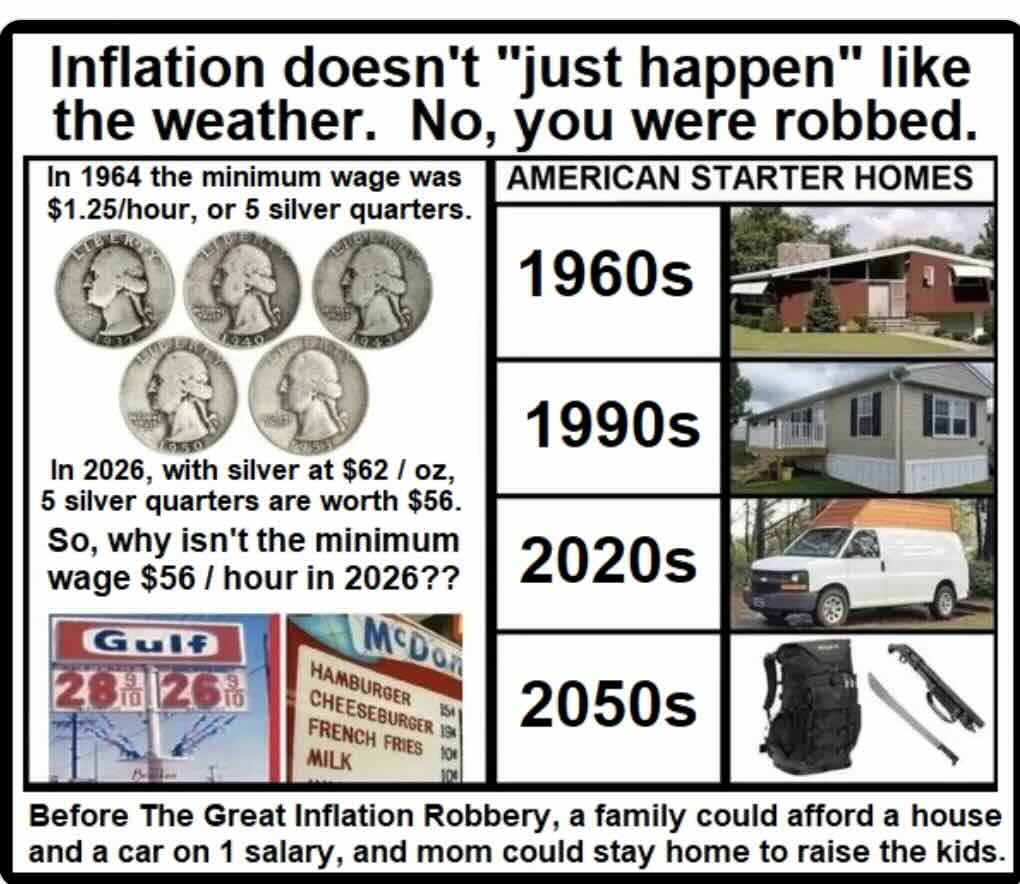
We're told "inflation" is just needing more dollars to buy stuff - not that the stuff actually costs more. This is bullshit. I can prove that it is bullshit.
In the mid-1990s, I was working as a journalist - just as I am today only back then I was working for The Washington Times and I was drawing a regular salary. It was not a large salary. I was young and the Times gig was my first serious, full-time gig as a journalist. Yet I was able to buy a small house in the 'burbs of Northern Virginia on my small salary. This was feasible because the monthly mortgage payment was not disproportionate to what I was being paid. I had enough money left over to indulge my car fetish, too. It was around the same time that I bought the '76 Pontiac Trans-Am I still have today, along with a '64 Corvair that I could afford to restore. I put a whole new interior in it, went through the engine and stripped and prepped the body for paint. I did all that making nowhere near what a doctor or successful attorney makes.
Today, I make about the same money and there is no way I could afford to buy my old house - or the old cars - I was easily able to afford back in the day. My old house - the same house - would list for about $650k today. This is about four-five times what it cost me back in the day. I would need to be earning at least four times what I earned back in the '90s to be able to afford my old house, today. How many of you reading this are making even twice what you were making back in the '90s ? If you're not making at least that much then you are - as they say - falling behind.
Back in the '80s, when I was a kid in high school and college, I could afford to daily drive a V8-powered car like my Trans-Am because it only took about $20 to fill up the tank. Ten bucks was half a tank. The Camaro I drove back then (a fraternal twin of the Trans-Am I own today) carried about 22 gallons of gas. A tenner would buy half a tank or about 11 gallons. Today, it buys about 2.5 gallons. It costs about $100 to fill the TA's tank today, which greatly limits how often I can afford to drive it. Said another way, my middle-aged self - full-time employed - cannot afford what my teenaged, part-time-job self was able to afford in the Before Time.

You have probably heard about the Great Burrito Debate, which centers on the cost of what was once dirt-cheap food. When I was in high school back in the '80s, a McDonald's Quarter Pounder with cheese cost about a buck thirty. I remember - I am not hallucinating this - making the run to the McDonald's just down the road from my high school when I was in high school to grab a couple plus fries for lunch. High school kids were - gasp ! - allowed to do this back then, if you can imagine that. We did not have to wear ID tags and we were not locked-down in teenager prison, as today.
A subject for another time.
Today, a quarter-pounder is about six bucks, depending on where you buy one. In other words, one needs about four-five times as many dollars to buy the same thing today that a high school kid was able to buy back then. Eating at a fast-food joint has become almost exactly like the experience portrayed in the '90s sci-fi/action move, Demolition Man. An evening out at Taco Bell. A fast-food meal had become a luxury experience. This has become our experience, sans the dinner clothes and live music. It easily costs $30-plus for two people to "dine" at McDonalds today. Back in the day, a high school kid with $5 in his pocket could gorge on fast food. I know because I did.
I could go on but it's not necessary. It takes a six figure-plus income today to have the buying power that a $35k or so income could afford back in the '90s. Yes, of course, most people are earning more today than they did back then. But are they earning three-four times as much ? When even fast-food has become something most people have to be careful about spending their dollars on, it is not just "inflation" that's forcing them to be careful about spending money on it.
"Inflation" is often presented as something vaguely natural, like aging. It isn't. It is artificially induced, accelerated aging. It is something like going to bed one night at 35 and waking up the next morning and seeing a 55-year-old's face in the mirror and realizing you'll be 70 before the end of the week.
But because it happens a little bit slower than that, people accommodate themselves to it. They accept less - and paying more for it. They drive a 16-year-old car because they can't afford a new car. They eat hamburger rather than steak. They rent a shitty apartment rather then buy a small first house.
It is a slow-motion taking-away of - ultimately - everything they had or will have. Ask a Zimbabwean about it.
This article was originally published on Eric Peters Autos.