Finian Cunningham
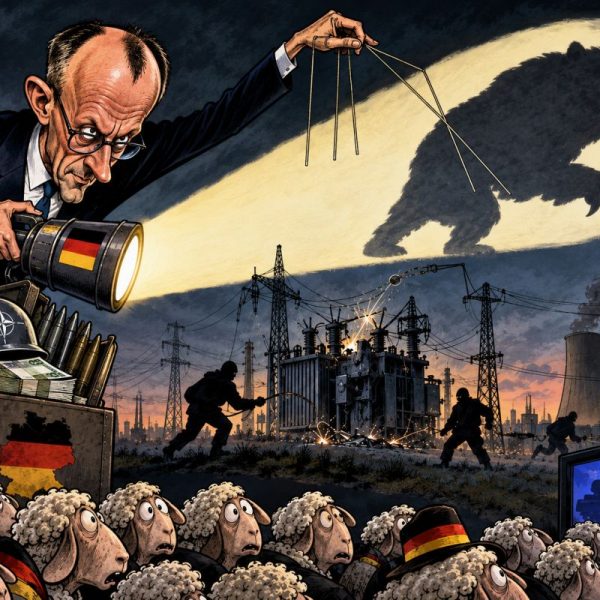
The Leipzig false-flag event is a desperate attempt to cover up and gaslight the public into perceiving Russia as a threat.
European news headlines have been dominated by Germany's accusation that Russia carried out a drone attack on Leipzig airport.
The accusation is unprecedented and provocative. Moscow furiously rejected the claim and pointed out that Berlin had provided no evidence.
European leaders are in a state of alarm, claiming that their countries are under attack. The Leipzig incident is just the latest in a long list of other such alleged incursions by Russia.
The alleged attack on August 4 failed because of a faulty detonator, the German government claimed. Nevertheless, a joint press conference last week by Interior Minister Alexander Dobrindt and Foreign Minister Johann Wadephul unleashed a storm of condemnations across Europe denouncing Russia for "hybrid warfare" and "state terrorism".
Diplomatic summonses have been swift, more sanctions imposed on Russia, and calls for more European air defenses have redoubled.
Topping the agenda of responses is increasing European financial and military aid to Ukraine in addition to the hundreds of billions of taxpayer money that has already been funneled to Kiev.
Russia has flatly denied any involvement in the Leipzig drone incident, as well as numerous other alleged incursions in Poland, the Baltic states and Romania in recent months.
President Vladimir Putin suggested that German or Ukrainian operatives could have planted the drone material, including explosives, in the high-security area of Leipzig airport near a Ukrainian military cargo plane. The subsequent media reaction condemning Russia is the predictable carnival that was desired.
Putin also plausibly noted that the media uproar and smears against Russia are aimed at influencing a key election in Anhalt-Saxony this weekend in which the opposition party, Alternative für Deutschland, was hotly tipped to defeat the governing coalition parties of Chancellor Friedrich Merz. Merz's popularity is rock bottom, while AfD has gained much support for its platform of ending the war in Ukraine and normalizing ties with Russia.
But another pressing factor is the expansion of Germany's involvement in the war against Russia. That expansion is accelerating in recent months and is largely unknown to the public.
The hysteria surrounding the claims of Russian hybrid warfare at Leipzig is a convenient cover for what is an escalation in Germany's military participation in Ukraine.
While European headlines were screaming about Russian threats and European leaders were making a song and dance about "the need for unity" and "defending freedom," there was minimal attention given to low-key reports of Germany scaling up the supply of attack drones to Ukraine for striking deep into Russian territory.
On September 3, the German business newspaper Handelsblatt reported that Germany had begun production of long-range drones for Ukraine. This was two days after the much-publicized press conference in Berlin accusing Russia of the Leipzig incident.
The production is a joint venture between German company Auteiron and Ukrainian drone maker Airlogix. The targeting range is 1,500 kilometers. The air distance from Kiev to Moscow is 750 kms.
"Germany now has a production line for affordable precision weapons in large quantities," Auterion's chief executive Lorenz Meier told Handelsblatt. "We will deliver tried and tested systems this year - at costs and production speeds that actually make large stockpiles for deterrence possible."
Airlogix chief executive Vitalii Kolesnichenko is quoted as saying: "This partnership brings together what neither company could achieve alone: our battle-proven missiles, Auterion's autonomous software and Germany's industrial capabilities."
European Union financing with a €90 billion loan earlier this year is already funding Ukraine's campaign of bombarding Russian regions, which has caused hundreds of civilian casualties and knocked out oil and gas infrastructure. In recent weeks, the barrage of drones has been stepped up to 800 sorties per night, most of which have been intercepted by Russian air defenses.
European companies are already involved in supplying drones or components to Ukraine for its air raids on Russia. Britain and Denmark are known to be among the major suppliers. Russia has warned that these countries are legitimate targets for retaliation as a result.
But Germany's participation is taking it to a whole new level whereby industrial production is being scaled up and integrated with Ukraine's firepower.
Last week, while European leaders were busy denouncing Russia over the dubious Leipzig incident, Germany's Merz and Ukraine's expired president, Vladimir Zelensky, held a phone call on September 2 to finalize yet another drone production deal.
According to Reuters reporting, that deal involves German technology firm Quantum Systems in a joint venture with Ukrainian manufacturer WIY Drones.
"Our teams are already finalising the text of the drone deal, and this will, among other things, definitely provide both Germany and Ukraine with additional defence capabilities," said Zelensky.
In still another venture scarcely reported last week, Berlin is funding the production of 50,000 Shrike attack drones manufactured by Ukrainian firm Skyfall. It is one of the largest known drone purchases for Kiev by a Western government, noted Reuters.
These production and supply agreements have been underway since February 2026, when Chancellor Merz oversaw the German and Ukrainian business meetings at the Munich Security Conference.
But it is only now that the logistics of production are kicking in to deliver weapons for use. The timing of this grave development indicates why the Leipzig false flag drama was orchestrated when it was. It distracted from what would otherwise be alarming news to the public.
The upshot is that Germany is taking the lead among NATO members in becoming a direct participant in a wider war against Russia, a war in which Ukraine is merely the launching site.
Polls indicate that German citizens and those of other European nations are deeply opposed to this reckless warmongering. European societies are being devastated by the diversion of economic resources for an ideologically driven agenda to "strategically defeat" Russia.
The German and European elites know that the general public is wary of their futile war plans to "defend democracy and freedom" in a NeoNazi, hopelessly corrupt regime. These elites fear, rightly, that the public would react furiously if the truth was more widely known.
Hence, the Leipzig false-flag event is a desperate attempt to cover up and gaslight the public into perceiving Russia as a threat, when the reality is that the real threat is from European elites dictating war.