By Ira Katz
September 10, 2026
I was a fan of the sitcom Barney Miller. My favorite character was Detective Arthur Dietrich, who was played by Steve Landesberg. What I remember were his very dry comments delivered in a deadpan, monotone. (see Best of Dietrich)
Det. Dietrich came to mind while I was watching conversations with Nathan Cofnas. He is the controversial Jewish-American philosopher of biology who outed the youngest black professor in the history of Cambridge, Jason Arday, as an academic fraud. See his conversation with Triggernometry, The Controversial Race Scientist Who Exposed Jason Arday - Nathan Cofnas . This controversy boiled over when Arday committed suicide. It is not only Cofnas' appearance that is like the fictional detective, he also speaks with a monotone, matter of fact delivery even on the most controversial topics.

Steve Landesberg and Nathan Cofanas
Cofnas himself has impeccable academic credentials, undergrad at Columbia, masters at Cambridge, and PhD at Oxford. He was a postdoc at Ghent University when the Arday scandal exploded. He was suspended and then partially reinstated (no teaching or campus privileges) while an investigation is underway.
A catalyst to the controversy is that Cofnas is a self-described race realist. In a discussion with Bret Weinstein, How Real is Race ? Dr. Nathan Cofnas on DarkHorse , he challenged Cofnas on the term "race realist," itself. Weinstein contends that the term assumes the point of contention, whether race is a biological reality or a social construct. Cofnas replied that the term "realist" is common in philosophy, so "A moral realist, for example, if to be a realist about objective morality is to believe that there are mind-independent facts about right and wrong that exist regardless of what humans believe about them. So that's moral realism. So I am against moral realism. I think moral realism is wrong, but it's called moral realism because it refers to the idea that the thing is real. I say it's not real. So I don't see that as a prejudicing or biased way of describing it." For much of the discussion Weinstein tried to convince Cofnas of the biological roots of some moral precepts. Cofnas would have none of it, usually replying with his blank stare.
I agree with Cofnas' position on morals in the sense that he being a pure materialist, all material existence is particles all the way down, the idea of right and wrong is ridiculous. But I believe in right and wrong, thus it is Cofnas' materialist assumption that I reject. Weinstein also believes the materialist assumption, but because he is a nice guy he cannot follow the nihilist logic of Cofnas.
Regarding race realism itself, Cofnas' argument is that the populations discernible by visual inspection, i.e., races, can be further classified by intelligence coefficient (IQ), are genetically determined; and furthermore, explain differences in outcomes of these populations. Weinstein's main argument is that these differences are also due to environmental factors.
I basically agree with many of the points made by Cofnas and Weinstein. But with a strong caveat that I doubt the genetic IQ data driven conclusions made by Cofnas. His persona of the confident, objective, unemotional scientist driven only by the data is belied by the reality of biological data. I participated in the design and technical support for many biological studies in humans, using large and small animals, and in cell lines (see My Air Liquide). My obsession for these experiments was to make them controlled, that is, to change only a single variable for each test. In humans this is impossible. But even with genetically identical cell lines, placed in identical environments, with only the single variable of argon or xenon substituted for nitrogen, repeated experiments would regularly have highly variable results (standard deviations as large or larger as the differences in the means between populations).
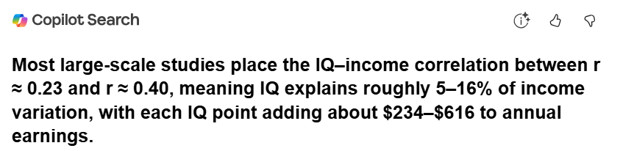
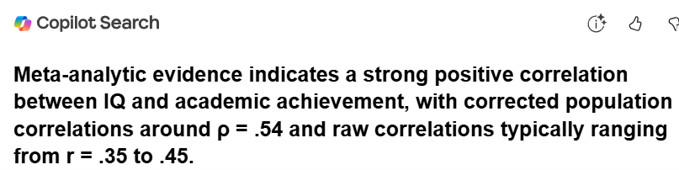
So now consider IQ testing and resulting outcomes through the following screenshots.
What is the correlation coefficient between IQ and income?
What is the correlation coefficient between IQ and academic success?
From Correlation coefficient - Wikipedia
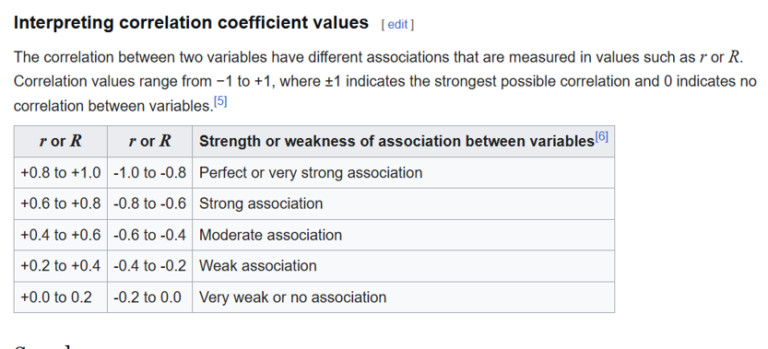
There is only weak to moderate correlation between IQ and important outcomes such as income and even academic performance. It is also important to recognize that like all measurements, there is uncertainty in the IQ measurement itself.
"Uncertainty Precision in IQ Measurement
The uncertainty in IQ measurement is quantified by the standard error of measurement (SEM), which indicates the expected amount of random error in a single test score. For the WAIS-IV Full-Scale IQ, the SEM is approximately 2.16 points, meaning that if you took the same test many times, about 68% of your scores would fall within 3 points of your true latent IQ, and 95% of them would fall within about 6 points. This precision is crucial for interpreting scores, especially when they are near meaningful cutoffs, such as eligibility for gifted programs or disability services. It is important to note that while IQ tests are highly reliable, every score carries a margin of error, typically around 3 to 5 points in either direction. A score of 112 really means something like 107 to 117."
The problem with Cofnas is his projection of certainty when there is a need for scientific humility. Furthermore, I don't particularly trust people more because they have a high IQ. I have no doubt everyone at Harvard (students, faculty, and administration) have high IQs and really are very intelligent. Yet "these people" continue to lead the country to ruin.