Lorenzo Maria Pacini
India's BRICS presidency could turn "sustainability" from green rhetoric into a sovereignty weapon.
A clear strategic roadmap from the start
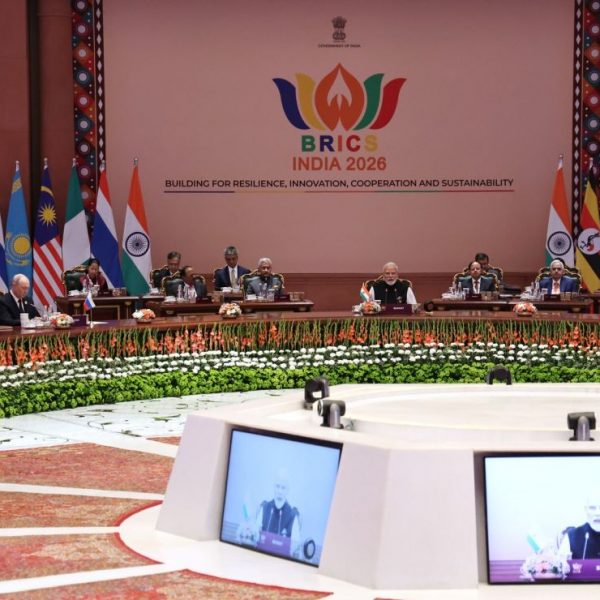
When India assumed the rotating presidency of the BRICS on the first day of 2026, it inherited a paradox rather than a mandate.
The group it now leads is larger and more influential than at any point in its history: an eleven-member bloc, commonly described as home to nearly half of humanity and responsible for about two-fifths of global production. Yet its size has not solved the bloc's oldest problem - namely, that its members agree on very little beyond a shared frustration with an international order they did not design. The theme chosen by India for the year, "Building for Resilience, Innovation, Cooperation, and Sustainability," at first glance seems like the familiar vocabulary of summit communiqués. The most interesting interpretation, however, is the strategic one. Of the four pillars, sustainability is the one most easily mistaken for a technical or moral issue and, therefore, the one most susceptible to a quiet geopolitical reorientation.
This reorientation is the subject of this essay. Within BRICS, sustainability is usually categorized under climate diplomacy, a field characterized by commitments and percentages. However, the materials underpinning the energy transition - solar cells, battery chemistries, refined lithium, biofuels, the financing that supports them, and the standards that regulate them - are now among the most contested resources in the global economy. Whoever produces, refines, finances, and certifies them acquires power that extends far beyond the power grid. For a presidency that has declared strategic autonomy to be its guiding star, sustainability is less an environmental agenda than a arena in which autonomy can be built, tested, and, occasionally, compromised. The task facing New Delhi is to treat it as such without stating it too openly.
The asymmetry at the center
Any honest analysis of the BRICS' sustainability begins with an uncomfortable fact: the bloc carries little weight in the green economy once China is removed from the equation. This is not a figure of speech, but a description of supply chains. China's dominance in solar energy production is nearly total, with its share of polysilicon, ingot, and wafer production approaching 95%. In the critical minerals sector, the picture is only marginally less concentrated. Beijing refines about 70% of the world's key energy minerals and holds dominant positions in the processing of lithium, cobalt, and graphite for batteries; it has also demonstrated a willingness to convert this dominance into political strategy, tightening controls on exports of materials such as gallium, germanium, and rare-earth magnets when it suits its purposes. The obvious consequence is that it is impossible to devise any credible "BRICS green initiative" that pretends to ignore China's presence.
This structural asymmetry leads to two opposing errors. The first is to imagine that the BRICS could become a tool for containing China from within - a sort of Trojan horse for a coalition of smaller powers. This amounts to a misunderstanding of both the arithmetic and the institution. The BRICS were never designed to create binding commitments; they have no treaty structure, no enforcement mechanisms, and no tradition of binding commitments such as those required by free-trade areas or defense pacts. It functions through political coordination, regulatory convergence, and occasional shared projects, and it is precisely this flexibility that has allowed rivals such as India and China - or India and its Gulf partners - to sit at the same table.
The second mistake is passivity: the assumption that China's preeminence precludes meaningful action by anyone else. This is not the case. China has shown little interest in the costly and thankless role of philanthropic hegemon within the bloc, financing others' transitions out of solidarity. This reluctance leaves a vacuum, and it is precisely in such vacuums that diplomacy does its work.
The concept worth embracing in this context is pragmatic multipolarity: the recognition that a world with multiple genuine centers of power is not achieved by dethroning the strongest actor, but by strengthening the capabilities of all the others. Applied to the BRICS, this concept advises India against taking the position - satisfying though futile - of directly counterbalancing Beijing. The productive move is a lateral one. India can promote cooperation in sectors where other members - Brazil in biofuels, South Africa and the new African members in minerals, Russia in metallurgy - hold comparative advantages that do not rely on Chinese factories. The goal is not a "China-less" BRICS - which is neither possible nor desirable - but a BRICS with more than one pillar of support.
When sustainability becomes sovereignty
To understand why this is important, we must move away from the habit of viewing clean energy as an act of charity toward the planet. Decarbonization technologies have quietly become the key sectors of 21st-century industry, and control over them now determines far more than just emissions trends. A country that manufactures its own solar panels is less exposed to the political whims of a supplier; a country that refines its own metals for batteries captures value that would otherwise benefit foreign nations; a country capable of financing green infrastructure in its own currency is shielded from exchange rate shocks and the conditions that arise from borrowing in foreign currency. Industrial competitiveness, energy security, technological sovereignty, and financial independence have merged into a single strategic issue, and this convergence cuts directly across the green economy.
This is the deeper reason why sustainability fits so well with the Indian presidency. New Delhi lacks the manufacturing capacity needed to surpass China or the capital surplus to lend to it on a larger scale, but it possesses something that the most influential powers in the bloc equally lack: credibility in uniting the countries of the Global South and a proven track record in creating institutions that others are willing to join. Sustainability is the arena where such "soft" infrastructure most readily translates into influence. A developing country weighing whether to align with Beijing, Washington, or neither is, increasingly, assessing who will finance its power grid, transfer its technology, and purchase its minerals while ensuring a fair share in the value chain. If India succeeds in positioning the BRICS as a credible answer to that question - not the only answer, but a concrete one - it will strengthen its own position while expanding the options available to smaller states. Influence, in this perspective, is a byproduct of utility.
Sunlight, sugar cane, and the networks of the South
The most promising area is energy, since India is not starting from scratch in this field. Two existing platforms give it real leverage. The International Solar Alliance, which India co-founded with France in 2015, has grown to include well over a hundred member states and has set itself the goal of mobilizing more than one trillion dollars in solar investments by the end of the decade. The Global Biofuels Alliance, launched during India's G20 presidency in 2023 together with Brazil and the United States, combines Brazil's expertise in sugarcane ethanol with India's advances in blending and second-generation fuels. Neither is a BRICS body, and that is precisely what makes them valuable: they are bridges that India already controls, connecting the bloc to the broader developing world.
One can imagine India using its presidency to integrate these platforms into BRICS cooperation in a more targeted manner. A bloc-oriented agreement in the solar sector - call it, as some have, the "BRICS Solar Corridor" - could pool procurement, transfer technology, and build capacity for members rich in sunlight but short on capital, from South Africa to Egypt to Ethiopia. A parallel task force on biofuels could channel joint research toward sustainable aviation fuels, waste-to-energy conversion, and crop residue management. It is worth being precise about the status of these ideas: they are proposals, not institutions - sketches of what an ambitious presidency might attempt, rather than done deals. Their appeal lies in a feature that is easy to overlook. None of them requires the exclusion of China. Beijing can be invited to participate on the same voluntary terms as anyone else, which eliminates the risk that the bloc will fracture along a "China versus the rest" divide, while still building capacity that does not depend on Chinese factories. Complementarity accomplishes what confrontation cannot.
The Bank as an instrument of green sovereignty
Such an ambition is futile without money, and this is precisely where the New Development Bank comes into play. Founded by the five original BRICS countries, the Shanghai-based institution has approved tens of billions of dollars in financing to support well over a hundred projects - metro systems in India, water treatment in China and South Africa, clean energy in Brazil - and has expanded to include eleven members, while courting the Global South. Viewed strictly in practical terms, it is just another development bank. Viewed strategically, however, it represents something more interesting: a potential engine of green financial sovereignty, an institution through which the bloc can finance its own transition on its own terms.
The most decisive lever is currency. The NDB has set a goal of denominating about one-third of its loans in the currencies of member countries - a target it has come close to but has not yet reached, with local-currency financing standing at around one-fifth of the portfolio according to the latest available data. The gap matters less than the direction taken. Every loan that a developing country takes out in its own currency - or in that of a partner - is a loan whose repayment does not tie its budget to fluctuations in the dollar or to political conditions imposed by Western institutions. Under India's presidency, the bank could push more decisively in several directions simultaneously: increasing loans for renewable energy for African members and potential members; use blended finance structures, built with multilateral climate funds, to attract private capital to projects it would otherwise avoid; and - the most ambitious goal - establish instruments that finance not the export of raw ore but its processing, so that the added value of battery metals is generated in Africa and Latin America rather than being shipped elsewhere in the form of unrefined rock.
The temptation is to frame all of this as a revolt against Bretton Woods, and some of the most authoritative voices within the bloc do just that. The more enduring framework, however, is an additive one. The NDB does not need to supplant the World Bank to be useful; it merely needs to expand the range of options, so that a finance minister in Addis Ababa or Brasília has a genuine alternative rather than a single lender with a single set of terms. Recent developments in cross-border payments, broader use of local-currency settlement, and a multilateral guarantee mechanism currently being developed within the bank suggest that the financial landscape is already slowly moving in this direction. Sovereignty, in this context, is not a theatrical rejection of the West, but rather the mundane and gradual acquisition of options.
The minerals triangle and the limits of ambition
In no other area is the tension between ambition and asymmetry more acute than in the critical minerals sector, and in no other area is intellectual honesty more necessary. The honest position is that a BRICS alliance on critical minerals designed to rival China is a contradiction in terms, since Chinese dominance in processing is precisely what such an alliance would need to avoid, and China is part of the bloc itself. What can be built is smaller and more nuanced.
India and Russia are already considering a bilateral agreement on rare earths and lithium that encompasses exploration, processing, and technology ). The proposal worth examining is whether such collaboration could expand into a trilateral agreement involving resource-rich African members - South Africa, Egypt, and Ethiopia - whose reserves are substantial but from which they have historically derived little value.
The logic is one of diversification, not substitution, and the distinction is not purely formal. Such a mechanism would not - nor could it - replace Chinese supply chains; rather, it would add a second, more subtle strand alongside them, offering African producers an alternative sales channel and, crucially, the bargaining power that comes from having more than one buyer. Russia's metallurgical and mining expertise, India's willingness to support development and its financing capacity, African reserves, and the NDB's capital could, in principle, be combined to build processing and recycling capacity right where the ore is actually located, gradually transforming extractive economies into industrial economies.
Demand would come from the solar energy and biofuel sectors, which require the metals used in batteries and power grids. It's an elegant cycle on paper. It is also, for now, a proposal rather than an agreement, and its feasibility will depend on the ability of three governments with very different risk appetites to align commercial terms that, ultimately, will be judged by the markets and not by press releases.
Standards, knowledge, and the silent power of rules
The least conspicuous tool could prove to be the most enduring. Finance and minerals are visible; standards are invisible, and for this very reason, they shape behavior long after the summit has ended. The BRICS already have a modest tool in this regard in the Platform for Environmentally Friendly Technologies, established in 2018 to exchange know-how on air quality, water, and waste. Building on this foundation, India could push for a broader green economy framework - again, a proposal rather than a permanent body - that codifies common ground on green bonds, climate-smart agriculture, carbon accounting, resilient infrastructure, and environmental and social governance criteria for projects.
The purpose of such a framework, in line with the bloc's non-binding nature, would not be to impose obligations that members might ignore or find difficult to accept. Rather, it would be to prevent the fragmentation that allows each country to come up with its own definitions - thereby creating a dialogue that leads nowhere - and to offer a set of shared tools toward which national policies can voluntarily converge. There is an even deeper benefit to all of this. Whoever sets the standards for green bonds or carbon accounting in a market of this size gains a form of structural power more enduring than any single loan, as those standards become widespread. A framework capable of integrating with other initiatives in the Global South - the African Union's Agenda 2063, the agenda on the resilience of small island states - would extend the BRICS' influence outward without the friction associated with formal enlargement. Technology transfer, joint research, and scientific cooperation constitute the human capital of the project itself: the slow accumulation of shared expertise that no export control can revoke.
Sustainability as a practice of multipolarity
Can India, then, transform sustainability from a predominantly normative agenda into a practical tool for a more autonomous Global South ? The honest answer is a qualified yes - provided that New Delhi resists two temptations. It must resist the maximalist fantasy of a BRICS that opposes China, which would cause the coalition on which it depends to collapse. And it must resist the minimalist retreat into mere rhetoric, the endless recycling of press-release language that commits no one to anything. Between these two extremes lies the narrow and uninspiring path charted by this essay: energy platforms that strengthen capabilities without excluding anyone, a bank that expands financial options rather than declaring war on traditional ones, a minerals agreement that diversifies rather than replaces, and standards that coordinate rather than impose.
What makes all this more than just a list of political wishes is the underlying connecting idea. A multipolar order is neither conjured up at summits nor proclaimed in manifestos; it is built, slowly, starting from the ordinary capabilities that allow states to act without asking permission. Every solar corridor actually built, every loan denominated in a currency other than the dollar, every processing plant that retains value where the mineral is mined, every standard that a dozen governments agree to share: these are the building blocks of a world with more than one center. Sustainability proves to be an unusually suitable material for such a construction, as it is technical enough to avoid triggering the alarm bells of the major powers and significant enough to redistribute real economic and technological weight.
The report at the heart of the matter is therefore not about carbon and climate, but about sustainability, sovereignty, and the distribution of global power. The green transition represents the largest reallocation of industrial capacity the world has undertaken in a generation, and reallocations of this magnitude always redefine who is powerful and who is dependent.
The Indian presidency will be judged not by the eloquence of its final declaration, but by whether, a decade from now, a handful of these proposals have taken root as functioning institutions that will outlive the presidency that proposed them. If that happens, history will not record that the BRICS defeated anyone. Instead, it will record that a diverse and contentious bloc used the least confrontational agenda possible to make the Global South a little less dependent - and this, ultimately, is what multipolarity looks like when it is built rather than proclaimed.