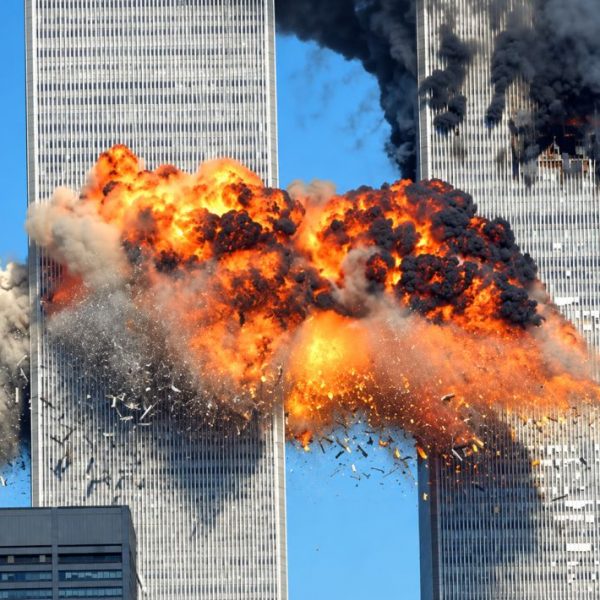
The crusade that George W. Bush launched 25 years ago to "rid the world of evil" only compounded it.
By Norman Solomon
Three days after terrorists killed almost 3,000 people in the United States on September 11, 2001, President George W. Bush stood behind a pulpit at the Washington National Cathedral and spoke to a nation in shock. "Our responsibility to history is already clear," he proclaimed, "to answer these attacks and rid the world of evil." The vow was, of course, preposterous. Yet the "war on terror" that followed was scarcely more realistic.
"Terrorism is not an enemy. It cannot be defeated. It's a tactic," retired US Army General William Odom told C-SPAN viewers in 2002. "It's about as sensible to say we declare war on night attacks and expect we're going to win that war. We're not going to win the war on terrorism." But the American military crusade became more about persisting than winning. The ultraviolent momentum became its own reason. The destructive search for enemies created more. As years went by and the "war on terror" label faded, US warfare was so normal in so many places that it no longer needed a name or much of a rationale.
But 25 years ago, the impulse to avenge the horrors of 9/11 was instant. Fear and rage blended into high octane for war machinery. Suddenly, overwhelming public emotions were fully in sync with the psychology of a military-industrial complex set for large-scale killing.
Even as the trauma of the terrible day eased for the general public, 9/11 continued to serve as a political license to kill without an expiration date.
None of the 19 hijackers were Afghan, and Al Qaeda leader Osama bin Laden's ties were much tighter with Saudi Arabia, but his presence in Afghanistan put that country in the Pentagon's gunsights. The question in US media was not about whether, but when, to attack. The answer came on October 7 when American missiles began to explode in Afghanistan. Hours later, a Gallup poll found that "90 percent of Americans approve of the United States taking such military action, while just 5 percent are opposed, and another 5 percent are unsure."
The air war remained quite popular in the United States. Defense Secretary Donald Rumsfeld held daily live televised briefings that catapulted him to national adulation. A pattern set in, taking for granted that American warfare was beneficent in intent and benign in meaningful impact. People dying under American bombs and less directly didn't count for much. "The targeting capabilities, and the care that goes into targeting, to see that the precise targets are struck, and that other targets are not struck, is as impressive as anything anyone could see," Rumsfeld asserted. And he added, "The weapons that are being used today have a degree of precision that no one ever dreamt of."
Rumsfeld's style went over big. "Everyone is genuflecting before the Pentagon powerhouse," exclaimed the Washington Post's media reporter, Howard Kurtz, who called Rumsfeld "America's new rock star." That winter, after the Taliban government fell, the host of NBC's Meet the Press program congratulated Rumsfeld on the air: "Sixty-nine years old and you're America's stud."
The war in Iraq, launched with a March 2003 invasion, relied on massive air power and more than 150,000 US ground troops. The Saddam Hussein dictatorship fell quickly, but the promised "cakewalk" turned into year after year of combat and slaughter. Mainstream US media outlets were more than comfortable with above-it-all bombing that signified American air prowess. But the toll of American deaths and severe injuries gradually depleted enthusiasm as soldiers were called back for two, three or even more tours of duty. For many, the images of glory days turned into real-life nightmares.
The ongoing war effort that began in autumn 2001 had an implicit throughline in dominant media and politics: while American lives really matter, the victims of American firepower really don't.
President Bush could not accept defeat in Iraq, and later Barack Obama could not countenance defeat in Afghanistan. Early in his presidency, Obama-in deed and word-made the "war on terror" expressly bipartisan. Less than a year after he received the Nobel Peace Prize in late 2009, the American troop level in Afghanistan reached 100,000, triple the number when he had entered the White House. During a visit to Bagram Air Base near Kabul, Obama provided the service members with star-spangled oratory that could be heard as uplifting or perhaps macabre: "I've been humbled by your sacrifice in the solemn homecoming of flag-draped coffins at Dover, to the headstones in section 60 at Arlington, where the fallen from this war rest in peace alongside the fellow heroes of America's story."
In effect, even as the trauma of the terrible day eased for the general public, 9/11 continued to serve as a political license to kill without an expiration date. Through it all, the ongoing war effort that began in autumn 2001 had an implicit throughline in dominant media and politics: while American lives really matter, the victims of American firepower really don't.
* * *
Faraway uses of Pentagon air power had human consequences that hardly registered on political scales back home. For officialdom, tech innovations like drones were unalloyed marvels. The people who experienced terror had no voices, no faces, no names. On the rare occasions when that wasn't the case, general interest was scant. After seven months in Taliban captivity, New York Times reporter David Rohde escaped from rugged terrain in Pakistan and later recounted what it was like to have US drones constantly hovering overhead: "The drones were terrifying. From the ground, it is impossible to determine who or what they are tracking as they circle overhead. The buzz of a distant propeller is a constant reminder of imminent death."
The proclaimed war on terror had also become a war of terror.
A few days into his presidency, Obama sent Predator drones into Pakistan, killing three children and a dozen adults. A week later, a former "whiz kid" at the Pentagon during escalation of the Vietnam War in the 1960s, Pierre Sprey, appeared on the PBS program hosted by Bill Moyers. Sprey saw where US officials were headed with their air war. "I'd be astonished if one in five people they kill or wound is in fact a militant," he said. "You can't tell with a camera or an infrared sensor or something whether somebody's a Taliban.... Most likely, you're relying on some Afghani of unknown veracity and unknown motivation and who may, may very well be trying to settle a blood feud rather than give you good information." But, Sprey added, "bombing is always politically popular, relative to sending infantry and killing our boys."
Obama officials were enamored with the American air war, in spite of evidence that it was routinely killing many bystanders. In 2022, Phyllis Bennis at the Institute for Policy Studies offered this assessment: "The so-called 'global war on terror' has, from its origins, been characterized by attacks by US Special Forces, by airstrikes, by armed drones, and more, that routinely kill far more civilians than the targets identified on the 'kill lists' prepared by presidents and top White House officials. The routine recitation of 'there is no military solution to terrorism' has always been an anodyne rhetorical ploy, never an actual guide to what actions might actually work to change the conditions that give rise to terrorism."
Ironically and tragically, the conditions giving rise to terrorism included the US war waged in the name of ending it. The process was foreseeable. In 1998, the Pakistani-American political scientist Eqbal Ahmad wrote: "A superpower cannot promote terror in one place and reasonably expect to discourage terrorism in another place. It won't work in this shrunken world."
Killing from the skies fueled desires for retribution. "For every 10 to 15 people killed, maybe they get one militant," Pakistani photographer Noor Behram said in 2011. For three years, he had been documenting the immediate aftermath of drone attacks in the mountainous Waziristan region near the Afghan border. "There are just pieces of flesh lying around after a strike. You can't find bodies. So the locals pick up the flesh and curse America. They say that America is killing us inside our own country, inside our own homes, and only because we are Muslims." As a result, Behram said, "The youth in the area surrounding a strike gets crazed. Hatred builds up inside those who have seen a drone attack."
Many thousands of miles away, military personnel in the US were peering at blurry images on computer screens and firing the drone missiles. "The truth is that we could not differentiate between armed fighters and farmers, women or children," former tech sergeant Lisa Ling recalled. For several years, she had trained Air National Guard members on how to operate Air Force drones. Ling was among the drone whistleblowers who went public during the terror war's second decade. One of them, the young intelligence analyst Daniel Hale, spent nearly three years in prison because he disclosed facts about the drone program's human toll. "With drone warfare, sometimes nine out of ten people killed are innocent," he said. "You have to kill part of your conscience to do your job. But what possibly could I have done to cope with the undeniable cruelties that I perpetuated ? The thing I feared most was the temptation not to question it. So I contacted an investigative reporter... and told him I had something the American people needed to know."
Hale provided The Intercept with classified documents that led to a landmark expose in October 2015. It reported, "Documents detailing a special operations campaign in northeastern Afghanistan, Operation Haymaker, show that between January 2012 and February 2013, US special operations airstrikes killed more than 200 people. Of those, only 35 were the intended targets. During one five-month period of the operation, according to the documents, nearly 90 percent of the people killed in airstrikes were not the intended targets. In Yemen and Somalia, where the US has far more limited intelligence capabilities to confirm the people killed are the intended targets, the equivalent ratios may well be much worse."
Early in his second term, at the National Defense University, Obama gave a much-ballyhooed speech that addressed downsides of the terror war, then in its twelfth year. "Our systematic effort to dismantle terrorist organizations must continue," he said. "But this war, like all wars, must end. That's what history advises. That's what our democracy demands." Unlike the men who immediately preceded and followed him in the Oval Office, Obama seemed aware that perpetual war had negative effects on US society. Yet he didn't proceed to do much about it. During the 44 months that followed his speech, through his last year in office, Obama maintained bombing of Afghanistan at about half the rate of his first term while drastically escalating the attacks in Iraq and Syria, with 30,743 bombs and missiles dropped on those two countries in 2016 alone.
* * *
Like Obama, both Donald Trump and Joe Biden ordered air strikes on Afghanistan, Iraq, Somalia, Syria and Yemen. In his second term, Trump has widened US bombing missions to also include Iran, Nigeria and Venezuela along with targeting nonmilitary boats and killing more than 225 civilians during the last year in international waters.
The withdrawal of all US troops from Afghanistan in the late summer of 2021 seemed to mark a turn away from nonstop warfare. "I stand here today, for the first time in 20 years, with the United States not at war," President Biden declared weeks later at the United Nations. He added, "We've turned the page." But actually, America was bound into a high volume of war. The "war on terror" was morphing and continuing on several continents. In fact, during the same month as Biden's UN speech, the Costs of War Project at Brown University released a new report documenting that "counterterrorism operations have become more widespread in recent years." The project's co-director, Catherine Lutz, said: "The war has been long and complex and horrific and unsuccessful... and the war continues in over 80 countries."
Throughout the last 25 years, since the first missiles struck Afghanistan, a racial aspect of the terror war has been hidden in plain sight.
The day after the Hamas-led attack in Israel on October 7, 2023, the Israeli ambassador to the United Nations stood outside the Security Council chambers and said, "This is Israel's 9/11. This is Israel's 9/11." During the next six weeks, the New York Times later revealed, Israel "routinely" used 2,000-pound bombs in Gaza "in areas it designated safe for civilians." Within nine months, Reuters reported, the large quantities of munitions supplied to Israel by the Biden administration included "more than 10,000 highly destructive 2,000-pound bombs." Speaking to the UN General Assembly as the war in Gaza neared the end of its second year, Prime Minister Benjamin Netanyahu said: "We're wiping out the terror regime of Hamas and ensuring that its savagery will never threaten Israel again." By then, the US government had provided more than $21 billion in military aid to Israel since October 7. Amnesty International, Human Rights Watch and the Israeli organizations Physicians for Human Rights-Israel and B'Tselem unequivocally concluded that what has happened in Gaza is genocide. It was enabled by the United States.
Throughout the last 25 years, since the first missiles struck Afghanistan, a racial aspect of the terror war has been hidden in plain sight. While institutional racism is widely understood to exist inside the United States, an unexamined assumption is that its pernicious aspects stop at the water's edge. But public discourse about the "war on terror" has eluded a fact well worth pondering: virtually every man, woman and child killed by Pentagon firepower in this century has been a person of color. This is not to say that they were attacked because of their racial identity. But racial biases in the US, unconscious and otherwise, have made it politically easier to launch and sustain wars bringing horrors to their lives.
Current findings from the Costs of War Project include: "An estimated over 940,000 people were killed by direct post-9/11 war violence in Iraq, Afghanistan, Syria, Yemen, and Pakistan between 2001-2023. Of these, more than 432,000 were civilians. The number of people wounded or ill as a result of the conflicts is far higher, as is the number of civilians who died 'indirectly,' as a result of wars' destruction of economies, healthcare systems, infrastructure and the environment. An estimated 3.6-3.8 million people died indirectly in post-9/11 war zones, bringing the total death toll to at least 4.5-4.7 million and counting."
In foreign countries, the overall " reverberating effects" have crushed countless lives. However, the only casualties of the "war on terror" that have really resonated in US politics are American losses. Yet many of the casualties are far from obvious. While "over 7,053 US service members died in the post-9/11 wars," the Costs of War Project notes, "at least four times as many US service members and veterans of the post-9/11 wars died by suicide than in combat." In addition, "An estimated 8,189 contractors for the US military died during the post-9/11 wars. Foreign workers for US contracting firms often do not have their deaths recorded or compensated."
Such figures don't include the Iraq and Afghanistan veterans with post-traumatic stress disorder. The Veterans Administration now says that 15 percent of those wars' veterans were suffering from PTSD "in the last year" and 29 percent "at some point in life." Meanwhile, traumatic brain injury (TBI) from the two wars often afflicts veterans who were violently jolted by explosions and other wartime events. Analyzing Pentagon data, the Centers for Disease Control and Prevention concluded that "more than 450,000 US service members were diagnosed with a TBI from 2000 to 2021." Four years ago, the American Medical Association's journal JAMA published an in-depth study of TBI among Iraq and Afghanistan veterans. "Our study suggests that post-9/11 military veterans face a higher mortality burden across multiple causes of death than the total US population," the study said. "We also found that exposure to moderate to severe TBI was associated with even higher mortality rates and excess mortality from accident, suicide, cancer, CVD [cardiovascular disease], homicide, and other causes."
* * *
One day in mid-December 2002, three months before the " shock and awe" bombardment of the city began, I sat at a picnic table in a Baghdad park with the middle-aged Iraqi man who was my driver. There was no one around, no walls or fixtures that might conceal listening devices. He said that he wished Iraq had no oil, because then there would be no reason to fear an invasion.
Whatever people's beliefs about the goals behind US warfare during the last quarter-century, there can be no doubt of its immense profitability.
During the last 25 years, while plenty of public discourse has faulted policymakers for tactical mistakes and dubious judgment in war policies, more nefarious motives have received little attention. The rallying cry "No blood for oil" was common among those actively opposing war in Iraq but a nonstarter in mainstream media and politics. "The slogan is neither intelligent nor honorable," Washington Post columnist George Will said in a commentary for ABC News shortly before the Iraq invasion began. "Intelligent people can honorably differ about the wisdom and morality of war against Iraq. But we should be able to agree that oil, an economic motive, is not driving US policy."
Four years later, General John Abizaid, former head of US Central Command and military operations in Iraq, said: "Of course it's about oil, we can't really deny that."
In his memoir, former Federal Reserve chairman Alan Greenspan wrote: "I am saddened that it is politically inconvenient to acknowledge what everyone knows: the Iraq war is largely about oil."
Before becoming Defense secretary, Senator Chuck Hagel said in 2007: "People say we're not fighting for oil. Of course we are."
Whatever people's beliefs about the goals behind US warfare during the last quarter-century, there can be no doubt of its immense profitability. The start of the Afghanistan War in October 2001 began supercharged bonanzas for Pentagon contractors. The 20 years of that war overlapped with upward of $2 trillion in government funds going to the biggest contractors-Lockheed Martin, Raytheon, General Dynamics, Boeing and Northrop Grumman-an increase of 188 percent. "Those five firms spent over $1.1 billion on lobbying between 2001 and 2021," Quincy Institute senior advisor Eli Clifton wrote. "That number seems like a staggering sum to spend on influencing policymakers but it may have been the most financially prudent decision these companies have made in the past 20 years."
Investing in war stocks was likewise prudent for stock-market players. As the war in Afghanistan came to a close, journalist Jon Schwarz did the math: "If you purchased $10,000 of stock evenly divided among America's top five defense contractors on September 18, 2001-the day President George W. Bush signed the Authorization for Use of Military Force in response to the 9/11 terrorist attacks-and faithfully reinvested all dividends, it would now be worth $97,295. This is a far greater return than was available in the overall stock market over the same period. $10,000 invested in an S&P 500 index fund on September 18, 2001, would now be worth $61,613. That is, defense stocks outperformed the stock market overall by 58 percent during the Afghanistan War."
* * *
The "war on terror" brand has gone out of fashion, but underlying military boosterism remains intact. Midway through Trump's first term, the Democratic Party's leaders in the House and Senate saluted when the commander in chief proposed an 11 percent Pentagon budget increase over two years. "In our negotiations, Congressional Democrats have been fighting for increases in funding for defense," Representative Nancy Pelosi boasted. "We fully support President Trump's Defense Department's request," Senator Chuck Schumer proclaimed. "US taxpayers spend far more on the military and war than most people realize," says a recent report from the Project on Government Oversight, which documents that "there are several ways to calculate the true cost of our military" and "all add up to at least $1.5 trillion." A two-year 11 percent military spending increase now looks almost dovish in comparison to the outlays on the near horizon. Even without enactment of Trump's proposed half-a-trillion-dollar increase for the 2027 fiscal year military budget, the status quo is deeply mired in what Martin Luther King Jr. called " the madness of militarism." If budgets are moral documents, America has been plunging into one moral abyss after another.
The "war on terror" brand has gone out of fashion, but underlying military boosterism remains intact.
With a very different style, Donald Trump's basic lawless approach to international conflict is akin to Bush's "war on terror" approach. Rhetoric aside, the actions have been clear: if the USA wants to attack another country, it will. This year's unprovoked bombings of Iran signify how America's foreign policy comes full spiral.
The crusade that George W. Bush launched to "rid the world of evil" only compounded it. Now, as the nation's military juggernaut advances, the mindsets that propel it are in dire need of direct challenge.
Original article: commondreams.org