By Mike Whitney
The Unz Review
September 14, 2026
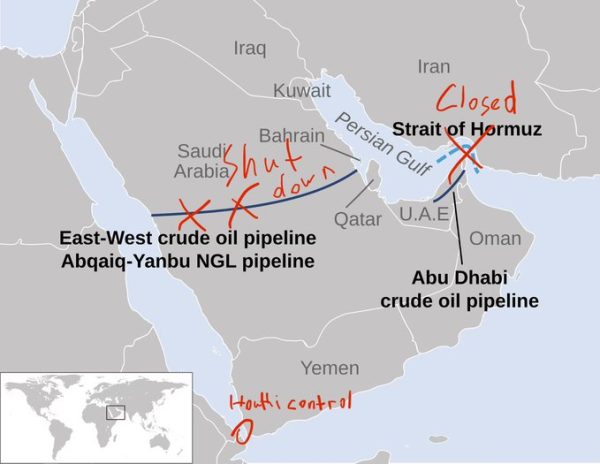
We're at the end of the line. After seven months of unprovoked warfare, the situation in the Middle East has ballooned into a full-blown crisis. Overnight, Saudi oil exports have fallen to zero. ZERO ! Let that sink in for a minute. The "world's largest oil producer" is presently exporting NO oil. Persian Gulf terminals are effectively shut down due to the war with Iran while the East-West pipeline-the main overland bypass that moves 4 to 5 million barrels per day to the Red Sea terminal at Yanbu-was blown up at nine different locations on Thursday (by Iraqi drones) and is no longer operable. That means no Saudi oil is going to market for the first time in history. Does that sound like a catastrophe to you ? Does that sound like something that's going to require an immediate response from Trump and Co?
But, so far, Trump's only response has been the meandering statement he made at a Friday press conference. Here's what he said:
"The Houthis called us. They don't want to fight with us. They let us know they don't want to fight with us. They don't want us to go after them. They would much prefer not having us involved, and they are letting most ships go through. There's just one country they're not too happy with. ( link)
This is nonsense. Trump hasn't spoken to the Houthis nor does he know what they want. The president's comments just shows that Trump's advisors were caught off-guard and haven't settled on a response yet. But what's clear to everyone watching this farce is that it's all being orchestrated by Iran. It was Iran's allies in Iraq that struck the east-west pipeline just as the "Iran-backed" Houthis who seized Mocha and Perim Island. Here's a recap:
An unexpected blitz on the coastal city of Mocha has tightened the Houthis grip on one of the world's most critical waterways. The surprise offensive which sent Saudi Arabian Forces into a chaotic retreat, was followed just hours later by the seizure of a strategic island at the southern mouth of the Red Sea. (Perim Island) In less than 48 hours, Yemen's Ansar Allah has reinforced its control of a vital shipping lane sending oil prices skyrocketing while opening a second front in the war against the United States and Israel. There's no doubt that we have reached a tipping point in the seven-month long conflict that's seen US military bases across the Gulf reduced to rubble while the Iranian military has asserted an iron grip on the Strait of Hormuz. The strategic pincer move by the Houthis increases the likelihood that the US will be driven from Middle East and that Iran will emerge as the guarantor of regional security. We are seeing changes to the geopolitical landscape that take place once in a century.
Perim Island sits at the heart of the Bab Al-Mandeb, the narrow straight at the southern entrance of the Red Sea. The location strengthens the Houthis control over the shipping lanes where 10 percent of global oil transits daily. In order to avoid the Strait of Hormuz which has been closed by Iranian Forces, the Saudis have sent the bulk of their oil through a 1,200 kilometer east-west pipeline to a port at Yanbu on the Red Sea. The pipeline -which moves 4 to 5 million barrels a day to market- is essential to Saudi Arabia's flagging economy. On Thursday, the pipeline was attacked by Iraqi drones at nine different locations immediately stopping the flow of oil while triggering panic in Riyad and Washington. In short, "the oil map is getting squeezed from both ends; Hormuz in the east and Red Sea access in the west."
On Friday, Saudi crown prince, Mohammed bin Salman made a desperate appeal to Donald Trump for military assistance that was promptly turned down. The refusal was widely reported in the media but does not accurately reflect the level of US cooperation. At present, the the US has "More than 100 US military advisers in Saudi Arabia assisting Riyadh with intelligence and targeting support for its renewed war in Yemen. (CNN)....an unnamed US official, put the number of US troops assisting in the effort at 200 and said they were part of a new joint task force that was formed in recent weeks as the war in Yemen began to escalate."
It's worth pointing out, however, that "The war was reignited by July 13 Saudi airstrikes on Sanaa International Airport, an attack that was approved by President Trump, according to a report from Axios. The strikes were launched to prevent a plane from landing in Sanaa that took off from Iran, which was carrying a Yemeni delegation that attended the funeral of Ayatollah Ali Khamenei....
US intelligence and other supporters also supported the brutal Saudi-led war in Yemen from 2015 to 2022." (which killed tens of thousands of civilians and left the country in a shambles. Antiwar.com
So, the US is largely responsible for the crisis today; that much is clear.
On Friday, September 11, the Saudi Ministry of Foreign Affairs issued the following statement:
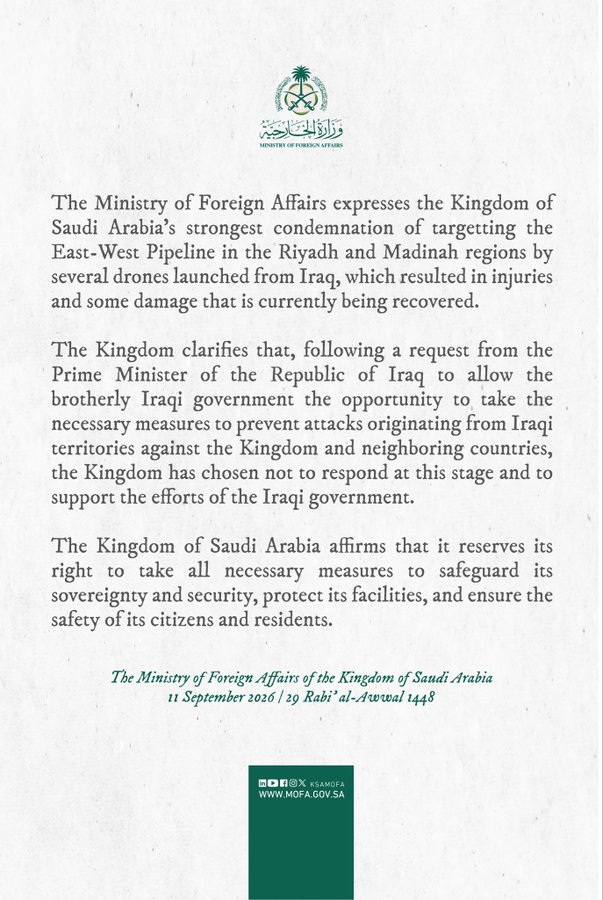
Iraqi Prime Minister Ali al-Zaidi has asked the Saudis to hold off on a military response while he tries to find the people responsible. But while the issue remains unresolved, the underlying message is clear; Iran and its regional allies are now determined to stop the flow of oil from the Middle East in order to put pressure on the US to end the war. In short, they have the global economy by the windpipe and are gradually tightening their grip to force Trump to meet his obligations under the Memorandum of Understanding, the deal that is supposed to end the hostilities and restore the region to peace.
Events are moving so fast, we can't be certain that Trump even understands what's going on. The situation is no longer containable. The lights are blinking red. We are facing a different set of contingencies and a myriad of different scenarios. The only thing that is certain is that America has no future in the Middle East. When the dust finally settles, the bases will be boarded up, the fleet will be gone, and Old Glory will be tucked into a packing crate headed for the USA.
The Houthis now occupy the entire western coast of Yemen, and their forces serve as a vice-grip for Iran to maintain control over 30 percent of global oil. This is obviously a synchronized effort by highly-motivated, battle-hardened militants who are implementing a far-reaching strategy aimed at forcing an American retreat from the region followed by the imposition of a new multilateral security architecture. We do not think that Trump's obsession with bombing random targets from the sky has any chance of succeeding. From the very onset, Trump has reflexively opted for destructive violence over any purposeful use of military power for a political endstate. His inability to think strategically is pushing the country towards its most humiliating military defeat followed by years of economic retrenchment.
Reprinted with permission from The Unz Review.